Senate Ratings Update: Election Eve
The 2026 elections for the United States Senate are of even greater import and suspense than the House of Representatives, where a Democratic majority is all but certain and merely the magnitude is in doubt. The power to control confirmation hearings in the Senate is massively consequential while six-year terms give each victory a lasting durability otherwise hard to find in politics. The suspense, meanwhile, owes to the fact that so many of the competitive Senate races are taking place in states where Democrats have not come close to a win in recent years, and others where high-profile recent misses are embedded in political consciousness (I’m looking at you, Maine 2020). Throughout this election season I have moved cautiously: identifying a wider map from the start, but with a high threshold to actually move a seat into the Democratic column. My early September ratings yielded a 50-50 Senate, with Dems gaining three seats from the current 53-47 Republican majority. A 50-50 tie, of course, still produces Republican control of the Senate, with the vice president casting the tiebreaking vote to organize the chamber. My October 24 update moved another seat into the Dem column, for a 51-49 majority – secure, although some would argue Pennsylvania’s John Fetterman would rescue the GOP with a party switch.
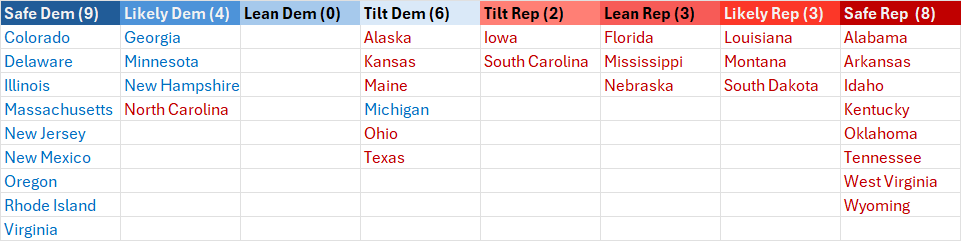
Tonight, I’m making a final set of six changes, all of them in the Democratic direction. There has not been much in the way of encouraging polling numbers for Republicans in the final weeks of this campaign, nor is there much to excite them from early voting data (which we should all be putting precious little stock in anyway) and nor have any Democratic candidates committed a major gaffe down the stretch. No, dear reader, I do not consider the news that Mary Peltola’s campaign was recruiting other guys named Dan Sullivan to get on the ballot a gaffe (it was obvious to most that it was orchestrated, so it’s not really news; it’s also not illegal and I don’t even think it’s unethical. I do think it’s mostly a waste of a campaign’s time and probably runs against the grain for the party that purports to be defenders of democracy. I’d pass on it if pitched to me. That said, it’s mildly funny and Democrats have struggled with being funny for, well, the entirety of my adult life.) And I do not consider the erratic machinations of Haley Stevens in Michigan likely to move votes, especially coming on the Sunday before Election Day in a state with significant uptake in early voting. Here’s what’s actually moving:

That brings us to a 53-47 Democratic majority. At this point, Adam Hamilton is consistently leading Kansas polls by large enough margins that we cannot simply assume “well, it’s Kansas, it’s rural, it’s mostly white, it hasn’t elected a Democratic senator since 1932.” And that’s true even if we suspect this is a place where the difficulty pollsters face in reaching rural Republican voters is too grave to address with refined techniques and weighting efforts. Hamilton has run a pitch-perfect campaign for Kansas, and incumbent Roger Marshall has run a poor one, as discussed on this site several times previously. Per Axios, Marshall recognized much too late the difficulty he faced and was overconfident that his oppo drop on Hamilton would end the race. Instead, it was Hamilton who delivered what I believe to be a knockout blow. Should I be correct, it may also be another reminder that senators should live in the state they represent, too – Marshall is another of these Florida guys who moved out of his home state years ago and maintains a faux residential claim in the form of a sparingly-visited hunting lodge. That approach does not seem to be to be working.
The other state that I am moving, after resisting for months, is Maine. Anyone writing about elections knows the Susan Collins story: she always outruns her polling, most famously in 2020 when she looked to be down and out against Sara Gideon but ultimately won by nearly nine points. But that was a different time, against a very different opponent. It was before a deluge of stories from ProPublica revealing Collins’ adjacency or outright involvement in pay-to-play federal procurement schemes. And while Troy Jackson isn’t a perfect candidate by any stretch, he largely avoided mistakes and has lured Collins and her allies into classist attacks that I do not think have served her well. It’ll be close, but I do not anticipate a polling miss this time nearly as large as in Collins’ 2020 race. This time, her remarkable run as an enduring blue state Republican fixture comes to an end.
I’m edging South Carolina one step closer to a flip – it’s now in the Tilt category for me. Too much close polling with a poor GOP candidate to consider this any safer than that. Darline Graham might have been the only candidate besides Nancy Mace who could lose this race…and that’s who they’ve got. I’ve noted before that I don’t think Annie Andrews is distinct enough to win a red state Senate race, but she’s done enough to keep it competitive. Graham will survive, but I expect the closest Senate race in decades.
In Florida, it looks like Angie Nixon’s going to hold Ashley Moody within single digits. Republicans need Election Day turnout on par with some of their best recent years if they’re going to win more comfortably than that. Republicans are panicking about the race for governor far more than the Senate race, but their level of alarm warrants a move from Likely Rep to Lean Rep in the Senate contest.
Louisiana and Montana move from Safe Rep to Likely Rep. In the Pelican State, the GOP has been forced to do some late spending as they fret over the early vote turnout and lagging enthusiasm in their ranks for Julia Letlow, who once seemed unbeatable. Democrat Jamie Davis is a distinctly-Louisiana candidate and has a small but plucky operation powered by a group of young, indefatigable folks who undertook the rebuilding of the state party and are beginning to have something to show for it. Republican operatives are saying the final result is going to be single digits, and I’m starting to believe them. In Montana, meanwhile, polling indicates that Democratic voters have started to get the message to vote tactically for independent Seth Bodnar. If Alani Bankhead – the Democratic candidate supported by very few Democratic officials and voters – continues to sink into single digits, Republican Kurt Alme’s months-long inability to keep his head above 40% becomes a problem for him.
I haven’t moved Iowa tonight. Josh Turek is a good candidate and is neck-and-neck with Ashley Hinson, but this is a race where the GOP recruited someone skilled enough to withstand the wave. She has much better approval/disapproval ratings than most of her fellow Republican Senate candidates in these high-profile races. I think she pulls it off, barely.
Nothing new on Mississippi tonight. It’s still one of my favorite seats on the board – it’s going to be single digits for sure, and maybe much, much closer. Only the inelasticity of Mississippi voting habits in federal races through the years is keeping me from moving it into the Tilt category. I think Scott Colom has that special something that you need to win a deep-red state…we’ll see just how special a year it is.
Here’s the final board: