Summarizing the mid-September State of Play in the Senate
After a week of breaking down the Senate state-by-state, let’s zoom back out and take a look at the big picture:
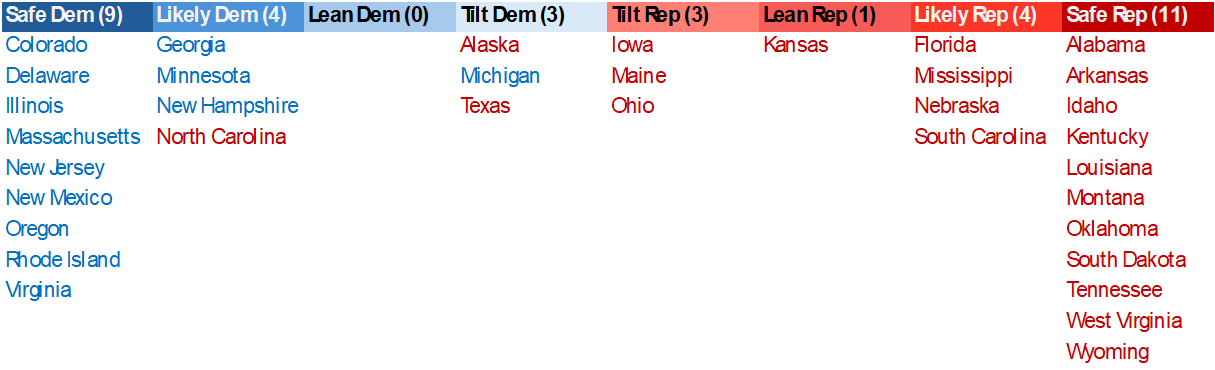
Democrats gain three GOP-held seats (Alaska, North Carolina and Texas) while holding each of their own. That makes for a 50-50 Senate, with the vice president breaking the tie to keep Republicans in control of the chamber. Or perhaps Pennsylvania Democrat John Fetterman switches parties to give them some additional breathing room. He continues to say he won’t, though, and he can probably cause more chaos (his apparent goal) by remaining a Dem who finds plenty of opportunities to lavish praise on Trump and his new best buddy, fellow Pennsylvania senator Dave McCormick.
But while 50-50 might be underwhelming from a Democratic perspective given the increasingly rosy picture offered by Congressional polling and Trump’s disapproval ratings, your biggest takeaway from that chart should be that Democrats have all of the upside. Only four Dem-held seats have competitive ratings, and three of those are in the Likely Dem column. The exception is Michigan, where Abdul El-Sayed consistently leads polls, but by small margins. The Republicans, meanwhile, hold three seats in the Tilt Rep column and have trailed more often than they have led in all three of them. Susan Collins’ history of outperforming her polling is keeping the race in her column, as is the reality that Democratic nominee Troy Jackson is still relatively new to this race. But good polling attempts to account for the factors that might have underestimated Collins’ chances in the past, and at some point I’ll need to believe what the numbers show.
In Iowa and Ohio, I’m reluctant to move them to Tilt Dem for two reasons: a) several cycles’ worth of recent history where they show positive signs for Democrats before fading at the end; and b) the weaker showings for the Dem candidates in these states the last time the NYT/Siena poll was in the field there. It’s not that NYT/Siena is the only outfit I trust – it’s that they have been earlier to spot Democratic weakness in the Midwest than some pollsters. These two are states where Democrats need a massive swing from their 2024 numbers in order to win, even larger than the national swing that we’re seeing with greater consistency in recent weeks. I need to see a little more to put them in the Tilt Dem column…but that’s the direction I expect both to move in if they move at all. The same goes for Maine.
The Republican candidate in Kansas, Roger Marshall, is coming off a bad week of news about jailing his patients for their medical debts as well what seems like a rough debate against Adam Hamilton. I don’t want to draw conclusions from crowd noise at a state fair debate, but he certainly seems like a man on the defensive right now. And on top of that, the latest polling in the Sunflower State shows Hamilton within the margin of error. It feels like a race that’s getting harder for the Republicans by the week.
Republicans also face some vulnerabilities with races that we must consider longshots, but not out of reach:
- Florida – after months of indicators that GOP fortunes were not deteriorating as much here as in the rest of the country, we’re seeing some indicators that Latino voters are in fact shifting substantially here as in other states, and that newly-gerrymandered Congressional seats remain competitive despite being drawn to be safely Republican.
- Mississippi – candidate factors still matter, and the GOP incumbent here has been demonstrated to underperform what he party can usually do in this state.
- Nebraska – Dan Osborn proved in 2024 that an independent could make a Nebraska senate race competitive. While his campaign is starting to lose momentum as his central conceit – his independence from either party – is hard to maintain in the face of Democratic support for his campaign, we still cannot discount that he could finish what he started two years ago and replace a Republican here.
- South Carolina – similar to Mississippi but with the added element of Graham getting the seat because she’s the previous holder’s family member. Nepotism does not play particularly well with voters.
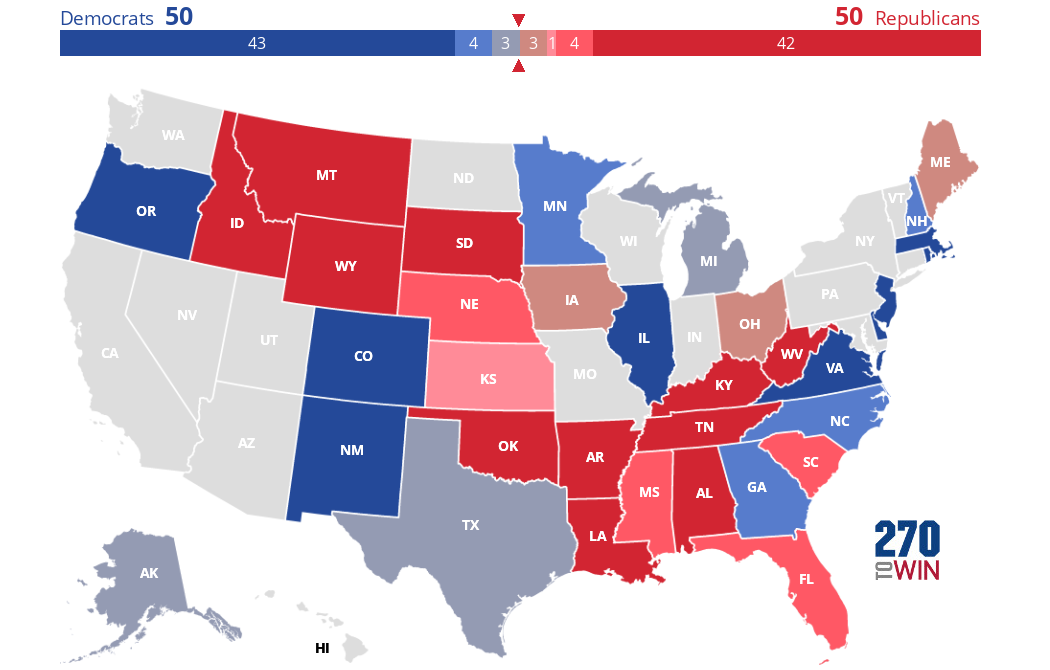
Here’s what that the current state of play looks like in map form – keep in mind that the interactive maps on the 270 to Win site use a color for Tilt Dem that sorta looks dark gray to me, rather than light blue.
Senate Week Posts:
Senate Week Overview
The Big 10 (Great Lakes/Midwest – Illinois, Iowa, Michigan, Minnesota, Nebraska, Ohio
The SEC (East) – Florida, Georgia, Kentucky, South Carolina, Tennessee
The SEC (West) – Alabama, Arkansas, Louisiana, Mississippi, Oklahoma
The Great Northwest – Alaska, Idaho, Montana, Oregon
The America East* – Delaware, Maine, Massachusetts, New Hampshire, New Jersey, Rhode Island
The Sun Belt – North Carolina, Virginia, West Virginia
The Plains and Rockies – Colorado, Kansas, New Mexico, South Dakota, Wyoming
Texas
 Within the Margin