Archive
Summarizing the late-September State of Play in the House

The House is currently 218-214, plus a Republican-turned-independent in Kevin Kiley who still caucuses with his former party. There are two vacancies; FL-20 was previously held by a Dem and remains a safely blue seat. TX-23 was Rep-held. For all intents and purposes, then, Democrats need to flip three seats to get to 218 and a majority. They are virtually assured of doing so and in fact would have been in virtually any midterm, as the president’s party tends to lose quite a few seats. But when the president is deeply unpopular – averaging 60% disapproval, his all-time low – you’d expect even heavier losses. There are plenty of data points beyond horse race polling that portend doom for Republicans as well: the strong historical correlation between primary turnout and the House popular vote; gas prices and inflation – worsened by the party’s support for Trump’s tariffs and his decision to start a war in Iran; Gallup’s quarterly leaned party identification survey.
My ratings reflect that reality, and the trajectory has been steadily worsening for the Republicans. What you see above is a 233-202 map – a comfortable Democratic majority but a modest pickup. Let’s contextualize that a bit:
Read more…Let’s Talk Tarrant
I would not normally devote a post to one poll…let alone one for a state legislative district. I’m about as interested in state legislatures as one can be – spent nearly a decade working in one – but I cannot be in the business of writing up every poll and I generally think polling is unreliable at that level of government (ask me how I know!) But the Texas Senate is different: with a population of about 940,000 souls per district, Texas Senate seats are considerably larger than the average Congressional district. They’re also larger than six states and the District of Columbia. There’s a case to be made that Texas state senators are better-known quantities than their counterparts in many other states.
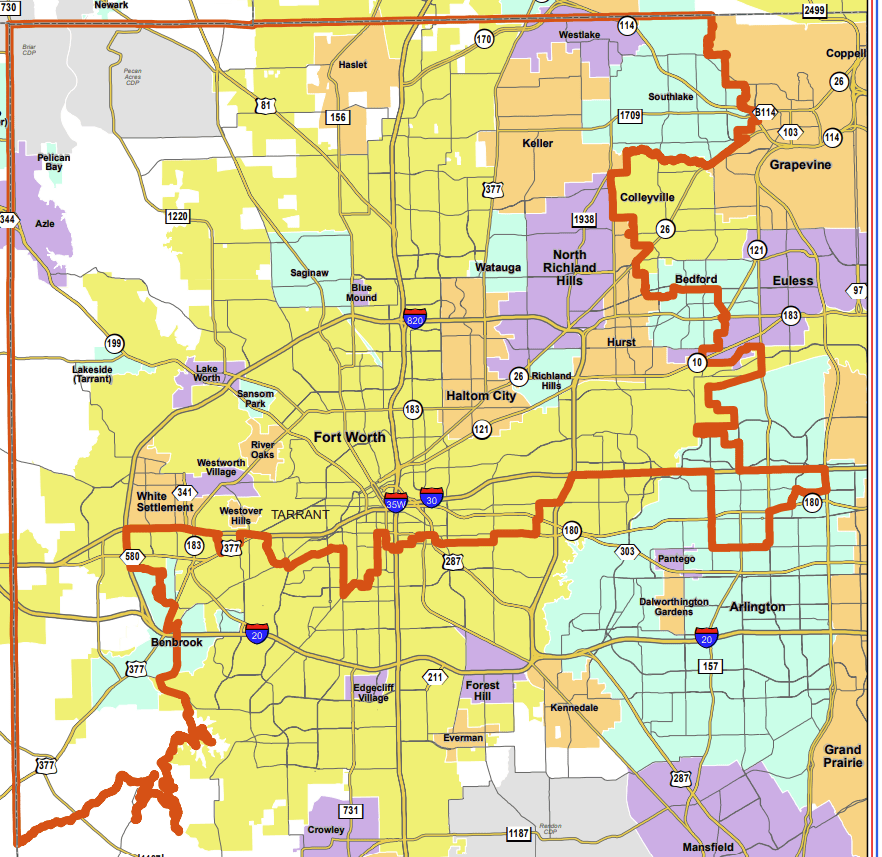
And the poll in question covers interesting territory for our purposes: the 9th Senate District covers northwestern Tarrant County, including a sizable portion of Fort Worth. The city of Fort Worth – the nation’s 10th-largest – voted narrowly for Harris in 2024 after giving Biden a bigger win four years earlier, but SD-9 includes some of the city’s reddest neighborhoods and then stretches north and northwest to include more of Tarrant County’s most Republican precincts. Trump carried the district as a whole by a 17-point margin in 2024, and downballot most of this territory has been staunchly Republican for decades. But Trump has often been downright toxic in suburban areas during his two terms in office, and that effect was on display this past January in a special election to fill a vacancy in this district. Taylor Rehmet, an Air Force veteran and mechanic, defeated political activist and Patriot Mobile communications officer Leigh Wambsganss. It marked the first Democratic win in this district in decades, but it was also something of a political earthquake because of how decisive it was: Rehmet won by more than 14 points in a seat that, as mentioned above, Trump won by 17 just a little over a year earlier. It’s a nearly unthinkable swing, even allowing for the quirks of special elections. And given how Wambsganss was so strongly associated with the MAGA movement and school board candidates who fought against DEI politics, it was pretty easy to see the result as a repudiation of Trump and Trumpism. Since that January election, of course, Trump’s own popularity has continued to fall. He appears to be a massive drag on his party.
That brings us to the poll. This was an internal poll, conducted by a Republican pollster. It showed Wambsganss down 14 points (53% to 39%) – matching, in other words, the margin from January’s special election. It also showed James Talarico leading Ken Paxton in the U.S. Senate race by 11 points within SD-9 and gubernatorial candidate Gina Hinojosa up by 9 points over longtime incumbent Greg Abbott. Republican trailed for lieutenant governor and Tarrant County judge (executive) as well. Up and down the ballot, the GOP would appear to be in trouble in a once-red portion of the Dallas-Fort Worth Metroplex, with statewide consequences. And the poll gives us yet another reason to believe that the special election results for Democrats this year – which have shown remarkable overperformances relative to the baseline – might not simply be the product of turnout differentials in low-profile races but a harbinger of things to come in November.
Last year’s general election results confirmed the strong Democratic polling in the months leading up to it…and even exceeded it. There’s a tendency on some circles to dismiss polling because of Trump’s history of beating his polling numbers, but there’s actually very little reason to dismiss it when he’s not on the ballot. Midterm polling did quite well in 2018 and 2022 and again in last year’s elections – underestimating Democratic success, in fact. A key reason I’m generally believing of the strong Democratic environment portrayed by polling is that we have those 2025 results in our pockets, and there are logical reasons – Iran, gas/diesel prices, ICE violence – to assume the veracity of polling that shows Republican standing deteriorating further since then. We’ve got this Texas poll now that shows Democrats in a dominating position in red territory where we already have proof of concept that it can actually happen. It’s another indicator that whether you’re looking at data or vibes, the questions right now are more about just how good Election Night will be for Dems this year, rather than whether it will be a good night.
Notable Waves We Have Known
I’ve spent a good bit of time this summer talking about the favorable political environment for Democrats and how a wave seems to be building. That has included quite a few references to past wave elections, in order to contextualize a given candidate’s victory or defeat, and to make comparisons to this current cycle. Those of us who like to nerd out over election analysis frequently reference these election in shorthand, so I figured I’d describe some of the notable midterm waves of the post-war era so that readers have a sense of what it means when we toss out a given year. We’ll start with 1946 and take us up to the present day.
Read more…Summarizing the mid-September State of Play in the Senate
After a week of breaking down the Senate state-by-state, let’s zoom back out and take a look at the big picture:

Democrats gain three GOP-held seats (Alaska, North Carolina and Texas) while holding each of their own. That makes for a 50-50 Senate, with the vice president breaking the tie to keep Republicans in control of the chamber. Or perhaps Pennsylvania Democrat John Fetterman switches parties to give them some additional breathing room. He continues to say he won’t, though, and he can probably cause more chaos (his apparent goal) by remaining a Dem who finds plenty of opportunities to lavish praise on Trump and his new best buddy, fellow Pennsylvania senator Dave McCormick. But while 50-50 might be underwhelming from a Democratic perspective given the increasingly rosy picture offered by Congressional polling and Trump’s disapproval ratings, your biggest takeaway from that chart should be that Democrats have all of the upside. Let’s break that down further.
Read more…Senate Week: Texas
We wrap up our regional previews with the state that is arguably a region unto itself, and which has its most competitive Senate race in decades: Texas. The Lone Star State was on our radars in 2018, when Beto O’Rourke challenged Ted Cruz, and even in 2020, when MJ Hegar generated some buzz around her effort to unseat John Cornyn. Beto came close in the end; Hegar did not. But neither of them was consistently leading polls into mid-September as this year’s Democratic candidate, James Talarico, has done. And neither faced a candidate as objectively unsavory as Ken Paxton. That’s right: for all that Ted Cruz does not generate a lot of warm fuzzies, even he – potentially the Zodiac Killer – does not reach Paxton’s level of odiousness. We’ll dive into it below.
Read more…Senate Week: The Plains and Rockies
We shall take leave of our college conferences structure for this one. Unless I’m missing something, there are just not any conferences that have, or have had, schools from all six of these states. Believe me, I looked. Instead, the unifying theme here will have to be their breathtaking natural beauty. The region also features one state we’re not used to seeing with a competitive Senate race, and another one where an independent could be putting it in play.
Read more…Senate Week: Sun Belt
For today’s second post, we call upon the Sun Belt Conference, which lets us group together North Carolina, Virginia and West Virginia: one of the swingiest states, a former swing state that leans blue, and a former blue state that quickly became one of the reddest.
Read more…Senate Week: The America East Conference*
I had to break out the asterisk for this one – the smallness of Delaware means there’s not a lot of colleges and therefore not many conferences to choose from. So I reached back to the 1990s edition of the America East Conference, which included the University of Delaware back then and features one from our other five states in his group (Maine, UMass-Lowell, New Hampshire, New Jersey Tech, and Bryant (Rhode Island). Listen, the narrative conceit amuses me.
Read more…Interlude
Senate Week takes a break today. Today, I just offer a picture that I took at the Flight 93 Memorial in Shanksville, PA in August of 2013. It includes a then-recently planted memorial grove of trees – new life, in commemoration of lives lost.

Back with three posts over Saturday and Sunday.
Senate Week: The…Great Northwest Athletic Conference
There comes a time in every political writer’s life when they’ve opted to break up the nation’s Senate elections into geographic chunks by prominent college sports conferences. And having made that choice, they know that Alaska will not fit nightly into this because there are not too many Alaskan colleges and universities – owing to its vastness and terrain. But all we have to do is cast our gaze beyond the D1 conference and embrace the Great Northwest Athletic Conference. It covers Alaska (both the Fairbanks and Anchorage campuses, in fact), Idaho (where are my Northwest Nazarene fans?), Montana (I see you, MSU-Billings), and Oregon (the unstoppable Western Oregon University). In other words, everything we need this year (Washington, too, but they don’t have a Senate election this time around). Tremendous logo, too. I’ll link to it rather than reproduce here because I do not know the copyright laws work for things like that.
Read more…