Four Years to Purple, or a Hundred Years to Blue?
Take your pick, folks:
Texas Monthly Senior Editor Paul Burka, in the days leading up to this past Tuesday’s Cruz-Dewhurst runoff:
I had a conversation with a nationally known Republican consultant yesterday. Here is what he told me: “If Ted Cruz wins the Senate race, Texas will be a purple state in four years.” In other words, the tea party is so extreme that even a Democrat might be able to get elected. Does it change anyone’s thinking? Probably not.
Or Texas attorney general Greg Abbott, who tweeted the following after Cruz (and other Hispanic Republicans) emerged victorious Tuesday night: 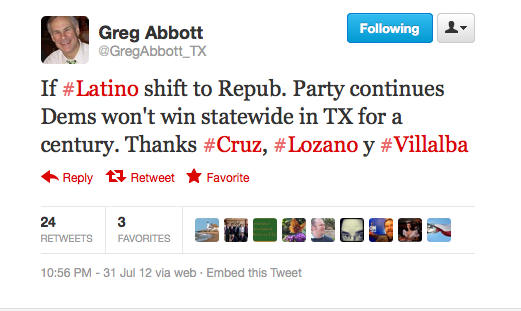
We shall see. Given Abbott’s status as a leader in disfranchising Hispanic voters in Texas, he might not be the best judge of where Latino politics is headed. That being said, Obama’s 43.6% vote share in the Lone Star state four years ago was a modern high-water mark and higher than any of us saw coming, yet still so far from putting the state in play. Texas is going to get purple, but whether it’s 2016 or 2020 remains anyone’s guess. Well, anyone but Abbott, of course.
Lugar Defeated As His Party’s Rightward Drift (Purge?) Continues Apace
There are a fair number of high-information Democrats who rank Richard Lugar as their “favorite Republican senator” – not simply President Obama, who was purported to think as much (though he’s never said it in so many words) in attack advertisements this primary season condemning Lugar for straying from the right’s preferred path. Note that this approval among some Democrats is not because he has a liberal voting record. Far from it. Lugar is a down-the-line social and fiscal conservative. In the 1970s, Richard Nixon called this guy his favorite mayor, and he hasn’t veered much from the conservative orthodoxy that Nixon appreciated then. His only real breaks from the party line comes on matters of foreign policy, where he strives for a bipartisan (or nonpartisan) consensus in how the United States makes itself and the world a safer place. For decades, he has worked with Democrats on the issue of nuclear weapon proliferation. This doesn’t mean he’s a peacenik or an isolationist – it means he takes a lofty view of government’s effectiveness, at least in one area of policymaking, and acts in good faith to make that view a reality. He has also co-sponsored the DREAM Act – anathema to many conservatives who take a hard line on illegal immigration, but in keeping with Lugar’s pragmatist persona in matters of international relations.
Savvier Democrats appreciate Lugar more than someone like Olympia Snowe, who gets lots of play in the national media for being some kind of moderate but ultimately offers only occasionally-liberal views on some social issues and a history of head-fakes toward compromise – the negotiations over the Affordable Care Act come to mind – followed by retreat when her conference turned up the heat. After repeated disappointments, it would be a stretch to call Senator Snowe a good-faith operator, and that’s exactly why Lugar has his fans on the other side of the aisle. He doesn’t string people along to gain editorial credence as some kind of mythical, throwback centrist: he plays it straight, bringing an informed, intellectual rigor to America’s dealings with other nations.
And let’s not forget the basis of that “Obama’s favorite Republican” idea. It’s not strictly borne out of Lugar’s work during the Obama presidency; its genesis is in their time together in the Senate, when they worked together on arms reduction. Obama was a freshman senator on the Foreign Relations Committee, and Lugar was the old hand who in the 1990s had collaborated with Georgia Democrat Sam Nunn on the Nunn-Lugar program, which brought about the cooperative dismantling and destruction of nuclear, biological and chemical weapons in former Soviet states. Obama and Lugar would co-author further arms reduction legislation during their time together in the Senate. In other words, the Obama-Lugar connection stems from an effort to control and reduce destructive weapons around the globe. They wanted to reduce the deadly variables threatening international security: the unaccounted-for weapons that could fall into dangerous hands. Today, by a 60%-40% margin, Republican primary voters in Indiana decided that national security was a less noble goal than the continued purge of the Republican party not simply of moderates or occasional conservative apostates, but of those who can work with a president of the other party.
To be sure, there are other reasons why Lugar went down today. His focus on international matters leaves less room to focus on parochial issues, and voters in a representative democracy have a right to focus on Indiana if they want to. Lugar did himself no favors by staying in hotels when he returned to Indiana, and using a house he had long ago sold as his voting address for many years. Lugar’s Tea Party-backed opponent, state Treasurer Richard Mourdock, attacked the incumbent for his literal and figurative distance from Indiana.
But at the end of the day, Lugar has seen his popularity among Republicans plummet since his last election bid, at a time when Republicans seem blinded by a hatred for Obama that makes it unacceptable for a co-partisan to have a function relationship with the man. And now, to the tune of a 60%-40% drubbing, Indiana Republicans have cast aside their conference’s most knowledgeable and productive foreign policy mind. For my money, there is nothing that better summarizes the last four years in Republican politics.
Realistic about Romney
Scarborough, earlier this week:
Romney’s continued weakness in the Heart of Dixie spells trouble for the GOP this fall. The only question is whether it will take a Santorum win in Wisconsin to refocus Republican minds on the unassailable fact that GOP presidential candidates cannot win unless they have the support of rock-ribbed conservatives. Mitt Romney does not, and that is becoming clearer by the day in this painful primary season.
No one questions that Romney has problems with conservatives of various stripes, and that this has helped forestall his clinching of the Republican presidential nomination. But earlier in that piece, the normally-sharp Scarborough ticks off the Southern states that are in play and references those that Barack Obama or Bill Clinton won over the last twenty years. Let me be clear: I do think that the two states Obama carried four years ago (Virginia and North Carolina) are very much winnable for him again, but I don’t think under-enthused conservatives will be Romney’s problem in those states so much as the growing ranks of highly-educated and often-transplanted voters in those states, whose social liberalism could be offset by an appealing fiscally conservative message but for the fact that Romney offers numbers that these voters know won’t add up: huge tax cuts coupled with large increases in defense spending. Elsewhere, asking conservatives to turn out so weakly in, say, Georgia that Obama is able to add that to his win column – as he almost did in 2008 – is a bit much. Romney would have to truly alienate independents to make that happen – mind you, the GOP’s twin-obsession with contraception and abortion might just do that, but we’re not there yet.
Meanwhile, I’m still deeply skeptical that Republican or conservative turnout will be weakened at all this year, whether we’re talking about the South like Scarborough is, or the Rust Belt, or the Rocky Mountains. Sure, Romney trails Obama more often than not in national polls and in key states, but we’re still in spring training in more ways than one. Democrats have not fully erased the enthusiasm gap that has existed since the darkest months of the recession. The idea that the Republican primary process is tarnishing their party’s image is true enough, but not irreversible. The idea that Republicans will be so bored with Romney that they don’t show up to vote against their hated foe, Obama? That remains laughable, in the South and everywhere else.
Less-Super-Than-2008 Tuesday
Only ten states feature in this year’s edition of Super Tuesday, compared to a ridiculous twenty-one four years ago. That means there’s not enough delegates at stake tonight for Romney to come anywhere close to clinching the nomination mathematically…but it’s more than enough to devastate Rick Santorum’s hopes. Here’s what tonight will bring:
Alaska: This was safely Romney territory (44%) four years ago, but the 2012 version of Mittens has struggled to keep up with Rick Santorum in caucuses, which is how Alaska will award its delegates tonight. A somewhat Santorum-esque character won here in 1988 in the form of Pat Robertson. But generally, I tend to think of Alaska as a libertarian stronghold, and I think Paul’s politics are in ascendance more than those of culture warriors. Coming into this nominating contest, I would have pegged The Last Frontier as one of Paul’s best chances to actually win a state…but let’s face it, folks: Republicans like their military and they like their Medicare, so Paul has a ceiling in this nominating contest, and it seems to be in the 23-27% range. He has topped that only once so far, in the Maine caucuses where it was just him and Mitt competing. With no polling in Alaska and with candidates focused on contests in the Lower 48, I think we’ll see a Mitt victory here, though not with an overwhelming vote share.
Georgia: No one likes a two-man race! We get those all the time. And so we are thankful, in a way, that Newt Gingrich is still around and will carry Georgia tonight. He’s up anywhere from 10 to 26 points in polling, and three surveys released yesterday actually pegged him at 47%. So not only should he win tonight, but he should come away with a considerable proportion of Georgia’s 76 delegates.
Idaho: Barack Obama posted a huge (above 80%) number in Idaho’s Democratic caucuses four years ago, as people began to realize that his campaign understood well that caucuses were the market inefficiency to exploit in the race for delegates. One assumes Paul will be well-organized here, but this fast-growing state features a sizable Mormon population in the southeast that will carry Mitt tonight.
Massachusetts: Like most states in the union, Mitt claims this as one of his home states. By the time he left the governor’s office in January 2007 his approval ratings were sliding among Democrats and independents, thanks to a sharp turn to the right ahead of his first presidential bid. The state’s GOP voters still liked him just fine, and he won 51-41 over McCain here in the 2008 primary. It’ll be a bigger margin this time, since Gingrich, Paul and Santorum lack the cache that McCain once held in New England.
North Dakota: Some of my in-laws are in Washburn, so I spent a few wonderful days hanging out in the Flickertail State back in 2006, and parts of two more days driving across its considerable width. It’s a great place, so it’s too bad the candidates couldn’t spend more time here this year. Alas, the focus is largely on Ohio, Georgia and Tennessee tonight. It’s a caucus state and it’s an upper midwestern state, and that’s been a winning formula for Santorum so far. Ron Paul is saying he could win here, and is in fact spending time in Fargo tonight. But I’m going to go out on a limb and predict that Santorum and Paul split enough votes for Mitt to squeak by.
Ohio: This is a big prize tonight, with 63 delegates and unlike Georgia, no home-field candidate. We had nine new polls released yesterday: two showed the race tied, four showed Romney ahead by anywhere from 1 to 7 points, and three showed showed a Santorum lead of 1-4 points. The Pennsylvanian’s time is slipping away, as has a previously-large Santorum lead in this state. Mitt’s win in Michigan leaves me convinced he can basically put Santorum away here. It’s too close to call, but that’s not how I roll…I see a narrow Romney win, maybe a 3-4 point margin.
Oklahoma: Where the wind comes sweeping down the plain! And where Rick Santorum will sweep to victory tonight. McCain narrowly beat Huck here four years ago, but the Huck-like candidate will prevail this time. Santorum has comfortably led Oklahoma polling for weeks now, but I think his margin won’t reach double-digits.
Tennessee: The Volunteer State brings the third-largest delegate haul tonight, and one of the few three-way races: most polls show a small Santorum lead over Romney, while Newt (from neighboring Georgia) hangs in at a respectable third or even second in some surveys. I think Newt ends up fading a bit further, allowing Santorum to eke out a win.
Vermont: Romney’s profile as the establishment quasi-moderate this year should allow him to cruise here. Santorum and Gingrich are simply abhorrent to Green Mountain voters of just about any stripe, and Paul is focused on the western caucus states. Easy win for Mittens.
Virginia: One of the things we’ll look back on with this nominating season is how ill-prepared everyone except Romney was for a national campaign. This is evidenced by the failure of anyone besides Romney and Paul to make it on the ballot in Virginia. Under those conditions, Romney will be Paul roughly 3:1.
So I’m predicting 7 wins for Romney, 2 for Santorum and 1 for Newt. Perhaps Paul can prove me wrong and snag a win or two in this three targeted states of Alaska, Idaho and North Dakota, but I’m skeptical for the reasons I mentioned in the Alaska capsule. As for Santorum, he needs to beat my prediction – most notably in Ohio. A couple of primary wins in OK and TN are nice, and some caucus wins would be helpful, but he has to show he can go head-to-head with Mitt in a big primary state and beat him. Otherwise, I wouldn’t be shocked to see Santorum out of this race in the near future.
Nothing to see here, says Team Romney
Romney knew perfectly well that he might not win Iowa, and that he was about to get wrecked in South Carolina. But only today, ahead of the contests in Colorado, Minnesota and Missouri, did I get an email from Romney campaign engaging in the sort of language we in politics use before losing an election:
Friend,
Please see below a memo from our Political Director Rich Beeson, “The Road Ahead – A Reality Check.”
Some quick takeaways:
- No delegates are being selected today. The delegate count tomorrow morning will remain the same as it is today. Gov. Romney has a significant delegate lead – he is the only candidate to have earned delegates in every available contest.
- Missouri is strictly a beauty contest (see ABC News: “Why Missouri Is Holding a ‘Meaningless’ Primary“). The primary being held today is completely divorced from any delegate allocation, and Missouri will hold an entirely separate caucus next month. We plan to compete in the actual Missouri contest in March.
- As our campaign has said from the outset, Mitt Romney is not going to win every contest. John McCain lost 19 states in 2008, and we expect our opponents will notch a few wins, too. But unlike the other candidates, our campaign has the resources and organization to keep winning over the long run. A winning conservative message, hard work, and old-fashioned delegate math will win this race for Governor Romney.
Thanks,
Matt Rhoades
Obviously, there’s no harm in this. Romney has seen the same polls as we have that show Santorum in position to win a contest or two today. This email means they’re seeing the same thing in their polls, so they lower expectations in the hopes of making the day as benign as possible for them. There are two interesting things here, though. First, as I mentioned above, we didn’t see this from them before some of the bigger contests they went on to lose – perhaps because there’s no escaping the outsized magnitude of Iowa and South Carolina in this media-driven process? And second, they have to know that regardless of their attempts to tamp down expectations, the punditry will flock to a couple of Santorum wins today as desperately-desired evidence that the race is still on, that chinks still exist in Romney’s armor of inevitability. I certainly will, because nominating contests are too interesting to be over by the Super Bowl.
Colorado, Minnesota and Mizzou Next, and a few words about Newt.
The Minnesota, Colorado and Missouri contests come up next on the Presidential calendar. Minnesota and Colorado present Caucuses where Rick Santorum and Ron Paul are likely to profit at the expense of Mitt Romney. Caucuses present a strength for Paul, despite his disappointing third place showing in Nevada.
Minnesota and Colorado offer Santorum a lifeline to his campaign. With little in the way of coverage after his Iowa showing (winning it over Romney), the super-conservatives who have taken hold of both state parties should be more palatable to Santorum than Romney, who continues to have a conservative problem…he just can’t seal the deal. Santorum has led in polling in both states in recent weeks, though only just above Romney. Wins, even slight wins, are needed here for team Santorum. Santorum can reboot his flailing campaign and return to fundraising to make the “anti-Romney” case more convincingly. Grabbing delegates away from Romney will help my favored outcome: a fractured convention. Losses here, however, should signal the end of the Santorum campaign and people re-remembering that he’s a joke. Minnesota’s GOP is hyper conservative after the more tea-flavored wing of the party swept into legislative power in 2010. Minnesota offers a great opportunity for Santorum to rebound. Polling has Santorum winning Minnesota with Paul coming in second. This would be a huge shot in the arm for Santorum and for my continual laughter at the state of the GOP. Colorado also offers a 2010 tea fueled base and the endorsement of former Rep and all out crazy man Tom Tancredo should also provide a needed boost to Santorum in the Centennial State. Public Policy Polling has Romney at 40% in Colorado and Santorum second at 26%. This continues the enthusiasm gap meme that’s growing (I’ll write about this later), GOP voters know Romney’s the best of the bunch, they just don’t want to actually vote for him. Turnout in CO will be interesting, low turnout may help Romney, but perpetuate the enthusiasm problem. Santorum may benefit from very high turnout, but it seems more likely that Romney will win here picking up a good number of Colorado’s 36 delegates.
Missouri will be a primary featuring Santorum and Romney, it’s symbolic in that it won’t award any delegates for the convention (they instead will have a later caucus, hence why Paul isn’t playing here for this symbolic primary; by the way, this no delegate primary is just plain stupid). Santorum needs to both play for and ignore this primary; that is it’s meaningless in the long run but a win helps him boost fundraising to stay in the race. This is the first example of Romney going one on one with another candidate and the more conservative Missouri electorate is more likely to support Santurom. Polling from PPP (a Dem leaning firm but one of the best in the business) has Santorum ahead in Missouri right now. This is a news cycle filling primary and nothing more to me: whoever wins can say they won a primary, and nothing more.
I have failed to mention Newt Gingrich because, well, I just can’t take him seriously as a presidential candidate. After the Iowa Caucus, all Newt has done is simply throw bomb after bomb at Romney. I don’t see a guy that wants to actually govern, he’s out for blood. Gingrich has never been anything close to a legitimate candidate in my mind…I’ve actually questioned if the GOP rank and file was serious about nominating this guy. One would think that if h were serious or wanted to be taken serious he would have garnered more endorsements than Rick Perry and Sarah Palin, both of whom have become train wrecks to the American people. Not one member from either house in, especially those who served with him, have endorsed him. Actually former Congressman Duke Cunningham, in jail for corruption, has endorsed him. No statewide elected officials of not have endorsed Newt. How is he supposed to be taken seriously at this point even though he’s won one primary…it’s just crazy to think that this guy possibly has a shot. I just don’t get it. Then again I don’t get the appeal of Mitt Romney.
NC Dems fall into the Tar Pits; 4 announce retirement this year
As someone who went to school in North Carolina, I try to pay attention to what goes on down there. I came to love my time in the Tar Heel state and helping elect President Obama there in 2008 was a great feeling.
Last week Governor Beverly “Bev” Perdue and Congressman Ralph Bradley “Brad” Miller announced they would not seek re-election this year. For Perdue, lagging poll numbers in popularity and unchanged head-to-head polls against 2008 GOP nominee and 2012 hopeful Pat McCrory were the largest culprits in her decision to serve just one term. Miller fell victim to a Gerrymander out of the first Republican-held North Carolina Legislature in a century. Faced with squaring off against fellow Democrat (and slightly more liberal) David Price in the new 4th District or retiring, Miller chose to retire.
Perdue has had a rocky term as governor, to say the least. She entered office during the worst of the economic downturn that faced much of the Country. North Carolina has had one of the highest unemployment rates in the nation since the recessions started and only recently saw its unemployment rate drop below 10%. Perdue and the Democratic majorities in the Legislature attempted to stop the economic bleeding in 2009, but partisan gridlock before the bloodbath of 2010 meant that little was accomplished. After Democrats lost the majorities in the House and Senate in NC, Perdue has largely played defense for much of the last two years, vetoing many bad bills and preventing NC from joining many other southern states in implementing discriminatory Voter ID laws. Assemble partisan gridlock, high disapproval ratings and a re-match against McCrory, and it’s easy to see that Perdue would rather take one for the team and not run again, allowing for another Democrat to grow in status and potentially keep the governorship in the hands of Team Blue. I think the GOP nominee for President could end up having significant impact on the North Carolina Council of State elections as well as congressional elections in the Tar Heel State.
Democrats in North Carolina, unlike other southern and swing states, have a wide bench to sort from to replace the outgoing governor, thanks in large part to their many state-wide elected officials. Right now the entire kitchen sink may well be considering a gubernatorial run. The North Carolina Council of State is largely filled with Democrats elected in 2008 (they hold 4 year terms, voted at the same time as the President). They include: Lieutenant Governor Walter Dalton, Attorney General Roy Cooper, Treasurer Janet Cowell, Secretary of State Elaine Marshall (who likely wouldn’t run for anything besides her post), Auditor Beth Wood, Superintendent of Public Instruction June Atkinson, and Commissioner of Insurance Wayne Goodwin. Of this group, Dalton has announced his intention to run; Cowell and Cooper are out and Wood hasn’t made any mention whatsoever. There’s also State Representative Bill Faison (who according to reports has been stockpiling cash for a while) interested in a run for Governor. Former Raleigh Mayor Charles Meeker would also make for an interesting candidate. Congressmen Heath Schuler and Mike McIntyre are way too conservative to a Democratic primary electorate. We don’t know who will jump in just yet, but I can say that Erskine Bowles (mentioned by the Washington Post) wouldn’t last long as a candidate for Governor. After two failed Senate bids and some less-than-successful time on corporate boards, Bowles should shy away from elective office, and he largely has. Also, Congressman Miller and former Congressman Bob Etheridge (who lost to Congresswoman Renee Ellmers in one of the most painful losses last year, and almost exclusively at the hands of two college-age Republican operatives) are now seriously considering the race.
As for Miller, his 13th District, and more specifically his apartment complex was gerrymandered perfectly into neighboring Democrat David Price’s 4th district. The Gerrymander was so precise that Mille is in the 4th but the rest of his precinct is in the 13th district. Republicans in charge of redistricting also made the 13th more Republican in hopes of scaring off Miller from Congress, and it appears that they’ll succeed. The blog Blue NC, and a look at North Carolina’s upcoming elections on Wikipedia, show a slew of Republican hopefuls all lining up to challenge for the seat. No Democrats as of right now have stepped up, though hopefully someone will. It’s not that the 13th will be all that winnable, but forcing the GOP’s hand in a district like the reformed 13th could be useful in the national landscape for the Democratic Party. Forcing precious resources in what should be a slam dunk seat for the GOP would be great. But that’s just my opinion.
Finally, of note, yesterday two female Democratic members of the General Assembly announced they would step down from their posts: Diane Parfitt and Alice Bordsen. From what I’ve read, Brodsen was a redistricting victim and the same likely holds true for Parfitt. It sucks to lose good Democrats, but when one party maintains most of the drawing power, these things will happen. It’s possible that these seats will be held by Dems in November, but it would have to take a historically poor performance by the GOP at the top of the ticket (presidential and Gubernatorial) to lose control of either chamber of the legislature that they’ve so craftily established. While I think North Carolina is a truly purple state for this presidential and gubernatorial election, things look rosy for the Republicans at the Legislative level.
As we get closer to the election a more thorough look at this race will be needed. By then, Dems will have their state-wide situation resolved and voters will remember who Pat McCrory is.
Winning in Wallace Country
As I looked at the map of county results in Florida tonight, I was immediately struck by the success of Newt Gingrich in northern Florida. It reminded me of the 1968 general election map of Florida, the year of a vigorous three-way race between Richard Nixon, Hubert Humphrey and arch-segregationist George Wallace. That year, Wallace received 8.6% of the nationwide vote, but won several southern states. He failed to capture Florida, finishing third with 28.5% as Nixon benefited from the decidedly un-Southern demographics in the central and southern portions of the state. But to the north, Wallace was dominant: he won almost every single county north and west of Orlando, some by outlandish margins – he took 87% in tiny Holmes County along the Georgia border and broke 70% in many other rural counties. He won pluralities in Leon (Tallahassee) and Duval (Jacksonville). He’s green on the map below, while Humphrey is red and Nixon is blue – thanks to Dave’s Election Atlas for the ongoing great work, but keep in mind that Dave uses red for Dems as was the case throughout the media for many decades. Meanwhile, on the adjacent map from Google Elections, Gingrich is red while Romney is yellow (click for larger images).
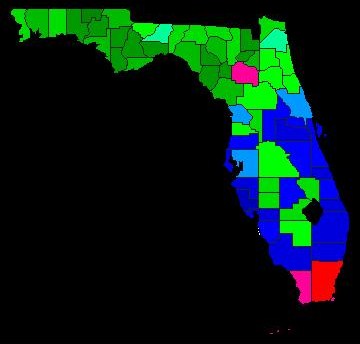
1968 General Election
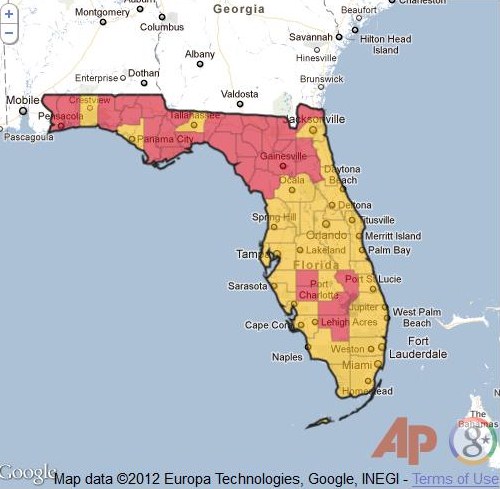
2012 Republican Primary
You can see that Gingrich’s areas of strength overlap quite a bit with areas that Wallace was winning almost 44 years ago. The Florida Panhandle and the Piney Woods of North Florida gave Wallace his best counties in the state back then, and they did the same for Gingrich tonight. Those are deeply Evangelical areas, mostly working-class, very white (with the occasional African American pocket mixed in) . We would expect them to be more receptive to Gingrich’s anti-establishment populism than wealthier areas featuring a larger professional class and lots of northern transplants. And indeed they were: Newt didn’t record too many blowout victories at the county level tonight, but he at least carried almost every northern county, some by a decisive margin. And take a look as well at that group of south central Florida counties that Gingrich won tonight. Those five inland counties, surrounded by yellow? Wallace won all five of them in 1968.
Has Newt inherited the Wallace mantle? Well, look: it’s unfair to say that these sections are Florida are seething with race resentment in the way they were back then. Integration is a reality, hostilities have softened. But many of these counties – that Newt won tonight and Wallace won in ’68 – are part of the small (and overwhelmingly white) subset of counties around the country that gave Barack Obama a smaller portion of the vote in 2008 then they did Kerry in 2004. These are places that swung toward the Republican presidential ticket even as the country as a whole, and Florida to a slightly smaller extent, were swinging to Obama by several percentage points. They are confined almost exclusively to Appalachia and the Deep South. We have no indicator to show that they were impacted differently by the economic conditions of 2008 – or any other factor – than were areas that followed the norm and moved toward Obama. It’s more complicated than race alone – it’s clearly wrapped up in resentment of elites; conservative anger in 2008 was aimed certainly aimed at Obama on that (somewhat bizarre, given his upbringing and some of his career choices) basis, and is being aimed at Romney now – remember that Gingrich’s sizable South Carolina win followed a stretch of attacks on his work at Bain Capital.
Now, those are all small counties. So they didn’t put Gingrich even in shouting distance of catching Romney, who was dominant in the populous areas of southern and central Florida; even in the north, Romney won razor-thin pluralities in Bay County (Panama City) and Leon County (Tallahassee, the state capital). And only winning areas like that won’t work in other states which, like Florida, feature larger population centers that gravitate toward Romney. I don’t think Newt can rely on a base of less-affluent, less-educated primary voters in many of the upcoming states; he won’t find himself in another southern primary until March 3, and the race may be quite different by then. In South Carolina he expanded beyond that base, winning almost everywhere and only losing narrowly in the state’s upscale and somewhat Florida-like areas; tonight, after being outspent 6:1 by the Romney campaign, his support was confined to the old Wallace strongholds.
And it goes without saying that while 2010 saw Republicans dominate the Congressional ballot in places like Appalachia and north Florida, capturing districts long held by moderate-to-conservative Democrats, the nation’s demographics will not allow the Republican nominee to rely on those regions while struggling in metro areas. No one expects the battle to be fought in America’s shrinking rural heartlands. It’s not news that Gingrich would be hopelessly ill-equipped to compete in a general election, but tonight helped show us why. The pseudo-historian is far more comfortable competing for the votes of America’s past than those of its present or future.
5 Questions for Florida and Beyond
I’ve been a bit absorbed in studying the proposed New York state legislative maps of late, but let me take a look at the state of play as the Republican nominating contest gives Romney a big win in Florida today. My questions:
- Does Romney crack 50% in Florida? Polling tells me he’s going to come close, and in fact I’ll predict he hits 50 on the nose. New Hampshire was supposed to be a big win for Romney, and while his margin was comfortable, he was held under 40%. Today he should finally get a win that’s impressive in both margin and percentage. Side note: InsiderAdvantage could get away with their pro-Gingrich polling in previous states when things were fluid and we were seeing late-breaking momentum altering the playing field in each state, but they’re going to look somewhat foolish tonight. They keep showing a 4-5 point Romney lead when everyone else shows a 15-20 point edge for Mittens…either IA is doing brilliant work, or they’re about to become completely irrelevant. I strongly assume the latter.
- What sort of momentum does the inevitable big win in Florida portend for Romney? It’s winner-take-all, so he’ll zoom ahead in the delegate count for a little while at least, but Florida’s scheduling shenanigans resulted in the halving of their delegates. So it’s not as important a win on paper as it would have been, but the media loves momentum and I assume they’ll award quite a bit of Big Mo in the aftermath of the Sunshine State’s big day.
- Does Gingrich show signs of holding on to Evangelical/born-again voters? He cleaned up with these groups in South Carolina, confirming that an important part of the Republican base was not climbing aboard the Romney wagon anytime soon. Florida’s primary electorate will include a smaller share of Evangelicals so we won’t have the best information to work with, but it will be interesting to see if they either splinter off to Santorum or start coalescing around Romney.
- Is Santorum still in this thing? Politico reports this morning that he’s heading to Missouri to compete hard in their February 7 primary. It’s a smart play: Gingrich isn’t on the ballot there and Santorum should match up well with a demographic that’s more blue-collar and Roman Catholic than Florida. I assume both candidates will play hard there, with Romney arriving after the Nevada caucuses on February 4. It’s a chance for Santorum to show why he’s a better not-Mitt than Newt, and a chance for Romney to show he can beat a variety of opponents in a one-on-one setting.
- Just what kind of impact can Ron Paul make in the upcoming caucuses? Obviously the assumption is that organization and enthusiasm matter more in caucuses than primaries, and Paul has these in spades. Nevada, Maine, Colorado and Minnesota loom large in determining whether Paul can bring to fruition his dream of bringing a significant contingent of delegates to the convention.
Drawing the Lines: Asian-Majority District in Queens
It was confirmed today that we can expect a new Asian-majority State Senate district in Queens when LATFOR releases its maps (originally expected late this morning). We’re told it will be 52% Asian and based in Flushing – here’s what just such a district might look like – click for larger image:
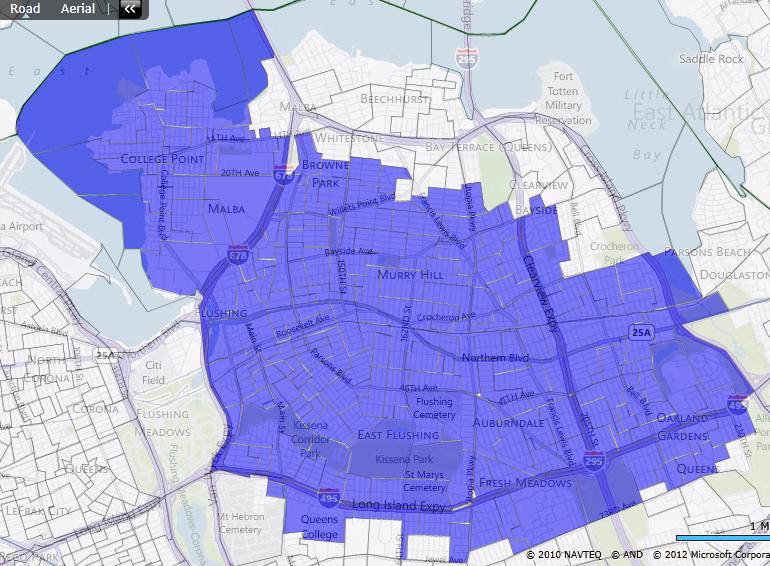
This district would incorporate much of the territory from the current 11th district, which Republican Frank Padavan represented from 1972 to 2010. Padavan held on in 2008 by 483 votes before losing to Democrat Tony Avella two years later. The territory within the borders depicted voted 62.8% for Barack Obama in 2008, compared to 62.6% in the old Padavan district. Once upon a time, the Republicans probably thought New York City Councilman Peter Koo might run for them in this seat, but Koo became a Democrat this month.
 Within the Margin