New York State/Local Primary Preview, Part I: The Marriage Equality Wars
Thursday marks the third statewide day of polling in New York so far this year, thanks to our insane legislature’s bipartisan inability to agree on a consolidation plan. We’ll have a fourth come November, obviously. And in my home town of Red Hook and in a scattering of others across the state, we had an special election in March, too, to cover Assembly vacancies. On tap for today: primaries for the state senate and assembly. I’m going to cover the interesting ones, with a particular focus on the Hudson Valley, but I’ll separate them into two categories: this post will cover those inspired by the June 2011 passage of a marriage equality bill, while a later post will look at the rest.
Four Republican state senators cast votes in favor of marriage equality last year. The state Conservative Party promptly promised to find primary challengers to each. It hasn’t played out quite that cleanly, and the respective challengers vary widely in skill and funding. One, Jim Alesi from the Rochester area, chose not to run for re-election to his seat amidst other problems back home. We’ll take a look at the other pro-marriage equality Republicans and the challengers they face today. They are varying shades of delightful, with two of them offering plenty of drama.
District 41 (parts of Dutchess and Putnam) – Steve Saland
Saland has held down this seat with ease since 1990. Redistricting removed Columbia County and gave him more of Dutchess (he now has the whole county save Beekman and Pawling) and three towns in western Putnam. This – well, this and the marriage vote – inspired Neil DiCarlo of Brewster to get into the race. No, DiCarlo still does not live in the new district. But he lives close enough to make a run and move into the district if he has to, post-election. DiCarlo’s previous run for office was a primary challenge to presumed frontrunner Nan Hayworth for the 19th Congressional District seat in 2010. His campaign focused on abortion, rather quixotically for a district known for sending pro-choice Republicans to Congress. Hayworth outspent him significantly and beat him 69%-31%; I assume he blamed the gays for his defeat. Now he’s back to challenge Saland for his marriage vote and his pro-choice views, while vaguely referencing taxes and Saland’s lengthy tenure in Albany as another reason to ditch the incumbent. And this time he’s packing an endorsement from Carl Paladino – never one to shy away from a challenge to the GOP establishment.
Anecdotally, I’m told Saland had a bit more trouble than usual in gathering petition signatures this summer, with the marriage vote regularly cited as the reason why. The question is whether DiCarlo can tap into that minority of Republicans and get them to the polls in significant numbers to topple the incumbent. I will answer that question for you: he cannot. DiCarlo has barely raised any money – $31K in total as of his 11-day pre-primary filing. Most of that seems to be spent on signs of various kinds. Normal-sized signs, which he or his supporters have been known to place in front of roadside memorials to victims of car accidents (I moved one last month in Hyde Park). Enormous signs, like the banner a supporter (or hostage) was awkwardly hoisting by the side of 9G in Hyde Park yesterday. Signs saying “RETIRE SALAND” with no accompanying information as to why one might be inclined to do so. Signs referencing DiCarlo’s support of “Faith. Family. Country.” – the third of which I’m sure was enlightening for anyone who thought he might be a hip-hop or electronica fan. Signs, to DiCarlo’s chagrin, cannot vote, and in fact his signs are so plentiful that they may exceed the number of votes he receives today. That hasn’t stopped him from focusing on them in the final days of the campaign, though: click here for some amusing local shenanigans and a Chuck Palahniuk reference while we’re at it.
Seriously, though, the reality is that Saland is a giant in these parts. No high-profile Republicans have endorsed his challenger. Most Hudson Valley Republicans are motivated by fiscal issues, not social issues. DiCarlo has no real connection to the district and nothing to distinguish him besides a set of starkly conservative views on social policy that will net him, I suspect, no more than 30% of the vote today. There’s also an Opportunity to Ballot election for the Conservative line in this race in which voters can write in either man’s name (or technically anyone else’s). One would think DiCarlo could do a little better with these folks, but I doubt he has the organization to actually beat Saland on this line, either.
District 43 (Columbia, parts of Rensselaer, Saratoga and Washington) – Roy McDonald
Joe Bruno’s successor in the state senate saw his district stretched out a bit – it used to be more focused on the capital region, but now it reaches south all the way to the Columbia/Dutchess border, while taking in two towns in Washington County and fewer people in Saratoga than previously. His challenger is Saratoga County Clerk Kathy Marchione. She’s an experienced candidate running a more professional campaign than DiCarlo; it helps that she has raised a great deal more money – about $175,000 as of her pre-primary filing. McDonald will comfortably outspend her, but that’s certainly enough money for her to break through.
The issues page on Marchione’s campaign website makes no explicit reference to marriage – but it’s definitely her lead line of attack, as seen during the only debate between the candidates. McDonald notes, quite rightly, that it wasn’t a matter of selling out, as Marchione says; after all, Democrats haven’t come close to winning this seat in past years so by casting this vote, he was making his life more difficult by inviting a challenge from the right.
McDonald does seem to be scrambling a bit, offering an attack on license plate issuance that resulted in a smack-down from several of Marchione’s fellow county clerks. More compelling is his attack on Marchione for potentially double-dipping if elected. This is because her pending retirement as county clerk will commence pension payments for this longtime public employee – and these would be on top of her state senate salary if she were to win in November.
Curiously, there is also a Conservative primary here, but it’s not between Marchione and McDonald: it’s between Marchione and Edward Gilbert, a first-time candidate who, according to Marchione, was placed on the ballot by McDonald operatives as a stalking horse.
A delightful race. I don’t think the Gilbert Gambit will succeed, in which case Marchione will appear on the November ballot regardless of what happens in the GOP primary. And as for that…my gut tells me Marchione has the momentum, but admittedly, it’s a damn hard thing to predict a state legislative primary (well, unless it’s Steve Saland obliterating Neil DiCarlo).
District 60 (Part of Erie) – Mark Grisanti
I’m not sure it gets much tastier than eight candidates competing in primaries across four different ballot lines. Grisanti defeated a scandal-plagued Democratic incumbent in 2010 by an ultra-narrow margin. He was a Democrat running on the Republican line, but he re-registered with the GOP for 2011. His speech in favor of marriage equality was the most touching of the four Republicans, but that does him little good in the primary. Since that day, his district has been radically altered as the Senate GOP attempted to shore him up for November: no longer is the seat based in inner-city Buffalo and Niagara Falls; now it features only a sliver of Buffalo, Niagara Falls is gone, and it stretches south into the suburbs and exurbs along Lake Erie. It’s not nearly the Democratic stronghold that Grisanti managed to conquer last time around. It’s still not a lock for Reps to hold in November, but Grisanti has to navigate the primary first. There, he faces Kevin Stocker, a Tonawanda attorney who ran a competitive underdog race for state assembly in 2010.
On the surface, Stocker’s campaign is not about marriage: he takes no specific position on the issue, other than saying it should be left to voters in a direct referendum, which New York does not actually have for matters other than constitutional amendments. He focuses instead on Grisanti’s “broken promises” and reform issues like term limits and legislative pay cuts. But marriage has worked its way in the campaign in ways so ostentatious as to draw national attention. I’m primarily referring to this mailer. Yeah, pretty amazing stuff. Homophobes are a gruesome lot, but bizarrely, this might not be coming from a homophobe per se, but rather a bisexual man who simply hates Grisanti and wants to tap into other people’s bigotry to get rid of the man. Then came news Wednesday of this letter, which condemns both Grisanti and Stocker on the marriage issue and appears to be an attempt to suppress primary turnout – a phenomenon which I assume would aid Grisanti as the incumbent and better-known, better-organized candidate.
It should be noted that Grisanti has faced other controversy, in the form of his involvement in a casino brawl; no charges were filed but Grisanti’s image was tarnished. But all things considered, the ugly turn this race has taken, the murky battle lines surrounding it, and a significant money advantage make for a situation where I think Grisanti squeaks through.
On the Democratic side, there’s no incumbent but marriage is still an issue. That’s because Erie County legislator Chuck Swanick received the Conservative endorsement as a foe of marriage equality and is assured of appearing on the ballot in November. Can he also claim the Democratic line? He faces Michael Amodeo, who supports same-sex marriage and advertises himself as the endorsed Democratic candidate. He claims to have knocked on over 5,000 doors. I believe him, because he certainly didn’t spent that time raising money – Swanick is outspendng him by a considerable margin. But that”s not all. The race also features perennial candidate Al Coppola. But this is a different sort of perennial candidate…because he actually once won this seat, or at least its precursor! He captured the seat in a 2000 special election, before losing the primary later that year for a full term. Coppola has gone on to lose many primaries since then, some against his cousin Marc, who also briefly held the seat. Sometimes he has run on the Republican line, and lost. His campaign didn’t come back to life until recently, and he has only raised $19,000 this cycle. But he has some name recognition and presents an interesting wild card. My guess is that Swanick wins, after months spent using his money advantage to, remarkably enough, knock Amodeo’s progressive credentials.
Grisanti also faces an Independence Party challenge from Marie Clark and Brian Siklinski. As near as I can tell neither of these are real contenders, so Grisanti should hold onto the IP line with ease.
And then there’s a Working Families primary, where Gregory Davis appears on the ballot but the opportunity for write-ins is presented. He’s our eighth candidate in this zoo of a race. I can’t begin to guess whether the three or four WFP voters who show up today will vote for him or write someone in.
***
I checked in with Matt about this menu of internecine warfare, and we’re in agreement that Saland cruises, Marchione takes out McDonald, and Grisanti survives. I’m looking forward to watching the results come in for these.
DNC 2012: Final Thoughts on the Convention
The political press is moving on from talk of speeches and messaging and production values, in favor of polling bounces and job numbers and debate preparation. But I wanted to offer a final wrap-up of my convention experience in more detail than my final missive to the Poughkeepsie Journal last week allowed.
I’ve already talked about how the Rural Council, aside from letting me laugh and clap along with the incomparable Brian Schweitzer, rekindled my spirit and helped me remember why I was even in Charlotte in the first place. I’ve written about the excitement of Bill Clinton’s take-down of four years of myth-making by the opposition. I want to close out my ramblings on the convention by talking about 6 or so minutes from the first night – the Kennedy tribute.
Now, I’m not as enamored with the idea of the Kennedy family as many Democrats. I never have been. In part, that’s simply generational; in part, it probably owes to the reality that I’m a largely abstemious person with less time than some for the personal dramas associated with the Kennedys over the years. But I’ve always had a healthy respect for Ted Kennedy’s legislative record, and more so after this convention. On Tuesday night, the first night of the convention, touching tribute was paid to the senator’s life and work – and it was all tied in to the accomplishments of the Obama administration. The video – worth a watch if you haven’t seen it – hit on so many key points, opening with the famous “the dream shall never die speech” from 1980*. It then launched into a chronicle of Kennedy’s legislative achievements and leadership on so many progressive causes, and praise for his place in history from Bill Clinton. Then came a show-stopping clip from Kennedy’s 1994 debate with Mitt Romney when the latter challenged him for his Senate seat. Romney’s vagaries and shifting positions, we were reminded in living color, are a longstanding phenomenon.
From there we saw his endorsement of Obama in 2008, and then – and this brought down the house – a smooth segue into Barack Obama’s achievements in the last four years. So many of these represented the next step forward from things Kennedy had worked on; these parallels were powerful in both an intellectual and emotional sense. Sitting in the audience, I could hear people’s breath catching as the video rolled and illustrated Obama’s place on this historical trajectory. Eyes were welling up all around. It was a powerful moment. Sometimes, the glitz and pomp of the political convention actually has something behind it, some real emotional and historical heft, and this was one of those times.
It’s the sort of moment that helped me understand why so many people were so happy for me when I was selected as a delegate. Conventions today are largely rallies – as delegates we’re not battling for our preferred nominee via floor demonstrations and closed-door arm-twisting; the official nomination is a formality by the time the convention rolls around. But there’s something to be said for rallying one’s spirit, and there’s real value in helping party leaders and activists to take stock of where they’ve been and where they’re going.
I was able to see first-hand the almost-spiritual connection so many of the delegates have with Michelle Obama, not just applauding but talking with her as she gave her speech, helping her along, praising her as she went. I was able to see the fire that burns in Cory Booker, who spoke hours before the networks were broadcasting on Tuesday. I was able to feel the energy on the streets of Charlotte, from store clerks excited by good speeches to the goodwill evident in so many local volunteers who wanted to make this work and help out in any way they could. I was able to enjoy great conversations with delegates from the around the country – Pat Jansen from Otsego, Minnesota; Wayne Manske of Mesa, Arizona; Bill Bonner of Meridian, Idaho.
So I’m energized again and looking forward to hitting my nearby swing states – Pennsylvania and New Hampshire – to lend a hand this fall. I will even try to make it out to Ohio one weekend to knock through a packet for Matt Clausen, the other man whose name appears on this blog, as he devotes himself to the OFA cause out there in the Buckeye State – where, thanks to people like him, there’s a palpable sense on the ground that Obama is opening a lead in the state perhaps most critical to his chances for reelection. Yes, everything feels a bit different this time around. Believe me, few are more acutely aware than me that it’s not 2008 any more. But that different feeling exists because we’ve already done some of the hard work of governing – making difficult choices and tirelessly defending them from well-meaning and spiteful foes alike. In a few months, if we’ve done our job, we’ll have the opportunity to make more of those tough choices.
* Perhaps more interesting to me than the words Kennedy spoke in 1980 is a simple but powerful gesture: after Kennedy finishes speaking, he offers a brief, confident, authoritative nod – one which signaled that he meant exactly what he was saying, that he had much work ahead of him, and that he looked forward to completing it. He had made his run for the presidency, it hand’t worked out, but he was ready to move on and continue his work. It’s such a subtle gesture, and maybe I’m projecting something onto it, but I think it resonates as much as anything he was saying that night. Of note as well is the grandfatherly nod he offered at the end of his 2008 convention speech, when he spoke of new lights continuing the work. He conveyed a different sort of confidence now – the confidence that others could carry on the work and see it to completion.
Clinton’s Message Resonates on the Streets of Charlotte
Coming into Wednesday night, I mentioned to my collaborator, Mr. Matt Clausen, that I had a specific tack in mind for Bill Clinton’s nominating speech. I wanted the Big Dog to give us a little compare and contrast with regard to partisanship. I figured he was equipped with enough of a reputation as bridge-builder that he could ably talk about how Republicans were different when he was president, and to be able to say that Newt Gingrich was a more willing partner than today’s Congressional Republicans.
He didn’t hit on that point specifically – though he did allude to Republican attacks on him in the mid-1990s. But the speech did even more than I had hoped for: it dissected, attack-for-attack, myth-for-myth, misdirection-for-misdirection, the Romney-Ryan case against Obama. It did so in the way that Clinton has become famous for: enough policy to please those of us who know this is actually about governing in the end, and enough folksy charm to keep it accessible and engaging to the widest audience possible. He was dying to give delegates and viewers the tools to present the same message back home in their communities, on the front lines of the campaign. I readily acknowledge my bias, but the contrast between the vagueness of last week’s Republican convention and the point-by-point Clinton onslaught made for a devastating takedown.
But the speech had an impact after the considerable applause gave way to the formality of the delegations casting their votes to renominate President Obama. Bear with my for a moment. You see, we have all been rained on continuously this week in tropical Charlotte. My clothes were running low, and I wanted to keep it a little less formal today, but I needed to buy some shorts, given that the mix of long drives, Carolina heat and lots of rain earlier in the week had rendered my existing options unwearable. First stop: TJ Maxx. Unsuccessful, but it didn’t feel that way because as I walked in, I came upon workers and customers raving about the Clinton speech – its moxie, its pointed detail. Note that I was in a section of Charlotte’s South Park neighborhood, pretty far from the hotels and quite a distance from Uptown. Next stop: Target, a considerable ways further south and therefore nowhere near any delegates but myself. I walked in…and found another conversation about staff, talking about how Clinton gets it done like few can. Having secured the sought-after apparel, I made my way to Uptown. I scored a burrito from Qdoba, where the young lady on the register sported a Hope button and asked me about the speech. We agreed it was exactly what we needed: a full rebuttal of the bullshit.
It’s a few conversations. But these are all pretty regular folk – not delegates, and not the upscale types inhabiting much of this rather suburban city. I suspect that not all of them voted in 2004. But I’m now certain they’ll be there this November. The question becomes whether it’s amplified in Charlotte because of the convention’s proximity, or if word is traveling with the same joy and fervor elsewhere.
Thoughts from the DNC Rural Council Meeting
I’ve been in North Carolina since Sunday night, but it wasn’t until Tuesday afternoon’s Democratic National Committee Rural Council meeting that this convention really got started for me, and that I figured out why I was here. Briefly, it’s been a brutal summer for me on a personal level. And let’s face it, Republicans have spent four years offering a lot of hyperbole, spite and resentment. That wears on me. It takes a lot out of me, which is exactly what they want, sadly. So politics simply hasn’t been fun for me for a while. I’ve had people telling me daily how wonderful it is to go to a convention, and how lucky I’ve been, but for some awfully legitimate reasons, I haven’t felt that way. But yesterday, some of the magic came back, thanks to the folks at the Democratic Rural Council meeting.
Now you might be thinking to yourself, “BK, Red Hook is a small town surrounded by farms, but you’re across the river from Kingston and a half-hour from Poughkeepsie. How rural is that, really?” Fair enough. Red Hook is not isolated. It’s not suburban, either, but you might call it some version of exurban. I barely get cell service on my back porch, yet I’m only a five-minute drive from a grocery store. But I attended the meeting for two reasons. One is that as a delegate, I represent more than just semi-rural northern Dutchess County. My current Congressional district stretches north and west to the Adirondacks and Catskills, with many small towns and isolated settlements, and a large number of farms of various sizes along the way. After redistricting it well get more rural, losing mostly-suburban Saratoga County but gaining Ulster, Sullivan and Schoharie with their mountains, foothills and extensive farm acreage (of note, it will also be more Democratic as a result). The other reason I wanted to be there is that I have an intense interest in agricultural policy and smart growth. Both are incredibly important to our rural communities: the former is a huge part of the rural economies, and the latter preserves the character and geography of our rural communities rather than encroaching upon them with sprawl. These are things I know a little about and seek to study in greater detail. This was my chance to connect those interests with the politics of the moment.
And so there I sat in the council meeting room with about 100-150 other folks, with Nebraskans and Alaskans in front of me, an American Indian delegate sitting to my left, and a collection of Texans to my right. Things got off to a rousing start as Montana Governor Brian Schweitzer was introduced. I was thrilled because beforehand I didn’t even realize he was up there on the stage – I was busy looking at everyone’s shirts and pins (the rural Dems dress down a little more and bring more flair than the New York delegation, so I fit in better in that respect too. I’m a big fan of Schweitzer, who I first learned about in 2004 when I stumbled upon a gubernatorial debate on C-SPAN. That day, it took about 30 seconds for me to think, “Wow, we’re going to win the Montana governor’s race.” That’s how good Schweitzer was. And yesterday, when he took the podium and launched into a story from his first 4-H steer competition as a nine-year old, it took about 30 seconds for the crowd to be enraptured, laughing along at each twist and turn.
But Schweitzer isn’t just about the laughs. There’s always a bigger message. In this case, he wanted to capture the connection between land and government. Like many states as one travels westward, Montana was long ago divided into townships and then sections, with certain sections set aside in trust to generate revenue to finance local public schools. In a state where so much of the land is publicly owned, it is vital that fair value be extracted from federally-owned lands, or the legislature has to appropriate greater and greater amounts from the general fund to pay for schools. And he described the cultural and economic importance of keeping Montana’s public lands open for hunting, fishing and camping. Along with minerals, these conservation-related activities form the backbone of the state’s economy.
Former Iowa governor and current Secretary of Agriculture Tom Vilsack followed Schweitzer to the microphone. The Montanan is more fun to listen to, but Vilsack arguably provided more to work with in terms of this election. He related an enormous laundry list of the Obama administration’s accomplishments in rural America. These include often-historic investments in farm/ranch loans, crop insurance, disaster relief, credit to rural small businesses, water treatment facilities, highways, and broadband access. One of Obama’s first actions as president to issue an executive order forming a Rural Council (not to be confused with the party subset of the same name) composed of various cabinet members whose policy spheres impacted rural areas. Four years later, we’re looking at record agricultural exports, a record agricultural trade surplus, record levels of conservation acreage, and record farm income – all despite severe drought conditions in many parts of the country.
Vilsack described a conversation with President Obama, as the magnitude of the drought began to sink in, in which the president told him to “do whatever you have to” to help farmers and ranchers. The problem was insufficient tools, and a Republican-led House that was unwilling to expand these tools. New tools had to come from the executive branch – and come they did, in the form of a streamlined disaster classification system, increased loans, and more lands opened for grazing. Crop insurance companies agreed to offer a grace period before charging interest on overdue payments. $170M worth of product was authorize to be purchased in pork, lamb, chicken and catfish to offset the high cost of feed caused by the drought.
And then Vilsack talked about the impasse in the Farm Bill. Republicans keep saying it’s about nutrition assistance cuts – i.e. SNAP, more commonly known as food stamps. That allows them to claim it’s a matter of cutting handouts and eliminating government reliance. Well, Vilsack noted that 90% of SNAP recipients are children, seniors, the disabled, and workers. Interesting categories to condemn as reaching for a handout. But beyond that, Vilsack also said it’s never just been about food stamps. The Republicans are highlighting that in order to cover deeper cuts to other key facets of the Farm Bill: crop insurance and disaster relief, for example. He also noted that farmers will ultimately lose billions in income if these SNAP cuts are enacted, as farmers receive 14 cents of every dollar from the program.
Vilsack ended by saying that these four years of investments, and the continuance of them for four more years, will mean that today’s rural children and grandchildren won’t have to leave their communities. This resonated with me: every ten years, the census reveals fewer and fewer people living in rural areas, leaving behind abandoned farms and shuttered Main Street businesses. It should go without saying that these are beautiful places which can touch a person deeply, and which can sustain wonderful communities. We’ve been losing them for decades, and the incredible level of detail Vilsack offered about the White Houses’s investments to sustain them energized me – and fellow audience members. Even many of the president’s supporters are likely unaware of all of these efforts; I didn’t know the half of them. The irony, of course, is that Republicans enshrined in their platform a condemnation of the Democratic party’s supposed attempts to engineer mass urbanization – ignoring everything Obama and Vilsack are doing to preserve rural America.
Then we heard from a senator: Alaska’s Mark Begich. Here the conversation turned from “rural” to “extreme rural” as he described a state where milk often costs $10/gallon and where 80% of towns are unconnected by roads. He praised the cabinet’s 2009 rural tour, in which 4 cabinet secretaries came to his state to get a sense of what was needed – paving the way for a total of 13 cabinet visits to Alaska during the Obama administration, an unprecedented figure. The stimulus was huge for Alaska, particularly in terms of improving the telecommunications on which so many of Alaska’s schools depend for a complete education in a land where populations are spread out and teachers are sparse. He also talked about the status of veterans’ health care: previously, veterans could not make use of the excellent Indian Health System facilities, even if they were in their home town: they had to fly to Anchorage or Seattle to visit the nearest VA facilities. Well, that’s changed now: veterans now have access to IHS facilities, saving them thousands on airline costs. Begich reported that the cabinet has readily understood that one size doesn’t fit all in federal programs; they’ve been very receptive with rural set-asides to meet the special needs of rural communities.
Next was a charismatic third-generation farmer from Turtle Lake, North Dakota, Roger Johnson. He served several terms as the state’s elected Ag Secretary before becoming president of the National Farmers Union. He noted that the administration has offered enormous bipartisan outreach, but that it’s all for naught “without a hand reaching back” from the other side. In terms of policy impact, he observed that as ag commish, he heard most frequently from farmers and ranchers about access to health care in rural areas. These areas are high-risk in the insurance world – the populations are older, working in a financially-risky occupation. The Affordable Care Act’s provisions to expand care will make it easier for these people to get access to the care they need.
Wrapping up the proceedings was John Carson, from the Office of Public Engagement. He talked about his Wisconsin farm – in his family for a hundred years – and talked briefly about the 2008 election. The story of that election, he said, is often said to be the engagement of college students, minorities, suburban moms. Less well-known was the unprecedented organization in rural America, with field offices in towns that had never had them before. North Dakota comes instantly to mind for me, with at least ten Obama offices open in 2008 in a state that Bush had carried by close to thirty percentage points four years earlier. The edge was cut to a little over eight points in 2008.
***
So I was left with a couple of things. One was a great deal of knowledge of how this administration has invested in rural communities, supporting agriculture and infrastructure to help them through a difficult climate – in both the economic and meteorological sense. I’m an information guy. I like details. I like them more than rhetoric. I was also left with the awareness that there were a lot of like-minded people in that room: they’re pragmatists who want to know what we’re doing and what we have to do to win a campaign and govern well – and who have a connection to the land that I envy and which grounds their thinking. Overarching was the sense that we’ve done great things, that there’s much more to do, and that if we can articulate those things with specifics – not rhetoric and hyperbole – that we’ll be able to do much more. And that’s just for rural America.
Being here, then, as a delegate has clicked for me. It has more of a meaning now. It allows us me to affirm that the last four years have mattered, and it gives me tools to help win an election so that the next four years can matter too. I didn’t know I was going to get that yesterday, and I’m glad I did.

2016 Already (Or, Why We Love Politico)
Politico is the embodiment of the 24/7 hyperactive news cycle that has contributed to the sharp-edged political environment we all so frequently lament. And yet, if you geek out on this stuff, you’re amused by entries like this from yesterday’s Playbook email:
2016 WATCH – RESPECT MUST BE PAID: Maryland Gov. Martin O’Malley, Minnesota Sen. Amy Klobuchar and Virginia Sen. Mark Warner will address the Iowa delegation’s breakfast on Wednesday. Montana Gov. Brian Schweitzer and New York Sen. Kirsten Gillibrand speak on Thursday. All five are potential presidential candidates in 2016. (h/t JMart)
In Politico’s mind, of course, no one talks to Iowa unless they want to win the Iowa caucuses for years from now. Iowans, they presume, are so wrapped up in the caucuses that they’ll forget to vote this November. But I’ll play along, because after all, there’s a reason I receive the Playbook email, isn’t there? Let’s take a look at those folks:
- Martin O’Malley is on everyone’s list as a “dude who’ll probably run” as a successful two-term governor who’s telegenic and currently heading up the Democratic Governors Association, the campaign committee tasked with winning governors’ mansions for Democrats this fall. O’Malley speaks at the convention tonight, so I’m looking forward to my first in-person glance at a contender.
- Amy Klobuchar is a first-term senator headed toward a landslide re-election win this fall. She’s frequently among the top few senators in terms of favorability polling. She’s known as a diligent, serious senator with impeccable progressive credentials but without the sharp partisan elbows of so many of her colleagues. By all accounts, she’s just a good person who happens to be a really effective senator. As a good-government-first guy, I would give serious thought to supporting a Klobuchar presidential bid. But the cynical side of me wonders if America is ready – ok, I’ll invite criticism: deserving – of a president like her. After all, Obama based his first term on the premise he could work with both parties, and that has proven a tad idealistic. Maybe she’s just talking to Iowa because they’re neighbors. But maybe she’s keeping her options open, too.
- Mark Warner remains popular in Virginia, where he was previously governor. I seem to recall that he preferred a senate bid to a presidential/vice presidential bid in 2008 because he didn’t want to deal with the enormous level of scrutiny involved, but I’m in a rush today so I can’t link to anything to that effect. Warner brings a slightly different profile than some major Democrats, as a hugely successful businessman who has performed very well in parts of rural Virginia that have been trending away from other Democrats in the last decade or so.
- Brian Schweitzer is a personal favorite for his style and effectiveness, including his ability to win big in Montana. I’m a staunchly pro-gun Democrat, so I’m happy to have a “more guns than I need and not as many as I want” national candidate. But I acknowledge that Schweitzer’s views on the issue would give him trouble in urban state primaries. His views on energy policy would do the same, and I might have to part with him there. But it seems like he should really be in the national discussion, to make sure Democrats are hearing from, and working with, extraction-based states as we develop a national energy infrastructure.
- Kirsten Gillibrand was my Congresswoman before she became a Senator; I knocked on oodles of doors for her in 2006 and 2008. She has supported – with actions, not just words – our local candidates in the Hudson Valley, even profound underdogs, and always remembered my brother from her first campaign in 2006. Responsible writing requires that I acknowledge that KG is a not an abstract political figure for those of us in northern Dutchess County. I think she would have strengths and weaknesses as a national candidate, with the foremost strength being a legislative record that’s quite impressive for someone who’s been in the Senate for under four years. I also think she would defer to fellow statewide official Andrew Cuomo, who everyone expects to run in 2016. But speaking to the Iowa delegation allows us, with the help of Politico’s framing, to wonder if a run is in the offing for the junior senator from New York
Veep Effects Are Small – But Could They Be Enough To Tip Wisconsin?
There’s no shortage of good writing out there about the politics and policy of the Paul Ryan vice presidential pick. But electoral history fascinates me as much if not more than current races do, so what I enjoy most about the pick is that it will give us a new and useful data point about the relationship between vice presidential geography and electoral outcomes. That’s because this will be the first VP nominee in two decades to come from a state that will be seriously targeted by both campaigns in the fall. Recent presidential elections have featured VP picks from states that were safe, or perceived to be safe, for one party the other:
- In 2008, Alaska was actually looking competitive before Sarah Palin was named to the Republican ticket. Summer Polls showed Obama within a few points of McCain. After Palin joined the fray, Obama did not seriously contest the Last Frontier, so we can’t really take too much away from the result. Plus, it’s not like Alaska was considered to be a competitive state in any other recent presidential elections. Nor is it likely to be competitive this year. So we can’t view Palin as a swing state pick in 2008. Joe Biden, of course, came from Delaware, which has been safely blue for a while now.
- 2004 saw a Republican running mate from Wyoming, where the result was never in doubt. John Edwards was chosen by Kerry ostensibly to make the South competitive, but actually showed little interested in pursuing any state in the region besides Florida. In the event, Edwards impact on North Carolina was negligible, but we’d have learned more if the Kerry/Edwards campaign had actually tried to win there.
- Both running mate choices in 2000 were made without any nod toward geography. Wyoming (Dick Cheney) and Connecticut (Joe Lieberman) were never in play.
- In 1996, the Dole campaign was never going to carry New York, so picking Jack Kemp tells us little. Bill Clinton’s holdover running mate from 1992, however, was Al Gore: chosen in 1992 to double-down on Clinton’s appeal as a youthful moderate Southerner while making up some of the ticket’s deficit in military expertise and experience. Gore indeed succeeded at carrying his native Tennessee in both 1992 and 1996, ending a streak of three consecutive Democratic losses there in presidential races. How much of that was Clinton’s appeal from next-door Arkansas, versus Gore’s strength as a native son? That’s hard to pin down, especially since Gore went on to lose Tennessee as the presidential nominee himself in 2000. But the Clinton/Gore win in 1992 represents the most recent time that a state flipped from one election to the next while running a VP nominee from said state.
While Wisconsin was an easy Obama win with 56% of the vote in 2008, and he has generally led this year’s Wisconsin polling by mid-single digits margins or above, the state has never appeared fully out of reach for Romney: Nate Silver at FiveThirtyEight currently projects a 4.4% or 5.4% Obama win, depending on whether you use the Now-cast or the November projection, while RealClearPolitics‘ Wisconsin polling average shows Obama up 5.4%. Certainly not a bad place for Obama to be, but the conventional wisdom is that the Great Lakes states are much tougher terrain for the president than they were four years ago.
Silver has worked the numbers (of course) and finds – with plenty of caveats owing to the nature of the data at hand – that from 1920 to 2008, a running mate was worth about 2.2 points on average in his home state, in terms of margin of victory (or defeat). In recent decades, it’s been more like four points – with an even stronger caveat about small sample sizes with many other factors involved. That’s a fairly small impact at the state level…unless we’re talking about a truly marginal state. Wisconsin was a blowout 14-point win for Obama in 2008, but John Kerry only won it by 0.38% in 2004, and Gore squeaked by with a 0.22% win in 2000. Silver has already adjusted his model to incorporate the historically-average 2.2% boost in Wisconsin; the RCP average to which I referred above is close enough that even a small additional impact could push Wisconsin deeper into toss-up territory, and at that point the Romney campaign may be even more inclined to devote its considerable financial resource to winning the state.
I’m guessing that the Romney/Ryan ticket will not see its Pennsylvania numbers improve much in the coming weeks, given that the Keystone State’s population skews older than much of the nation and will be hearing a lot of about the effect of Ryan’s budget policies on Medicare and Social Security. By mid-September, it might make a lot of sense for the campaign to concede those 20 electoral votes, while re-doubling their efforts to win 10 in Wisconsin.
Four Years to Purple, or a Hundred Years to Blue?
Take your pick, folks:
Texas Monthly Senior Editor Paul Burka, in the days leading up to this past Tuesday’s Cruz-Dewhurst runoff:
I had a conversation with a nationally known Republican consultant yesterday. Here is what he told me: “If Ted Cruz wins the Senate race, Texas will be a purple state in four years.” In other words, the tea party is so extreme that even a Democrat might be able to get elected. Does it change anyone’s thinking? Probably not.
Or Texas attorney general Greg Abbott, who tweeted the following after Cruz (and other Hispanic Republicans) emerged victorious Tuesday night: 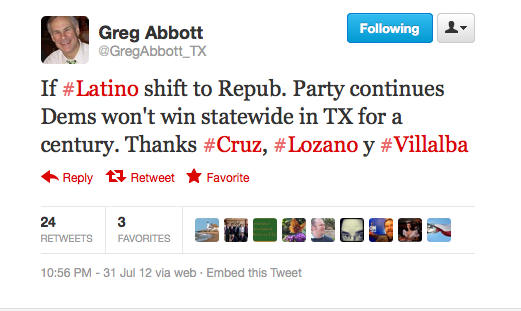
We shall see. Given Abbott’s status as a leader in disfranchising Hispanic voters in Texas, he might not be the best judge of where Latino politics is headed. That being said, Obama’s 43.6% vote share in the Lone Star state four years ago was a modern high-water mark and higher than any of us saw coming, yet still so far from putting the state in play. Texas is going to get purple, but whether it’s 2016 or 2020 remains anyone’s guess. Well, anyone but Abbott, of course.
Lugar Defeated As His Party’s Rightward Drift (Purge?) Continues Apace
There are a fair number of high-information Democrats who rank Richard Lugar as their “favorite Republican senator” – not simply President Obama, who was purported to think as much (though he’s never said it in so many words) in attack advertisements this primary season condemning Lugar for straying from the right’s preferred path. Note that this approval among some Democrats is not because he has a liberal voting record. Far from it. Lugar is a down-the-line social and fiscal conservative. In the 1970s, Richard Nixon called this guy his favorite mayor, and he hasn’t veered much from the conservative orthodoxy that Nixon appreciated then. His only real breaks from the party line comes on matters of foreign policy, where he strives for a bipartisan (or nonpartisan) consensus in how the United States makes itself and the world a safer place. For decades, he has worked with Democrats on the issue of nuclear weapon proliferation. This doesn’t mean he’s a peacenik or an isolationist – it means he takes a lofty view of government’s effectiveness, at least in one area of policymaking, and acts in good faith to make that view a reality. He has also co-sponsored the DREAM Act – anathema to many conservatives who take a hard line on illegal immigration, but in keeping with Lugar’s pragmatist persona in matters of international relations.
Savvier Democrats appreciate Lugar more than someone like Olympia Snowe, who gets lots of play in the national media for being some kind of moderate but ultimately offers only occasionally-liberal views on some social issues and a history of head-fakes toward compromise – the negotiations over the Affordable Care Act come to mind – followed by retreat when her conference turned up the heat. After repeated disappointments, it would be a stretch to call Senator Snowe a good-faith operator, and that’s exactly why Lugar has his fans on the other side of the aisle. He doesn’t string people along to gain editorial credence as some kind of mythical, throwback centrist: he plays it straight, bringing an informed, intellectual rigor to America’s dealings with other nations.
And let’s not forget the basis of that “Obama’s favorite Republican” idea. It’s not strictly borne out of Lugar’s work during the Obama presidency; its genesis is in their time together in the Senate, when they worked together on arms reduction. Obama was a freshman senator on the Foreign Relations Committee, and Lugar was the old hand who in the 1990s had collaborated with Georgia Democrat Sam Nunn on the Nunn-Lugar program, which brought about the cooperative dismantling and destruction of nuclear, biological and chemical weapons in former Soviet states. Obama and Lugar would co-author further arms reduction legislation during their time together in the Senate. In other words, the Obama-Lugar connection stems from an effort to control and reduce destructive weapons around the globe. They wanted to reduce the deadly variables threatening international security: the unaccounted-for weapons that could fall into dangerous hands. Today, by a 60%-40% margin, Republican primary voters in Indiana decided that national security was a less noble goal than the continued purge of the Republican party not simply of moderates or occasional conservative apostates, but of those who can work with a president of the other party.
To be sure, there are other reasons why Lugar went down today. His focus on international matters leaves less room to focus on parochial issues, and voters in a representative democracy have a right to focus on Indiana if they want to. Lugar did himself no favors by staying in hotels when he returned to Indiana, and using a house he had long ago sold as his voting address for many years. Lugar’s Tea Party-backed opponent, state Treasurer Richard Mourdock, attacked the incumbent for his literal and figurative distance from Indiana.
But at the end of the day, Lugar has seen his popularity among Republicans plummet since his last election bid, at a time when Republicans seem blinded by a hatred for Obama that makes it unacceptable for a co-partisan to have a function relationship with the man. And now, to the tune of a 60%-40% drubbing, Indiana Republicans have cast aside their conference’s most knowledgeable and productive foreign policy mind. For my money, there is nothing that better summarizes the last four years in Republican politics.
Realistic about Romney
Scarborough, earlier this week:
Romney’s continued weakness in the Heart of Dixie spells trouble for the GOP this fall. The only question is whether it will take a Santorum win in Wisconsin to refocus Republican minds on the unassailable fact that GOP presidential candidates cannot win unless they have the support of rock-ribbed conservatives. Mitt Romney does not, and that is becoming clearer by the day in this painful primary season.
No one questions that Romney has problems with conservatives of various stripes, and that this has helped forestall his clinching of the Republican presidential nomination. But earlier in that piece, the normally-sharp Scarborough ticks off the Southern states that are in play and references those that Barack Obama or Bill Clinton won over the last twenty years. Let me be clear: I do think that the two states Obama carried four years ago (Virginia and North Carolina) are very much winnable for him again, but I don’t think under-enthused conservatives will be Romney’s problem in those states so much as the growing ranks of highly-educated and often-transplanted voters in those states, whose social liberalism could be offset by an appealing fiscally conservative message but for the fact that Romney offers numbers that these voters know won’t add up: huge tax cuts coupled with large increases in defense spending. Elsewhere, asking conservatives to turn out so weakly in, say, Georgia that Obama is able to add that to his win column – as he almost did in 2008 – is a bit much. Romney would have to truly alienate independents to make that happen – mind you, the GOP’s twin-obsession with contraception and abortion might just do that, but we’re not there yet.
Meanwhile, I’m still deeply skeptical that Republican or conservative turnout will be weakened at all this year, whether we’re talking about the South like Scarborough is, or the Rust Belt, or the Rocky Mountains. Sure, Romney trails Obama more often than not in national polls and in key states, but we’re still in spring training in more ways than one. Democrats have not fully erased the enthusiasm gap that has existed since the darkest months of the recession. The idea that the Republican primary process is tarnishing their party’s image is true enough, but not irreversible. The idea that Republicans will be so bored with Romney that they don’t show up to vote against their hated foe, Obama? That remains laughable, in the South and everywhere else.
Less-Super-Than-2008 Tuesday
Only ten states feature in this year’s edition of Super Tuesday, compared to a ridiculous twenty-one four years ago. That means there’s not enough delegates at stake tonight for Romney to come anywhere close to clinching the nomination mathematically…but it’s more than enough to devastate Rick Santorum’s hopes. Here’s what tonight will bring:
Alaska: This was safely Romney territory (44%) four years ago, but the 2012 version of Mittens has struggled to keep up with Rick Santorum in caucuses, which is how Alaska will award its delegates tonight. A somewhat Santorum-esque character won here in 1988 in the form of Pat Robertson. But generally, I tend to think of Alaska as a libertarian stronghold, and I think Paul’s politics are in ascendance more than those of culture warriors. Coming into this nominating contest, I would have pegged The Last Frontier as one of Paul’s best chances to actually win a state…but let’s face it, folks: Republicans like their military and they like their Medicare, so Paul has a ceiling in this nominating contest, and it seems to be in the 23-27% range. He has topped that only once so far, in the Maine caucuses where it was just him and Mitt competing. With no polling in Alaska and with candidates focused on contests in the Lower 48, I think we’ll see a Mitt victory here, though not with an overwhelming vote share.
Georgia: No one likes a two-man race! We get those all the time. And so we are thankful, in a way, that Newt Gingrich is still around and will carry Georgia tonight. He’s up anywhere from 10 to 26 points in polling, and three surveys released yesterday actually pegged him at 47%. So not only should he win tonight, but he should come away with a considerable proportion of Georgia’s 76 delegates.
Idaho: Barack Obama posted a huge (above 80%) number in Idaho’s Democratic caucuses four years ago, as people began to realize that his campaign understood well that caucuses were the market inefficiency to exploit in the race for delegates. One assumes Paul will be well-organized here, but this fast-growing state features a sizable Mormon population in the southeast that will carry Mitt tonight.
Massachusetts: Like most states in the union, Mitt claims this as one of his home states. By the time he left the governor’s office in January 2007 his approval ratings were sliding among Democrats and independents, thanks to a sharp turn to the right ahead of his first presidential bid. The state’s GOP voters still liked him just fine, and he won 51-41 over McCain here in the 2008 primary. It’ll be a bigger margin this time, since Gingrich, Paul and Santorum lack the cache that McCain once held in New England.
North Dakota: Some of my in-laws are in Washburn, so I spent a few wonderful days hanging out in the Flickertail State back in 2006, and parts of two more days driving across its considerable width. It’s a great place, so it’s too bad the candidates couldn’t spend more time here this year. Alas, the focus is largely on Ohio, Georgia and Tennessee tonight. It’s a caucus state and it’s an upper midwestern state, and that’s been a winning formula for Santorum so far. Ron Paul is saying he could win here, and is in fact spending time in Fargo tonight. But I’m going to go out on a limb and predict that Santorum and Paul split enough votes for Mitt to squeak by.
Ohio: This is a big prize tonight, with 63 delegates and unlike Georgia, no home-field candidate. We had nine new polls released yesterday: two showed the race tied, four showed Romney ahead by anywhere from 1 to 7 points, and three showed showed a Santorum lead of 1-4 points. The Pennsylvanian’s time is slipping away, as has a previously-large Santorum lead in this state. Mitt’s win in Michigan leaves me convinced he can basically put Santorum away here. It’s too close to call, but that’s not how I roll…I see a narrow Romney win, maybe a 3-4 point margin.
Oklahoma: Where the wind comes sweeping down the plain! And where Rick Santorum will sweep to victory tonight. McCain narrowly beat Huck here four years ago, but the Huck-like candidate will prevail this time. Santorum has comfortably led Oklahoma polling for weeks now, but I think his margin won’t reach double-digits.
Tennessee: The Volunteer State brings the third-largest delegate haul tonight, and one of the few three-way races: most polls show a small Santorum lead over Romney, while Newt (from neighboring Georgia) hangs in at a respectable third or even second in some surveys. I think Newt ends up fading a bit further, allowing Santorum to eke out a win.
Vermont: Romney’s profile as the establishment quasi-moderate this year should allow him to cruise here. Santorum and Gingrich are simply abhorrent to Green Mountain voters of just about any stripe, and Paul is focused on the western caucus states. Easy win for Mittens.
Virginia: One of the things we’ll look back on with this nominating season is how ill-prepared everyone except Romney was for a national campaign. This is evidenced by the failure of anyone besides Romney and Paul to make it on the ballot in Virginia. Under those conditions, Romney will be Paul roughly 3:1.
So I’m predicting 7 wins for Romney, 2 for Santorum and 1 for Newt. Perhaps Paul can prove me wrong and snag a win or two in this three targeted states of Alaska, Idaho and North Dakota, but I’m skeptical for the reasons I mentioned in the Alaska capsule. As for Santorum, he needs to beat my prediction – most notably in Ohio. A couple of primary wins in OK and TN are nice, and some caucus wins would be helpful, but he has to show he can go head-to-head with Mitt in a big primary state and beat him. Otherwise, I wouldn’t be shocked to see Santorum out of this race in the near future.
 Within the Margin