Archive
House Race Capsules: Mid-Atlantic (DE, MD, NJ, PA)
This set of states builds to a crescendo – nothing competitive in Delaware, then one notable race in Maryland, a trio in Jersey, and finally a quintet of notable contests in Pennsylvania.
We’ll start with a zoomed-out look at the final forecast map for the region:

Now, onto the individual states.
Read more…House Race Capsules: New England
We’ll start with a zoomed-out look at the final forecast map for the region:
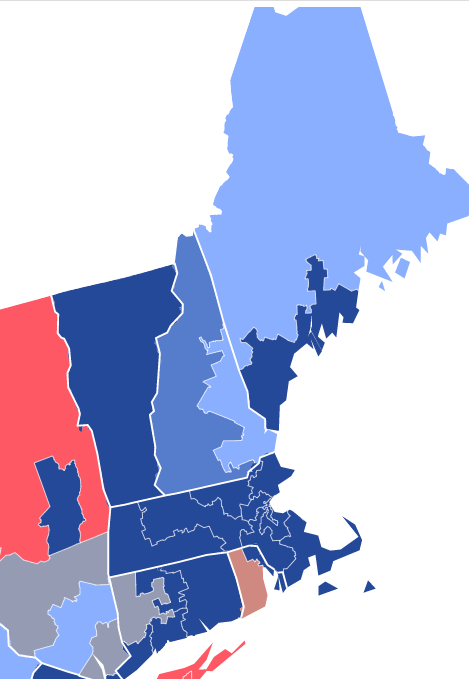
Now, on to the competitive seats in each of New England’s states.
Read more…House Race Capsules: New York
Let’s get a look at the final forecast map before breaking down the competitive races:
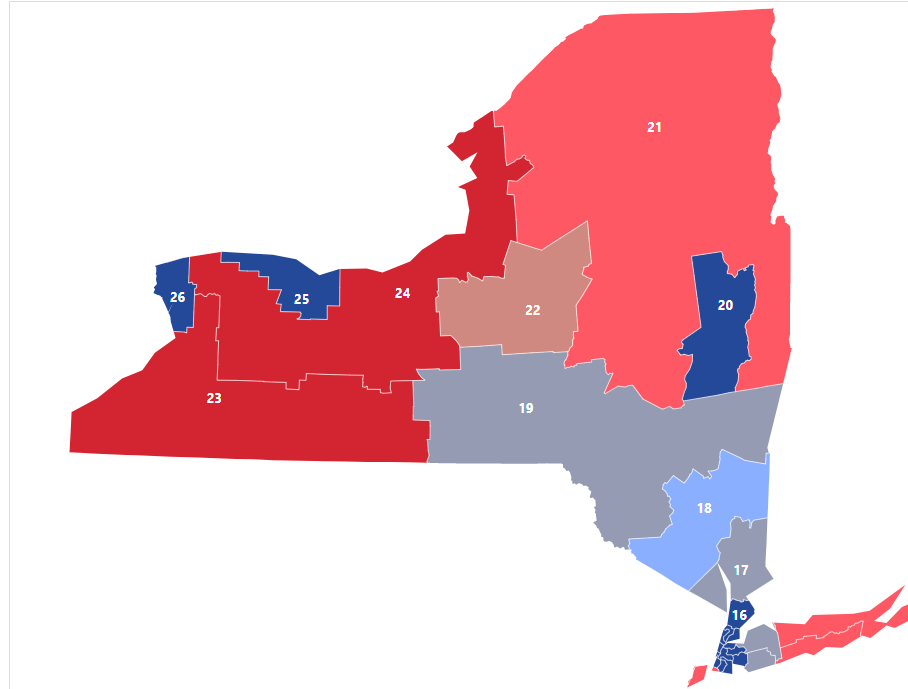
Next, we’ll go district-by-district for the competitive seats.
Read more…House Update, 11/6/2022
In the regional updates to follow, I’ll walk folks through my thought process with where each of the competitive seats stand. First, the full map of what I anticipate are my final House ratings for 2022. After the map, a list of changes since my October 21 update.
Click through for interactive map. Remember, that very gray shade of blue is the Tilt Dem seats. No toss-ups here. The idea here is to tell you where my instincts say things are going, not to say, “ehhh, toss-up, who knows?”
Read more…Senate Update, 10/30/2022
Anyone following the news of the last week would be expecting some movement toward the Republicans in this Senate update. The past week saw the Fetterman/Oz debate that launched a unsympathetic and generally insensitive national media narrative regarding Fetterman’s stroke recovery and his accompanying difficulties in the debate format, plus a bevy of Senate polls showing pro-Republican movement in several states even as some of the generic ballot House polls showed the opposite. And indeed, I was initially planning to move four races one step in the GOP’s direction – Arizona, Georgia and New Hampshire from Lean Dem to Tilt Dem, and Pennsylvania from Tilt Dem to Tilt Rep. But longtime collaborator Matt Clausen has tempered my instincts a bit here. He rightly notes that the preponderance of Senate polling in recent days has come from GOP-aligned polling firms. That doesn’t mean they’re wrong! Trafalgar, for one, redeemed themselves in 2020 by catching a lot of Trump support that other firms were missing. But methodologically they remain problematic, and some of these firms have been far enough out of step on polls this year that we have to view them with caution. I’m thinking here of co/efficient in particular. Add to that stew some GOP-sponsored polls and we don’t have a lot to work with. New Hampshire actually does have a more solid-footing firm that has taken a recent look at the race; Emerson found a four-point lead for Hassan. Does that warrant a move from Lean to Tilt? Let me see more.
And as far as the Fetterman situation goes, we have to combine that lack of non-aligned firms with the fact that Oz made mistakes in that debate, too – most notably, his assertion that the decision to have an abortion should involve one’s local political leaders. Matt is inclined to wait on shifting all four races; I’m still comfortable shifting one of them:

In my view, what’s different here is that Kelly is about to face $5 million in spending on his behalf in a race where Kelly has frequently had the advantage in the air wars, and Arizona’s other statewide races don’t seem to have any organizational strength – so if Kelly slips, he won’t have as much help arresting that slide. He maintains the edge in polling, though, and he maintains the edge in our rating here.
The map, with the lone update:
As always remember that blueish-gray color is Tilt Dem. And click here for the interactive map.
Level-setting: 2022 Gubernatorial Races
The map below is my forecast from last Friday; I’ll be updating this Friday night or Saturday. You might not see as much coverage of these races as you should – in a post-Dobbs and post-contested elections world, these and state legislative races are just as important or perhaps even more so than the federal scene.
(click here for interactive map. Remember, that very gray shade of blue is the Tilt Dem seats. No toss-ups here. The idea here is to tell you where my instincts say things are going.)
That 28-22 lead in favor of the Republicans matches the breakdown coming into this year’s elections. But I have two flips in each directions. Maryland and Massachusetts represents easy takeovers for Democrats; these are very blue states each coming off of eight years under a relatively moderate Republican governor first elected in the red wave of 2014. This time, neither is running: Maryland’s Larry Hogan is term-limited and Massachusetts’ Charlie Baker opted not to seek a third term. In their place, Republicans nominated a pair of Trumpers who have been rich in controversy and far behind in polls. I have both races rated as Safe Dem.
On the flipside, Republicans are currently forecast here at Within the Margin to gain the governorships in Nevada and Oregon. In the Senate post earlier tonight I referenced my pessimism throughout the cycle with respect to Nevada; that extends to the governor’s race. In Oregon, the outgoing Democratic governor is among the most unpopular in the country. Add to that the presence of an independent candidate who, as a moderate former Democratic state senator, is pulling more votes from that party’s nominee, and you have the conditions for a Republican win. It would be their first win in an Oregon gubernatorial election since 1982.
More to come this weekend.
Level-setting: 2022 Senate Races
The map below is my forecast from last Friday; I’ll be updating this Friday night or Saturday with at least one seat moving toward the Republicans.
(click here for interactive map. Remember, that very gray shade of blue is the Tilt Dem seats. No toss-ups here. The idea here is to tell you where my instincts say things are going.)
That’s a 50-50 map, but two seats change hands from the 50-50 status quo we’ve lived under since the start of 2021. For the moment, I have Pennsylvania flipping to Dems…emphasis on “for the moment.” And in the other direction, I haven’t liked an assortment of things coming out of Nevada this cycle, and it currently sits at Tilt Republican. That could change in a future update; after all, the incumbent Democrat (Cathy Cortez Masto) continues to lead in most polling.
Level-setting: 2022 House Races
The map below is my forecast from last Friday; I’ll be updating this Friday night or Saturday with races moving in both directions.
(click here for interactive map. Remember, that very gray shade of blue is the Tilt Dem seats. No toss-ups here. The idea here is to tell you where my instincts say things are going.)
That 222-213 margin represents a nine-seat shift to the GOP, if we assign the three current vacancies to their previous party. By historical midterm standards it would be a fairly tame result – but obviously enough to control the chamber. The generic ballot points to a larger shift – though caveats apply. Many of the higher-rated pollsters are showing a Republican lead in the generic, but a higher number of pollsters overall are still showing Democratic leads. We can find lots of encouraging data points for Dems in the early/mail vote so far…but we can pick holes in most of it, too. It’s a less predictable midterm than most but I’m going to try to nail some of these predictions in the final weeks. Back tomorrow with more.
The Nebraska First Special Is Worth Keeping In Mind
Earlier this month, I attended a We Won’t Go Back March in Poughkeepsie, NY. At its conclusion we heard from quite a few local electeds, candidates, activists and community members. Among them was Pat Ryan, county executive in Ulster County across the river – and candidate in the upcoming (August 23) special election for New York’s 19th Congressional District. The 19th – my home for the last 14 years and my neighboring district before that – is very swingy district, with Democrats flipping it in 2018 and Republicans hellbent on taking it back this year. Pat naturally made reference to the special election during a brief and focused speech that read the parade and rally audience reasonably well. He noted that it is the only remaining Congressional special election following the Dobbs ruling that overturned Roe v. Wade and before the November general election. The outcome will be picked apart, analyzed and weaponized: will it show Republicans marching inexorably toward retaking the House of Representatives majority? Or will it upend the narrative by showing Democrats mobilizing in a post-Roe world, and perhaps indicate that some voters who were leaning toward the usual midterm behavior of punishing the party in the White House are changing course in reaction to the Supreme Court’s far-right supermajority?
But it is important to note that the election in NY-19 is not the only Congressional special election between Dobbs and November: there are several others, and we actually already had one in late June, days after the ruling and largely out of the national spotlight. It was in Nebraska’s 1st Congressional District, the updated lines of which continue to contain the capital city of Lincoln (the state’s second-largest, with 291,082 people), along with the fast-growing Omaha suburbs of Bellevue (featuring a population of 64,176, making it the third-largest city in Nebraska) and Papillion (24,159), Offutt Air Force Base, several smaller cities beyond the Omaha metro area such as Columbus, Fremont and Norfolk, and several very rural counties (Butler, Cass, Colfax, Cuming, Seward, Stanton and part of Polk), some with populations below 10,000. It’s worth noting an oddity in this election: it was held on the new lines for NE-1, even though the special election is for the final months of the current term – meaning the winner, Mike Flood, will be representing people who couldn’t vote for him, and tens of thousands of people who could vote for him won’t be represented by him. It’s hard to imagine this is a remotely constitutional arrangement.
It was also hard to imagine the election being particularly close: as drawn, the new NE-1 is a little bit bluer than the old version, thanks to some land swaps by Nebraska’s Republican-dominated legislature to make NE-2 redder (that’s the one Democrats occasionally carry in presidential and Congressional races). But it’s still safely Republican under most circumstances; it voted 54%-43% for Trump over Biden in 2020. Lincoln (and Lancaster County) is something of a Democratic outpost thanks to the presence of the University of Nebraska and its government workforce and high education attainment levels. But it doesn’t vote Dem by landslide margins, and is comfortably outvoted by the much redder counties around it. Those suburban pieces of Sarpy County mentioned above are trending blue but aren’t quite there yet. Like many military posts, Offutt AFB trended hard away from Trump in 2020, but it still voted narrowly for him. One can see the pieces coming together for NE-1 to be more competitive in a decade…but we wouldn’t have expected it to be particularly close this time around, especially in a political environment that had trended toward the GOP all year.
And yet…it was pretty close. Republican candidate Mike Flood won by 5.4% (52.7% to 47.3%) in this district that, as noted above, would have voted for Trump by 11 points if we overlay the 2020 results onto its new configuration. Overperforming a district’s partisanship by almost six points is no small feat when you’re the party in power in DC; special elections typically see the out-of-power party overperforming instead. The Democratic candidate, Senator Patty Pansing Brooks of the Nebraska unicameral legislature, was dominant in Lincoln’s Lancaster County, leading the Republican nominee – fellow Senator Mike Flood – by just over 10,000 votes, or 14%. This strikes me as notable given that this was a summertime election, meaning the University of Nebraska and its massive student population were largely away from campus for the summer and less likely to be voting in this election. Flood carried each of the remaining counties, with Sarpy the closest as we’d expect. Brooks would need to carry Sarpy handily to win the November rematch; she probably also needs to cut his margins in the rural counties where he generally exceeded 80% of the vote.
Not a win, which would have upended the political landscape, this seat has been held by Republicans since 1966 – but a stunning performance nonetheless. Was this a product of Democratic voters charging to the polls following the Dobbs ruling a few days earlier? Is it an interesting portent of renewed Democratic enthusiasm despite the myriad challenges currently facing the party in power (however narrowly) in Washington? It’s only one data point so we should avoid drawing conclusions; it’s possible it was simply anomalous – a summertime election in a district whose voters are not accustomed to competitive Congressional elections in the first place. It’s possible Dobbs was a factor but will be swallowed by other factors as the year goes on. The next opportunity to learn more will be August 23, when Democrats attempt to hold onto the more traditional swing territory of NY-19.
State of Play – the Senate (no toss-ups)
We expect Senate control to be tight…but all the upside is with Dems. Click through for the map and big picture.
 Within the Margin