Level-Setting: The 2026 Midterms
Welcome to August. We’re less than a hundred days out. Let’s get started.
History & Trends
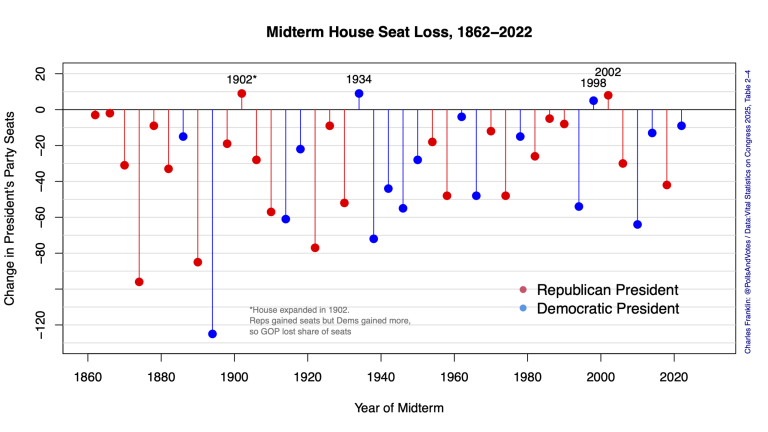
If you’re reading this site, you probably have a basic awareness of how midterm elections typically play out. Generally, the incumbent president’s party loses House seats – this has been true in every midterm in recent decades, save 1998 and 2002. Often the loss is profound: years like 1994, 2006, 2010 and 2018 serve as a shorthand of sorts for election analysts. These were massive and iconic wave elections, with the then-president’s party (Democrats in 1994 and 2010, Republicans in 2006 and 2018) losing 30+ House seats in each and control of the chamber flipped to the opposition.
The Senate is a bit different: because only a third of the seats are up every two years, and because polarization and sorting has left many fewer states competitive, the results have tended in recent years to mirror the recent presidential results in those states. 2018 is a good example: Democrats netted 40 House seats but actually lost ground in the Senate. In 2022, Republicans flipped the House (albeit narrowly) but lost the only Senate seat that changed hands that year.
Thanks to a series of mid-decade redistricting efforts at the state level, the Congressional battleground is quite small unless it turns into an incredible year for one party or the other. I would note that several metrics pointing to this in fact being such a year for Democrats, as I’ll discuss below. In theory, the Senate map should be quite small, too – but Democrats have recruited strong candidates in a number of states Republicans have been winning at the presidential level and often comfortably. Senate polling is highly encouraging. Democrats have a shot at flipping the Senate this year thanks to competitive races in states like Alaska, Iowa, Ohio and Texas, despite recent trends that should make it all but impossible.
Data & Polling
All of the usual caveats apply about the limitations of polling. But I should note that alongside those caveats come the reality that their main weakness in the last ten years or so has come when Trump is on the ballot, and even still they did pretty well in 2024. For all of the hysterics around polling – mostly from extremely-online people engaged in motivated reasoning – the industry as a whole tends to be directionally accurate with respect to issues and “horse race polling.” More often than not, they’re in the ballpark in terms of magnitude, too.
As of this writing, polling is mostly grim for the incumbent president and his party. The Silver Bulletin approval tracker places Trump at 38.2% approval and 58.8% disapproval; that -20.6 net approval is the worst of Trump’s second term so far. And it’s notably worse than Trump’s standing at this point in his first term (-11.3) when Democrats went on to flip 40 House seats a few months later. Silver Bulletin’s generic congressional ballot tracker, meanwhile, gives Democrats roughly a six-point lead (48.4% to 41.9%). For comparison, in 2024 Republicans won the popular vote for the House of Representatives by about two and a half points (49.8% to 47.2%), which yielded a miniscule 220-215 majority. Assuming that this generic ballot polling is remotely accurate, that’ll be enough for Dems to flip the House – though not as resoundingly as they would if the ongoing round of mid-decade redistricting had not occurred.
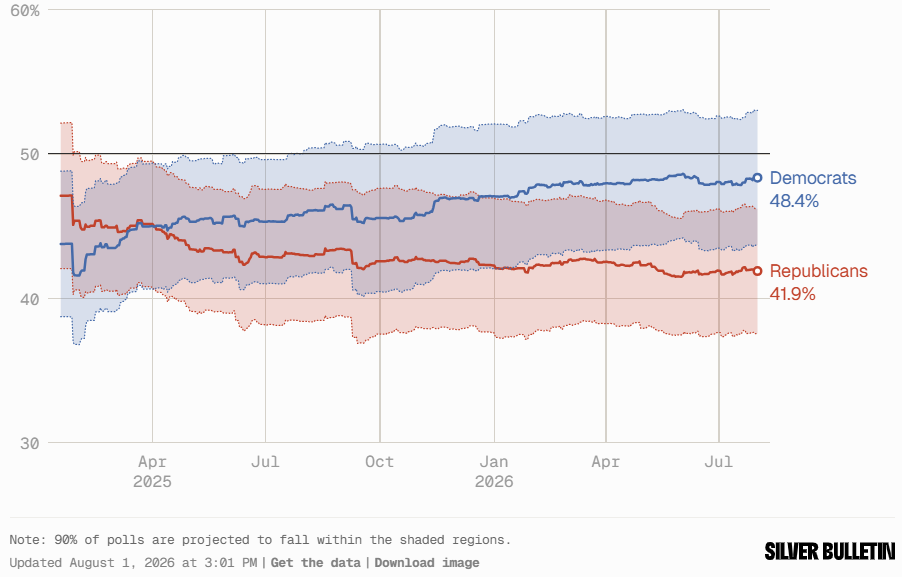
This does not represent quite as decisive a Democratic edge as in the 2018 midterms. This is perhaps counterintuitive, given Trump’s weaker position at this point in his term relative to the early summer of 2018. We might ascribe it to the Democratic brand being weaker than eight years ago – which is another conversation, and one that is probably more important for Democrats to solve by 2028 than it is an urgent problem for 2026. Several recent polls have shown that Democrats have an even larger edge with the voters who indicate a higher motivation to turn out and vote this year, though, so there is an argument that we should expect the Democratic advantage to grow slightly as polls hone in on likely voters in the coming months.
Beyond the generic ballot polling, another useful indicator of political sentiment is Gallup’s quarterly party identification surveys. The most recent data there is for Q2 of this year, with Democrats up 10 (49-39). That figure includes where independents, who initially make up 44% of the sample, are asked who they lean toward. In the final quarter of 2024, during which Trump was re-elected, Republicans held a 47-43 advantage in this survey. Gallup’s website provides this data going back to the first quarter of 2015; that ten-point advantage for the Dems is the largest lead for either party during this period. Pew Research finds a narrower spread, with Democrats leading 47-43 in their most recent party affiliation measure (covering January to June of this year). That still represents a positive trend for Dems, though, as the 2025 edition of this survey returned a 46-46 result and the 2024 edition gave Republicans a 47-46 advantage.
Maps & Gerrymandering
Republicans came out of the 2024 elections with the narrowest House majority since 1930. Even a reasonably popular incumbent would have trouble surviving a midterm with such a small majority intact and this…well, this is not a reasonably popular incumbent. As Trump’s popularity began to fall after weeks of DOGE cuts and especially the “Liberation Day” tariffs, Trump urged Texas Republican leaders to re-draw their Congressional map to eliminate several Democratic seats. The thinking was that they played it too safe with their 2022 gerrymander and that the 2024 elections, with dramatic increase in support for Republicans among Latino voters in Texas (and elsewhere), indicated the GOP could take a more aggressive approach. Texas Republicans complied, devising a map premised on their ability to hold those 2024 gains. It is designed to flip five additional seats this year, though realistically it may fall short – something we’ll examine in more depth in our forecasting later this year.
Democratic-controlled California responded by placing a measure on the 2025 ballot to temporarily replace the maps drawn by their independent redistricting commission with a new map that targets five GOP-held seats.
Other states pursued smaller mid-decade redistricting efforts with varied success. Virginia passed a map that would likely flip three GOP-held seats but their effort was ultimately overturned by the Virginia Supreme Court, with an appeal then rejected by the U.S. Supreme Court.
In North Carolina, where the governor is a Democrat but under state law cannot veto redistricting bills, the GOP-controlled legislature followed their 2023 gerrymander with an update designed to flip NC-1.
Ohio’s 2022 map was only good for two election cycles due to their somewhat goofy laws around redistricting, so they were aways going to attempt a new map for 2026. The GOP-controlled legislature wanted a 13-2 map to replace the current 10-5 map, but this would have again been temporary. They ultimately reached a compromise with legislative Democrats to make OH-1 and OH-9 redder but still not guaranteed to flip.
Missouri passed a new map intended to split the Democratic seat in Kansas City among three Republican districts, while also boosting the GOP vote share in previously most-vulnerable GOP-held seat (MO-2, in the St. Louis suburbs).
Indiana’s Republican-held legislature faced a fearsome push from Trump, J.D. Vance and others to eliminate Indiana’s two remaining Democratic seats (out of nine), but ultimately rejected their demands. For their heresy, a number of Indiana Republican state legislators were targeted by their party for defeat in this spring’s primary elections; most of the targeted incumbents lost their seats.
Following the Supreme Court’s ruling in Louisiana v. Callais, which held that plaintiffs in Section 2 challenges under the Voting Rights Act must demonstrate that a state intentionally diminished opportunities for minority voters because of their race. If a plaintiff cannot “disentangle race from the state’s race-neutral considerations, including politics,” their lawsuits will fail. Most of my readers will understand that this is particularly unreasonable in parts of the country where voting has long been polarized along racial lines. But the majority of our current Supreme Court do not count themselves among my readership, and have now fulfilled one of the longest-running goals for conservatives in America: neutering Section 2.
The immediate effect of this ruling was to strike down Louisiana’s 6th Congressional district, two weeks before the state’s scheduled primary elections for 2026. Governor Jeff Landry moved to suspend those elections to buy the state time to draw new maps; the Supreme Court permitted this and Louisiana soon adopted a new map with a GOP-friendly version of the 6th district. Tennessee quickly followed with a new map that eliminated their only majority-minority Congressional district (the Memphis-area 9th district) and split it among various GOP-heavy seats. In Alabama, early voting for Congressional primaries was already underway: the state nevertheless asked the Supreme Court to restore a map drawn by the legislature that had been deemed a racial gerrymander. The Court complied.
South Carolina governor Henry McMaster tried to follow suit and pass a new map that eliminated SC-6, the already-gerrymandered state’s lone blue seat thanks to its non-white majority. This effort failed when the SC Senate refused to take up the bill.
In Florida, the state’s voter-approved 2010 Fair Districts Amendment sits on the books as a dead letter. In theory, it forbids any Congressional apportionment plan from being “drawn with the intent to favor or disfavor a political party or an incumbent.” Initially, this law – which was supported by 63% of Florida voters in the 2010 referendum – was faithfully interpreted by state courts: Florida’s 2012 redistricting was found to be in violation, and new districts were ordered for the 2016 elections. But in 2022, Governor Ron DeSantis was displeased with the state legislature’s initial set of maps for the new decade. Though drawn by Republicans, those maps did not accomplish what DeSantis was seeking. He ordered a special legislative session and eventually strongarmed legislators into passing his desired map that spring. This extreme gerrymander was ultimately upheld by Florida’s Supreme Court.
But that did not satisfy DeSantis. This spring, DeSantis and Florida’s GOP-dominated legislature passed a new and even more extreme mid-decade gerrymander that turns the current 20-8 map into a 24-4 map for the GOP. The new map was immediately challenged in court, but deemed by a DeSantis-appointed judge to be acceptable: while the Fair Districts Amendment prohibits partisan intent, he observed, the Equal Protection guarantees supposedly set forth in Callais are of greater importance.
If we assume that these various mid-decade redistricting efforts play out as their sponsors intended, the GOP will gain five seats in Texas, four seats in Florida, two seats in Ohio, and one seat each in Alabama, Louisiana, Missouri, North Carolina and Tennessee. Democrats would gain five seats in California and one in Utah (where a court ruled that Republicans had exceeded their authority under the Utah constitution by repealing an independent redistricting law back in 2020, and the resulting map gives Democrats a seat in the Salt Lake City area) for a net of +10 in the GOP direction. As things currently stand, the Republicans likely will not fare quite that well in Texas, and Don Davis is a strong enough incumbent that he may hold on in NC-1. Likewise, the slightly-redder version of OH-1 will likely stay in Democratic hands given this year’s electoral environment, while Marcy Kaptur in OH-9 could plausibly survive yet again in her ever-reddening seat. But the net effect of redistricting will still be a substantial haul of new seats for the GOP – probably in the 5-7 seat range. That makes Democrats’ job harder this year when it comes to flipping the House, but hardly impossible.
Mandates & Vibes
There may come a day when a winning political party does not exaggerate or misread their mandate, but the first half of Trump’s second term as president has not been that time. Others have written as well or better than I can about this, but there was a months-long victory lap among Trump’s supporters that included quite a bit of high profile alignment and/or capitulation from institutions in media, Big Law, higher ed and so on. There was a sense – probably exaggerated at the time but certainly not borne out by events that followed – that we were in a new era, with a certain cultural sensibility in ascendance. But it seems fairly obvious that the 2024 electorate wanted a more affordable America, an absence of chaotic scenes at the border, and a president who could communicate what he’s up to better than Joe Biden often could during his time as president. Instead, we remain sour on the economy. Stubborn inflation has been exacerbated by seemingly-random tariffs and the gasoline shocks brought about by the president’s decision to attack Iran. Chaotic scenes at the border were already on the wane by the end of Biden’s term. But they have been replaced by chaotic scenes in the streets as masked ICE and Border Patrol agents act without basic levels of restraint, oversight or training – and with fatal consequences. And Trump seems to be no more skilled than Biden at arresting a political slide. He’s probably quite worse: while Biden seemed to think people would feel the impacts of his American Rescue Plan much more quickly and personally than he did, at least he was talking about them. Trump talks about ballrooms and reflecting pools when people can’t afford to buy a house, let alone one with a pool. He couldn’t pull off a feel-good event for America’s 250th birthday. He even managed to fuck up the Knicks’ playoff winning streak, briefly interrupting the best run of good vibes New York has experienced in eons.
Maybe there’s a clever political strategy coming down the pike, but it looks like the GOP is out of ideas for the moment other than “make people hate the Dems,” which is not wildly different than what they do the rest of the time and may feel repetitious to voters who are tired of ~gestures broadly~ all of this. Coming into the year, they were talking up a “midterm convention” to charge up the less-engaged segments of their base by making the election about Trump. This idea had some merit, since Republicans have been struggling in recent years when he’s not on the ballot. But with his approval ratings reaching the low 30s in recent polls, it seems likely that making these elections about Trump does them more harm than good. We’ll see – maybe he’s got something up his sleeve for this soiree in Dallas next month. But as things stand, it looks like it’ll just be a two-day Trump rally, with some other speakers thrown in.
 Within the Margin