The Eyes Wide Open Election, Part 3: Pursuance
[continuing a series on the election that was. To read “Part 1: Acknowledgement,” click here. To read “Part 2: Resolution,” click here.]
It is one thing to acknowledge the world as it is, another to evaluate competing narratives around it, and another, far more challenging thing to determine where I think the Democratic Party goes from here. I think there are a few obvious elements when it comes to strategy and infrastructure:
- Playing to the cable news audience is a fool’s errand. Personally I’d rather news just be, you know, news. There’s room for talking heads on cable news just as I believe there’s room for editorial pages in a newspaper – but the ratios ought to be very different than they presently are. But if cable news is going to operate the way it currently does, and include an ideological bent, I don’t think the Democratic Party or its officials need to play along. The MSNBC crowd does a better job of sharing facts with their viewers than, say, Fox News. But it does little to encourage viewers to understand the electorate around them, and every minute Democratic figures spend talking to high-info base voters is a minute that could have been spent trying to reach people who oscillate between engagement and non-engagement, or the even smaller portions of the electorate that splits their tickets or swings between parties from one election to the next. This seems like an incredibly obvious point, but it’s stunning how much time Democrats spend talking to their most fervent supporters at the county, state and national level. It’s stunning when you watch it up close in local politics, and stunning when you watch it from a distance on the national scene.
- A lot of folks seem to understand that the political consultant class adds little. Coin flip national elections have become the norm, and we win them about as often as we would a…coin flip. It was clear in 2016 that Democrats faced softness with white working-class voters, and Biden barely improved on Hillary Clinton’s margins with these voters in 2020. It was clear in 2020 (and every subsequent year) that Democrats now also faced softness with Black, Latino and Asian working-class voters, and Dems went backwards with these voters in countless elections in 2021, 2022 and 2023. Everyone knew, in other words, that Democrats faced a challenge in reaching working-class voters across the demographic board in 2024. And yet the consultants paid to win elections could not develop a plan to turn the tide. The reality is campaign fundraising for federal elections is easier than ever, and the consultants get paid – win or lose. And then they usually get hired again. So a lot of our supporters’ hard-earned money is going to people who spend December vacationing on a beach whether they’ve won or lost the previous month. Democrats need to re-assess who actually adds value when it comes campaign infrastructure. This, again, seems like an incredibly obvious point. And yet it doesn’t happen. Professionals who can make campaigns more of a turnkey operation likely raise the floor in electoral performance, but I’m worried it lowers our ceiling and leaves us dependent on how the national-level coin flip lands. Maybe Democrats need to run candidates who devise their own bespoke strategies based on their feel for their communities – and if they don’t have that feel, if they have nothing distinctive to offer on their own without having consultants craft it for then, they need not to run.
- In a time of low social trust with lower contact rates from phonebanking and doorknocking, I’m not sure that the classic campaign field tools should be relied upon as much. It’s not 2008 or even 2018 anymore, but you wouldn’t know that from the endless speeches from well-meaning organizers about how we need to be pounding the pavement. That said, I remain interested in well-meaning organizers who are immersed in a community for several cycles and can develop a feel for what works and what does not. I’m certainly open to returning to and expanding the Dean-era 50/50 state strategy. I’m interested in moving away from the “gig economy” model of organizing toward something that provides living wages, benefits and stability for a larger number of organizers than we’ve previously done in our allegedly pro-labor party.
Messaging, policy and strategy present questions – with much less obvious answers – of how to pursue electoral success in a second Trump term.
- I’d start by pulling back from left/right or economics-versus-culture wars dichotomies and ask how Democrats assess the wider societal dynamics that got us into the Trump Era. Democrats are losing the war for attention, in part because the party styling themselves as overturning the present order are going to have the upper hand in winning eyeballs. There’s a lot of discontent in the post-pandemic world, and it’s easer to tap into that than to defend an unpopular status quo as Democrats found themselves doing in the Biden years. But there’s a larger question to be asked about the attention economy and its impact on how people view contemporary life. I’m always saying that this timeline we’re in just doesn’t “feel right” – and screens and social media and the homogenizing of American communities might have something to do with that feeling. I think there’s room for someone to demand that we pump the brakes on our screen-induced devolution and to resist the mega-corporations at the core of that decay. Ezra Klein recently discussed this idea on his podcast with guest Chris Hayes, arguing that aspects of this sensibility are widespread and that the next really successful national candidate – from whichever party – might be the one that taps into those feelings. I tend to agree. The transcript is worth a read, but here’s the passage I found most resonant:
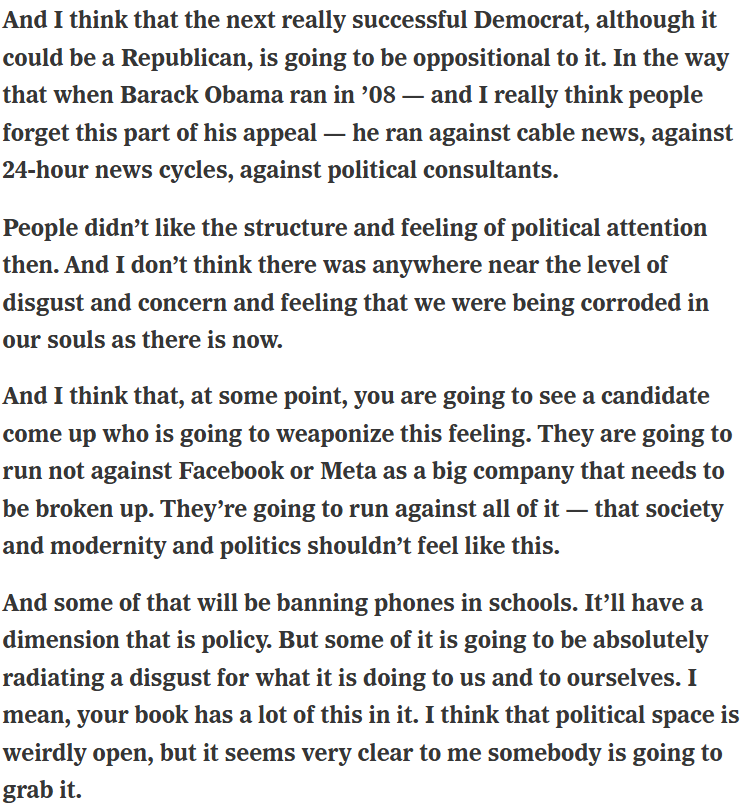
- I’d widen that brake-pumping – or preferably, outright reversal – to AI’s growing infection as well. And lest you think I’m falling into the trap I often lament and suggesting that a candidate who conspicuously and conveniently echoes my own beliefs is the one who’ll carry the day, let me offer a couple of caveats. I have no idea if this narrative will produce electoral majorities. But I think there’s a space for it that someone would be wise to fill, and a wayward Democratic Party that frankly isn’t doing any other big-picture projects ought to do it. And I’m being consistent: I’m not spending time in this space suggesting that Democrats focus heavily on foreign policy concerns that are of major interest to me…and not too many other folks. I predicted in 2002-03 that following up our Afghanistan nation-building efforts with an invasion and occupation of Iraq would not only become massively unpopular (it did) but would launch a generation of isolationism in response, uniting Americans on the political right and left against overseas involvement. It did, with Trump’s America First agenda reaching escape velocity as a result. It is damn near impossible to have serious discussions about international security, inside our party and among the wider polity. That frustrates me to no end, but I’m not going to suggest that the electorate is willing to re-engage on foreign policy and national security outside of yelling at each other in an often-reductionist fashion about the existential threats facing both Israelis and Palestinians.
I’d like to feel more confident that something like what I’ve described above is at hand, but I’m still seeing too many Democrats engaging in tired defenses of Biden’s political strategy or arguing that we just have to wait for Trump to mess up, and then we’ll be ok. The latter might produce some midterm wins, but it’s not clear to me that it won’t be too late at that point to roll back a lot of damage in both policy terms and to small-d democratic governance. And it’s not clear that it will create national majorities in 2028 and beyond.
-
February 3, 2025 at 10:36 pmThe Eyes Wide Open Election, Part 4: Psalm | Within the Margin
 Within the Margin