Archive
Another Year, Another Special Election Win

And most importantly…a chance to mention the Lincoln Highway!
Coalitions determine election outcomes, and the current sorting of the American electorate is leaving Democrats with a greater share of the highest-engagement, highest-propensity voters. This has limited value in high-turnout, national elections. But it raised the party’s floor in the 2022 midterms despite then-President Biden’s unpopularity, and it has contributed to quite a few impressive performances in special elections taking place outside the normal calendar (i.e. outside November). That includes some victories in reddish territory, and a 2024 near-win in a deep, deep red part of eastern Ohio. That Ohio race turned out not to be remotely indicative of a Democratic comeback in the Buckeye State, as Trump went on to win the district and state by considerably larger margins than he had four years earlier. Instead, it served as a demonstration that many of the most-engaged voters are Dems even in heavily Republican areas, making them a higher proportion of the electorate in a low-turnout contest.
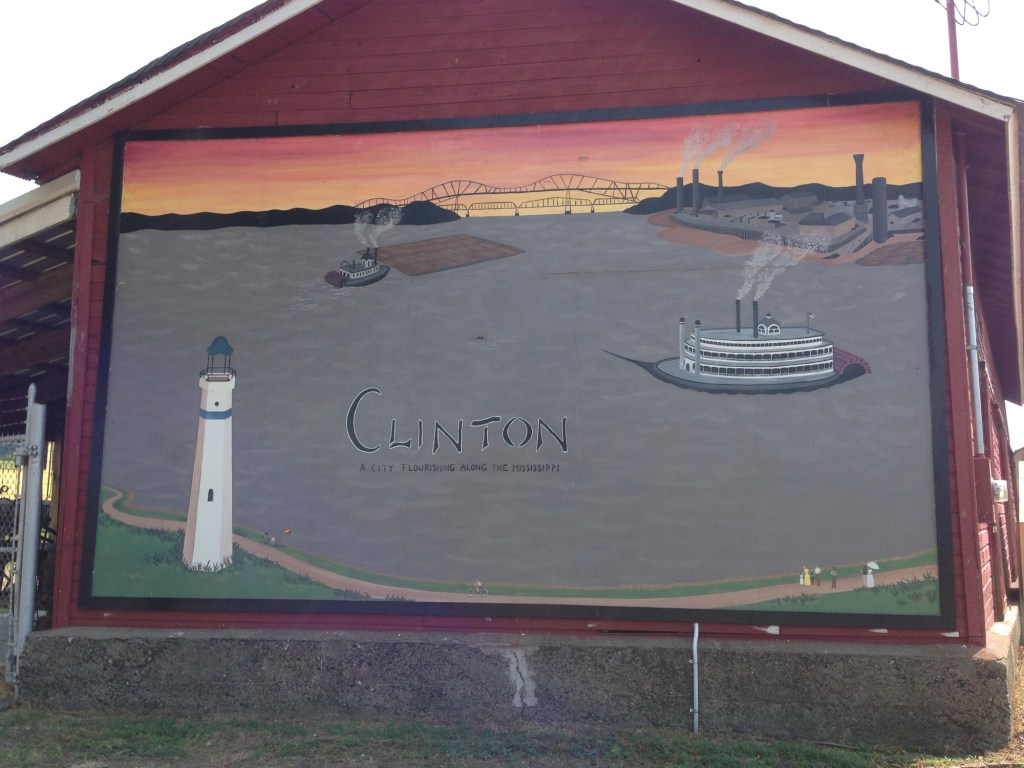
And so it is that we have last week’s impressive triumph for Democrat Mike Zimmer in Iowa’s 35th Senate District. This was a special election called after incumbent Republican Chris Cournoyer vacated the seat upon her appointment as Iowa’s lieutenant governor. This is a great district: it includes all of Clinton County, and small portions of Jackson and Scott counties to the north and south, respectively. Clinton County is home to Clinton, right on the Mississippi River. It’s the first place I ever visited in Iowa, on my Lincoln Highway road trip back in 2013. The Lincoln enters Iowa on U.S. 30, crossing the Mississippi from Illinois. Clinton’s a cool place, with paddlewheel logo and its river-town vibes; this is the Midwest but maybe with a slightly Southern touch. Until 2020, they had an affiliated minor league baseball team; after MLB’s purge, it’s a collegiate summer league team these days. Clinton (both city and county) have been declining in population for decades. I’m sure it has its issues. But to my eyes in 2013, this district seemed like a cool and unique place to live.
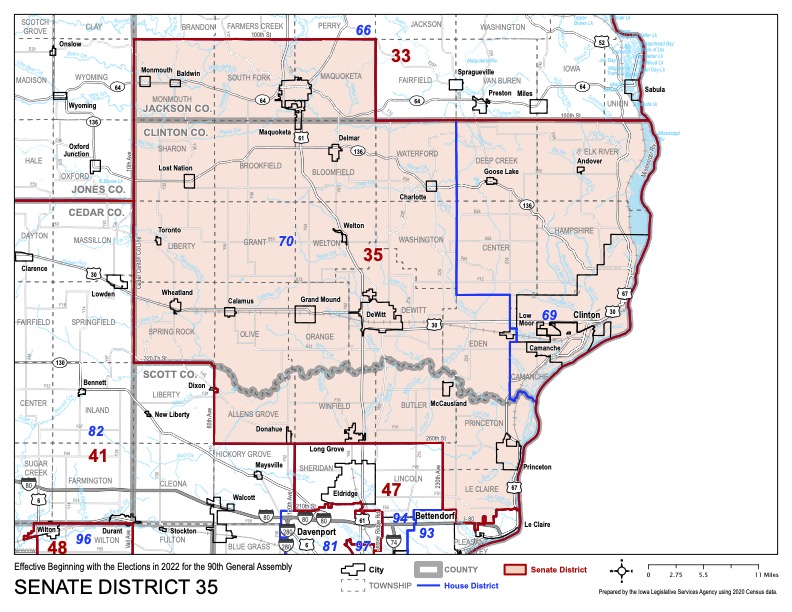
These days, it’s also a very red district. It supported Trump by 21(!) points over Kamala Harris last year. That’s quite a change from the Obama years, when he won this area by about the same margin – twice. But then Democrats began to plummet among the white working-class voters who make up a large portion of the electorate here and in most of Iowa, so it’s firmly Trump Country today. Downballot, this state senate seat flipped to Republicans in 2018 even as Democrats enjoyed a good year nationally; in 2022 Cournoyer was re-elected to the renumbered district by 22 points.
You wouldn’t know that from this special election, though. Zimmer won by almost four points, flipping a seat that will be hard for Democrats to hold in 2026 – but in the meantime gives them a new voice in the GOP-dominated Iowa legislature. He lost the Scott County portion by 12 votes. But he won the small Jackson County portion by over a hundred votes, and the Clinton County portion – which makes up 70% of the district – by a couple hundred. I had a feeling coming into it that this might be brewing, given recent history in special elections along with the timing: a week after Trump’s inauguration seems like a good time for Dems to blow off some steam by voting, even in a contest far removed from the maelstrom in the nation’s capital.
It probably helped, too, that this election took place last Tuesday in the midst of confusion over Trump’s freeze of trillions in grant spending. Every local government and not-for-profit entity that receives any kind of federal money was facing uncertainty over what comes next, without any guidance from an administration hellbent on embodying the Silicon Valley credo of moving fast and breaking things. A day later, the White House rescinded the freeze. But some damage was done, and that may have been reflected in the result – especially in an election with such a tight turnaround, leaving little time for absentee voting. So most voters were likely voting on Election Day itself, and the latest dose of Trump chaos probably did not dispose them favorably to the GOP.
There’s a clear trend in recent years in special elections up and down the ballot, all over the country. But where special elections used to be more indicative of performance in coming general elections, the relationship has changed a bit thanks to Democrats’ increasing dominance among the people most likely to turn out in any given contest. That said, winning in such deep red turf points, at minimum, to Dem voters retaining their engagement despite the national discourse declaring them to be in the midst of a period of wound-licking and navel-gazing.
The Eyes Wide Open Election, Part 4: Psalm
[continuing a series on the election that was. To read “Part 1: Acknowledgement,” click here. To read “Part 2: Resolution,” click here. And to read “Part 3: Pursuance,” click here.
“In the bank of life isn’t good that investment which surely pays us the highest and most cherished dividends?”
– John Coltrane, notes to “A Love Supreme”
The confidence with which each side of the American political divide presents themselves as righteous and good is for many people one of the great turn-offs of our political discourse. Perhaps that’s why Trump, his party and his supporters now try to have it both ways: presenting as God’s chosen messiah (“I was saved by God to make America great again“) while also reveling in villainy, in cancellation, in being assholes who hurt people – but assholes on your side. Self-consciously positioning as the opposite of that – on the side of democracy, on the side of maliciously-targeted groups – has produced limited success for Democrats. I’m not about to suggest that Dems attack the same people, or embrace authoritarianism. We should continue to be, for lack of a better term, the good guys, and let Trump and his flock be the villains/false idols they so desire to be. But by itself, we now know that won’t be enough. So we need to find another way to reach people.
We’re in the midst of a substantial political realignment along educational lines and along levels-of-engagement lines. I generally believe that Democrats will come out on the short end of this realignment, but will achieve intermittent electoral success should Trumpian chaos leave voters short-tempered in lower-turnout elections. I could see the former changing if a Dem breaks through at the national level with a message outside the usual left/center-left dichotomy into less-charted territory relating to how screens and social media platforms and artificial intelligence have frayed, and will fray, our societal bonds. This terrain maps less neatly onto our political divides, meaning it offers the chance to build new coalitions.
To everything there is a season, and in this season it seems more practical for me to read, think and write about past realignments and those presently underway than to do the hamster-wheel work within the party. That’s not to say the latter is unimportant – but one must understand what they have available to offer at any given time. Pretending that everything is normal and we just go about our business with the same political strategies and structures as before? That seems naive. I need to go away and dream it all up again, to quote Bono back in 1989. I’ll very much still be following elections and commenting on them – but on the ground, right now, it falls to someone else to do the party work and the voter contact and all that. When I’ve had some time to dream up something new and find myself having something to offer, I’ll get back to that kind of work, and I hope the Democratic Party will be ready when I am.
***
These four pieces are the most forced things I’ve written in a long time. I’m not sure how I feel about them. I suspect I will not look back favorably on them for their style or construction or most certainly their titles, and I suspect I’ll be annoyed most of all at their lack of insights. But at least I acknowledge a lack of insight, at a time when so many Democratic electeds and “leaders” would have us believe they have the answers when in fact they’re stunned, directionless and simply waiting for something to happen.
The Eyes Wide Open Election, Part 3: Pursuance
[continuing a series on the election that was. To read “Part 1: Acknowledgement,” click here. To read “Part 2: Resolution,” click here.]
It is one thing to acknowledge the world as it is, another to evaluate competing narratives around it, and another, far more challenging thing to determine where I think the Democratic Party goes from here. I think there are a few obvious elements when it comes to strategy and infrastructure:
- Playing to the cable news audience is a fool’s errand. Personally I’d rather news just be, you know, news. There’s room for talking heads on cable news just as I believe there’s room for editorial pages in a newspaper – but the ratios ought to be very different than they presently are. But if cable news is going to operate the way it currently does, and include an ideological bent, I don’t think the Democratic Party or its officials need to play along. The MSNBC crowd does a better job of sharing facts with their viewers than, say, Fox News. But it does little to encourage viewers to understand the electorate around them, and every minute Democratic figures spend talking to high-info base voters is a minute that could have been spent trying to reach people who oscillate between engagement and non-engagement, or the even smaller portions of the electorate that splits their tickets or swings between parties from one election to the next. This seems like an incredibly obvious point, but it’s stunning how much time Democrats spend talking to their most fervent supporters at the county, state and national level. It’s stunning when you watch it up close in local politics, and stunning when you watch it from a distance on the national scene.
- A lot of folks seem to understand that the political consultant class adds little. Coin flip national elections have become the norm, and we win them about as often as we would a…coin flip. It was clear in 2016 that Democrats faced softness with white working-class voters, and Biden barely improved on Hillary Clinton’s margins with these voters in 2020. It was clear in 2020 (and every subsequent year) that Democrats now also faced softness with Black, Latino and Asian working-class voters, and Dems went backwards with these voters in countless elections in 2021, 2022 and 2023. Everyone knew, in other words, that Democrats faced a challenge in reaching working-class voters across the demographic board in 2024. And yet the consultants paid to win elections could not develop a plan to turn the tide. The reality is campaign fundraising for federal elections is easier than ever, and the consultants get paid – win or lose. And then they usually get hired again. So a lot of our supporters’ hard-earned money is going to people who spend December vacationing on a beach whether they’ve won or lost the previous month. Democrats need to re-assess who actually adds value when it comes campaign infrastructure. This, again, seems like an incredibly obvious point. And yet it doesn’t happen. Professionals who can make campaigns more of a turnkey operation likely raise the floor in electoral performance, but I’m worried it lowers our ceiling and leaves us dependent on how the national-level coin flip lands. Maybe Democrats need to run candidates who devise their own bespoke strategies based on their feel for their communities – and if they don’t have that feel, if they have nothing distinctive to offer on their own without having consultants craft it for then, they need not to run.
- In a time of low social trust with lower contact rates from phonebanking and doorknocking, I’m not sure that the classic campaign field tools should be relied upon as much. It’s not 2008 or even 2018 anymore, but you wouldn’t know that from the endless speeches from well-meaning organizers about how we need to be pounding the pavement. That said, I remain interested in well-meaning organizers who are immersed in a community for several cycles and can develop a feel for what works and what does not. I’m certainly open to returning to and expanding the Dean-era 50/50 state strategy. I’m interested in moving away from the “gig economy” model of organizing toward something that provides living wages, benefits and stability for a larger number of organizers than we’ve previously done in our allegedly pro-labor party.
Messaging, policy and strategy present questions – with much less obvious answers – of how to pursue electoral success in a second Trump term.
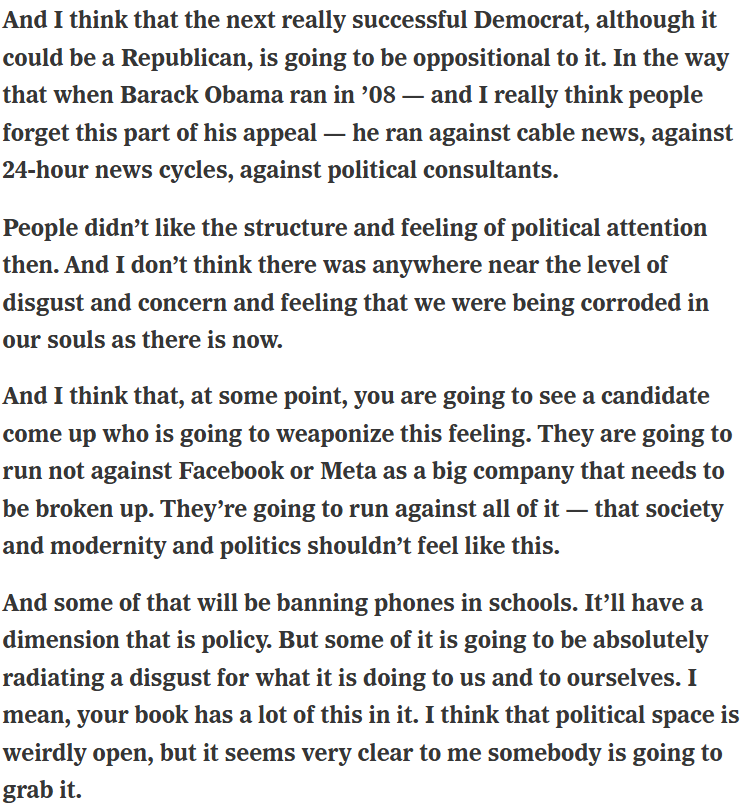
- I’d start by pulling back from left/right or economics-versus-culture wars dichotomies and ask how Democrats assess the wider societal dynamics that got us into the Trump Era. Democrats are losing the war for attention, in part because the party styling themselves as overturning the present order are going to have the upper hand in winning eyeballs. There’s a lot of discontent in the post-pandemic world, and it’s easer to tap into that than to defend an unpopular status quo as Democrats found themselves doing in the Biden years. But there’s a larger question to be asked about the attention economy and its impact on how people view contemporary life. I’m always saying that this timeline we’re in just doesn’t “feel right” – and screens and social media and the homogenizing of American communities might have something to do with that feeling. I think there’s room for someone to demand that we pump the brakes on our screen-induced devolution and to resist the mega-corporations at the core of that decay. Ezra Klein recently discussed this idea on his podcast with guest Chris Hayes, arguing that aspects of this sensibility are widespread and that the next really successful national candidate – from whichever party – might be the one that taps into those feelings. I tend to agree. The transcript is worth a read, but here’s the passage I found most resonant:
- I’d widen that brake-pumping – or preferably, outright reversal – to AI’s growing infection as well. And lest you think I’m falling into the trap I often lament and suggesting that a candidate who conspicuously and conveniently echoes my own beliefs is the one who’ll carry the day, let me offer a couple of caveats. I have no idea if this narrative will produce electoral majorities. But I think there’s a space for it that someone would be wise to fill, and a wayward Democratic Party that frankly isn’t doing any other big-picture projects ought to do it. And I’m being consistent: I’m not spending time in this space suggesting that Democrats focus heavily on foreign policy concerns that are of major interest to me…and not too many other folks. I predicted in 2002-03 that following up our Afghanistan nation-building efforts with an invasion and occupation of Iraq would not only become massively unpopular (it did) but would launch a generation of isolationism in response, uniting Americans on the political right and left against overseas involvement. It did, with Trump’s America First agenda reaching escape velocity as a result. It is damn near impossible to have serious discussions about international security, inside our party and among the wider polity. That frustrates me to no end, but I’m not going to suggest that the electorate is willing to re-engage on foreign policy and national security outside of yelling at each other in an often-reductionist fashion about the existential threats facing both Israelis and Palestinians.
I’d like to feel more confident that something like what I’ve described above is at hand, but I’m still seeing too many Democrats engaging in tired defenses of Biden’s political strategy or arguing that we just have to wait for Trump to mess up, and then we’ll be ok. The latter might produce some midterm wins, but it’s not clear to me that it won’t be too late at that point to roll back a lot of damage in both policy terms and to small-d democratic governance. And it’s not clear that it will create national majorities in 2028 and beyond.
The Eyes Wide Open Election, Part 2: Resolution
[continuing a series on the election that was. To read “Part 1: Acknowledgement,” click here.]
Democrats are doing the usual Democratic thing: analyzing the defeat and suggesting changes.
That’s healthy, in theory. It’s what normal political parties who assume their viability is more or less tied to the popularity of their specific policies would do. There’s a catch, though: just as predictably, the ideological bent of too much of the Democratic post-mortem discourse has been eyeroll-inducing. The party’s left flank argues that if only Dems embraced more leftist positions, new voters would stampede to the polls in support. It’s probably worth noting that Bernie Sanders1 and Elizabeth Warren2 received fewer votes than Kamala Harris in their respective states – though I’ll acknowledge those states are not demographically representative of “swing” states. Centrist Dems outran Harris in some of the toughest Congressional seats that Democrats held (see ME-2 and WA-3 for two good examples). At the same time, centrists argue that Dems must tack to the center to win back voters who have drifted to the GOP…but they mainly focus on what not to talk about rather than an affirmative set of policy prescriptions. Voters quite clearly signaled in the years leading up to this election that their primary concerns were inflation and immigration, so after-the-fact prescriptions about rejecting “wokeism” or embracing Medicare For All do not ring true – even if I tend to agree that the language Democrats use around certain issues is unhelpful, and agree wholeheartedly that Democrats would be wise to attack (legislatively as well as rhetorically) consensus evils like the outrageous, patient-killing tactics employed by private insurers.
Republicans are doing the usual Republican thing: exalting in victory and over-claiming their mandate. They had Sen. Bill Haggerty of Tennessee on Sean Hannity’s show shortly after the election declaring that “Trump certainly has a mandate that we’ve never seen before.” Countless Republicans have echoed the sentiment. In reality, Trump’s margin of victory ranks quite low in terms of the popular vote, with his vote share coming in under 50% and his lead over Kamala Harris ending up at less than 1.5%. That is the seventh-smallest popular vote margin since the Civil War. It’s wider in the electoral college, which is obviously the ballgame: but a 1.5% shift in the three closest states gives Harris an electoral college win, so we’re still not talking about big margins. Trump won, and no one disputes this. But the idea that it’s a large, historic mandate is confounded by simple math. His mandate in mathematical terms is nowhere near Biden’s, or either of Obama’s; even George W. Bush’s 2004 win came with a considerably larger popular vote share. But many media outlets are currying favor with the incoming administration and Congressional majorities. We’ve seen the settlements with Trump over lawsuits, which feel a bit like bribery. And they’re eager to be seen as ratifying voters’ choices and perhaps to attract Trump voters back to legacy media outlets they’ve long since abandoned. So the tenor of coverage presents an incongruously imperious political position for a party whose presidential candidate won narrowly and is currently polling five points underwater, and whose House majority is the smallest any party has enjoyed since 1931.
People who spend their time dismissing parties and elections as a means of improving the world are suddenly finding out that those things do in fact matter.
One can find folks online – and definitely in my own real-life circles – saying, “wait, Democrats prophesied doom if Trump won – why are they carrying on now like everything is normal? Heavens, why…why aren’t they DOING SOMETHING about it?” Folks, this isn’t hard: they argued the election was critically important *because* of the lack of things you can do when all the guardrails have been stripped away, which already happened: the Supreme Court has rolled over for Trump. His party, which now controls both house of Congress, long ago rolled over for Trump. Yeah, they’ll draw the line at a Matt Gaetz attorney general nomination, but not much else. What do you want Democrats in Washington to do? Chain themselves to desks? Get arrested? Your mileage may vary, but I’m not interested in performance politics right now. As Jonathan Van Last notes, most of the remaining power of resistance is in the hands of bureaucrats – the so-called “Deep State” – to work quietly – unseen – to delay harmful actions. In sum, Democrats said the election had existential stakes precisely because the last eight years have eroded the options to resist.
That being said: sure, I would rather Biden have dispensed with now-obsolete niceties like posing for pictures with the president-elect – especially if by pardoning his recidivist son, he was going to make politics harder for those of us tasked with carrying the torch for this declining, atrophied party in the aftermath of his presidency. I would rather Democrats have repaired any number of long-standing structural problems involving special counsel authority, ethics for federal judges, and background checks for cabinet appointments, to offset some of the erosion in guardrails in the Trump era. I would rather Senate Democrats have use their appointment powers to maximum effect in the lame duck period, but former Democrats Joe Manchin and Kyrsten Sinema are a limiting factor. And I’d rather responsible non-Democrats like Christopher Wray not resign as head of the FBI and instead make Trump actually fire him, so as to put more cards on the table for more people to see. But none of these individuals are behaving responsibly or effectively. They’re confused and capitulating. Caveat: David French offers another take on Wray’s decision.
Even as I write this, the Democratic leaders in the House and Senate are responding in slow-motion – to the extent they’re responding at all – to Elon Musk’s friends potentially taking over payment systems at the Department of Treasury, or the firing of over a dozen prosecutors at the Department of Justice in retaliation for previously investigating Trump. It may be that to truly change the political dynamic, you have wait for Trump, Musk & Co. to do something that breaks through to people. But you still have to provide your own supporters with something to grasp onto to take advantage of those eventual mistakes.
- my preferred candidate in the 2016 primaries – but it’s complicated and I came to regret that. Whatever her faults, Hillary Clinton deserved better in those primaries, and obviously in that general election. ↩︎
- my preferred candidate in the 2020 primaries – after which I had to reckon with the reality that I am not particularly representative of the vast majority of the population. ↩︎
 Within the Margin