Archive
Another Year, Another Special Election Win

And most importantly…a chance to mention the Lincoln Highway!
Coalitions determine election outcomes, and the current sorting of the American electorate is leaving Democrats with a greater share of the highest-engagement, highest-propensity voters. This has limited value in high-turnout, national elections. But it raised the party’s floor in the 2022 midterms despite then-President Biden’s unpopularity, and it has contributed to quite a few impressive performances in special elections taking place outside the normal calendar (i.e. outside November). That includes some victories in reddish territory, and a 2024 near-win in a deep, deep red part of eastern Ohio. That Ohio race turned out not to be remotely indicative of a Democratic comeback in the Buckeye State, as Trump went on to win the district and state by considerably larger margins than he had four years earlier. Instead, it served as a demonstration that many of the most-engaged voters are Dems even in heavily Republican areas, making them a higher proportion of the electorate in a low-turnout contest.
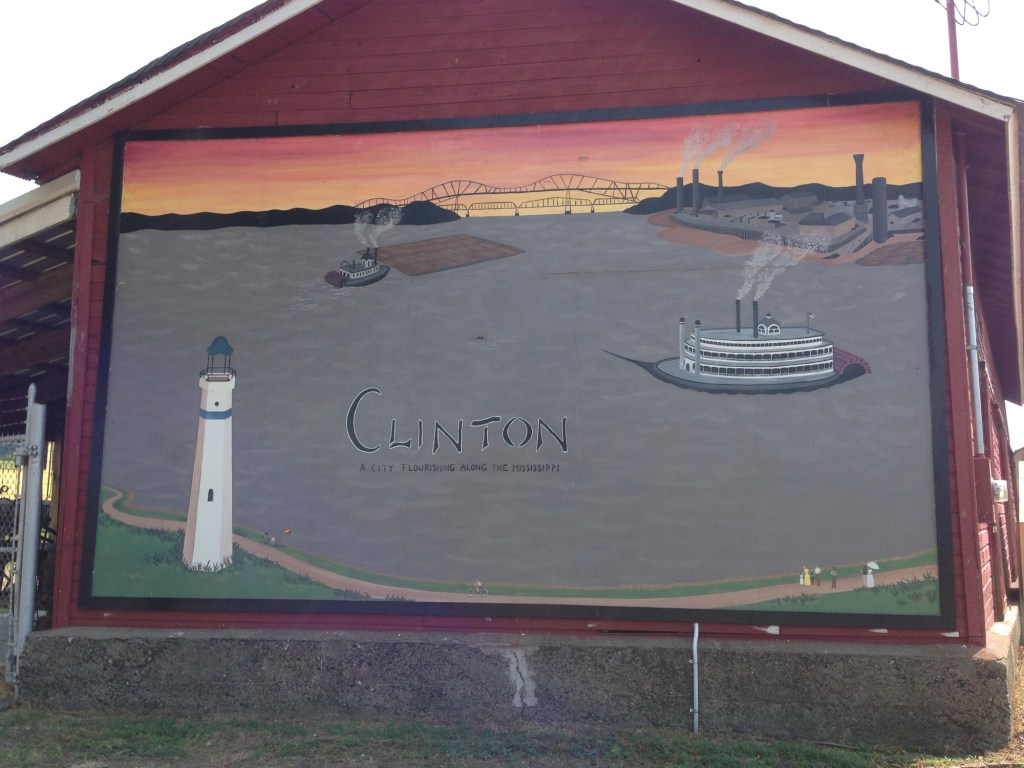
And so it is that we have last week’s impressive triumph for Democrat Mike Zimmer in Iowa’s 35th Senate District. This was a special election called after incumbent Republican Chris Cournoyer vacated the seat upon her appointment as Iowa’s lieutenant governor. This is a great district: it includes all of Clinton County, and small portions of Jackson and Scott counties to the north and south, respectively. Clinton County is home to Clinton, right on the Mississippi River. It’s the first place I ever visited in Iowa, on my Lincoln Highway road trip back in 2013. The Lincoln enters Iowa on U.S. 30, crossing the Mississippi from Illinois. Clinton’s a cool place, with paddlewheel logo and its river-town vibes; this is the Midwest but maybe with a slightly Southern touch. Until 2020, they had an affiliated minor league baseball team; after MLB’s purge, it’s a collegiate summer league team these days. Clinton (both city and county) have been declining in population for decades. I’m sure it has its issues. But to my eyes in 2013, this district seemed like a cool and unique place to live.
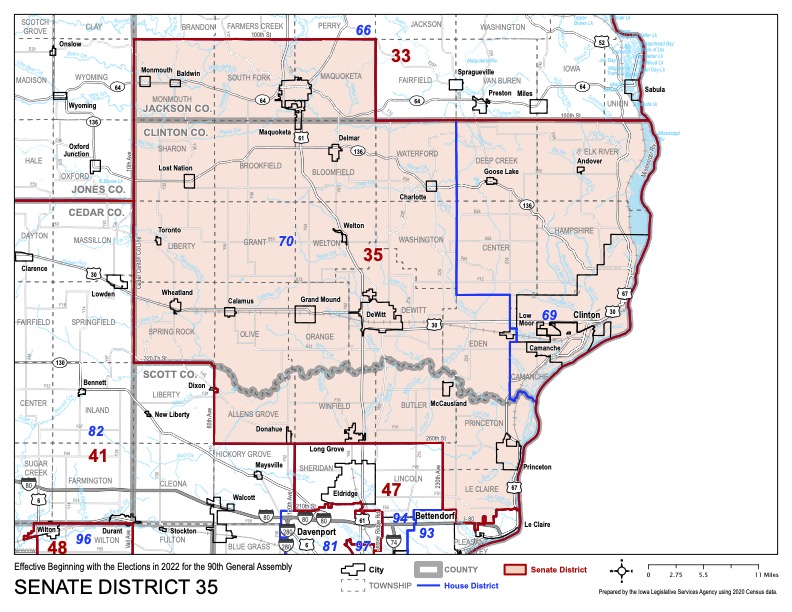
These days, it’s also a very red district. It supported Trump by 21(!) points over Kamala Harris last year. That’s quite a change from the Obama years, when he won this area by about the same margin – twice. But then Democrats began to plummet among the white working-class voters who make up a large portion of the electorate here and in most of Iowa, so it’s firmly Trump Country today. Downballot, this state senate seat flipped to Republicans in 2018 even as Democrats enjoyed a good year nationally; in 2022 Cournoyer was re-elected to the renumbered district by 22 points.
You wouldn’t know that from this special election, though. Zimmer won by almost four points, flipping a seat that will be hard for Democrats to hold in 2026 – but in the meantime gives them a new voice in the GOP-dominated Iowa legislature. He lost the Scott County portion by 12 votes. But he won the small Jackson County portion by over a hundred votes, and the Clinton County portion – which makes up 70% of the district – by a couple hundred. I had a feeling coming into it that this might be brewing, given recent history in special elections along with the timing: a week after Trump’s inauguration seems like a good time for Dems to blow off some steam by voting, even in a contest far removed from the maelstrom in the nation’s capital.
It probably helped, too, that this election took place last Tuesday in the midst of confusion over Trump’s freeze of trillions in grant spending. Every local government and not-for-profit entity that receives any kind of federal money was facing uncertainty over what comes next, without any guidance from an administration hellbent on embodying the Silicon Valley credo of moving fast and breaking things. A day later, the White House rescinded the freeze. But some damage was done, and that may have been reflected in the result – especially in an election with such a tight turnaround, leaving little time for absentee voting. So most voters were likely voting on Election Day itself, and the latest dose of Trump chaos probably did not dispose them favorably to the GOP.
There’s a clear trend in recent years in special elections up and down the ballot, all over the country. But where special elections used to be more indicative of performance in coming general elections, the relationship has changed a bit thanks to Democrats’ increasing dominance among the people most likely to turn out in any given contest. That said, winning in such deep red turf points, at minimum, to Dem voters retaining their engagement despite the national discourse declaring them to be in the midst of a period of wound-licking and navel-gazing.
The Nebraska First Special Is Worth Keeping In Mind
Earlier this month, I attended a We Won’t Go Back March in Poughkeepsie, NY. At its conclusion we heard from quite a few local electeds, candidates, activists and community members. Among them was Pat Ryan, county executive in Ulster County across the river – and candidate in the upcoming (August 23) special election for New York’s 19th Congressional District. The 19th – my home for the last 14 years and my neighboring district before that – is very swingy district, with Democrats flipping it in 2018 and Republicans hellbent on taking it back this year. Pat naturally made reference to the special election during a brief and focused speech that read the parade and rally audience reasonably well. He noted that it is the only remaining Congressional special election following the Dobbs ruling that overturned Roe v. Wade and before the November general election. The outcome will be picked apart, analyzed and weaponized: will it show Republicans marching inexorably toward retaking the House of Representatives majority? Or will it upend the narrative by showing Democrats mobilizing in a post-Roe world, and perhaps indicate that some voters who were leaning toward the usual midterm behavior of punishing the party in the White House are changing course in reaction to the Supreme Court’s far-right supermajority?
But it is important to note that the election in NY-19 is not the only Congressional special election between Dobbs and November: there are several others, and we actually already had one in late June, days after the ruling and largely out of the national spotlight. It was in Nebraska’s 1st Congressional District, the updated lines of which continue to contain the capital city of Lincoln (the state’s second-largest, with 291,082 people), along with the fast-growing Omaha suburbs of Bellevue (featuring a population of 64,176, making it the third-largest city in Nebraska) and Papillion (24,159), Offutt Air Force Base, several smaller cities beyond the Omaha metro area such as Columbus, Fremont and Norfolk, and several very rural counties (Butler, Cass, Colfax, Cuming, Seward, Stanton and part of Polk), some with populations below 10,000. It’s worth noting an oddity in this election: it was held on the new lines for NE-1, even though the special election is for the final months of the current term – meaning the winner, Mike Flood, will be representing people who couldn’t vote for him, and tens of thousands of people who could vote for him won’t be represented by him. It’s hard to imagine this is a remotely constitutional arrangement.
It was also hard to imagine the election being particularly close: as drawn, the new NE-1 is a little bit bluer than the old version, thanks to some land swaps by Nebraska’s Republican-dominated legislature to make NE-2 redder (that’s the one Democrats occasionally carry in presidential and Congressional races). But it’s still safely Republican under most circumstances; it voted 54%-43% for Trump over Biden in 2020. Lincoln (and Lancaster County) is something of a Democratic outpost thanks to the presence of the University of Nebraska and its government workforce and high education attainment levels. But it doesn’t vote Dem by landslide margins, and is comfortably outvoted by the much redder counties around it. Those suburban pieces of Sarpy County mentioned above are trending blue but aren’t quite there yet. Like many military posts, Offutt AFB trended hard away from Trump in 2020, but it still voted narrowly for him. One can see the pieces coming together for NE-1 to be more competitive in a decade…but we wouldn’t have expected it to be particularly close this time around, especially in a political environment that had trended toward the GOP all year.
And yet…it was pretty close. Republican candidate Mike Flood won by 5.4% (52.7% to 47.3%) in this district that, as noted above, would have voted for Trump by 11 points if we overlay the 2020 results onto its new configuration. Overperforming a district’s partisanship by almost six points is no small feat when you’re the party in power in DC; special elections typically see the out-of-power party overperforming instead. The Democratic candidate, Senator Patty Pansing Brooks of the Nebraska unicameral legislature, was dominant in Lincoln’s Lancaster County, leading the Republican nominee – fellow Senator Mike Flood – by just over 10,000 votes, or 14%. This strikes me as notable given that this was a summertime election, meaning the University of Nebraska and its massive student population were largely away from campus for the summer and less likely to be voting in this election. Flood carried each of the remaining counties, with Sarpy the closest as we’d expect. Brooks would need to carry Sarpy handily to win the November rematch; she probably also needs to cut his margins in the rural counties where he generally exceeded 80% of the vote.
Not a win, which would have upended the political landscape, this seat has been held by Republicans since 1966 – but a stunning performance nonetheless. Was this a product of Democratic voters charging to the polls following the Dobbs ruling a few days earlier? Is it an interesting portent of renewed Democratic enthusiasm despite the myriad challenges currently facing the party in power (however narrowly) in Washington? It’s only one data point so we should avoid drawing conclusions; it’s possible it was simply anomalous – a summertime election in a district whose voters are not accustomed to competitive Congressional elections in the first place. It’s possible Dobbs was a factor but will be swallowed by other factors as the year goes on. The next opportunity to learn more will be August 23, when Democrats attempt to hold onto the more traditional swing territory of NY-19.
Alabama Addendum
In my piece last night, I referenced a pair of former federal prosecutors as the sort of candidates that might, if the GOP nominates one of the two truly flawed candidates in the race so far, give Democrats a chance for a major upset. The gurus over at Daily Kos Elections didn’t reference those two in their writeup of Moore’s entrance into the race, but they did offer up another pair of names that I did not: Tuscaloosa mayor Walt Maddox, who’s saying “it’s certainly a possibility” when asked about both the 2018 governor’s race and the 2017 senate contest, and state representative Chris England. Maddox is young-ish and already in his fourth term as mayor, having been nationally recognized for his leadership in steering the city through the aftermath of a tornado that destroyed over a tenth of Tuscaloosa. Maddox seems like gubernatorial material, and is being talked about quite a bit for that race, but it would be hard to argue with him seeking any office, given his admirable resume. England is also based in Tuscaloosa, and part of a budding local political dynasty, so he may well have the contacts to start building an organization for a statewide run.
The one guy who’s already in the race for Democrats, marijuana legalization activist Ron Crumpton, is likely a non-starter. He ran in last year’s Senate race against longtime incumbent Richard Shelby, raising little money and losing 64%-36%.
And try for Alabama, too
Last week, I wrote about the importance of Democrats widening the playing field. The worst that happens is you lose. “Oh, but it takes money!” say the naysayers. “Oh, but people will just be disappointed after losing an unwinnable race!” Now, this might be news to some folks, but people were pretty disappointed after losing an eminently winnable race to Donald Trump last year. Please, Democratic strategists: do not concern yourself with my disappointment – other than the disappointment that would come from failing to try new things in new places. As for the money, I hear you: but we can always strive to make up in 2018 for whatever shortfalls come from spending money on a few risky races in 2017. And besides: we’re seeing with Ossoff and Quist (not to mention the Delaware state senate special back in February) that the national donors from the grassroots to the big spender will kick in cash in the hopes of winning an early victory against Trump, especially in surprising territory. In other words, the very act of competing in a new place brings in money we might not otherwise have raised, rather than draining from future donations.
It does take something special to win in hostile territory, though. There has to be a special factor, even beyond Trump’s unique, early unpopularity, since he of course did win in these “expand the map” places we’re discussing. Fortunately, when it comes to the Alabama senate election taking place off-cycle this November, we have two such factors: an incumbent touched by scandal (the full extent of which remains unknown) and the presence of a Republican primary challenger who is a hero to his base, but reviled by many even in this conservative state.
The scandal in question involves Luther Strange’s appointment to replace Jeff Sessions in the U.S. Senate when the latter was confirmed as U.S. Attorney General. The whole sordid tale is worth a look on your own if you haven’t already, but for our purposes here: Strange was appointed to the Senate by recently-resigned Alabama governor Robert Bentley…who was being investigated by Strange for a scandal involving the use of state resources to cover up his affair with staffer and consultant Rebekah Mason. Except Strange publicly denied such an investigation, knowing how bad it would look to take a Senate appointment from a guy he was investigating for corruption. But once Strange’s replacement as Alabama AG took office, he revealed that indeed, such an investigation was underway. So not only did Strange take an appointment from a guy he was supposed to be investigating, but he lied about the investigation. Ultimately, Bentley resigned rather than face impeachment, and the new governor, Kay Ivey, opted to move the special election for the duration of Sessions’ unexpired term up a year. Alabama law gives governors discretion in scheduling such elections; Bentley chose 2018. But Ivey recognized that the circumstances surrounding Strange’s appointment cast considerable doubt over its legitimacy, and moved the special up to 2017 so as to restore some confidence in the office sooner rather than later. This way, voters can ratify the appointment (or not) and Strange gets less time to insulate himself through the powers of incumbency.
Keep in mind, too, that public corruption is something of a theme in Alabama of late. Former Speaker of the House Mike Hubbard was convicted last year on 12 felony counts of violating state ethics laws. When events fit into an existing narrative, that narrative is strengthened. Right now, the narrative is that corruption at the state capitol includes a whole lot of people, and one of them faces an election for U.S. Senate in a few months.
Which brings us to his most prominent announced primary challenger: Roy Moore, Chief Justice of the Alabama Supreme Court. He announced his resignation from that position today in order to run. He enters the race as a confirmed Trumplodyte, as well as nationally-known figure for his strident actions over the years on church/state issues – placing a Ten Commandments monument in the state judicial building, telling lower-court judges they had to uphold the state’s prohibition on same-sex marriage despite a Supreme Court ruling to the contrary.
In Alabama, those positions have given him a base and a career. They also nearly cost him the 2012 election as chief justice, as Democrats recruited a strong candidate who outraised Moore by a considerable amount and got over 48% of the vote despite the top of the Democratic ticket (Barack Obama) losing badly in Alabama. Moore has won and lost Republican primaries, so it’s an open question whether he can win this nomination. By positioning himself as the morals candidate in the face of corruption, he may well overtake the tainted Luther Strange. But the flaws of both candidates leave the door wide open to other candidates – some who have already entered and some who are still considering.
But if the nominee is the damaged Strange or the controversial Moore, it’s possible Democrats could be competitive here…with a strong candidate. This is not a state where a generic Dem can ever beat even a flawed Republican. Does that special candidate exist? My friend and occasional WTM collaborator Matt Clausen immediately and wisely referenced the recently-departed U.S. attorneys to have served the state’s three districts. Two of them in particular jump out: the Norther District’s Joyce Vance, with a history of successfully prosecuting public corruption cases in Alabama (and whose husband nearly defeated Moore in 2012), and the Southern District’s Kenyen Brown, who successfully prosecuted a terrorism case during his time a USA. Both present an interesting profile, with Vance in particular offering a helpful contrast should Strange still be the nominee.
If Democrats – who admittedly haven’t won anything in Alabama in a long time, and who have been undermined by infighting in recent years – can indeed find a viable candidate, it would be political malpractice not to recruit him or her with a real eye toward shocking the political world and winning this race. It would give Democrats their first U.S. Senator from the Yellowhammer State since Howell Heflin retired in 1996…which opened to the door to Jeff Sessions’ successful candidacy.
Compete in the Montana special? Yes, obviously.
The Times has a piece today about the GA-6 result and how it has strengthened liberal activists’ calls for the national Democratic party to compete in more of the special elections taking place in traditionally-hostile territory this spring. Of particular interest to me is the look-back at the Wichita-area special in Kansas’ 4th Congressional District last week, and the questions it raises about the party’s level of involvement in a race that was impressively close despite having been so safely Republican for decades.
The largely unspoken argument against competing in KS-4 seemed to be that once national Democrats start spending money there, it would be an opening for the Estes campaign to tie Democratic nominee James Thompson to Nancy Pelosi. Sure, but that was happening anyway: when Ted Cruz headlined a rally for Ron Estes in Wichita the weekend before the election, he called a vote for Thompson a “knee-jerk vote for Nancy Pelosi.”
The voiced argument from the House’s third-ranking Democrat, Jim Clyburn, is that “people tend to get disappointed” if you “spend resources where you don’t have a shot at winning.” Well, hey. I respect Jim Clyburn. Seems like a good dude. He’s also a dude who has spent all but six of his 24-plus years in the House in the minority, and I wonder if his complacency is a cause or effect of that. Our septuagenarian House leadership is not always the fastest to adapt to changing conditions – in this case, the changing condition is that Democrats want to experiment and compete, rather than banking on 2018 wins in the same group of suburban targets we’ve mostly failed to hold or capture for the last four cycles. Right now, I will “tend to get disappointed” if we don’t fight in more places, rather than if we try and lose. I’m going to be somewhat dismissive of financial concerns, too, given that these specials are unleashing donations from the grassroots and big donors eager for a win: in other words, we’re not spending money from the midterm pot so much as raising money we otherwise wouldn’t have.
That doesn’t mean playing everywhere. I’m deeply skeptical that we could do anything in PA-10 if it opens due to Tom Marino taking a job as Trump’s drug czar. I’m not sure SC-5 (vacated by Mick Mulvaney when he took over as Trump’s budget director) is particularly viable. But I see a case for MT-AL, and I could see the case for KS-4 as the latter stages of that race unfolded.
First, you look at the candidate. Do you have someone who ably fits the district? It’s not solely a question of local roots, renown, or issue positions, but all all of those help and you need to have some of those in place. Then, district fundamentals. Have Democrats won anything here lately? How did Trump do in November? Republicans run the show in most of the places we’re talking about right now – how are they viewed? A universal factor is that the party that has lost the presidency tends to be more enthusiastic during special elections, and that’s the case right now. Finally, for the moment, Trump’s weak numbers are a constant. That could change, and we’ll have to change with it. But right now, the opposition party is fired up, independents are unimpressed, and some of his supporters are wondering when the winning begins.
So how do those considerations play out in each of the special elections for Republican-held seats that have taken place or are scheduled this year? Let’s take them one at a time:
KS-4: Our candidate had an interesting profile: veteran, civil rights attorney, overcame homelessness as a child. Young guy who fit the district nicely. Republicans were freaking out and calling in reinforcements. There was word of a GOP internal that only had their guy up a point. With Trump struggling to find his footing, the possibility existed that any Republican candidate would underperform. And that’s especially true of a statewide elected in Kansas, where Sam Browback’s administration has damaged the GOP brand. Estes was the state treasurer, for heaven’s sakes, for a state whose treasury has been depleted under Brownback’s disastrous watch! The Louisiana lesson from 2015, where budgetary disaster under Bobby Jindal was a factor in John Bel Edwards recapturing the governorship for Democrats, is informative here. No, I don’t think DCCC involvement would have flipped the seat, but I do think we should have found out. I desperately hope that DCCC folks are mind-melding with Thompson and his campaign team to learn every detail of what they were seeing on the ground, because there are lessons to be learned about the electoral environment as it stands in April 2017, and those lessons could be applied in further special elections this spring and quite possibly through to next year’s midterm elections.
GA-6: This is the one where we were always going to play, once the dust settled after the November election and revealed that this long-safe Republican territory had given Trump only a 1.5% (48.3-46.8) margin of victory in November. Jon Ossoff, the Democratic candidate has an interesting if imperfect profile, is a district native who went on to work as a Congressional aide and documentary filmmaker. He’s easily presented as a young, inexperienced, urbane liberal. But this isn’t a rural district. It’s Georgia’s best-educated district and has long been affluent and cosmopolitan, so the urbane part won’t hurt, and the inexperienced part might not, either, given Ossoff’s familiarity with national security issues stemming form his work with another suburban Atlanta congresssman, Hank Johnson. It remains to be seen how the “young, liberal” aspect plays over another two months of campaigning after this past Tuesday’s all-party primary, but that he got to 48% in a district where Democrats have not competed in decades is awfully intriguing. And they’re going to spend a lot more money to find out just how far they can take Ossoff (or he can take them).

The guy’s basically the Marlboro Man with a banjo. How can we pass on his race?!
MT-At Large: Again, start with the candidate. Rob Quist is quintessentially Montana, as a native-born fellow who went on to a successful career as a bluegrass and country musician. He was also a Bernie Sanders supporter during the 2016 primaries. Remember, the idea is to be experimenting right now: let’s see if a less-than-traditional candidate profile can find traction in 2017 with a populist message. There’s also a case to be made that however impossible it might be to win the support of certain Sanders supporters, here we have a chance to show that the party is united behind one of Sanders’ guys. Montana voted heavily for Trump (56-36) but it simultaneously re-elected Steve Bullock for the fourth consecutive Democratic gubernatorial victory here. Senator Jon Tester won re-election in 2012, and Democrats have held various other state-wide offices in recent years despite the ups and downs of the national party’s fortunes. Voters just rejected the Republican candidate, Greg Gianforte, in the gubernatorial race this past November, so it’s not like he’s a champion vote-getter. In fact, he’s a rather flawed candidate, as observed in the Times article I linked above. To pass on investing in this race would be irresponsible. So far, the party is committing exactly that sort of malpractice.
SC-5: Archie Parnell has to get through the May 2 primary and potential May 16 runoff first, but he is expected to be the Democratic nominee come June 20 (the same data as the GA-6 runoff). He’s a tax expert with private and public sector experience. The state’s Democratic luminaries, who are few in number, are lining up behind him. At 57-39 for Trump, this is not the most Republican- or Trump-friendly place to have a special election in the first half of 2017, but nor is it the easiest for Democrats, either. Once Mick Mulvaney captured it from 28-year incumbent Dem John Spratt in 2010, he held it with double-digit victories. Then again, each of his four wins was under 60%, which is unusual for a solidly Republican district that Democrats were not putting any resources behind. Were SC-5 voters somewhat less than enamored with Mulvaney, whose Freedom Caucus budget-hawkery might not have sat well with everyone in a district that has its share of struggling old textile towns and might not be so sure that the free market solves all ills? Would a less ideological Republican suit them better, or is there a ceiling above which Republicans simply can’t climb here? If it’s the latter, things get interesting if Parnell could replicate the sort of swing Thompson managed in KS-4. I’m not so sure that’s possible; I think Thompson is a more interesting candidate and that the eventual GOP nominee won’t have the baggage that Estes did as a mediocre candidate from a state government that no one likes right now. Right now, Clyburn would probably say we shouldn’t devote national resources to this race (which is next door to his own district) and I’d probably agree. But if Parnell can muster the sort of groundswell that Thompson did, or Republicans nominate a flawed candidate as they did with Estes, I’m prepared to change my mind. The Republican field is currently fighting over the Confederate flag, or at least Sheri Few wants them to be. She could well be that “flawed candidate” to which I just alluded.
PA-10: We don’t yet know for sure if this seat is opening up; the Tom Marino news referenced above is not official. And we have no idea who the Democratic candidate would be, so we can’t really proceed with an evaluation of competitiveness, except to say that this district has always been conservative and is ever more so now. Dems actually did win the predecessor to this district in 2006 and 2008, when Chris Carney replaced a scandal-tarred Republican incumbent. Carney was a great recruit, but the district was always going to be tough on Dems once the national tide swung right again, and sure enough Carney was defeated in 2010. Romney won this district 60-38 and then Trump blew the doors off with a 66-30 win that makes it hard to imagine Democrats can be competitive here. But for the moment, we’re still at the rule-nothing-out stage.
(A Runoff) Keeps Georgia On My Mind
Appropriately enough for an election that was effectively a Dem-versus-Rep showdown but won’t yield a winner for another two months, yesterday’s special election in Georgia’s 6th congressional district feels like a split decision, with a mixed bag of takeaways in terms of political momentum.
Let’s start with the positive for Democrats. This has been said many times elsewhere but cannot be repeated enough: it’s amazing that we’re talking about a special election in GA-6. Comparisons across the decades are difficult in metropolitan Atlanta congressional districts, because rapid population growth means the districts look very different from decade to decade (oh, and Georgia’s propensity for mid-decade redistricting sometimes changes them even faster than that). For example, this seat was really GA-4 in the 1980s, with Republicans capturing it in 1984 and losing it amid scandal four years later. When it became GA-6 in 1992 as part of a redistricting plan to defeat Newt Gingrich, the future Speaker of the House prevailed. But broadly speaking, Democrats lost this seat decades ago and have never won it back. Usually, the winning Republican margin has been 30-40 points, when Democrats have bothered to contest it at all.
Beyond that, this is terrain where Republican candidates for statewide office and president have also typically cruised, including in very competitive races…until Trump came along. And so that was part of the test in this first round of balloting: would the district’s disdain for Trump extend to other Republicans, particularly those who ran as outright Trump supporters? The answer is clearly yes: GA-6 is not yet comfortable with this president, and is willing to elect a Democrat or a Trump-skeptical Republican (making the runoff behind the easy Democratic winner Jon Ossoff was Karen Handel, who ran as a conservative Republican but not necessarily a Trump Republican).
To sum that up: for the first time in decades, Democrats have GA-6 as a pickup target. The playing field has been expanded, whether Ossoff wins in June or not. And unlike KS-4 a week earlier, where Republicans were left scrambling in the final days as a much redder district showed signs of competitiveness, GA-6 offers two data points for “expanded playing field status:” this result, and the November presidential result. It’s possible but still unlikely Jim Thompson could make KS-4 competitive again in midterms, but it’s almost certain that Democrats will pursue GA-6 in 2018 even if Ossoff goes on to lose the runoff this June.
So…what are the negatives? I indicated above that this was a mixed result. And it surely is, because first off, Democrats didn’t quite pick up the seat. Getting closer than ever is progress, but I’m familiar enough with parliamentary procedure to know that you don’t get a vote in Congress for the seats you almost win. More significantly, this election didn’t see nearly as large an improvement over Hillary’s 2016 performance in the district as we’ve seen in almost every other special election held in 2017 for a Congressional or state legislative race. There have been ten special elections so far in 2017 at the state legislative or Congressional level – excluding “jungle primaries” like CA-34 earlier this month and GA-6 yesterday. In eight of the ten, the margin improved in Democrats’ direction. This didn’t actually flip any seats, because these were mostly either blue districts getting bluer or red districts getting purple, but not quite changing over. All told, the average change in margin in those ten districts was 10.9% in the Democrats’ direction, which would of course be a dramatic gain: if Democratic Congressional candidates outran Clinton’s margin by 10% in the 2018 midterms, they would gain a huge number of seats. For what it’s worth: in the CA-34 jungle primary, Democratic candidates combined to improve substantially on Clinton’s 2016 showing.
Yesterday’s result saw Ossoff himself outrun Clinton by about 1.3%, and the total combined Republican margin over the combined Democratic margin was about the same as Trump’s edge of Clinton in November. And that gives me pause: this district had an incredible level of investment and energy on both sides, and that allowed Dems to fight it to a draw, and to get another shot in two months (by which time the Pelosi/Trump attacks from the respective sides may well have so exhausted voters that they don’t show up). And that’s huge progress for this district…but more progress is needed, or this is just another almost-seat for Democrats, which doesn’t actually change the numbers in D.C. What we’ll find out in the meantime is whether it changes the governing calculus: put all the nuance aside for a second, and ask yourself if it’s a good day to be a marginal Republican in a place Democrats already knew was competitive, if places like this are now seemingly competitive in the long term, too? And then throw in the fact that we’re not quite sure what Trump’s most ardent supporters will do: the Washington Post noted that when defeated Trumplodyte candidate Bob Gray asked supporters at his election night gathering to get behind Karen Handel, not a single person applauded. Party unity is a complicated thing in the Age of Trump.
When viewed as the collection of all these dynamics, it becomes clear we still don’t fully know what’s happening in this district. But in two months we should have a much better idea, when we get our next data point from these northern Atlanta ‘burbs.
 Within the Margin