Archive
A Tale of Two Maps: Presidential Edition
There’s a scene in the film Margin Call where an investment bank CEO played by Jeremy Irons observes that his role boils down to knowing what the “music” of the financial markets is going to sound like over time. As his company faces a financial crisis, he notes that at that moment he doesn’t hear the music at all – not a thing.
I’ve always liked that metaphor as it relates to those of us who have engaged with elections and campaigns. The three prognosticators at WTM have been around them as campaign staffers, advisors, volunteers, and close-up observers for a long time now. I think that I’ve personally gotten a lot better in recent years at hearing the music of a campaign and tuning down the inherent optimism that comes from having a rooting interest and in some cases being involved in the campaigns beyond simply voting for a candidate. 2022 was something of a triumph in the other direction, in that I knew as the campaign unfolded that the prevailing narratives were off and the presumed “red wave” was not actually forming. Yet I recognized that closer to home in New York it actually would be a redder year, though I missed the severity. I think in 2023, I could tell the way the music was playing in my home county: I anticipated flipping one county-wide seat, gaining three county legislative seats, and losing one. And that’s what happened, though Dems did even better than I expected in town races. All in all, good signs that I wasn’t getting lost in the cacophany of the miracles I was rooting for, while still seeing the victories that were achievable.
For the first six and a half months of 2024, the music I was hearing said the same thing as much of the polling: Donald Trump was in a considerably stronger position than 2020, and Joe Biden was in a vastly worse place…and steadily slipping. The fundamentals of consumer sentiment and an unpopular incumbent seemed to be feeding into each other. Biden couldn’t seem to create his own political weather, and swing voters’ skepticism was hardening. His State of the Union performance in March seemed to show he could still put together a solid set piece. He could still deliver a narrative and be quick enough on his feet to engage in repartee with opposition hecklers. It wasn’t a game-changer, but it seemed like it could arrest the slide. But June’s debate with the former president proved otherwise, and the bottom really began to fall out. An electoral map where Trump approached the electoral collage numbers of Barack Obama or Bill Clinton now seemed possible. That started to change when Biden withdrew from the race and Kamala Harris executed an incredibly successful campaign launch. Polling improved, of course, but something else did too: a second song was now playing alongside the other one. For all that Joe Biden’s record on domestic policy includes major wins – infrastructure investments, the CHIPS Act, prescription drug prices, a surprising “soft landing” where inflation came down without a recession – it didn’t feel like there was narrative heft behind it. There was no music to it. The Harris launch unleashed a torrent of optimism among Dems who knew a change was needed to a candidate who could make an affirmative case and put in the work – the rallies, the countless media hits, and, yes, the debate performance – needed to win this election.
But that didn’t change that the other music was still playing. And so for the final months of this campaign, it has hasn’t been that I can’t hear the music, like the Jeremy Irons character…it’s that I’m hearing two very distinct pieces of music at once. To torture the metaphor a little bit more, maybe the discordant, chaotic piece of music is just a little bit louder than the organized, cautious, hopeful piece.
People smarter than me have correctly noted that in such a tight election, it’s going to come up Trump’s way at least 45 times out of a hundred, and Harris’ way at least 45 times. It’s the other ten times that are harder to predict. That’s one way where it differs so much from 2020, when Biden’s polling lead was enough to withstand a historically large polling error – and indeed we got the large polling error, and Biden still got the win. This time, a normal polling error in either direction would give either candidate a fairly comfortable win. And there’s not much reason to believe the polling error would be in Trump’s direction, like it was in 2016 and 2020, as opposed to the Dems’ direction like it was in 2012 and various 2022 midterm races.
But as I said above: I think one set of music is playing loud enough to win just a little more often. And so we get this map from me:

It’s not a massive Trump win. It’s fewer electoral votes than his 2016 victory. But it’s enough to win. Let me hit on the seven swing states, and then make another couple of observations, and then show you the Matt/Jim map.
- Michigan: This is a state where Harris has led more often than not and where we get a double-whammy in terms of ground game: the Harris campaign is better organized than Trump’s turnout operation nationally, and in Michigan the state Democratic Party is effective whereas the GOP is in disarray. Inflation has hit the Midwest to a lesser extent than other parts of the country, and the polling in non-swing Midwestern states shows Democrats holding up well. Even if it’s effectively a polling tie, the combination of late-breakers with less of an economic argument against Harris plus the strong organization on the ground gives her the edge. I think Arab-American abstentions or third-party votes will be impactful, but that’s priced into polling.
- Wisconsin: Most of the same factors as Michigan, but the disparity in organizational effectiveness among the state parties is even greater. Ben Wikler’s Wisconsin Dems are very good at what they do in statewide elections, and I suspect that provides an extra edge – along with the fact that so much of their coalition is high-propensity voters. As with Michigan, Ron Brownstein has noted that the share of white working-class voters has dropped here since 2020, and I think that puts Harris in a good place here despite how incredibly close the Badger State was four years ago.
- Pennsylvania: Pennsylvania has largely been fought to a draw. I think the attention given to the party registration changes here are a bit overblown, as Democratic registration trends still look solid in the largest and fast-growing counties. I suspect Trump’s Madison Square Garden rally has set back or even reversed any inroads he was making among the state’s large Puerto Rican community. But I also think the mood music in the Keystone State has been problematic in terms of election administration stories in Bucks and Lancaster counties that contribute to confusion and the general sense among Trump-curious voters – however inaccurate – that the system disadvantages him somehow. Of the states I have Trump winning, this is the one where I’m least confident, by far – and with 19 electoral votes it’s the difference on my map between winning and losing the entire election.
- North Carolina: There are reasons to believe Harris is finishing strong here, and there may also be some folks in red-leaning counties who are unable to prioritize voting while digging out from the horrible damage wrought by Hurricane Helene. I hate to even raise that in a horse race electoral context. But even accounting for that, this is a state Trump won in 2020, and making up a point and a half in a country that seems, on the whole, a little bit more Republican than four years ago is a big ask. I think North Carolina will be even closer than 2020, but Trump holds on.
- Georgia: I expected Democratic momentum here to continue into the 2020s, given the favorable demographics of a fast-growing, diverse population with a lot of college-educated transplants. But while Harris has made up considerable ground here since replacing Biden atop the ticket, I can’t ignore that she continues to trail and that the campaign seems to have given more time down the stretch to North Carolina.
- Nevada: As the Obama/Reid era of Democratic dominance fades from view in Nevada, elections have been getting tighter and tighter here. We’re talking about a state that was hit harder than most with price increases, with a population heavily tilted toward working-class, often transient people – including, it seems a lot of people fleeing California’s housing shortages and even higher costs. However misplaced the blame for high prices might be, the reality is they’re feeling it. Coupled with Trump’s inroads among Latino men, and the early/mail voting numbers in the only state where we can actually divined something from them, and I think Trump edges it. Harris has a shot; Nevada elections guru Jon Ralston picked her to win by a few tenths of a point based on his intricate analysis of the turnout prior to today. But I think he’s expecting a slightly better election day turnout than we’re actually going to see in a state where voters feel like they’ve faced too many challenges in the last four years.
- Arizona: Like Georgia, I expected Democratic fortunes here to continue to shine post-2020. And in fact, Democrats won three major contests here in 2022: flipping the governorship and Attorney General while holding onto Secretary of State. But like Nevada, the combination of higher inflation than much of the country and the influx of conservatives from other states makes it difficult to see what Harris’s path would have been – and polling has consistently shown her lagging accordingly, though less than Biden had been here.
I can articulate countless arguments to the contrary:
- The organized, professional Democratic turnout operation reaches more of their low-propensity voters than Trump’s, and is worth more on the margin even than I’m predicting above. Matt emphasized this in the piece he published for the site overnight. Check it out here.
- A Dobbs effect that pollsters (besides Ann Selzer at the Des Moines Register) are missing, where women make up an even larger and more Democratic share of the vote than usual, perhaps with crossover support from Republican women – though pollsters largely saw this in 2022, so it would be unexpected for them to miss it now,
- Or the inverse: the “manosphere” voters who the Trump campaign is relying on are generally low-propensity voters and that’s always a risky bet. If they don’t show up in substantial numbers – and they certainly aren’t getting doorknocks or phone calls nearly the way Dem voters are – that gives Harris more margin for error.
- Haley voters (or some other kind of Trump-skeptical Republican – support Harris in larger numbers than pollsters are seeing. The Trump campaign certainly didn’t make much use of her offers for help down the stretch. What carries more weight – her dog-bites-man endorsement of him, or the anger toward Trump felt by those who voter for in the GOP primaries – often in sizable numbers even after she had exited the race?
- Harris has shown signs of making up some of the ground Biden had lost with Black and Latino voters. If she gets something like 2020 turnout and 2020 margins – in defiance of polling and metrics – she’d be in great shape.
- Maybe polls in general have been too Trump-friendly as various surveys attempt to avoid a repeat of their 2020 misses. Smarter folks than I have pointed out the issues with weighting to re-create something like the 2020 electorate, and there’s been so much herding in the final weeks where pollsters just show a tie or a one-point lead in state after state because they don’t want to stand out or be assailed for a miss. Of course, they could also be herding away from a clearer Trump win – though there’s less reason to assume that given that pollsters are trying to correct that.
And countless others I’m forgetting. Those reasons and more are why the other two-thirds of the Election Ratings posse here at Within the Margin are much more confident of a Kamala Harris victory. Jim and Matt have her sweeping the swing states, for 319 electoral votes:
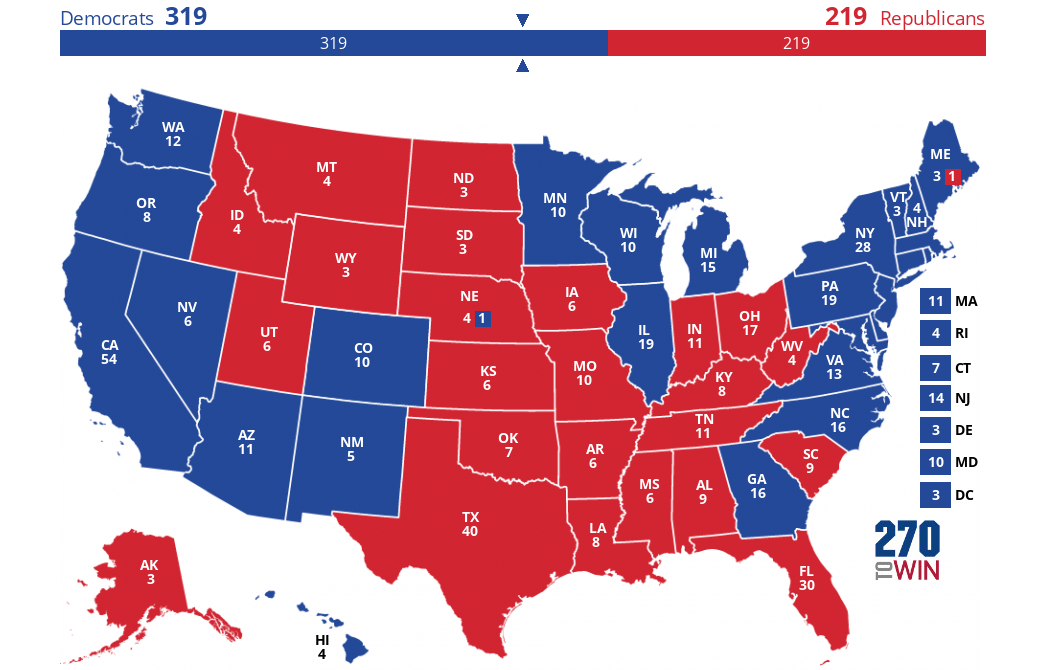
I like that map quite a bit, and I can see where they’re coming from. We’ve been talking this through for months, after all.
Let’s see what happens. It feels weird to leave it at that given the stakes – but that’s a very different conversation. Thank you all for reading. We’ll see you in the coming days.
(Thinking About) How To Think About The Presidential Race
I wanted to take this time before we get into our race ratings for the presidential contest to think through how I’m thinking about this election. It’s easy enough to look at a polling average in each state, but I see value in assessing where I think the campaign is going to go and why – what will account for the actual results, and any potential deviations from those state-by-state polls as they currently stand at the beginning of September?
Enthusiasm and the short campaign. Democratic fortunes were already imperiled by tepid enthusiasm – fair or not – for Joe Biden before his disastrous debate performance in late June. The turnaround since his departure from the race and the emergence of Kamala Harris as the party’s nominee has been striking. Gallup’s most recent polling finds that Democrats and Democratic-leaning independents are now notably more enthused to vote this year than Republicans and Republican-leaning independents – a stark reversal from March. Meanwhile, Tom Bonier at the progressive-aligned data and consulting firm TargetSmart has analyzed registration trends in 15 states (red, blue and swing) that have provided voter file updates since the candidate switch from Biden to Harris in late July. He finds remarkable surges in registration – especially in comparison to the same period in 2020 – with concentrations among women and particularly women of color. The spike in women’s percentage of new registrants looks similar to the one that followed the Dobbs ruling in 2022 (more on Dobbs in a moment). Will this be sustained? Consequential? I’m inclined to think so; I suspected there was more upside to a Kamala Harris candidacy than the chattering class presumed and these numbers (along with her polling improvement over Biden) are certainly confirming that prior. There are plenty of other factors that mitigate against my optimism and I’ll get into them below – but we have substantial data showing that the enthusiasm gap is now working in Democrats’ favor, and that has transformed this election. With a much shorter run-in, it’s not impossible to ride that momentum much of the way to the finish line.
The Dobbs Factor. The basic story is well-known to election analysts: the ruling that overturned Roe v. Wade also unleashed a fervor among pro-choice voters, leading to Democratic overperformance in special elections, the midterms, and state-level referenda. That electoral success makes sense: after all, a solid majority of Americans support legal abortion. But polling and focus groups shows that the basics of how Dobbs came to be elude some voters. Donald Trump promised to appoint judges who would overturn Roe. His appointed judges then, indeed, overturned Roe – a rare kept promise! And ever since, he has bragged about doing so. It’s his central pitch any time he addresses religious groups, particularly white Evangelicals. He constantly offers it up as a proud accomplishment. But some less-engaged voters are unclear on Trump’s positioning and actually associate this ruling with Joe Biden, since the court ruling occurred during his presidency (and perhaps because Biden was not the most impassioned or articulate defender of abortion rights; this is certainly an area where Kamala Harris has demonstrated greater effectiveness). Trump’s personal history as a womanizing rich guy from Manhattan, and his on-again, off-again attempts at softening Republican rhetoric on abortion, also contribute to confusion over the partisan dynamics at work and the stakes of this election when it comes to abortion rights. He spent the end of August confused and dissembling on how he’d vote in Florida’s referendum this November, or if he’d revoke access to mifepristone, struggling all the while to reassure abortion rights advocates and foes alike with how he’d approach the issue in a second term as president. All of which is to say: engaged and impassionate abortion rights supporters are plugged in and understand the state of play, but Democrats need to work on voters who are staunchly pro-choice but much less knowledgeable about the fundamental facts of American politics. If those voters think they can vote Trump and still protect individual freedoms when it comes to reproductive health, they’re not only mistaken – they could be decisive in the outcome. Can Democrats cut through the fog?
The Trump campaign’s focus on young men. In 1961, Barry Goldwater acknowledged that Republicans were unlikely to win back Black voters anytime soon and told a gathering of Georgia Republicans that they ought to “go hunting where the ducks are” – meaning conservative white Southerners who were wavering from their previous Democratic loyalties. Federal intervention to end segregation was shaking them loose from their longheld party ties and by the time Goldwater ran in ’64, they were increasingly ready to back a Republican for president (unlike the rest of the country: Goldwater won his home state of Arizona plus five Southern states, and lost the other 44 to Lyndon Johnson). Sixty years later, the Trump campaign has made clear that “hunting where the ducks are” means courting the votes of young men, including some who voted for Joe Biden in 2020. I have little to add to the story in terms of who these men are, what’s motivating them (though the story often involves a reaction to “wokeness” and the perceived “feminization” of the Democratic Party or society writ large) and how the Trump campaign is pursuing them. Quite a few media outlets, including the New York Times and Business Insider in just the last few days, have published pieces on these efforts. I readily acknowledge that this engagement is often happening through podcasts or MMA-focused shows that I rarely consume or encounter. To my eye, though, the Trump campaign is doing this deftly, and JD Vance’s daily unearthed utterances might even be a feature, not a bug. Some of these targets are infrequent voters, meaning pollsters attempting to model turnout might lack confidence they’ll actually show up to vote – which in turn means they might help Trump outperform his polling. I suspect they’re also the least likely people in American to answer a poll and if they do, the most likely to troll pollsters with their answers (look, I was a young man once myself!) The prospect of success in growing Trump’s vote share with younger males creates a higher ceiling for Trump and downballot Republicans, but as I discuss below, I’m not sure they raise the floor all that much.
A potential “last mile” problem for Republicans. I’m far from alone in thinking the Trump campaign is hunting where the ducks are in targeting young men across various ethnic backgrounds, and doing so in clever ways. I’m curious about how adept they’ll be at turning these young men from Trump-curious or even Trump-supporting into actual voters. My gut tells me that a great many of these potential voters have not spent a lot of time thinking about the mechanics of registration and voting; these guys come from the “too cool to think about that politics shit” crowd. To anyone reading this and therefore possessing some interest in political campaigns, it seems obvious that one must give a bit of thought to how to actually turn support for a candidate into a vote. But to people who think about politics in passing, there might be a lack of attention to civic basics. Combine that with the talk of the Trump/GOP focus on recruiting “election protection” volunteers and outsourcing their field and turnout operation to outside entities with little history of producing results and I’m left to wonder: are the Republicans ready to turn sporadic or new voters into reliable ones? In states with automatic vote registration, do some of these voters realize they’re registered? Is the Trump campaign finding these folks and talking through logistics? I suspect that the Democratic field operative’s focus on making a voting plan strikes them as quaint or intrusive. But it might come in handy, and I’m not sure the Trump campaign is mapping out an equivalent.
Democratic ground game versus Republican “election protection.” Pairing these concepts is not ideal from a rhetorical standpoint, insofar as the former represents the normal blocking and tackling of an election campaign while the latter takes on a more ominous aspect in this era of political violence in America. But as alluded to above, the Trump campaign is largely outsourcing turnout to unproven, grift-infused outfits that may or may not actually be skilled at getting GOP voters to the polls. After Lara Trump took over leadership of the Republican National Committee (RNC), her team ditched plans to open and staff 40 field offices in swing states. The Trump campaign’s focus, instead, is on the largest “election protection” effort yet seen, where they plan to have droves of people watching poll sites for signs of “fraud” or “theft.” Keep in mind that the RNC spent decades under a consent decree that stemmed from its violations of the Voting Rights Act through their Ballot Security Task Force‘s actions in the 1981 New Jersey governor’s race. After several amendments and renewals, the consent decree was ruled in January 2018 to have expired and would not be extended. That made 2020 the first presidential election since 1980 without the decree in place, and the RNC intended to mobilize 50,000 poll watchers for “ballot security” alongside the Trump campaign’s efforts to deploy an assortment of law enforcement official and military veterans for this purpose. Election turnout proved to be very high in 2020, and it’s unclear whether these efforts bore fruit – but more ballots than ever were cast via mail or drop boxes, making it harder to employ in-person intimidation tactics. As we return to a more “traditional” approach to this year’s election, will Republican efforts to “protect” the vote be more successful, or is this a dog that fails to bark?
The perils of polling. To be clear, polling is a public good. This is especially true in a huge and diverse country, where it’s valuable to get some sense of where the electorate stands on policy measures outside of campaigns. Even horserace polls have value: both for strategic voting and volunteering and, within reason, for setting expectations for outcomes that can serve as a check on illicit activity by election administrators. And most of the election-related polling is still pretty good despite myriad challenges posed by low response rates – there are sound statistical principles at work in quality survey research, and many public-facing pollsters employ those principles and offer valuable insights. Polling was pretty solid in 2018 and 2022 (with the exception of some partisan GOP pollsters who, whether due to poor assumptions or intentional malfeasance, spent the final weeks of the 2022 cycle depositing gobs of polls of low methodological quality which missed pretty badly on the final results). But now we’re back to a presidential year with Trump on the ballot, and pollsters struggled with those conditions in 2016 and 2020. That sets up some questions for us in 2024:
- Do we assume a repeat of presidential polling misses in the last two cycles (especially 2020)? Generally, there’s no correlation between the direction of polling misses from year to year; in 2012, for example, presidential polling underestimated Barack Obama’s fortunes (though Within the Margin was generally on the mark). But is there something specific about Trump’s presence on the ballot that confounds pollsters? Is there something specific to 2020? Nate Silver posited that pandemic protocols were more likely to be followed by Dem-leaning voters, meaning they were sitting at home more likely to answer a call from a pollster. That part, at least, should be removed from the equation this time around. I tend to think the thing to do is to operate with less certainty: all things being equal, I’d probably take a polling edge that points to a Likely Dem rating and move it to Lean Dem. If polling pointed to Tilt Dem (the closest pro-Dem forecast), does it then follow that I would shift to Tilt Rep? I’m not sure. Thinking that through in the coming weeks.
- Is polling properly capturing the magnitude of shifts toward Trump among non-white voters? This is a two-part question, really: first, are surveys and turnout models confounded by shifts among traditionally Democratic groups and second, are those difficulties magnified further when the movement is among non-college voters? Part of the issue facing pollsters in the Trump Era has been a difficulty capturing the realignment taking place along education lines.
- Are pollsters struggling with Arizona again? It might be unfair to say polling companies writ large “missed” here in 2022, as the high-quality pollsters like Marist and Fox News had Mark Kelly leading in the AZ Senate race. But the lower-quality pollsters that nonetheless were more accurate about Trump’s chances around the country in 2020 went on to perform disastrously up and down the ballot in 2022, and particularly Arizona where they kept finding sizable leads for Blake Masters (and smaller but consistent leads for Kari Lake in the AZ governor’s race). This is a state where I’ll probably lean even more heavily into the highly-rated, methodologically-transparent pollsters in 2024.
Pennsylvania’s downballot results in 2020. I’d say Pennsylvania’s recent election results are a three-part story: Working backwards: Republican midterm in 2022 hopes crash upon the rocky shoals of abysmal candidate recruitment. Dr. Oz loses the Senate election; rabid election denier Doug Mastriano is obliterated by Josh Shapiro in the race for governor. Two years earlier, “Scranton Joe” Biden narrowly wins back the Keystone State from Trump in 2020 by crushing him in the suburbs and yes, faring slightly better than Hillary Clinton in some of the former industrial territory that swung away from Dems for decades. The third piece? Republicans running quite well downballot statewide elections in 2020 even as Biden was carrying the state. Unheralded GOP candidates flipped the state auditor and treasurer positions and kept the attorney general race close. I think it’s dangerous to point to the Oz and Mastriano losses as signs of healthy Democratic performance downballot without looking at those treasurer and auditor wins for the Republicans. Is Trump fighting himself in Pennsylvania more than he’s fighting a propensity to elect Dems statewide? Does he simply have to match the performance of a replacement-level Republican? That’s a pretty low bar, with grim consequences for Democrats if that’s all he has to manage.
Palestine and campus protests. I’m not interested in using this platform to address the October 7 attacks, the war in Gaza, or the related protests. But a note about their impact on my thinking about this election is required. These events are especially complicated for the Democratic coalition and do not map perfectly onto a left-right spectrum within the party. It’s important to keep in mind that public polling shows a more nuanced picture of American thinking than many of the online discussions we encounter; Nate Silver broke down findings from several respectable pollsters back in May. Michigan and Minnesota stand out as states whose sizable Arab and/or Muslim populations could be particularly impactful if the hostility of some of these voters toward Joe Biden carries over to Kamala Harris. As for the protests, the media class made clear their hunger for a 1968 redux at the Democratic National Convention in Chicago, seemingly rooting for blood in the streets. But it did not come to pass. Whether the fall semester brings a return of the angry convulsions seen on a relatively small percentage of campuses in the spring remains to be seen, as does the degree to the Harris and Trump campaigns are asked to weigh in on the tone of those protests, the police response, and so forth. My starting assumption is that they will not play a major role down the stretch; I would also suggest, though, that Trump is desperate for chaos in Gaza and unrest in America. The degree to which Benjamin Netanyahu and his government can or would contribute to that in some fashion is worth contemplating, but is such a tangled web that it can only impact my thinking so much.
Trump Surrenders Virginia
It’s not quite Appomattox Court House, but…
In 2004, I was desperate for Democrats to expand the electoral map – at that point, the institutional advantages in the Electoral College clearly favored the Republicans. Further, the most recent reapportionment meant that simply winning the Gore 2000 states would actually leave Kerry further behind. Of all the Bush 2000 states, only New Hampshire (which Kerry ultimately did recapture) showed consistent signs of flipping in 2004…and those four electoral votes would not longer be enough to win the election, as they would have been in 2000. So I spent the year rooting for Kerry to fight hard in places like Colorado, Nevada and Virginia.
He opted for the first two and fell short; to my dismay (and that of John Edwards, unpleasant though it is to agree with him on any element of human existence) the Kerry campaign never seriously competed in Virginia. I saw it as a missed opportunity: Fairfax County and the other northern suburbs were rapidly trending blue and at that time, southwest Virginia’s coal country was not so virulently anti-Democratic as it is today. Throw in some Democratic strongholds in Southside Virginia and Hampton Roads, and there seemed to be the makings of a viable coalition. But they didn’t pursue it, and Bush won the state comfortably.
Four years later, Obama was always going to compete in the Commonwealth, and indeed he won pretty comfortably in the end: 52.6%-46.3%. He crushed it in the NoVA ‘burbs, including the first Democratic presidential victories in Loudoun County (the northwest suburbs and exurbs along the banks of the Potomac, going out toward Harper’s Ferry) and Prince William County (the southern ‘burbs including Manassas and the Quantico area) since 1964. 2012 saw a narrowing of the margins, but Obama still won his old and new strongholds and carried the state 51-47.
And now, just twelve years after Democrats weren’t ready to compete there when they urgently needed to remake the map, Hillary Clinton’s position in Virginia is now so strong that NBC News reports that Trump is bailing on the state. The decision appears to be borne out of a strategy to concentrate resources on four states – Florida, North Carolina, Ohio and Pennsylvania) that get past 270 electoral votes. Presumably, Trump is banking on Iowa, as his leads in that Obama ’08 and ’12 state have been durable – but those four states, plus holding Romney’s 2012 territory, puts him at 273, so Iowa would be gravy.
This doesn’t seem like a viable strategy just now – most Pennsylvania polls have him trailing by high single- or low double-digits. But no plan looks great when you’re down as much as Trump is less than four weeks out. Clinton will now be able to shift Virginia resources elsewhere, too, either to bolster defenses in Trump’s dwindling targets or to expand the map into places like Arizona and Georgia where the campaign has at times been hopeful of triumphing for the first time since the 1990s.
It also remains to be seen how accurate this initial reporting is: Trump has been pursuing Colorado aggressively, so a pullback there would be abrupt and dramatic. And it would leave this kid with less to do.
Things evolve quickly in presidential election politics. What was a safe Republican state in the Bush years has become, for the moment, a safe Democratic state.
 Within the Margin