Archive
House Race Capsules: The Southwest
This is a region replete with competitive and impactful races up and down the ballot, from goverbors to secretaries of state to Congress and the state legislatures.
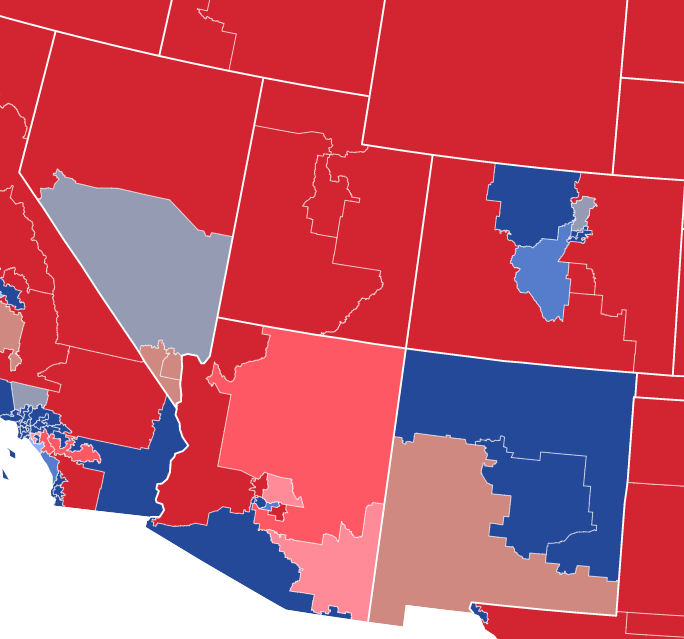
Let’s break the race for Congress down state by state.
Read more…Enchanting, but far-fetched
The political week kicked off Monday with a Trump rally in New Mexico, reflecting the view of the president’s campaign that they can put the Land of Enchantment’s five electoral votes in play for 2020. Listen, I’m all for campaigns playing on a big map, and obviously states can shift quite a bit in four years. But is New Mexico really in play?
The idea apparently stems from a Trump rally in El Paso earlier this year, where campaign staffers noted lots of folks from New Mexico crossing into Texas to attend. It’s important to note at the outset, though, that many of the counties close to the Texas border are among the state’s more Republican places. For example, the stretch of high plains in the southeastern part of the state is known as “Little Texas” and is the most conservative section of the state. Doña Ana County is the exception; it’s right across from El Paso and includes the university town of Las Cruces. Things get red in a hurry in each direction beyond Doña Ana, though, with Trump exceeding 59% of the vote in each southeastern NM county and even topping 70% in Lea County, in the extreme southeast corner. We’d expect some of these folks to journey to the closest Trump rally to hit the region in years.
Axios offered some commentary from the RNC and a NM political expert on why a win there might be achievable for Trump, and their arguments are reasonable: the state is faring well economically after an extended downturn, New Mexico Democrats are somewhat more socially conservative than their national counterparts, and so on. I would add that registration trends in NM are not as strong for Dems as elsewhere – both parties are losing ground to independents, and the Democratic lead over Republicans in total registrants is slightly smaller than it was in 2016. Further, while Clinton carried the state by eight points (48%-40%) in 2016, and Obama carried it by double-digits in his two runs, we don’t have to look to ancient history to find a Republican winning New Mexico. George W. Bush very narrowly captured it in 2004, the last time that Republicans really contested the state in a presidential race. Susana Martinez was then elected governor twice – though in GOP-friendly years, and she wore out her welcome as evidenced by plummeting approval ratings by the end of her second term in 2018.
The 2016 race also featured a unique factor in that former Republican governor Gary Johnson -running as the Libertarian nominee – performed better in his home state than the other 49, getting a little over 9%. Some would argue that a Republican nominee would more often be the second choice for Libertarians, making them gettable for Trump with Johnson out of the picture, but that breaks down somewhat in the age of said president. Some of those Johnson voters are not going to be any persuaded by Trump’s first term than by the campaign that preceded it; some were Libertarian true believers who will vote for whoever the party puts up in any given year; and others can be expected to avoid the major parties again as some third party voters are quite attached to that element of their political identity (or lack thereof, I suppose). In other words, converting all of those voters to Trump supporters will not be easy, meaning the president’s re-election campaign has to flip Dems and identify voters who sat out 2016 (though the latter group tends toward left-leaning views, according to a 2018 WaPo analysis based in turn on Pew’s research into verified voters).
As for that 2004 race, Bush triumphed by 5,988 votes, or 0.79%. John Kerry was arguably not well suited to turn out working class Hispanic and Native American voters, though turnout was significantly higher than four years earlier when Gore squeaked by with a 366-vote victory (NM was one of Ralph Nader’s best states, so minor party voters made that awfully close). In 2008, with Bush gone and Obama successfully ramping up turnout among all segments of the population, NM was a foregone conclusion. Romney and Trump would not make a push, either.
The final factor leading me to just about dismiss the idea of Trump being competitive in NM this cycle is the 2018 midterms. It’s not that Democrats swept the statewide races, and generally by landslide margins, while also picking up six seats in the state House of Representatives to approach supermajority status in both houses of the legislature. We largely expected that as a reaction to Trump/GOP rule in Washington. It’s that Democrats flipped NM-2, by far the reddest of the state’s three Congressional districts. NM-2 is the southern half of the state, including much of aforementioned Little Texas as well as Las Cruces, White Sands, Gila National Forest, Alamagordo and the delightfully-named Truth or Consequences.
Romney had carried it 52%-45%; Trump 50%-40%. It’s a seat that last went blue in the 2008 Obama landslide and immediately flipped back two years later. An icing-on-the-cake seat, in other words; one Democrats win in their very best years. Asking Republicans to change the environment from one where Democrats are winning NM-2 to one in which the GOP is winning the entire state in just two years is a big ask. They did it in the 2010 midterms, but that was the reddest election cycle in more than half a century. If it was happening again, we’d probably be seeing the effects already. Instead, Democrats continue to lead the generic ballot for control of Congress by a margin only slightly less than last year’s actual vote. Leading Democratic presidential contenders continue to lead Trump nationally. Trump’s approval rating remains mired at similar levels to 2018. In other words, the environment is not yet changing from one where Republicans lose the reddest third of New Mexico to one where they are cutting into the typical Democratic advantage in the bluer parts of the state.
All of the usual caveats apply, as a lot can happen between now and November 3, 2020. But a whole lot needs to happen for this week’s bluster about winning New Mexico to be anything more than that – bluster from a campaign whose best bet is likely to fight like hell to hold onto the states they flipped in 2016.
 Within the Margin