Archive
Cornhusker Considerations
Nebraska has a pair of U.S. Senate elections this year…and one of them is looking competitive. That’s typically not the case for statewide elections in Nebraska, of course. Quick background: there’s a special election to fill the seat Ben Sasse vacated to engage in an 17-month grift on behalf of himself and his friends as president of the University of Florida. Former governor Pete Ricketts, Sasse’s appointed successor, is expected to easily win that race and serve out the rest of Sasse’s term through 2026. But there’s also the regularly-scheduled Senate election, where two-term GOP incumbent Deb Fischer appears to be in a spot of trouble against independent Dan Osborn. We’ve seen a version of this movie play out before, where the plucky independent candidate polls well against a not-especially-popular Republican incumbent on the Great Plains before partisanship catches up and the Republican pulls away. That’s probably what will happen here…but it’s worth considering both the past example, and why this case might be different.
First, who are the players this time around? Deb Fischer was first elected in 2012, when Democrat Ben Nelson retired after winning, remarkably, three Senate terms. She was a rancher and state legislator from the state’s beautiful Sandhills region. The Democratic nominee that year was Nelson’s predecessor, Bob Kerrey – once a prominent national figure with a moderate reputation. Kerrey was a decorated veteran who lost part of his leg in Vietnam; he was twice elected governor and then won two Senate terms. Along the way, he ran for president in 1992, winning one primary in neighboring South Dakota. After his Senate tenure, Kerrey moved east to become president of The New School. It is a prestigious academic post, to be sure – but a decade in Greenwich Village is generally not what Nebraska’s electorate is seeking. A few polls showed Kerrey close in mid-to-late October (WTM spotlighted this at the time with a rating adjustment) but Fischer ultimately won by the comfortable margin of 57.8%-42.2%. She was easily re-elected in 2018, getting 57.7 against an unheralded and underfunded challenger – not quite as dominant as one might expect for a Nebraska Republican in a statewide race, but it was a blue wave year. She’s a rank-and-file conservative senator not known for making waves at home or in Washington.
Her 2024 challenger, Dan Osborn, is a former Democrat who became an independent in 2016. Osborn served in the Navy as an enlisted man, then in the Nebraska Army National Guard. An industrial mechanic who rose to become president of his Bakery, Confectionary, Tobacco Workers and Grain Millers International Union local, he led the strike at the Kellogg’s Omaha plant in 2021 (part of a nationwide strike against Kellogg’s over pay tiers, benefits, and cost-of-living adjustments). Kellogg’s later fired him for watching Netflix at work – a claim Osborn disputes. He’s now an apprentice in the steamfitters’ union and a first-time candidate for public office. There’s some question over whether he pursued the Nebraska Democratic Party’s support for his Senate run, but regardless of that he collected the signatures necessary to appear on the general election ballot as an independent while Democratic efforts to recruit another candidate did not bear fruit. In terms of his platform, Osborn is sometimes light on details but generally tracks as a centrist or slightly center-left: opposed to federal limits on abortion; pro-Second Amendment but favoring “reasonable gun safety measures;” guaranteed Right to Repair for farm equipment, cars and electronics; securing the border from illegal immigration; lower taxes on overtime wages; supporting the PRO Act to battle anti-union measures.
That brings us to this spring and summer, when a series of polls have shown a close race. The Democratic firm Public Policy Polling found Fischer up 37-33 in late April. A July poll conducted jointly by Democratic and Republican firms reported a 42-42 tie. Finally, last week SurveyUSA released a poll showing Fischer ahead 39-38. Of note, Fischer released a poll she commissioned in July showing her obliterating Osborn 2:1…but if we’re talking internals, we have to note that an Osborn-sponsored YouGov poll in early August showed a two-point race.
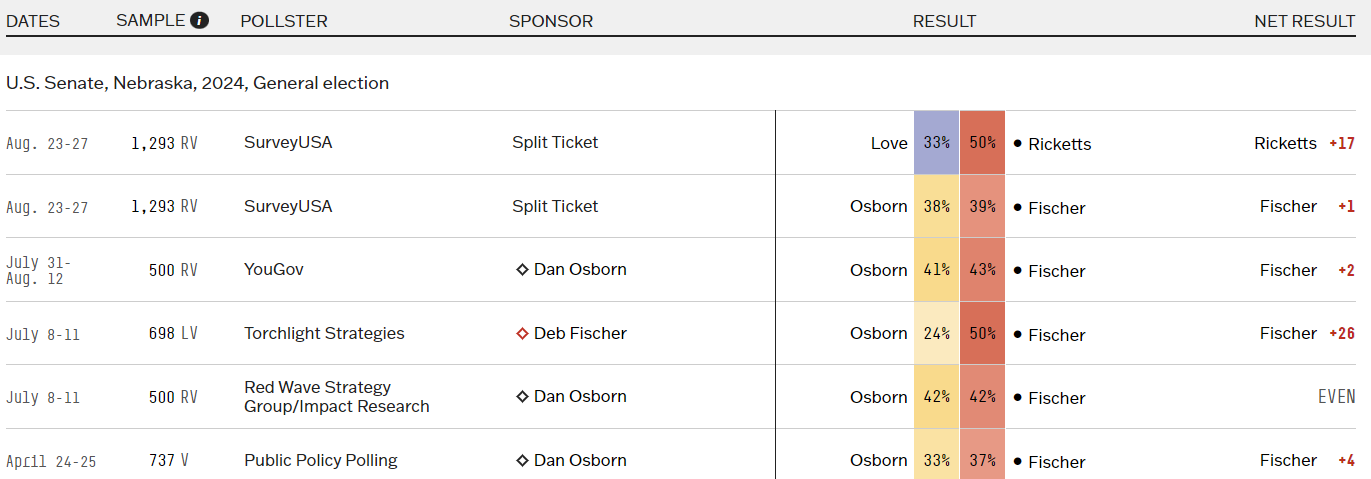
What are we to do with these numbers? Is a Republican in danger of losing a Senate seat to an independent – a largely Dem-aligned independent, no less? It might be useful to look at a similar contest – albeit from a decade ago – and evaluate similarities and differences.
In 2014, incumbent Republican senator Pat Roberts was seeking his third term in Kansas. The problem was, he wasn’t in Kansas very much. And he didn’t live in Kansas – at all. He resided inside the Beltway in Alexandria, Virginia and did not own a home in the Sunflower State. Two years earlier, a similar situation had led to the downfall of Indiana senator Richard Lugar, a six-term senator highly regarded on both sides of the aisle. But he was also a man without an Indiana address and facing a Tea Party-style challenge in the GOP primary. He lost to state treasurer Richard Mourdock, who went on to lose the general election to Democrat Joe Donnelly. In ’14, Roberts faced several primary challengers. Most notable was Milton Wolf, a radiologist with the bizarre habit of posting x-rays of his dead patients on the internet. Roberts won, but with only 48% of the vote. Wolf took 41%. Meanwhile, independent businessman Greg Orman was gaining traction. He had briefly run in the 2008 Democratic primary for the seat but dropped out after determining he could not take some of the positions necessary to win the nomination. Now, standing as an independent, Orman had bypassed the primary and was running a reasonably well-funded effort. Polling after the August GOP primary showed Roberts in trouble: he was polling in the low 30s in a three-way race against Orman and Democratic attorney Chad Taylor. Senate GOP strategists began to sound the alarm: Roberts didn’t have much of a campaign going to turn these numbers around and as the primary demonstrated, lacked grassroots support as well.
Two things happened in early September: Taylor dropped out of the contest and Roberts acceded to demands to shake up his campaign staff – and himself – and run a real race. With Orman now picking up some of Taylor’s support, most September polling showed him opening up a lead and even approaching 50%. The race narrowed in October, with Roberts encamped in a Kansas hotel as his campaign base instead of his actual home in, you know, Not Kansas. Election coverage increasingly focused on who Orman would caucus with in the Senate if elected. He indicated he’d go with whoever had the majority; if he was the tiebreaking vote, he’d allow both caucuses to seek his support for the opening months of the term by committing to certain positions on his priority issues.
At the end of the day, though, Kansas is a Republican state. Roberts just needed to hold on to most of the people who’d generally prefer a Republican senate majority. Nonetheless, Orman led more often than not in polls all the way up to the election in November – but these were close margins, effectively ties. And we know that independent and third-party candidates tend to underperform their polling when the votes are actually counted. In a year that turned out even redder than expected, Kansas’ Republican leanings were enough and the state re-elected Roberts by a double-digit margin, 53%-43%. Orman performed well relative to the baseline for a de facto Democratic candidate, but not nearly well enough.
So we’d expect Osborn to fade, too, right? Fischer is not a worldbeater but she doesn’t have the same glaring vulnerabilities as Roberts had. Osborn’s going to get the caucus question too, and Republican voters will decide to skip that uncertainty and just go with the Republican, and Osborn will end up short of his final polling numbers anyhow…right? Probably, yeah. But he might have more room to hedge on caucusing than Orman did in 2014, given the uncertainty over who the Republican Senate leader will even be come January. Mitch McConnell is retiring, and Rick Scott, a slew of guys named John and presumably Johnny 99 are all seeking the post. And unlike Kansas in 2014, this year’s ballot allows Nebraskans to vote for a Republican for Senate anyway…and still elect an independent. That’s because there’s also the aforementioned special election, featuring a normal R vs D matchup. Would a critical mass split their ticket in this way? Voters aren’t uniformly thinking in terms of control of a given Washington deliberative body. If your focus is electing a GOP Senate majority, then no, of course. But if you’re indie-curious, unattached to the undistinguished Fischer, and not overly concerned with the national battle for the Senate, then maybe. I can make an argument, therefore, for a closer finish than that 2014 Kansas race.
In any other situation, three polls in a row averaging out to less than a two-point lead would yield a Tilt or Toss-up rating. When it involves an independent candidate – and some decent pollsters, but none of the gold-standard firms – there’s a tendency to ignore it. Right now, each of the major predictors has the race in their safest Republican category. I think we have reason to hedge that, and my guess is that we’ll open with a Likely (but not Safe) Republican label for this one when we publish Senate ratings in the coming weeks.
House Race Capsules: Great Plains and Upper Midwest
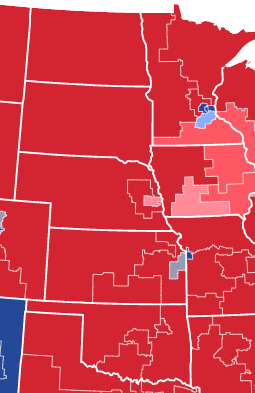
There’s a handful of competitive races across this sprawling landscape, even with the Dakotas completely falling off the competitive map – at least in terms of major-party tussles – for the time being. Let’s start zoomed-out:
And below we go state-by-state.
Read more…The Nebraska First Special Is Worth Keeping In Mind
Earlier this month, I attended a We Won’t Go Back March in Poughkeepsie, NY. At its conclusion we heard from quite a few local electeds, candidates, activists and community members. Among them was Pat Ryan, county executive in Ulster County across the river – and candidate in the upcoming (August 23) special election for New York’s 19th Congressional District. The 19th – my home for the last 14 years and my neighboring district before that – is very swingy district, with Democrats flipping it in 2018 and Republicans hellbent on taking it back this year. Pat naturally made reference to the special election during a brief and focused speech that read the parade and rally audience reasonably well. He noted that it is the only remaining Congressional special election following the Dobbs ruling that overturned Roe v. Wade and before the November general election. The outcome will be picked apart, analyzed and weaponized: will it show Republicans marching inexorably toward retaking the House of Representatives majority? Or will it upend the narrative by showing Democrats mobilizing in a post-Roe world, and perhaps indicate that some voters who were leaning toward the usual midterm behavior of punishing the party in the White House are changing course in reaction to the Supreme Court’s far-right supermajority?
But it is important to note that the election in NY-19 is not the only Congressional special election between Dobbs and November: there are several others, and we actually already had one in late June, days after the ruling and largely out of the national spotlight. It was in Nebraska’s 1st Congressional District, the updated lines of which continue to contain the capital city of Lincoln (the state’s second-largest, with 291,082 people), along with the fast-growing Omaha suburbs of Bellevue (featuring a population of 64,176, making it the third-largest city in Nebraska) and Papillion (24,159), Offutt Air Force Base, several smaller cities beyond the Omaha metro area such as Columbus, Fremont and Norfolk, and several very rural counties (Butler, Cass, Colfax, Cuming, Seward, Stanton and part of Polk), some with populations below 10,000. It’s worth noting an oddity in this election: it was held on the new lines for NE-1, even though the special election is for the final months of the current term – meaning the winner, Mike Flood, will be representing people who couldn’t vote for him, and tens of thousands of people who could vote for him won’t be represented by him. It’s hard to imagine this is a remotely constitutional arrangement.
It was also hard to imagine the election being particularly close: as drawn, the new NE-1 is a little bit bluer than the old version, thanks to some land swaps by Nebraska’s Republican-dominated legislature to make NE-2 redder (that’s the one Democrats occasionally carry in presidential and Congressional races). But it’s still safely Republican under most circumstances; it voted 54%-43% for Trump over Biden in 2020. Lincoln (and Lancaster County) is something of a Democratic outpost thanks to the presence of the University of Nebraska and its government workforce and high education attainment levels. But it doesn’t vote Dem by landslide margins, and is comfortably outvoted by the much redder counties around it. Those suburban pieces of Sarpy County mentioned above are trending blue but aren’t quite there yet. Like many military posts, Offutt AFB trended hard away from Trump in 2020, but it still voted narrowly for him. One can see the pieces coming together for NE-1 to be more competitive in a decade…but we wouldn’t have expected it to be particularly close this time around, especially in a political environment that had trended toward the GOP all year.
And yet…it was pretty close. Republican candidate Mike Flood won by 5.4% (52.7% to 47.3%) in this district that, as noted above, would have voted for Trump by 11 points if we overlay the 2020 results onto its new configuration. Overperforming a district’s partisanship by almost six points is no small feat when you’re the party in power in DC; special elections typically see the out-of-power party overperforming instead. The Democratic candidate, Senator Patty Pansing Brooks of the Nebraska unicameral legislature, was dominant in Lincoln’s Lancaster County, leading the Republican nominee – fellow Senator Mike Flood – by just over 10,000 votes, or 14%. This strikes me as notable given that this was a summertime election, meaning the University of Nebraska and its massive student population were largely away from campus for the summer and less likely to be voting in this election. Flood carried each of the remaining counties, with Sarpy the closest as we’d expect. Brooks would need to carry Sarpy handily to win the November rematch; she probably also needs to cut his margins in the rural counties where he generally exceeded 80% of the vote.
Not a win, which would have upended the political landscape, this seat has been held by Republicans since 1966 – but a stunning performance nonetheless. Was this a product of Democratic voters charging to the polls following the Dobbs ruling a few days earlier? Is it an interesting portent of renewed Democratic enthusiasm despite the myriad challenges currently facing the party in power (however narrowly) in Washington? It’s only one data point so we should avoid drawing conclusions; it’s possible it was simply anomalous – a summertime election in a district whose voters are not accustomed to competitive Congressional elections in the first place. It’s possible Dobbs was a factor but will be swallowed by other factors as the year goes on. The next opportunity to learn more will be August 23, when Democrats attempt to hold onto the more traditional swing territory of NY-19.
 Within the Margin