Archive
About those priors…
On Monday night, I posted some thoughts to make sure they were recorded for posterity before events overtook us and I semiconsciously retconned my priors to match. I approached the exercise with circumspect caution: positive portents abounded in the national polling, the data out of early voting in several states pointed to reasonably strong Democratic engagement levels, and local vibes were good in my homeland of Dutchess County, NY with all its competitive town and county elections. But we just didn’t know enough yet when I wrote those thoughts up. I couldn’t be sure that the national tide had truly shifted, that Black and Latino voters were starting to come back, that the reluctant Trump voters who backed him in ’24 because of cost of living concerns would pivot away from the party that has failed to address them despite unfettered control of the federal government (and here in Dutchess, control of most of county government). I couldn’t be sure that the “Mamdani Effect” that has re-engaged younger voters would overcome the corresponding fearmongering campaigns throughout the country but especially in the Hudson Valley, where the GOP sure seemed to think he was on the ballot in places besides NYC. Funny how they’re quick to condemn people for voting against Trump in local races, though.
So with all that in mind, I offered some tempered optimism: an 8-10 point win for Abigail Spanberger in Virginia with narrow wins for Ghazala Hashmi (lieutenant governor) and Jay Jones (attorney general) but uncertainty about how many House of Delegates seats she’d pull along with her; a 4-5 point win for Mikie Sherill in New Jersey; and juju-proof vagaries in Dutchess County.
Well, Democrats exceeded those expectations, and then some. Spanberger’s winning margin stands at 14.8% for the largest blowout in a Virginia gubernatorial since 2009. Polls close awfully early in Virginia, so the race was called even before Democrats in New York gathered for results watch parties that featured a a newly optimistic tenor. Hashmi and Jones won comfortably, too – however unfortunate that may be, in the latter case.1 In New Jersey, Sherill ran well ahead of most polling for a 13.5% margin of triumph.
Democratic successes were abundant downballot as well. They exceeded even the rosiest expectations for the Virginia House of Delegates, picking up 13 GOP-held seats to grow a 51-49 majority to 64-36, the largest Democratic majority in the Commonwealth since the 1987 elections. In New Jersey, Democrats have flipped three Assembly seats but Republicans concede that two more losses are likely. That’ll bring Dems to at least a 57-23 majority, the largest for either party since the GOP’s 58-seat win in 1991.
In Pennsylvania, where three Democratic justices on the state Supreme Court faced a retention vote, each passed the rest with flying colors – over 61% of Pennsylvania voters opted to retain all three justices. They carried the day in the usual Pennsylvania swing counties like Bucks and Erie, but elsewhere, too. Beaver, Fayette and Westmoreland counties spent decades as mighty Democratic strongholds in southwest PA before moving slowly to the GOP in the 1990s and 2000s, and sharply in the 2010s. But they supported all three Democrats for retention. Blue-trending Cumberland in the south-central portion of the state did, too – a result unthinkable 20 years ago. Luzerne County, home to Wilkes-Barre and Hazleton in the Anthracite Kingdom of northeastern PA, is often used to depict eroding Dem fortunes among working-class voters in the age of Trump. It, too, supported all three Dems. The red-for-decades Columbia, Montour and Union in the Susquehanna Valley? All three. Pike County on the NY border, which has neither an ancestral Dem heritage nor a notable recent trend toward Dems? All three. York County voted to retain two of them and Yes (retain) trails by only 20 votes for the third (David Wecht). Even Northumberland County – where Democrats are a half-century removed from their heyday – supported retention for one of the three.
The downballot triumphs in Pennsylvania are too numerous to list, but highlights include flipping the sheriff and district attorney positions in swingy Bucks County – the latter for the first time since the 1800s. Bucks was ground zero for Moms for Liberty victories in 2021; they were wiped out this time around. Clearfield County gave Trump 75% of its vote a year ago, but Democrat Josh Maines flipped a county court judgeship – beating the incumbent Republican district attorney for good measure. The small borough of Beaver went deep-red even when the surrounding county of the same name was a Democratic stronghold; it last voted for a Democratic presidential nominee in 1912. It had an unbroken streak of Republican mayors dating to World War II. Well, that streak is broken.
To bring it home, I’ll note that in Dutchess County – where I hedged mightily despite increasing signs for optimism as the election drew to a close – Democrats had the strongest night in the party’s history. There have been great federal and state elections before for Dutchess Dems, but in county races, nothing like this. I’ll be writing in more detail in a future post, but Dems held the Comptroller position and flipped a county court judgeship – by margins not previously seen for Democrats in countywide offices. And they decisively flipped the county legislature, last held by Dems in 2008-09, along with a dozen and a half town-level seats.
I was too cautious, it turns out – Democrats won, they won bigger and more widely than both the polls and the incorrigible optimists foresaw, and they did it both via increased turnout over similar contests in previous years and, as Nate Cohn notes at the New York Times, by flipping 2024 Trump voters. What a night. More to come from me on these happenings.
- I rarely vote for a Republican, but I would have in the Virginia AG race because I simply do not believe Jay Jones can hold a law enforcement position with any credibility with his history of graphic, violent texts. I understand all the counter-arguments; I also disagree with them. ↩︎
House Race Capsules: New York
Let’s get a look at the final forecast map before breaking down the competitive races:
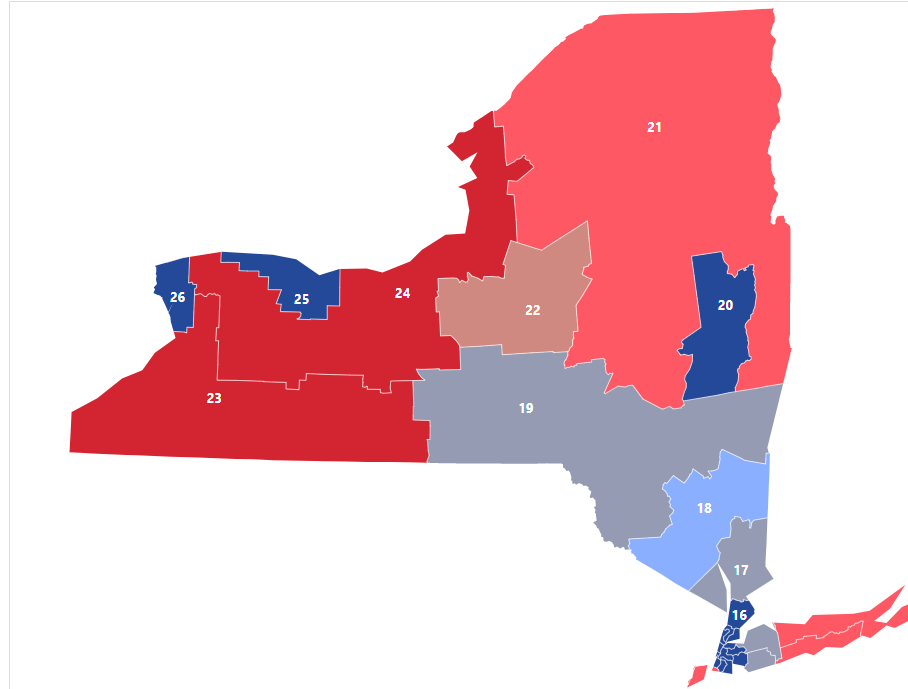
Next, we’ll go district-by-district for the competitive seats.
Read more…Drawing the Lines: The New 63rd District
This is part of our Drawing the Lines series, in which we focus on New York’s new Assembly, Senate and Congressional lines – how they’ll impact the makeup of each chamber, and how that impacts policy at the state – and perhaps federal – level.
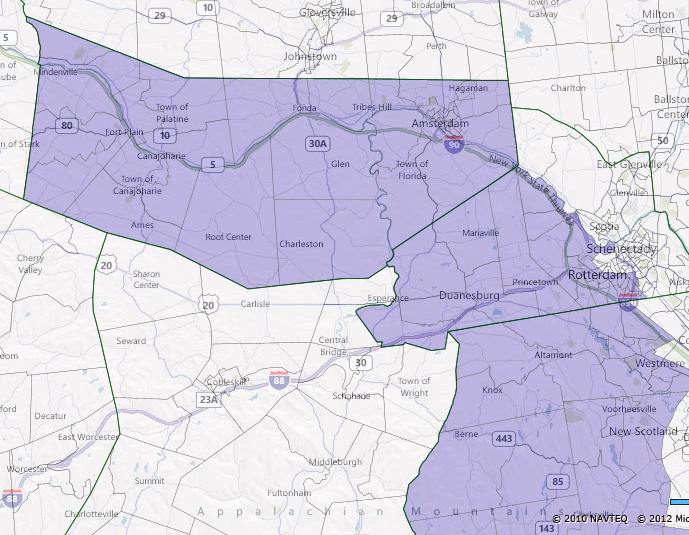
We haven’t yet seen the first draft of new state legislative maps out of Albany, but we know they’re coming soon. Jimmy Vielkind wrote last night about the proposed 63rd State Senate district – notable because it represents a controversial increase in the size of that body, and because its purpose would be to strengthen the GOP’s narrow (32-29 with one previously-Democratic vacancy in Brooklyn) hold on the chamber. Vielkind’s source in state government indicated the new district would be carved out of the capital region, though it’s best described as a hybrid that also draws from the Hudson Valley and Catskills.
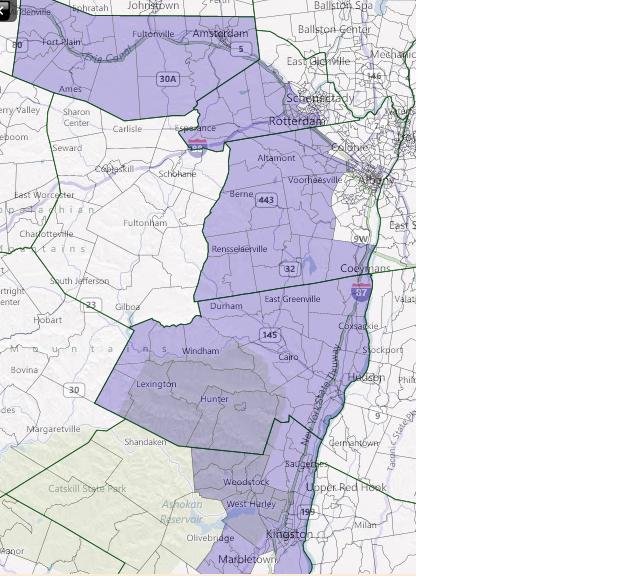
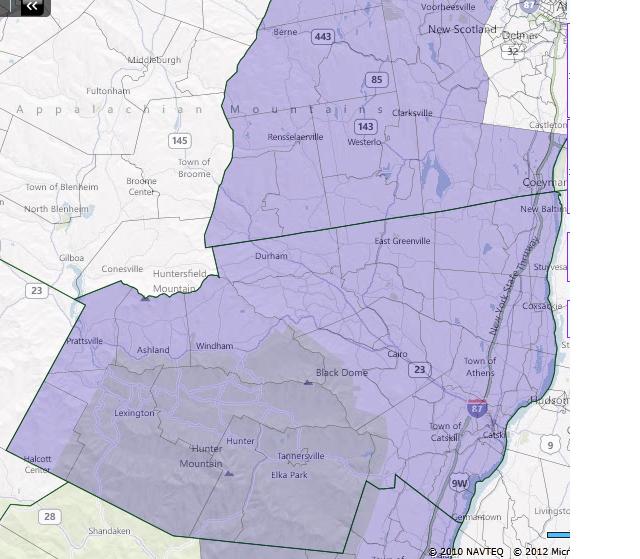
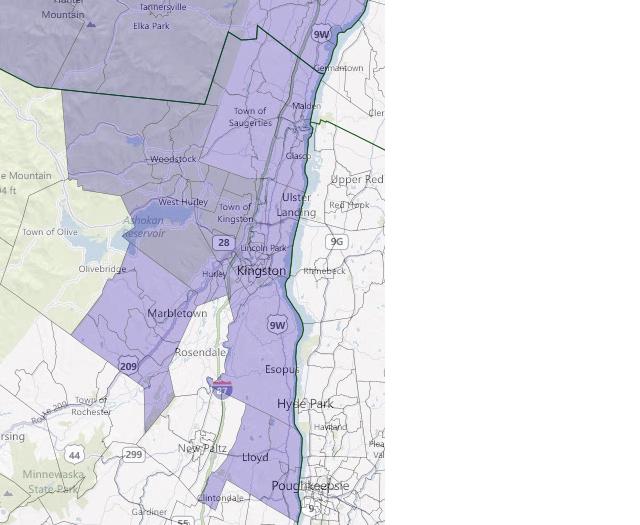
I have also uploaded close-ups of the upper, middle and lower portions of the proposed district.
In terms of aesthetics, it’s not a monstrosity: a bit long, but not particularly tortured or serpentine. It’s a stretch to say that Amsterdam and the Schenectady area have much to do with Kingston, but the NYS Thruway does serve as a common thread. Regardless, Republicans aren’t seeking awards for clean maps that preserve communities of interest: they want to pick up a free seat.
To that end, how good a job did they do here? If indeed the district Vielkind provides is the district we’ll see, call it a “Likely Republican” seat for now. Using DRA, it looks like a 53.5% Obama district (I didn’t include the sliver of Schenectady, but it’s only supposed to be about 1,000 people, and that won’t impact the 2008 presidential results much). That compares to 44.7% for McCain. As I (and others) have referenced before, that’s a pretty good district for Democrats on the federal level, but not so much in the New York state legislature. Democrats have rarely won any of the current districts that didn’t push a 58%-60% performance for Obama in 2008.
Looking into the individual components of the district, Montgomery County has been trending away from Democrats for a long time – Dukakis won it despite barely carrying New York in 1988, but McCain won it by 8 points in 2008. Obama barely improved upon Kerry’s performance there, a trend seen in several of of upstate’s older industrial cities. Andrew Cuomo barely beat Carl Paladino in Montgomery in the 2010 gubernatorial race. The district features some bluish Albany suburbs, connected to Montgomery by a small (and basically red) piece of Schenectady County. Further south, Greene County sees the occasional Democratic success at the town level and a few Democratic county legislators but is mostly Republican at all levels of government – Cuomo edged out Paladino by fewer than 400 votes – and has provided its current senator (Jim Seward of the 51st district) with comfortable margins during the last decade.
But then the district enters Ulster County, picking up Saugerties and Kingston and running all the way down the river to Lloyd (Highland) while also going inland for some Catskill communities. For me, this is the most interesting piece – because it means I live 10 minutes across the Kingston-Rhinecliff Bridge from the proposed district, and because of the rippling effects created across the western Hudson Valley’s senate districts. By grabbing strongly-Democratic areas like Kingston, Hurley, Marbletown and Woodstock, the proposed 63rd actually does feature a Democratic bench and organization. Presumably state Republicans are assuming that those liberal bastions won’t produce a candidate palatable further north, and there’s some validity to that. And Ulster is not monolithically Democratic by any stretch; Republicans control the county legislature and most town governments, even in the mountain towns. But Democratic Ulster County executive Mike Hein is riding high at the moment after running unopposed for a second term in 2011. Ulster Democrats right now are sorting through who the potential successor to retiring Congressman Maurice Hinchey will be, but they have enough people with experience and ambition that I wouldn’t be shocked if an Ulster Dem takes a shot at this race.
Republicans are said to already have their candidate in place, as Assemblyman George Amedore is expected to run. The Rotterdam resident won the 105th Assembly district in a 2007 special election and has been re-elected twice by comfortable margins. His campaigns have been well-financed and he would be expected to perform very strongly in his Montgomery and Schenectady base. Greene is a given for Amedore, even if they’ve not heard of him before he announces his bid. A Democratic opponent would need a very strong showing in Ulster and in the Albany suburbs.
That last bit might be the wild card here: for at least the last two decades, the entirety of Albany County has comprised its own senate district. This new district would carve the county into two pieces, with Senator Neil Breslin (currently of the 46th) seeing his district push across the river into Rensselaer County. While voters consistently tell pollsters they’re upset about gerrymandering, are they attached enough to Breslin that they’ll cast voters in large numbers against the party that cleaves him from the western section of Albany County? Breslin has faced primary challengers each of the last two cycles and lost the support of the Albany County Democratic Party in 2010. And will Democrats lose some votes as the advantage of incumbency disappears and they build their candidate’s name recognition from scratch?
Meanwhile, as I alluded above, nothing in redistricting happens in a vacuum. The Ulster portions of this district are being removed from Bill Larkin’s 39th and John Bonacic’s 42nd districts. Bonacic has occasionally been a Democratic target as his district leans Democratic, so these changes benefit him by removing blue sections from his turf. I could see a scenario in which Schoharie County replaces the territory lost to get it back up to population minimums, further securing his place. As for Larkin, he turns 84 next month. He’s taking one last shot before retiring in 2014, so Republicans would probably like to shore up that district. Removing Kingston and replacing it with Warwick (from David Carlucci’s overpopulated district) seems like a good way to do that.
In sum, Republicans have likely gained a seat here while better securing two others, but they’ve hardly assembled a rock-ribbed conservative district. It will likely be one of the better places for Democrats to play offense this year.
 Within the Margin