State of Play: Delaware
The First State offers a dearth of state or federal electoral competition these days, with Democrats dominating to a greater extent than presidential results would lead one to assume. The state GOP is moribund, seemingly unable to recruit competitively. They lost their last two statewide offices, Treasurer and Auditor, in the 2018 Democratic wave. In 2022, Democrats tended to struggle in much bluer strongholds (like California and New York, while performing quite well in purple states) but the races in Delaware for Attorney General, Treasurer and Auditor all yielded solid eight-point Democratic wins, while the lone federal race on the ballot was a twelve-point Democratic victory. Further downballot, Republicans lost another seat in the state senate: where once they were tied 10-10 with a shot to flip the chamber in an early 2017 special election, they’re now reduced to a super-minority at 15-6. The situation in the other state legislative chamber is similar, with a 26-15 Democratic majority. Dems have held the Delaware Senate since 1974 and the Delaware House since 2008.
Click to continue reading.Introducing the 2024 State of Play Series
[Note: Ideally, this would be a 50-state series. And hopefully in 2026, it will be! But I got a pretty late start on it, and spun my wheels a bit from to time. I’ve got a bunch of states in the hopper, and we’ll see if I get a few more added to the pile before Tuesday.]
Starting Tuesday morning, each day I’ll be publishing one or two state-by-state looks at the 2024 election.
What does this series look like? For each state, my goal is to weave together three things: political geography, electoral history and the current political environment. This is the frame through which I like to analyze politics, as each element informs the other two. I’ve taken inspiration from the biennial Almanac of American Politics since grad school, before I got my start in government and politics as a career. Those publications certainly influence my writing, though I think 21st century politics – with its 24-hour news cycles and nationalized-to-a-fault political environment – has sanded them down a little bit. I want to recapture some of that exploratory sense of place as part of political discourse.
And for each state, I’ll take a look at the following, including our official WTM ratings for each:
- The presidential contest
- The U.S. Senate race if any (about a third of states do not have a Senate election this year)
- Congressional districts deemed competitive by any of our three-man ratings bureau (Matt, Jim and myself) – or by one of the various respectable ratings publications
- The gubernatorial election, where applicable (eleven states elect their governor in presidential years)
- Occasionally some discussion of the state legislature where notable and/or when time permits
- Some tables and stats and occasionally some pictures from rambles around the country over the years
I hope these are as enjoyable to read as they’ve been to write, and provide a little bit of color and narrative that you might not be finding elsewhere. I’ll see you first thing tomorrow with the first two entries in our series, Delaware and Pennsylvania!
Aurora, Coachella and the Garden
While the Harris/Walz campaign maintains a laser-like focus on the seven states universally considered to be swing states in this presidential campaign (Arizona, Georgia, Michigan, Nevada, North Carolina, Pennsylvania, Wisconsin), the Trump campaign is taking a somewhat different approach. They’re hitting those states still, but also mixing in large, attention-grabbing events in blue states. Recent stops in Aurora and Coachella are not an indication that they’re remotely competitive in Colorado or California. Nor does Trump’s upcoming date to finally play Madison Square Garden mean he can win New York (though it’ll be tighter than 2016 and 2020 in the Empire State). So what’s he up to?
The Trump campaign argues that these events are necessary to ensure “the media cannot look away and refuse to cover” what their candidate is doing and proposing. Putting aside his campaign’s propensity to say things that are not true, this claim strains credulity because the Trump campaign has no trouble – zilch, nada, none – getting “the media” to cover everything they say and do. The campaign shut down a McDonald’s for an afternoon so Trump could hand French fries to five carefully-selected, non-paying customers, and you won’t have any trouble finding coverage of this non-event.
Democratic observers meanwhile have suggested that these events keep Trump’s profile a little bit lower in swing states at a time when more Trump is not necessarily better for the handful of remaining undecided voters. I’m not persuaded by that; as Ed Kilgore notes, his rallies have some virality regardless of where he does them. Inside the conservative bubble, they’ll argue that it demonstrates that his 2024 campaign is a nationwide cultural phenomenon; mainstream media will reinforce that in the course of normal reporting. Exposure is a feature and never a bug when it comes to the Trump campaign.
When Trump did an event at the Nassau Coliseum (I’m not going to call it by its weird corporate name; we all know it as the Coliseum – or Mausoleum for us Rangers fans) in mid-September, I assumed it was all about ginning up enthusiasm and engagement for Congressional races: there’s a couple of competitive district on Long Island and several more in the Hudson Valley, so an NYC-area rally served to focus attention on seats the Republicans need to preserve and expand their slim majority in the House of Representatives. That holds true for the Coachella rally too, as southern California is host to a number of competitive House seats. Aurora is the focal point of Colorado’s lone competitive House race this year.
To the extent Trump thinks about actual governance and the majorities that facilitate them, there’s a logic to pursuing these events and maximizing his side’s turnout. That said…it’s somewhat presumptuous to pursue downballot supremacy when you haven’t locked up the presidential contest yet. Maybe his internal polling says he’s home and dry, but public polling still shows a coin flip. This may be why some have located a more sinister aspect: this thread from Veterans for Responsible Leadership suggests that Trump is looking to work the rank and file into a frenzy in populous states like California and New York where his supporters are clearly a minority, but are huge in terms of raw numbers. It’s a dark thread, suggesting that the goal of that frenzy is to produce the shock troops to enforce Trump’s inevitable declaration of victory no matter what the vote count actually says. Taegan Goddard, meanwhile, argues that it’s about the House…but not simply a majority. It’s about a majority that will demand a fully Trump-aligned Speaker of the House when it comes time to count electoral votes. Leverage does seem to be a concept Trump understands well enough, so I could see Taegan being right.
I can see any of the above being plausible, but I think Occam’s Razor implies that the biggest showman wants to do the biggest shows, in places that generate bigger headlines. So that means Aurora, which he wants people to believe is overrun by Venezuelan gangs (local law enforcement dismisses Trump’s claim). It means Coachella, home of a festival of some cultural import (Trump understands little as well as he understands a crowd). And it means Madison Square Garden, in his native New York City (many have pointed to the 1939 Nazi rally at MSG as an inspiration, though I suspect Trump’s knowledge there is passing while his obsession with the city’s iconic venue is enduring).
***
For the record, I tend to think the unbelievably well-funded Harris campaign would be smart to do some big events in places where they could draw a crowd and dominate local media coverage for a day or two even if they can’t win the state this year. Think Nashville, or New Orleans, or any number of cities in Texas. They should do it not because it stimulates bored political reporters or placates “the base” – but because it would reinforce the Harris/Walz campaign’s message of unity for all Americans, as something bigger than strategic considerations. It would signal that they have something to everyone – even those outside the only seven states thought to matter in presidential politics. It would be a good investment in today’s messaging and tomorrow’s campaign infrastructure.
Cornhusker Considerations
Nebraska has a pair of U.S. Senate elections this year…and one of them is looking competitive. That’s typically not the case for statewide elections in Nebraska, of course. Quick background: there’s a special election to fill the seat Ben Sasse vacated to engage in an 17-month grift on behalf of himself and his friends as president of the University of Florida. Former governor Pete Ricketts, Sasse’s appointed successor, is expected to easily win that race and serve out the rest of Sasse’s term through 2026. But there’s also the regularly-scheduled Senate election, where two-term GOP incumbent Deb Fischer appears to be in a spot of trouble against independent Dan Osborn. We’ve seen a version of this movie play out before, where the plucky independent candidate polls well against a not-especially-popular Republican incumbent on the Great Plains before partisanship catches up and the Republican pulls away. That’s probably what will happen here…but it’s worth considering both the past example, and why this case might be different.
First, who are the players this time around? Deb Fischer was first elected in 2012, when Democrat Ben Nelson retired after winning, remarkably, three Senate terms. She was a rancher and state legislator from the state’s beautiful Sandhills region. The Democratic nominee that year was Nelson’s predecessor, Bob Kerrey – once a prominent national figure with a moderate reputation. Kerrey was a decorated veteran who lost part of his leg in Vietnam; he was twice elected governor and then won two Senate terms. Along the way, he ran for president in 1992, winning one primary in neighboring South Dakota. After his Senate tenure, Kerrey moved east to become president of The New School. It is a prestigious academic post, to be sure – but a decade in Greenwich Village is generally not what Nebraska’s electorate is seeking. A few polls showed Kerrey close in mid-to-late October (WTM spotlighted this at the time with a rating adjustment) but Fischer ultimately won by the comfortable margin of 57.8%-42.2%. She was easily re-elected in 2018, getting 57.7 against an unheralded and underfunded challenger – not quite as dominant as one might expect for a Nebraska Republican in a statewide race, but it was a blue wave year. She’s a rank-and-file conservative senator not known for making waves at home or in Washington.
Her 2024 challenger, Dan Osborn, is a former Democrat who became an independent in 2016. Osborn served in the Navy as an enlisted man, then in the Nebraska Army National Guard. An industrial mechanic who rose to become president of his Bakery, Confectionary, Tobacco Workers and Grain Millers International Union local, he led the strike at the Kellogg’s Omaha plant in 2021 (part of a nationwide strike against Kellogg’s over pay tiers, benefits, and cost-of-living adjustments). Kellogg’s later fired him for watching Netflix at work – a claim Osborn disputes. He’s now an apprentice in the steamfitters’ union and a first-time candidate for public office. There’s some question over whether he pursued the Nebraska Democratic Party’s support for his Senate run, but regardless of that he collected the signatures necessary to appear on the general election ballot as an independent while Democratic efforts to recruit another candidate did not bear fruit. In terms of his platform, Osborn is sometimes light on details but generally tracks as a centrist or slightly center-left: opposed to federal limits on abortion; pro-Second Amendment but favoring “reasonable gun safety measures;” guaranteed Right to Repair for farm equipment, cars and electronics; securing the border from illegal immigration; lower taxes on overtime wages; supporting the PRO Act to battle anti-union measures.
That brings us to this spring and summer, when a series of polls have shown a close race. The Democratic firm Public Policy Polling found Fischer up 37-33 in late April. A July poll conducted jointly by Democratic and Republican firms reported a 42-42 tie. Finally, last week SurveyUSA released a poll showing Fischer ahead 39-38. Of note, Fischer released a poll she commissioned in July showing her obliterating Osborn 2:1…but if we’re talking internals, we have to note that an Osborn-sponsored YouGov poll in early August showed a two-point race.
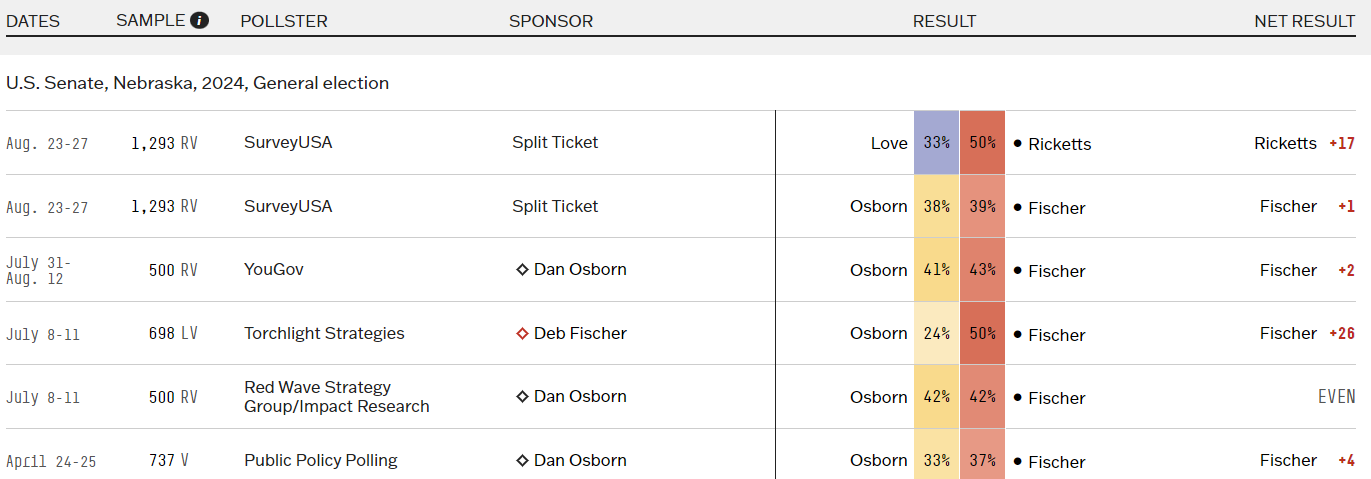
What are we to do with these numbers? Is a Republican in danger of losing a Senate seat to an independent – a largely Dem-aligned independent, no less? It might be useful to look at a similar contest – albeit from a decade ago – and evaluate similarities and differences.
In 2014, incumbent Republican senator Pat Roberts was seeking his third term in Kansas. The problem was, he wasn’t in Kansas very much. And he didn’t live in Kansas – at all. He resided inside the Beltway in Alexandria, Virginia and did not own a home in the Sunflower State. Two years earlier, a similar situation had led to the downfall of Indiana senator Richard Lugar, a six-term senator highly regarded on both sides of the aisle. But he was also a man without an Indiana address and facing a Tea Party-style challenge in the GOP primary. He lost to state treasurer Richard Mourdock, who went on to lose the general election to Democrat Joe Donnelly. In ’14, Roberts faced several primary challengers. Most notable was Milton Wolf, a radiologist with the bizarre habit of posting x-rays of his dead patients on the internet. Roberts won, but with only 48% of the vote. Wolf took 41%. Meanwhile, independent businessman Greg Orman was gaining traction. He had briefly run in the 2008 Democratic primary for the seat but dropped out after determining he could not take some of the positions necessary to win the nomination. Now, standing as an independent, Orman had bypassed the primary and was running a reasonably well-funded effort. Polling after the August GOP primary showed Roberts in trouble: he was polling in the low 30s in a three-way race against Orman and Democratic attorney Chad Taylor. Senate GOP strategists began to sound the alarm: Roberts didn’t have much of a campaign going to turn these numbers around and as the primary demonstrated, lacked grassroots support as well.
Two things happened in early September: Taylor dropped out of the contest and Roberts acceded to demands to shake up his campaign staff – and himself – and run a real race. With Orman now picking up some of Taylor’s support, most September polling showed him opening up a lead and even approaching 50%. The race narrowed in October, with Roberts encamped in a Kansas hotel as his campaign base instead of his actual home in, you know, Not Kansas. Election coverage increasingly focused on who Orman would caucus with in the Senate if elected. He indicated he’d go with whoever had the majority; if he was the tiebreaking vote, he’d allow both caucuses to seek his support for the opening months of the term by committing to certain positions on his priority issues.
At the end of the day, though, Kansas is a Republican state. Roberts just needed to hold on to most of the people who’d generally prefer a Republican senate majority. Nonetheless, Orman led more often than not in polls all the way up to the election in November – but these were close margins, effectively ties. And we know that independent and third-party candidates tend to underperform their polling when the votes are actually counted. In a year that turned out even redder than expected, Kansas’ Republican leanings were enough and the state re-elected Roberts by a double-digit margin, 53%-43%. Orman performed well relative to the baseline for a de facto Democratic candidate, but not nearly well enough.
So we’d expect Osborn to fade, too, right? Fischer is not a worldbeater but she doesn’t have the same glaring vulnerabilities as Roberts had. Osborn’s going to get the caucus question too, and Republican voters will decide to skip that uncertainty and just go with the Republican, and Osborn will end up short of his final polling numbers anyhow…right? Probably, yeah. But he might have more room to hedge on caucusing than Orman did in 2014, given the uncertainty over who the Republican Senate leader will even be come January. Mitch McConnell is retiring, and Rick Scott, a slew of guys named John and presumably Johnny 99 are all seeking the post. And unlike Kansas in 2014, this year’s ballot allows Nebraskans to vote for a Republican for Senate anyway…and still elect an independent. That’s because there’s also the aforementioned special election, featuring a normal R vs D matchup. Would a critical mass split their ticket in this way? Voters aren’t uniformly thinking in terms of control of a given Washington deliberative body. If your focus is electing a GOP Senate majority, then no, of course. But if you’re indie-curious, unattached to the undistinguished Fischer, and not overly concerned with the national battle for the Senate, then maybe. I can make an argument, therefore, for a closer finish than that 2014 Kansas race.
In any other situation, three polls in a row averaging out to less than a two-point lead would yield a Tilt or Toss-up rating. When it involves an independent candidate – and some decent pollsters, but none of the gold-standard firms – there’s a tendency to ignore it. Right now, each of the major predictors has the race in their safest Republican category. I think we have reason to hedge that, and my guess is that we’ll open with a Likely (but not Safe) Republican label for this one when we publish Senate ratings in the coming weeks.
(Thinking About) How To Think About The Presidential Race
I wanted to take this time before we get into our race ratings for the presidential contest to think through how I’m thinking about this election. It’s easy enough to look at a polling average in each state, but I see value in assessing where I think the campaign is going to go and why – what will account for the actual results, and any potential deviations from those state-by-state polls as they currently stand at the beginning of September?
Enthusiasm and the short campaign. Democratic fortunes were already imperiled by tepid enthusiasm – fair or not – for Joe Biden before his disastrous debate performance in late June. The turnaround since his departure from the race and the emergence of Kamala Harris as the party’s nominee has been striking. Gallup’s most recent polling finds that Democrats and Democratic-leaning independents are now notably more enthused to vote this year than Republicans and Republican-leaning independents – a stark reversal from March. Meanwhile, Tom Bonier at the progressive-aligned data and consulting firm TargetSmart has analyzed registration trends in 15 states (red, blue and swing) that have provided voter file updates since the candidate switch from Biden to Harris in late July. He finds remarkable surges in registration – especially in comparison to the same period in 2020 – with concentrations among women and particularly women of color. The spike in women’s percentage of new registrants looks similar to the one that followed the Dobbs ruling in 2022 (more on Dobbs in a moment). Will this be sustained? Consequential? I’m inclined to think so; I suspected there was more upside to a Kamala Harris candidacy than the chattering class presumed and these numbers (along with her polling improvement over Biden) are certainly confirming that prior. There are plenty of other factors that mitigate against my optimism and I’ll get into them below – but we have substantial data showing that the enthusiasm gap is now working in Democrats’ favor, and that has transformed this election. With a much shorter run-in, it’s not impossible to ride that momentum much of the way to the finish line.
The Dobbs Factor. The basic story is well-known to election analysts: the ruling that overturned Roe v. Wade also unleashed a fervor among pro-choice voters, leading to Democratic overperformance in special elections, the midterms, and state-level referenda. That electoral success makes sense: after all, a solid majority of Americans support legal abortion. But polling and focus groups shows that the basics of how Dobbs came to be elude some voters. Donald Trump promised to appoint judges who would overturn Roe. His appointed judges then, indeed, overturned Roe – a rare kept promise! And ever since, he has bragged about doing so. It’s his central pitch any time he addresses religious groups, particularly white Evangelicals. He constantly offers it up as a proud accomplishment. But some less-engaged voters are unclear on Trump’s positioning and actually associate this ruling with Joe Biden, since the court ruling occurred during his presidency (and perhaps because Biden was not the most impassioned or articulate defender of abortion rights; this is certainly an area where Kamala Harris has demonstrated greater effectiveness). Trump’s personal history as a womanizing rich guy from Manhattan, and his on-again, off-again attempts at softening Republican rhetoric on abortion, also contribute to confusion over the partisan dynamics at work and the stakes of this election when it comes to abortion rights. He spent the end of August confused and dissembling on how he’d vote in Florida’s referendum this November, or if he’d revoke access to mifepristone, struggling all the while to reassure abortion rights advocates and foes alike with how he’d approach the issue in a second term as president. All of which is to say: engaged and impassionate abortion rights supporters are plugged in and understand the state of play, but Democrats need to work on voters who are staunchly pro-choice but much less knowledgeable about the fundamental facts of American politics. If those voters think they can vote Trump and still protect individual freedoms when it comes to reproductive health, they’re not only mistaken – they could be decisive in the outcome. Can Democrats cut through the fog?
The Trump campaign’s focus on young men. In 1961, Barry Goldwater acknowledged that Republicans were unlikely to win back Black voters anytime soon and told a gathering of Georgia Republicans that they ought to “go hunting where the ducks are” – meaning conservative white Southerners who were wavering from their previous Democratic loyalties. Federal intervention to end segregation was shaking them loose from their longheld party ties and by the time Goldwater ran in ’64, they were increasingly ready to back a Republican for president (unlike the rest of the country: Goldwater won his home state of Arizona plus five Southern states, and lost the other 44 to Lyndon Johnson). Sixty years later, the Trump campaign has made clear that “hunting where the ducks are” means courting the votes of young men, including some who voted for Joe Biden in 2020. I have little to add to the story in terms of who these men are, what’s motivating them (though the story often involves a reaction to “wokeness” and the perceived “feminization” of the Democratic Party or society writ large) and how the Trump campaign is pursuing them. Quite a few media outlets, including the New York Times and Business Insider in just the last few days, have published pieces on these efforts. I readily acknowledge that this engagement is often happening through podcasts or MMA-focused shows that I rarely consume or encounter. To my eye, though, the Trump campaign is doing this deftly, and JD Vance’s daily unearthed utterances might even be a feature, not a bug. Some of these targets are infrequent voters, meaning pollsters attempting to model turnout might lack confidence they’ll actually show up to vote – which in turn means they might help Trump outperform his polling. I suspect they’re also the least likely people in American to answer a poll and if they do, the most likely to troll pollsters with their answers (look, I was a young man once myself!) The prospect of success in growing Trump’s vote share with younger males creates a higher ceiling for Trump and downballot Republicans, but as I discuss below, I’m not sure they raise the floor all that much.
A potential “last mile” problem for Republicans. I’m far from alone in thinking the Trump campaign is hunting where the ducks are in targeting young men across various ethnic backgrounds, and doing so in clever ways. I’m curious about how adept they’ll be at turning these young men from Trump-curious or even Trump-supporting into actual voters. My gut tells me that a great many of these potential voters have not spent a lot of time thinking about the mechanics of registration and voting; these guys come from the “too cool to think about that politics shit” crowd. To anyone reading this and therefore possessing some interest in political campaigns, it seems obvious that one must give a bit of thought to how to actually turn support for a candidate into a vote. But to people who think about politics in passing, there might be a lack of attention to civic basics. Combine that with the talk of the Trump/GOP focus on recruiting “election protection” volunteers and outsourcing their field and turnout operation to outside entities with little history of producing results and I’m left to wonder: are the Republicans ready to turn sporadic or new voters into reliable ones? In states with automatic vote registration, do some of these voters realize they’re registered? Is the Trump campaign finding these folks and talking through logistics? I suspect that the Democratic field operative’s focus on making a voting plan strikes them as quaint or intrusive. But it might come in handy, and I’m not sure the Trump campaign is mapping out an equivalent.
Democratic ground game versus Republican “election protection.” Pairing these concepts is not ideal from a rhetorical standpoint, insofar as the former represents the normal blocking and tackling of an election campaign while the latter takes on a more ominous aspect in this era of political violence in America. But as alluded to above, the Trump campaign is largely outsourcing turnout to unproven, grift-infused outfits that may or may not actually be skilled at getting GOP voters to the polls. After Lara Trump took over leadership of the Republican National Committee (RNC), her team ditched plans to open and staff 40 field offices in swing states. The Trump campaign’s focus, instead, is on the largest “election protection” effort yet seen, where they plan to have droves of people watching poll sites for signs of “fraud” or “theft.” Keep in mind that the RNC spent decades under a consent decree that stemmed from its violations of the Voting Rights Act through their Ballot Security Task Force‘s actions in the 1981 New Jersey governor’s race. After several amendments and renewals, the consent decree was ruled in January 2018 to have expired and would not be extended. That made 2020 the first presidential election since 1980 without the decree in place, and the RNC intended to mobilize 50,000 poll watchers for “ballot security” alongside the Trump campaign’s efforts to deploy an assortment of law enforcement official and military veterans for this purpose. Election turnout proved to be very high in 2020, and it’s unclear whether these efforts bore fruit – but more ballots than ever were cast via mail or drop boxes, making it harder to employ in-person intimidation tactics. As we return to a more “traditional” approach to this year’s election, will Republican efforts to “protect” the vote be more successful, or is this a dog that fails to bark?
The perils of polling. To be clear, polling is a public good. This is especially true in a huge and diverse country, where it’s valuable to get some sense of where the electorate stands on policy measures outside of campaigns. Even horserace polls have value: both for strategic voting and volunteering and, within reason, for setting expectations for outcomes that can serve as a check on illicit activity by election administrators. And most of the election-related polling is still pretty good despite myriad challenges posed by low response rates – there are sound statistical principles at work in quality survey research, and many public-facing pollsters employ those principles and offer valuable insights. Polling was pretty solid in 2018 and 2022 (with the exception of some partisan GOP pollsters who, whether due to poor assumptions or intentional malfeasance, spent the final weeks of the 2022 cycle depositing gobs of polls of low methodological quality which missed pretty badly on the final results). But now we’re back to a presidential year with Trump on the ballot, and pollsters struggled with those conditions in 2016 and 2020. That sets up some questions for us in 2024:
- Do we assume a repeat of presidential polling misses in the last two cycles (especially 2020)? Generally, there’s no correlation between the direction of polling misses from year to year; in 2012, for example, presidential polling underestimated Barack Obama’s fortunes (though Within the Margin was generally on the mark). But is there something specific about Trump’s presence on the ballot that confounds pollsters? Is there something specific to 2020? Nate Silver posited that pandemic protocols were more likely to be followed by Dem-leaning voters, meaning they were sitting at home more likely to answer a call from a pollster. That part, at least, should be removed from the equation this time around. I tend to think the thing to do is to operate with less certainty: all things being equal, I’d probably take a polling edge that points to a Likely Dem rating and move it to Lean Dem. If polling pointed to Tilt Dem (the closest pro-Dem forecast), does it then follow that I would shift to Tilt Rep? I’m not sure. Thinking that through in the coming weeks.
- Is polling properly capturing the magnitude of shifts toward Trump among non-white voters? This is a two-part question, really: first, are surveys and turnout models confounded by shifts among traditionally Democratic groups and second, are those difficulties magnified further when the movement is among non-college voters? Part of the issue facing pollsters in the Trump Era has been a difficulty capturing the realignment taking place along education lines.
- Are pollsters struggling with Arizona again? It might be unfair to say polling companies writ large “missed” here in 2022, as the high-quality pollsters like Marist and Fox News had Mark Kelly leading in the AZ Senate race. But the lower-quality pollsters that nonetheless were more accurate about Trump’s chances around the country in 2020 went on to perform disastrously up and down the ballot in 2022, and particularly Arizona where they kept finding sizable leads for Blake Masters (and smaller but consistent leads for Kari Lake in the AZ governor’s race). This is a state where I’ll probably lean even more heavily into the highly-rated, methodologically-transparent pollsters in 2024.
Pennsylvania’s downballot results in 2020. I’d say Pennsylvania’s recent election results are a three-part story: Working backwards: Republican midterm in 2022 hopes crash upon the rocky shoals of abysmal candidate recruitment. Dr. Oz loses the Senate election; rabid election denier Doug Mastriano is obliterated by Josh Shapiro in the race for governor. Two years earlier, “Scranton Joe” Biden narrowly wins back the Keystone State from Trump in 2020 by crushing him in the suburbs and yes, faring slightly better than Hillary Clinton in some of the former industrial territory that swung away from Dems for decades. The third piece? Republicans running quite well downballot statewide elections in 2020 even as Biden was carrying the state. Unheralded GOP candidates flipped the state auditor and treasurer positions and kept the attorney general race close. I think it’s dangerous to point to the Oz and Mastriano losses as signs of healthy Democratic performance downballot without looking at those treasurer and auditor wins for the Republicans. Is Trump fighting himself in Pennsylvania more than he’s fighting a propensity to elect Dems statewide? Does he simply have to match the performance of a replacement-level Republican? That’s a pretty low bar, with grim consequences for Democrats if that’s all he has to manage.
Palestine and campus protests. I’m not interested in using this platform to address the October 7 attacks, the war in Gaza, or the related protests. But a note about their impact on my thinking about this election is required. These events are especially complicated for the Democratic coalition and do not map perfectly onto a left-right spectrum within the party. It’s important to keep in mind that public polling shows a more nuanced picture of American thinking than many of the online discussions we encounter; Nate Silver broke down findings from several respectable pollsters back in May. Michigan and Minnesota stand out as states whose sizable Arab and/or Muslim populations could be particularly impactful if the hostility of some of these voters toward Joe Biden carries over to Kamala Harris. As for the protests, the media class made clear their hunger for a 1968 redux at the Democratic National Convention in Chicago, seemingly rooting for blood in the streets. But it did not come to pass. Whether the fall semester brings a return of the angry convulsions seen on a relatively small percentage of campuses in the spring remains to be seen, as does the degree to the Harris and Trump campaigns are asked to weigh in on the tone of those protests, the police response, and so forth. My starting assumption is that they will not play a major role down the stretch; I would also suggest, though, that Trump is desperate for chaos in Gaza and unrest in America. The degree to which Benjamin Netanyahu and his government can or would contribute to that in some fashion is worth contemplating, but is such a tangled web that it can only impact my thinking so much.
A Quick Look Back at ’22: The Gubernatorial Elections
Stability was the theme in the 36 elections for governor in 2022, with the incumbent party winning 35 of them. Only Nevada changed hands, with Republican Joe Lombardo narrowly defeating Democrat Steve Sisolak. For our part, we called 35 of the races correctly, including that Nevada flip. The lone miss was Arizona, which we had at Tilt Republican on the eve of the election. It’s easy to dismiss Kari Lake now, in the aftermath of her refusal to accept the result of the election she lost and the ever-rightward and increasingly unhinged drift in her rhetoric. But in the fall of 2022, she led in almost every poll – though the final edition of two of the only higher-quality surveys (Siena and Marist) showed a tie and a one-point Katie Hobbs lead, respectively.
Most of those calls were pretty straightforward, of course. Even two of the flips (Maryland and Massachusetts moving from popular but term-limited moderate Republican governors to Dems) were essentially written in stone from the start of the cycle as Republicans lacked another candidate with the political skills or moderation of Larry Hogan or Charlie Baker. In fact, the GOP nominated hardcore Trumpers in both states, further ensuring Dem pickups in two of America’s bluest states.
Let’s review the other notable races, including a few where we were a shade too confident or not confident enough:
- Georgia: It never quite felt like Stacey Abrams was recapturing the magic of her near-miss in the 2018 race for governor. In part that stemmed from the nature of the two election cycles, each involving a president with declining popularity from opposite parties. It also had something to do with incumbent Republican Brian Kemp managing to thread the needle of backing Donald Trump without supporting the latter’s attempts to overturn the results of the 2020 election. Predictably enraged, Trump endorsed Kemp’s primary opponent, former Senator David Perdue…and Kemp absolutely smoked him in the primary, 74%-22%. Creating that mostly one-sided separation in voters’ minds helped Kemp thrive even as the state’s high-profile race for U.S. Senate showcased Republican extremism and their tendency to nominate oddballs. We kept the race at Lean Republican throughout the cycle, and Kemp’s margin of victory of 7.5 points is indeed at the outer edge of that Lean band.
- Kansas: Democratic incumbent Laura Kelly was defending her 2018 win over far-right former KS Secretary of State Kris Kobach. It was a massive win in a Dem-friendly year and 2022 stood to be tougher – after all, it’s not like someone would ever nominate Kris Kobach again, right? This time the GOP nominated KS Attorney General Derek Schmidt. But just as Kobach’s extremism created room for Greg Orman’s independent candidacy in 2018, Schmidt’s relative moderation (by today’s GOP standards) allowed Dennis Pyle to run as the self-proclaimed “conservative” choice. Kelly’s 2.2% margin of victory was greater than Pyle’s vote share, though. Her popularity – along with the continued drift of pro-choice GOP moderates in eastern KS into the Dem column following the Dobbs ruling – bumped her vote share upward from 2018’s 48% to 49.5%. There wasn’t much polling here throughout the cycle, but the non-partisan polls showed her ahead. With a state like Kansas, you’re rarely if ever going to see a Safe or Likely Dem rating – but Kelly’s strengths allowed us to keep it in the Tilt Dem column throughout the cycle.
- New Mexico: Michelle Lujan Grisham was another Democratic incumbent who flipped a seat in 2018, in a much blue seat than Kansas. Grisham’s approval ratings were not quite as strong as Kelly’s, and she was not facing a fellow statewide officeholder this time around. But Republican meteorologist Mark Ronchetti had run a surprisingly strong U.S. Senate race in 2020 and was viewed as a solid recruit for this race. Most polling, including every nonpartisan poll, showed Grisham ahead…but the margin was narrowing as the election approached. As a result, we moved this from Lean Dem to Tilt Dem in our final Election Eve forecast. We could have left it where it was: that late movement in the polls turned out to be ephemeral if it was real at all, and Grisham won by nearly six and a half points.
- New York: Closer to home, the Empire State’s gubernatorial race turned out to be a tricky one for us to get our arms around. From the start of the race, our position was that Lee Zeldin was too conservative to thrive in a statewide race: an unapologetic supporter of Trump’s efforts to “investigate” and overturn the 2020 election, Zeldin was also staunchly anti-choice and had voted against marriage equality during his time in the state senate back in 2011. On both social issues and the democracy issues stemming from the January 6 insurrection, Zeldin was well to the right of the national electorate, let alone blue New York’s. And yet: he consistently dismissed those attacks, on the rare occasion incumbent Kathy Hochul or the state Democratic party attempted to make them. He was teflon. Hochul had risen to the position after the resignation of three-term governor Andrew Cuomo in the summer of 2021; she was probably damaged by the brief re-imposition of some COVID lockdown measures the following winter but much more so by the perception that crime was rampant – particularly in New York City. Dem vote shares had already slipped a bit in NYC’s Latino, Asian-American and Haredi communities in the 2020 presidential election, and that slide continued in 2022. It was clear to us as the campaign moved along that this was not a Safe Dem race like mot of NY’s recent gubernatorial elections, and we toyed with moving it from Likely Dem to Lean Dem in our final forecast. We stuck with Likely Dem, but should not have: Hochul only won by six points as the “red wave” that missed most of the country squarely struck New York – particularly on Long Island, but also neighborhoods of NYC that Republicans had not won in decades, like Brooklyn’s Chinatown(s). (note that while Zeldin claims victory in Manhattan’s Chinatown, he did not win a single precinct there. Zeldin is lying when he says that. He did reduce Dem margins there, though). With New York politics in a more dynamic state than we’ve seen in quite a while, forecasting elections here will again be a real challenge in 2024 and 2026, despite our proximity.
- Oklahoma: This race looked increasingly interesting as it unfolded. Incumbent Republican Kevin Stitt was less popular than one would expect in a deep-red state, and faced a competitive challenger in Rep-turned-Dem Joy Hofmeister, previously elected statewide as Superintendent of Public Instruction. Polling tends to be scarce in Oklahoma, with the better-rated pollsters rarely making a foray into the Sooner State. A series of Republican-affiliated pollsters descended up on the state in October, initially finding Hofmeister ahead – a directional difference from many swing state polls in ’22 where the Rep-affiliated companies were finding GOP leads that ended up far removed from the final result. With the better-rated Emerson showing a single-digit Stitt lead in late October, and a competitive high-profile race for Superintendent of Public Instruction involving the controversial Ryan Walters, our final forecast moved our rating from Likely Rep to Lean Dem, just in case something was really happening. In the end, Stitt won comfortably – albeit behind most of the Oklahoma GOP ticket, and far behind recent GOP presidential showings in the state. A 55%-42% margin of defeat passes for respectable these days in Oklahoma, but with Stitt and Walters continuing to stir up controversy one wonders if 2026 might be closer. We’ll have to be disciplined, though: the 2022 example (and some before that) indicates that pollsters understate GOP support in OK regardless of whether it’s a presidential year or not.
- Oregon: Throughout the 2022 cycle, Oregon looked like one of the GOP’s best opportunities to capture a governorship – something they had not done in Oregon since Victor Atiyeh was term-limited in 1986. Democrat Kate Brown was not running, having reached her term limit; the Dem nominee was former state House Speaker Tina Kotek. The GOP had a reasonably strong nominee in former state House Minority Leader Christine Drazan. Brown left behind abysmal approval ratings, while Democratic state senator Betsy Johnson was running as an independent candidate likely to eat into the usual Dem margins in Oregon. And sure enough, polling throughout the summer and early fall showed Drazan ahead, with Johnson polling in double-digits – occasionally passing the 20% mark. But as tends to happen, the autumn saw the independent/third party support drop off, and by late October Johnson had fallen into single-digits. Both major-party candidates saw their vote shares rising, but Kotek was gaining faster and leading more often than not down the stretch. We shifted our rating from Tilt Rep on October 21 and 27 to Tilt Dem as midnight struck on November 8, and that proved to be correct. Kotek prevailed 47%-43.5%, with Johnson trailing at 8.6%. The GOP drought in the Oregon governor’s mansion (I assume they have a mansion?) continues for another term.
- Rhode Island: Man, I don’t even remember precisely why we thought this was Likely Dem instead of Safe Dem. It probably owed to a mix of factors – starting with the lack of any public polling after the first week of October, which did show a closer-than-usual contest in the Ocean State, and the RI-2 open seat race was understood to be quite competitive. And Dems were tearing each other up in various primaries up and down the ballot. But Dan McKee won by 19 points, running only slightly behind the baseline Dem performance here. We hedged the appropriate amount, but no serious person would have looked askance at a Safe Dem call here, either.
- South Carolina: The Palmetto State is really the inverse of Rhode Island: with former one-term Congressman Joe Cunningham carrying the torch for Dems, there was a chance this race could pop. Summertime polling showed a single digit lead for incumbent Republican Henry McMaster, and then pollsters disappeared from the scene entirely a week into September. That necessitated a bit of hedging to Likely Rep, but no one on the ground was saying Dems really had a shot here down the stretch. Sure enough, McMaster won by a little over 17 points. Our hedging had some logic but as with RI, few would quibble with a Safe rating in a state with such a strong partisan lean.
If we wanted, we could probably add Michigan as a state where we were too conservative at Lean Dem, as incumbent Gretchen Whitmer ended up with a comfortable double-digit win over GOP challenger Tudor Dixon. All told, though, pretty solid work. Wish we had nailed Arizona, obviously, to get all of these correct.
That wraps up our look back at the ’22 elections. Next up, it’s time to put together some assessments of the present state of affairs in what has rather suddenly turned into a dynamic 2024 election cycle.
A Quick Look Back at ’22: The Senate
Let’s continue the review of Within the Margin’s 2022 forecasts with the Senate races. One overarching narrative of the year was the Republican Party’s nomination of an array of underachieving candidates who were too conservative, too bizarre or too distant in terms of recent residency from the states in which they were running. In some cases, like Herschel Walker in Georgia, all three factors applied. Meanwhile, Democrats had particularly solid incumbents running in Arizona and Georgia who had just won 2020/2021 special elections and had not made notable errors in the time since – not a guarantee of re-election, but helpful in enduring a less-than-favorable political environment. In addition to candidate factors, the Dobbs decision in June of 2022 provided a midterm enthusiasm boost often lacking for the party that won the previous presidential contest.
Our October 30 Senate forecast predicted a 50-50 chamber – maintaining the same partisan breakdown as the 2020 elections yielded – with Democrats flipping Pennsylvania and Republicans flipping Nevada. We were correct about Pennsylvania flipping despite John Fetterman’s post-stroke debate struggles. Longtime collaborator Matt Clausen took the lead on keeping that race at Tilt Dem despite all the noise, and he was correct: despite Fetterman’s health struggles, he defeated Dr. Oz’s ludicrous candidacy by a fairly comfortable five-point margin. In fact, voters may have responded poorly to Republican efforts to capitalize on those health issues…and the New Jersey doctor recently known for selling quack supplements might not have been the best choice to make the case against a quintessentially Pennsylvanian figure in the first place.
Left to his own devices, Matt might have wisely kept Nevada in the Democratic column as well. In that race, first-term Democratic incumbent Cathy Cortez Masto faced Adam Laxalt. Like Masto, he was the state’s former attorney general; unlike Masto, he was defeated in a 2018 run as the Republican nominee for governor. Polling throughout 2022 indicated a difficult cycle for Nevada Dems, despite Masto not having any particular weaknesses beyond being a Dem facing midterm headwinds…and despite Laxalt’s sometimes-fringy, often-Trumpy political persona. More reputable pollsters tended to show a narrow Laxalt lead or a tie, as did the Democratic-aligned Data for Progress. More controversial (and GOP-aligned) entities like Trafalgar, Insider Advantage and Cygnal found larger Laxalt leads. Jon Ralston’s always-sharp turnout analysis left the Senate race truly too close to divine from the early voting and mail ballots…and I fell on the side of Nevada being a place where the vaunted Dem turnout machine would be a little bit weaker than other years. I saw economics trumping Dobbs, in a place where the Dem coalition leans more working-class than some states. And I saw a pretty rough poll out of Emerson, one of the few theoretically non-partisan pollsters to drop a Nevada poll down the stretch. Ultimately, Masto won by just under a full percentage point, securing a 51-49 Senate majority for Dems (a net pickup of one seat in a cycle once forecast to be a bloodbath).
We moved Arizona from Lean Dem to the tighter Tilt Dem in our final forecast. As it turns out, we could have kept it on the safer side: Mark Kelly dispatched venture capitalist and noted weirdo Blake Masters by about five points. Refusing to believe the GOP hype about Herschel Walker in light of countless flaws that would make it quite difficult for late deciders to choose him, we kept Georgia in the Lean Dem column. I should note here that this Georgia election makes for an interesting case. Incumbent Raphael Warnock led by a point (49.4% to 48.5%) in the November first round, then won by just under three points in the December runoff. That points to a Tilt Dem rating being closer to the mark, but…there are races where the tremendous flaws of the candidate create a ceiling and Walker might have had that to an extent beyond even, say, a Donald Trump (Walker couldn’t quite replicate Trump’s raw vote margins in some of Georgia’ rural counties). It’s worth pointing out, too, that Warnock runs damn good campaigns from an organizational and strategic standpoint, and that’s a difference-maker in close races.
A Rep-held seat where the Lean Rep rating should have been the closer Tilt Republican? Wisconsin, where incumbent Ron Johnson took a break from trying to overturn the 2020 presidential election result to seek re-election himself against Lieutenant Governor Mandela Barnes. But we followed the polling, where Barnes’ brief time in the polling lead in August was followed by a much longer stretch of small but consistent Johnson leads. There were signs – both in polls and anecdotes that the race was closing in the final week, so a Tilt Rep would have been justified…and indeed, Johnson ended up winning by only a point. He did not attempt to overturn that result.
One race where I’m particularly proud of our steadfastness is Washington, where a flood of GOP-friendly pollsters raced to match the narrative coming out of National Republican Senate Committee headquarters about Tiffany Smiley. To hear them tell it, their candidate (a nurse and veterans advocate making her first bid for public office) was setting hearts ablaze, closing fast and headed for an upset win over longtime, fairly uncontroversial Dem incumbent Patty Murray. One after another, a series of Republican pollsters found a tied or inside-the-margin-of-error race in the final weeks – in stark contrast to what independent pollsters were showing. Matt and I did not believe the hype and kept it at Likely Dem – a seat that would probably only go red in a wave election. That wave did not come, and Murray won her sixth term comfortably, with 57% of the vote. Simon Rosenberg often overstates the case for Democratic optimism – but he was on the mark late in the 2022 cycle with his comments that certain pollsters were trying to flood the zone and build the narrative of an impending red wave. In theory, the market will now correct itself, as Nate Silver suggested on the eve of the election: the poorly-performing polls will lose business and credibility, and they’ll address their biases (whether intentional or simply based on bad modeling) this cycle.
In sum, our Senate forecast mainly reflected a cycle where Dems tended to nominate stronger candidates and Republicans fell prey to their 2012-era bugaboo of nominating bizarre people or simply poor fits for their states – helping Dems maintain a polling advantage ultimately confirmed by the results. The toughest choice to make was trusting the electorate’s sympathy for John Fetterman in PA, and that choice was vindicated.
A Quick Look Back at ’22: The House
It’s been a minute! And despite thinking often about the need to do an accountability check on our 2022 work, I haven’t gotten to it…until now. So let’s take a look at each of the three sets of predictions (House, Senate, Governors) and see what was on target and what missed the mark – and importantly, the thought processes driving those calls at the time. That’ll set us up to do some baseline work on 2024, which is shaping up somewhat differently than other presidential years of recent vintage. We’ll start today with the House of Representatives.
Final topline seat prediction: 224 Republican, 211 Democratic (Republican net gain of 11 seats)
Actual result: 222 Republican, 213 Democratic (Republican net gain of 9 seats)
The leading forecasters spent much of the cycle, including in their final predictions, predicting significantly bigger gains for the Republicans. This was in line with typical recent midterm landslides. They did this despite polling throughout the cycle showing closer races. Most of those forecasters, of course, included two- or three-dozen toss-ups, whereas we make a final call on each because, well, you the reader already generally know the races are close; anyone can give you a list of close seats. I think it’s more interesting to actually come down on one side or the other, even if we’re gonna miss on some of them. That’s because getting to that level of commitment forces us to think critically about each race and gives readers more insight into our thought process. Larry Sabato’s Crystal Ball, to their credit, did so: they ended up with a 237-198 edge for Republicans. FiveThirtyEight (in its final election under Nate Silver’s guidance) used “toss-ups” as terminology for races within a certain margin but their model still provided a vote share forecast for each seat, even those characterized as toss-ups. Under their Classic model, their final prediction had the Republicans with 226 seats; the Deluxe model (which incorporates ratings from non-FiveThirtyEight experts in addition to the features of the Classic model) put them at 225.
Decision Desk HQ had fewer undecideds than most; they gave the GOP a 223-200 lead along with a dozen toss-ups. The others (Cook, Inside Elections, Politico, RealClearPolitics, Fox News, Economist) projected the Republicans from 208 (Economist) to 227 (RCP), with anywhere from 20 to 38 of these elusive toss-ups. For what it’s worth, if you think of these as 50-50 chances and simply distribute half to each party, the Economist comes closest to the actual result (221.5 seats for the GOP) and RealClearPolitics is furthest away (246).
On October 21, our House forecast had the breakdown at the eventually-correct 222-213. The two changes from October 21 to the November 2 forecast were a pair of Nevada seats, NV-1 and NV-3, and on November 8 I caveated that moving NV-1 back into the Dem column warranted serious consideration. My recollection is that collaborating analyst Matt Clausen was always more confident about Nevada than me during the ’22 cycle, and the results validated his instinct. But at 224, we can still feel pretty good about how we did and can make a case – depending on how you want to view those toss-ups – for coming in second-best among this group of race-rating entities.
Let’s go under the hood, though – because it also matters which races we nailed and which ones we missed! I’ll start with the misses:
- There’s 16: nine where we predicted a Rep victory but the Dem won; and seven where the opposite occurred.
- None of the seats we identified as Safe for one party were won by the other. One seat we rated as Likely R went to Dems, though, as Marie Gluesenkamp Perez flipped Washington’s 3rd district (Vancouver and southwest Washington). It was Dems’ first win here since 2008, made possible in part by Trump’s fatwa against those Republicans who voted to impeach him – like WA-3 incumbent Lisa Herrera Beutler. She finished third in Washington’s top-two primary behind Joe Kent, a far-right Trump endorsee. Gluesenkamp Perez, a mechanic and small business owner, ran as a very different sort of Dem candidate than we’ve seen much of lately and defeated Kent by a little under one percentage point.
- Three seats rated as Lean to one party went to the other:
- OH-13 (Akron, Canton): won by Democrat Emilia Sykes by almost five and a half percentage points.
- NC-13 (southern edge of the Research Triangle region; Goldsboro): won by Democrat Wiley Nickel by a little over three percentage points. To be honest, I think I intended to shift this to no more than Tilt R and simply forgot in the maelstrom of the campaign’s final days.
- CA-13 (San Joaquin Valley, inc. Merced, Madera and southern Modesto):won by Republican John Duarte by under 600 votes (less than half a percentage point) in one of the country’s closest Congressional races.
- The rest of our misses were seats we had listed as Tilt (our closest rating).
- Four of these were in NY.
- As pessimistic as we were once the Hochul campaign’s weaknesses became apparent in the final stretch, we still didn’t quite realize how bloody it would be for Dems. My final House post did note that I was giving strong consideration to moving NY-3 and NY-4 (both primarily in Nassau County on Long Island) into the Republican column. But – noting the weak Republican candidate in NY-3 and the heavy partisan lean of NY-4 – I stuck with the Tilt Dem rating. That Republican candidate, by the way, was one George Santos. That seat has already flipped back to Dems, in a February 2024 special election won comfortably by Santos’ predecessor, Tom Suozzi, following the scandal-plagued Santos’ resignation.
- In the Hudson Valley’s NY-17, we knew that DCCC chair Sean Patrick Maloney was distracted by national concerns and had never established as firm a grip on his district as one might have thought. His prior margins just weren’t that impressive. And we knew first-term Assemblymember Mike Lawler was a hard-working candidate with a lot of connections throughout GOP politics. But we felt the final indications were that Maloney had stopped the freefall and might still eke out a win in a district Joe Biden carried by ten points in 2020. We were wrong.
- Further north in the Hudson Valley and out through the Catskills and Southern Tier, NY-19 was incredibly difficult to call politically – and perhaps, for once, made more difficult by geographic proximity. Though not an inch of my home county of Dutchess lies in this district, Dutchess County executive Marc Molinaro was oddly running for this seat. He had spent his (failed) summer special election campaign in his old district lashing out at people tweeting about him, complaining about news coverage, and dodging any attempts to make him say something coherent about the Dobbs ruling that overturned Roe v. Wade. Seeing him squirm so uncomfortably then and in the months that followed may have left me too optimistic. We had it at Tilt Dem, but Molinaro squeaked by with a narrow win.
- In the other direction, Dems avoided the worst-case scenario in Nevada – not unlike Harry Reid’s legendary 2010 win in the Silver State. This time not only saw Dems hold the Senate seat (now in Catherine Cortez Masto’s hands) against a strong challenge, it featured wins in NV-1 (southeast Las Vegas metro) and NV-3 (western LV metro) which we had labeled as Tilt Republican.
- The last few:
- Forecast for Democrats but won by Republicans:
- CA-27 (northern LA County and the Antelope Valley)
- VA-2 (Virginia Beach, Chesapeake, Suffolk, southern Delmarva peninsula)
- Forecast for Republicans but won by Democrats:
- NM-2 (southwestern NM, plus a small portion of the ABQ metro)
- OR-6 (Salem, McMinnville and the southwest Portland suburbs)
- PA-7 (Lehigh Valley and Jim Thorpe/Carbon County)
- RI-2 (southern and western Rhode Island, downtown Providence, Federal Hill, Olneyville). Matt was always more skeptical that Allan Fung could actually swing this one, and he was right.
- Forecast for Democrats but won by Republicans:
- Four of these were in NY.
You’d rather win ’em all. But on most of these, the other forecasters had them as too close to call – no one’s posting their perfect bracket when it comes to ’22, after all. What are some of the correct calls we should feel particularly good about?
- We were correct on 17 of our 29 “Tilt” calls – those are the seats frequently being called toss-ups by other forecasters. 59% of the supposed coin-flips isn’t too shabby.
- We were 16 for 19 on “Lean” Calls – so 84% in races where we were expressing more confidence. That seems right. Likewise, 32 for 33 (97%) on Likely ratings, and 100% on Safe ratings. Now, on a number of those the margin ultimately warranted a more-or-less confident call in either direction, and that’s something to hone going forward.
- CO-8 (northern Denver metro inc. Westminster, Thornton, Commerce City and Brighton; Greeley). Cook and Politico had this brand-new district as a toss-up; everyone else had it Lean or Likely Republican. We did not: from the beginning, I thought state representative and pediatrician Yadira Caraveo was a strong fit for this district, which has the largest Hispanic population of any Colorado seat. Historically, candidates who have helped deliver people’s babies or keep them alive during their childhood years fare well with candidates. And then there’s the Colorado GOP, who never miss an opportunity to nominate a fool: conservative senator Barbara Kirkmeyer. This anti-abortion, anti-contraception, secession-curious candidate was a marked contrast to the modern, practical Caraveo, whose relative youth could also appeal better to a district full of transplants and young families. In a district most expected to flip to the GOP, Caraveo won by seven-tenths of a percentage point to narrowly vindicate our Tilt Dem rating.
- CT-5 (northwest Connecticut: Danbury, Torrington, parts of Waterbury, and the Litchfield Hills). Two-term incumbent Jahana Hayes faced a GOP rising star (they hoped) in George Logan, a former state senator who also fronts a Jimi Hendrix tribute band. It was a rare battle of two Black candidates in a mostly-white district, and Republican operatives thought they had the momentum as the campaign entered its final weeks. My own drive-by observations found a better-organized Dem operation on the ground, even in Republican-leaning Torrington. We had the race at Tilt Dem for the final call; Sabato had it flipping Republican and most others had it in their toss-up categories. Hayes indeed won, by eight-tenths of a point. She and Logan will face each other in a rematch this year.
- IL-17 (Quad Cities, Rockford, Galesburg, Peoria, Bloomington). This gerrymandered monstrosity was drawn to keep the district in Dem hands despite Cheri Bustos’ retirement. Joe Biden had carried it fairly comfortably in 2020, but Bustos had only won by four points; this terrain has given Democrats problems in tough years. Three of the raters had it flipping to Republicans; two had Dems keeping it and the rest listed it as a toss-up. We kept it in the Tilt Dem column throughout the year in no small part due to meteorologist Eric Sorensen’s local name rec and relentless campaigning. He ultimately won by four percentage points.
- ME-2 (northern and Downeast Maine, inc. Augusta, Bangor and Lewiston). This is the much more rural of Maine’s two congressional districts and shifted sharply to the right after 2012, voting for Trump twice by solid margins. Despite that, Jared Golden was elected in 2018, re-elected in 2020, and struck us as a solid favorite in ’22 against the man he defeated the first time, Bruce Poliquin. We rated it as Lean Dem; six of the nine national forecasters rated it a toss-up. Golden led by four points after the first round of the ranked-choice election, and won comfortably (by slightly over six points) after reallocation. Golden has serious chops: against a strong Republican nominee we’d have hedged more with a Tilt rating, but Poliquin’s weaknesses seemed clear to us. The other forecasters were leaning too heavily on district fundamentals on this one.
- OH-1 (Cincinnati and most of its metro area, inc. Warren County). Historically, Cincinnati was one of America’s largest Republican-voting cities. That reputation was fading by the Obama Era, but decennial Republican gerrymanders splitting the city – and the strong GOP lean of many Cincinnati suburbs – ensured that the various iterations of this seat stayed in GOP hands from 1994 through to 2022, with one blip in 2008. But two factors converged to make the seat vulnerable to a Dem pickup in ’22. First, the Trump Era rapidly shifted many suburbs blue, and Cincy’s eastern suburbs were not immune. Second, the 2022 elections were fought under a map that kept the city unified, giving it a slight Dem edge (D+2 according to Cook’s Partisan Voting Index). Given that Steve Chabot was never hugely popular and had achieved longevity primarily through favorable mapping, we liked this as a potential Dem flip and rated it Tilt Dem. The other forecasters? Four went Lean R; five went Toss-Up. We were correct, as Democrat Greg Landsman defeated Chabot 52.8%-47.2%.
- PA-8 (Scranton, Wilkes-Barre, Hazleton, the Poconos). This might be a cheap one to claim insofar as we were perhaps too optimistic for Dems with our Lean D rating…but two forecasters saw it as Lean R and seven as toss-up, making them collectively a shade too pessimistic relative to Dem chances here. Ultimately, five-term Democratic incumbent Matt Cartwright won re-election by two and a half percentage points, so the “correct” prediction here was probably more like Tilt Dem. Still, that puts us slightly closer to the mark than the collective wisdom.
Alright…I’m happy to have a little closure on the 2022 House results. The next post will take a look at the Senate forecast and results.
Final Changes to the Governors Ratings
I’ve made three changes to my gubernatorial ratings in the final days of the campaign, and I want to address each of them very briefly. Updated map to follow at the end.
Read more…Some Final Thoughts on the House Ratings
As is generally well-understood at this point, midterms tend to go poorly for the president’s party. Seat losses typically number in the dozens. Given that the Democratic majority in the House of Representatives cannot survive even a half-dozen seat loss, it is overwhelmingly likely that Republicans will take control. Narratives abound as to why, with lots of the usual gnashing of teeth over Democratic messaging and strategic weaknesses. But the basic fundamentals are that inflation is high and economic concerns loom largest, and that’s usually going to hurt the party in control even before we contemplate the usual dropoff form the president’s party relative to the prior election. All of that is reflected in my projection: a 224-211 majority for the GOP, meaning an eleven-seat gain for them.
Read more… Within the Margin