Archive
Drawing the Lines: Can The New Map Turn the 37th Red?
As 2012 continues, we’ll spend a fair amount of time analyzing the state of play in New York’s State Senate. The Republicans are clinging to a razor-thin 32-30 majority. They appear to have the chance to redistrict themselves into a safer position, but a lot can happen between now and the adoption of a new map. Even with a favorable map, demographics and political behavior make it unlikely that they’ll return anytime soon to the larger majorities they enjoyed in the State Senate at the start of the last decade.
We’ll also delve into whether it’s even a majority worth winning, given the chaos and legislative failure of Democrats’ brief stint in the majority in 2009 and 2010, as well as the dark clouds surrounding recent and current conference leaders like Malcolm Smith and John Sampson.
***
Today, longtime Democratic senator Suzi Oppenheimer announced her retirement from the 37th District. This sets up an open seat race sure to be hotly-targeted by both parties. The 37th sits in central and southeastern Westchester along part of the I-287 corridor and the Long Island Sound shoreline, and includes all of White Plains and most of New Rochelle, along with Harrison, Mamaroneck, New Castle, North Castle, Ossining, Rye (town and city) and Scarsdale. Notable villages and hamlets include Chappaqua, Larchmont and Port Chester.
Republicans smell blood, and immediately began talking up their chances at taking the seat. Bob Cohen was already in the race, following his narrow 2010 defeat against Oppenheimer – a race where the outcome wasn’t known until the first week of December. A businessman and New Rochelle resident, Cohen ran a relatively moderate campaign and lost by only 730 votes. He said today that he’s eager to see the district as re-drawn by the Republican senate majority; we’re expecting the first draft of legislative maps any day now. Cohen has much to gain, obviously: during the last re-drawing, the Republicans held three neighboring Westchester seats and therefore needed to consolidate Democratic territory in Oppenheimer’s district. Since then, they’ve lost the 34th and 35th districts and can reasonably view the 37th as a better target, having seen their candidate come close to winning the last cycle.
Some Democrats were particularly bearish – the AlbanyProject, for one, tweeted about their serious doubts as to whether Dems can hold the district. But I think the idea that this seat is in greater danger with Oppenheimer gone is a bit overblown. We’re talking about a district that Barack Obama won with nearly 65% of the vote in 2008. That may prove to be the high-water mark for Democrats in the lower Hudson Valley for some time, but it’s still a profoundly blue district as current drawn. But we know the low-water mark, too: County Executive Andrew Spano lost the 37th 56%-44% in his 2009 re-election bid against Rob Astorino. That’s not too far off from Astorino’s county-wide percentage – the Republican’s victory was not a total shock, but the margin was stunning. Now, as we know all too well, Democratic turnout lags far behind Republican turnout in non-presidential years, and 2012 is a presidential year. Even if Obama is lagging behind his 2008 margins in lower Westchester, it’s hard to imagine him coming anywhere close to losing the district. But is that enough to thwart Cohen’s chances? The New York state senate has proven somewhat resistant to presidential coattail effects, or Democrats would control it by a huge majority. Keep in mind that Obama won 53 of the 62 NY state senate districts in 2008…but Democrats only took 32 senate seats. Andrew Cuomo blew out Carl Paladino the 2010 gubernatorial race, but his party lost more seats than they gained.
A “safe Dem” district in the Senate requires an Obama number approaching 58%-60% in most circumstances, and Senate Republicans were no doubt already hoping to draw the 37th closer to that figure before Oppenheimer announced she would not be a candidate this November.
Is it feasible? Tonight, I attempted to draw a more Republican-friendly 37th using Dave’s Redistricting Application.
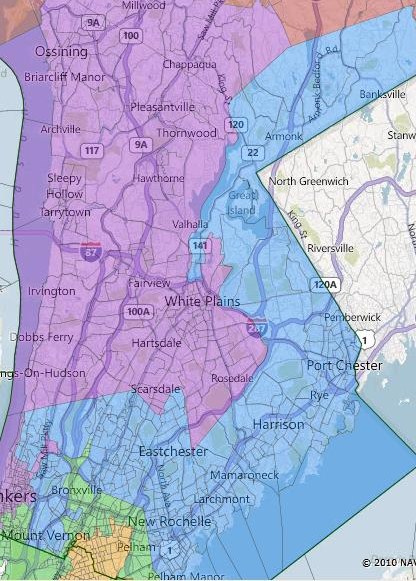
Possible 37th District
The result? It’s definitely feasible, but I think Republicans need to be ballsy enough to divide the City of Yonkers three ways to feel good about their chances. I’m not sure that’s even allowed under the state Constitution, as the language is fairly arcane. If it is permissible, then Republicans have a shot at drawing a somewhat-friendly 37th with minimal disruption to the lone currently-Republican district that includes part of Westchester, that of Greg Ball.
By removing heavily-Republican Eastchester from Jeff Klein’s district and placing it into the 37th, it becomes possible to connect the district to eastern Yonkers. This conservative, mostly middle-class section of the city features many of John McCain’s best Westchester precincts from 2008, and it voted reliably Republican enough to keep Nick Spano in the State Senate for almost two decades. By the way, there’s no relation between Nick and the aforementioned Andrew Spano; everyone in Westchester politics on both sides of the aisle is named Spano.

Lower Westchester closeup
The old Spano district, now held by Democrat Andrea Stewart-Cousins, compensates for the land-grab by taking in deep-blue Ossining and New Castle along the district’s northern border. She would still represent a healthy chunk of Yonkers, but the bulk of the district’s population would now be in suburban areas. Klein’s 34th would retain its current borders in the Bronx, Mount Vernon and Pelham, but would take in some heavily Hispanic areas in southern Yonkers. On the whole, his district’s character changes little, which fits the likely approach of Republican redistricters who are unlikely to displace their quasi-allies in the Independent Democratic Conference, of which Klein is the leader.
This new 37th gave Obama 56.8% of the vote, so it represents a roughly 8% improvement for the Republicans. If Cohen’s 2010 strength is ephemeral enough to be bowled over in a presidential year, that won’t be enough. But when one considers how difficult it is for Democrats to win Senate seats outside of the five boroughs, such a map probably creates a swing seat out of this lower Westchester territory. That’s not what Dems are looking for, a week after Republicans confirmed that they will be conjuring up a 63rd district out of thin air in the hopes of preserving their majority.
Roemer for 6th Place? Here’s Hoping.
New Hampshire feels like an interregnum, between an interesting Iowa and a possibly-climactic South Carolina.
I think Matt ably summed up what New Hampshire will look like when the results come in tonight: Romney gets an easy win, but he’ll still be hard-pressed to crack 40%. Nate Silver projects him to come in around 38.5%, and I’ll take the over on that – but just barely. It’s not as good as McCain’s 48% in 2000 or Reagan’s 50% in 1980, but it will surpass other recent winning New Hampshire totals on the Republican side.
Coverage this week has focused on three themes:
- Huntsman is generating some momentum, but too little and too late to ensure even a distant second-place finish.
- Santorum followed his Iowa surge by stalling out in NH ahead of what many see as a must-win in South Carolina. Santorumentum looks to be over unless he can get a head-to-head matchup with Romney in South Carolina (see below).
- There are still too many non-Mitts to derail Willard’s path to the nomination.
I concur with all three of these, as well as with the notion that New Hampshire was never really going to matter. New Hampshire, by virtue of being one of Romney’s de facto home states and by showcasing a slightly more libertarian brand of Republicanism, cannot serve as a winnowing force in the field. That’s apparently now the role of South Carolina, where Perry will make his last stand. One imagines that Santorum and Gingrich will also both head to SC, with one perhaps dropping out and endorsing the other sometime between now and January 21st. I’m not betting on it, though. The idea that conservative leaders will coalesce around a non-Romney in time to do some damage in SC is somewhat plausible, but the idea that individuals as stubborn as Newt or Santorum would subsume themselves for the good of a wider movement strikes me as laughable – even in the context of their mentor/protege dynamic. Newt was a distant 4th in Iowa, and that was an opportune time to drop out if he wanted to give Santorum some space. He didn’t.
I’ll conclude with the estimates – whereas in Iowa I was banking on Santorum outperforming his polling by a decent margin (and he in fact exceeded even my generous figure), I don’t see anyone doing so tonight.
Mitt Romney: 39%
Jon Huntsman: 19%
Ron Paul: 18%
Rick Santorum: 12%
Newt Gingrich: 10%
Buddy Roemer: 1% (I overshot in Iowa on this one…Buddy won’t let me down this time.)
Rick Perry: 1%
Others – <1%
‘Twas the night before Iowa…
In less than 24 hours, we should know the outcome of the Iowa Republican caucuses. It’s less likely that we truly know what that outcome means, though: polling basically shows a three-way tie between Mitt Romney, Ron Paul and Rick Santorum and I think that we’ll have a result pretty close to that, which will mean that the most a non-Romney winner could claim is some momentum – nothing approaching a decisive win. And the most Romney could claim is that he barely won against deeply-divided opposition, and that he still has a great deal to prove going forward.
Over the past few days I have been able to convince myself that any of the three will come out on top.
Rick Santorum, because of his late momentum – to use a cliche, he’s peaking at the right time, when it’s too late to really come under attack from his opponents or be savaged by the press. The possibility exists that enough Bachmann and Perry supporters opt to go with a (potential) winner and move their votes to the man who most easily passes for their next-of-kin. Familiarity with Santorum, borne out of the man’s near-residence in the state this year, has resulted in the highest Iowa favorability of any of the Republicans in the race and could get him over the hump.
Ron Paul, because we have always been told that organization counts a great deal in Iowa, because we have seen how organization counts, and organization he has in spades. He’s doing a late fade after his brief surge, but Paul’s floor has always been stable.
Mitt Romney, because he never fades, because his opposition is not up to the task of mounting a sustained offensive on the openings he provides, and because – most importantly – Mitt said Monday that he was going to win. I’m not being tongue-in-cheek; I think that really is important. More on that below.
I will not, under any circumstances, give Gingrich a shot at winning this thing. The ridiculousness of watching a man concede defeat, only to hours later start talking about compound sentences and how he may indeed pull of a historic upset, rivals only that of watching Rex Ryan incorrectly assess his team’s playoff chances at a post-game press conference. For Gingrich, we’ve already moved into the post-game. Yet, does his book tour require him to press on for now? His egomaniacal desire to be able to declare that he influenced the course of debate may also necessitate appearing in another couple of debates. And he would certainly lose face among conservative opinionmakers by bailing before New Hampshire after receiving that state’s most promiment newspaper endorsement.
Likewise, Bachmann and Perry are done. Bachmann isn’t getting out of the high single-digits in current polling, she’ll probably end up bleeding even more supporters to Santorum at the very end, and she has no money to continue after this. Her campaign will end tomorrow in the state where she was born. As some of my family members pointed out to me on Christmas Eve, when the discussion around the wood stove turned to politics, she didn’t flame out as spectacularly as Perry or Cain or even Gingrich. She couldn’t raise money, and she couldn’t hold on to staffers, but her relatively quiet rise and fall are a distinct phenomenon from other other one-time pack leaders.
Perry, on the other hand, may continue past Iowa because he has the money to do so and because South Carolina looms as a potentially friendly environment for the Southerner to mount a final stand. But more likely, the Santorum surge finishes Perry and dooms him to single-digit performances in Iowa and any other states he contests.
That leaves Jon Huntsman, who has maintained a laser-like focus on New Hampshire but is stagnating there even as his opponents are encamped in Iowa, and Buddy Roemer, the oft-forgotten former Louisiana governor whose populist, shoestring campaign has not caught on anywhere. Both do register a bit of support in most Iowa polling, so I include them in my final call.
So my prediction – or perhaps best guess – about Tuesday’s final numbers:
Mitt Romney – 25%
Rick Santorum – 23%
Ron Paul – 21%
Newt Gingrich – 12%
Rick Perry – 9%
Michele Bachmann – 6%
Jon Huntsman – 3%
Buddy Roemer – 1%
There’s nothing earth-shattering there, though clearly I’m buying into the idea of Santorum finishing even stronger than his current polling shows, by claiming a good chunk of the undecideds and nipping a point or two from Gingrich/Perry/Bachmann. And I think Romney wins with a lower percentage in the Iowa caucus than we’ve seen in the modern era – even lower than Bob Dole’s 1996 showing.
Why do I see Romney hitting 25% and taking the win, despite failing to reach that mark in any of the four weekend polls? I’m putting a lot of credence in his Monday statement that “we’re going to win this thing.” Yeah, I know a campaign aide later said he was referring to the nomination, but the context of the statement was clearly about Iowa, because he immediately followed by referring to “other states.” Mitt’s campaign has been marked by limiting Iowa expectations while raising expectations everywhere else. They’ve been remarkably disciplined in this approach. Mitt rarely goes off-script, in part because emotion is what makes you go off-script, and emotion is not what Mitt does. That the words came out of his mouth, even in the heat of the moment, even on the eve of a major election, when candidates are tired and raw, tells me that Mitt believes their organization will get the job done on Tuesday.
The ordained Republican frontrunner usually – well, always – wins the nomination. But he rarely wins Iowa. I think this is the year that changes, and that Romney wins despite never really planning to do so.
But don’t count out the two guys still standing – Paul and Santorum – who actually engender some enthusiasm among Republicans. And tell us what you think in the comments.
 Within the Margin