Archive
The Eyes Wide Open Election, Part 1: Acknowledgement
My thanks go out to a longtime friend for describing the “eyes wide open” nature of this election. I think he nailed why this result hits the way it does for those on the losing side – even if all available data showed defeat was as likely as victory, if not more so. This one lacked the newness of Trump’s 2016 campaign; it lacked any subtlety. Whether one believes his talk of mass deportations and retribution against political enemies or not, he campaigned loudly and clearly on these items and gained support along the way – ending up more popular than at any point previously, albeit still underwater with the American people.
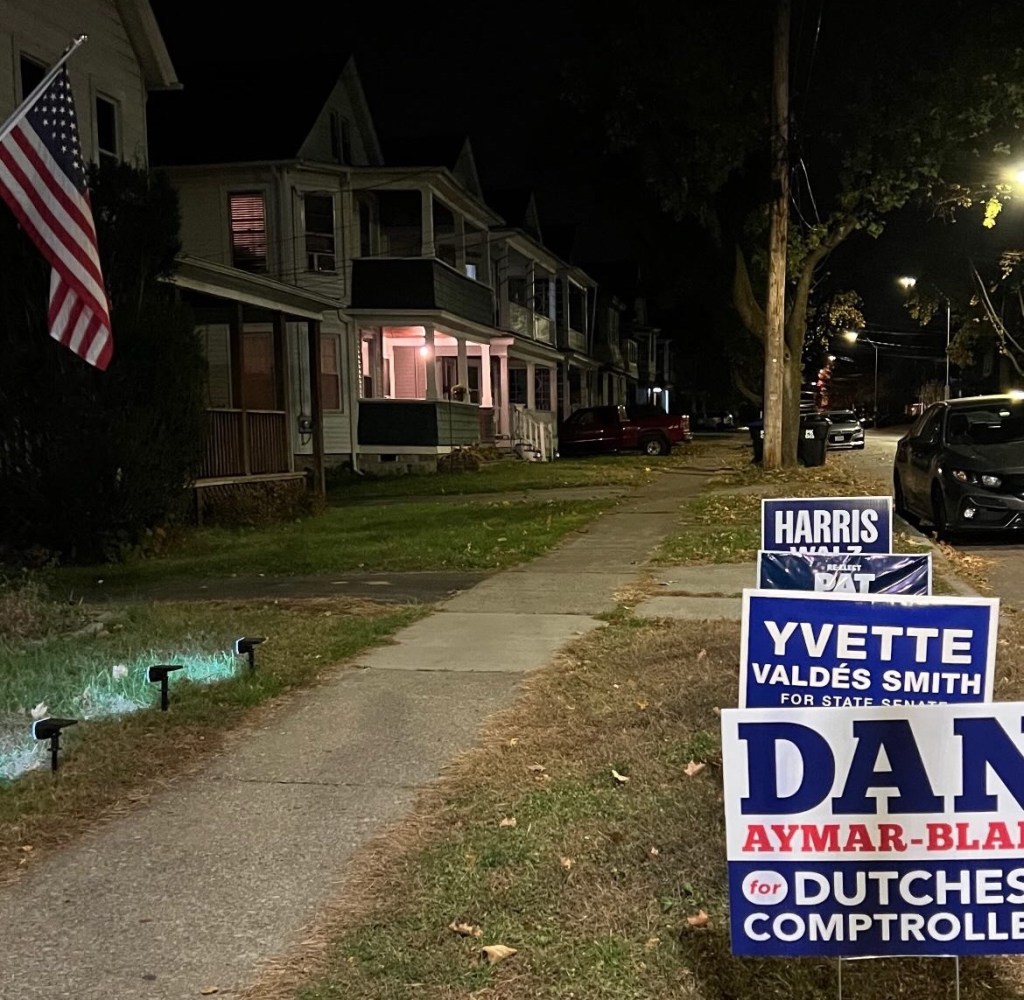
In 2016, one could plausibly argue that his rhetoric was a means to an end, and that he would govern differently. Even in 2020, one could still argue that there was a limit to Trump’s self-aggrandizing behavior – though unlike me, my mother was among those who correctly anticipated he would not engage in a normal, peaceful transfer of power. To take one piece of a much larger puzzle, Trump’s campaign this time not only dismissed culpability on his part for the violence and vandalism that took place on January 6, 2021 – he pledged to pardon those who carried it out. We once again have a president who through his rhetoric and actions expresses a view of the presidency as a vehicle to enrich allies and punish enemies, a Supreme Court that has ruled he cannot be held criminally liable for any actions he takes as president, and an ever-growing base of support for him: from just under 63 million votes in 2016 to 74 million in 2020 to a little over 77 million in 2024. I’m not particularly exercised by claims that the media failed to properly elucidate the stakes of this election, or that people “voted against their own interests.” Those 77 million people aren’t making their decisions based on New York Times and Washington Post headlines. Nine years into this experience, most voters know what kind of person and president we’re dealing with here, and enough of them have gauged it’s in their interest to back him that he keeps increasing support both in raw numbers and in his share of the electorate. To the extent they anticipate consequences to Trump’s policy plans and political project, they foresee those consequences helping and hurting the “right” people. Their eyes are wide open, and our eyes ought to be as well.

I suppose mine were, not that it alters my emotional response to the results. I felt by March of this year that Joe Biden was headed to defeat. His State of the Union performance was pretty solid and stopped the bleeding for a bit…only for the worst debate performance in modern times to re-establish the tenuousness of his position. After weeks of stubborn deliberation, he finally stepped aside in late July so Kamala Harris could make it a ballgame – and she did. That said, she was unable to open comfortable leads in any of the swing states. When our trio of analysts here at WTM started our Race Ratings spreadsheets in September, I had Trump winning the electoral college, 281-257. Over the next month, I expanded his lead in my ratings to 312-226 as I moved Michigan, Nevada and Wisconsin into the Trump column. As the final weekend of the campaign drew to a close and Harris appeared to be finishing stronger, I moved MI/WI back to Harris, leaving Trump winning 287-251 on my final map.
As I noted at that time, the “official” WTM map showed a Harris win – because my optimistic colleagues outnumbered me. But from March through November, I rarely if ever had Harris reaching 270 electoral votes. I could see arguments for Harris outperforming her polling – in particular, I thought her campaign infrastructure and closing message were stronger than Trump’s outsourced, fraud-riddled voter contact efforts and his at best unhelpful rally at Madison Square Garden that highlighted the cesspool that orbits around him. But while that path was plausible, I believed throughout the fall that Trump had advantages that could and probably would narrowly offset those deficiencies. And lo, they did.
***
If there’s one thing the last few months have shown us, it’s the limited value of immediate post-mortems following an election. For one thing, they start much too early. 10 pm on Election Night? Too early. Late November? Still too early. Even setting aside the fact that truly granular, enlightening analysis requires a look at the voter file to see who actually showed up to vote where, it took a while to get final raw numbers. Some states count efficiently and others do not; some states have generous ballot-curing laws that allow voters to correct mistakes on their mail ballot envelopes so that election administrators can confirm they are legally cast and subsequently count them. Various tranches of votes get counted on varying timelines in each state, resulting in a somewhat picture on election night than once everything is counted weeks later. Trump’s share of the vote was around 51% on election night; it ended up below 50%; he finished a point and a half ahead of Harris with the seventh-closest popular vote margin since the Civil War. Subsequent attempts to paint the election as a landslide are mathematically bizarre, ahistorical and reveal insecurities on the part of both the party advancing that notion and the stenography-oriented media outlets echoing it. But two things can be true at once, and it also the case that losing an election – however close – to a candidate with a demonstrated preference for Orban-style illiberal democracy is an earthshattering defeat that reveals something about both the electorate and the defeated party.
It’s also now clear that in some of the cities and counties where Trump’s share of the vote went up substantially, he made little to no gain in raw votes: in those cases, the changes are due to drops in the raw vote for Harris relative to Biden. Note that none of that changes the reality that Trump gained vote share in every state and made notable gains in Democratic heartlands – there are indeed plenty of urban precincts where Trump gained in his raw vote total over 2020, contributing to him growing his raw vote total by more than three million nationally.
There are illuminating elements to this defeat. A couple weeks before the election, I mentioned to WTM collaborator Matt Clausen that losing the popular vote – as seemed a real possibility to me – would at least be clarifying for Democrats in some fashion. And indeed that popular vote defeat has come to pass. So this isn’t 2000 or 2016, where Democrats could point to the popular vote and say “but for the anachronistic electoral college, we’d have won.” Or point to an unfavorable court ruling, like 2000. Democrats have to reckon with the reality that while this loss was close, it was also comprehensive at both the presidential and Senate level. Comprehensive losses require comprehensive solutions – turnout played a role in this defeat, but so did persuasion. And those two concepts are more intertwined than some Democratic operatives are inclined to believe. George Packer makes note of this in his recent piece on “Democratic delusions” that can now be retired.
I think there is illumination to take in terms of campaign elements and strategy as well. The Harris campaign was better-funded and it had a stronger traditional ground game, as Matt and I wrote about on this site at different points. These either didn’t matter or didn’t matter enough. Or maybe the ground game was just bad. My understanding is that while the Harris campaign exceeded the nearly non-existent door-to-door effort of 2020, and had more offices in more places than Clinton in 2016, Dems were still a long way from having an organized campaign on the ground in every county in each presidential swing state. The 50-state strategy days of 2008 are a distant memory even though Democrats are quicky to point to how outgunned they are in the media environment. Every state, every county: if Dems believe that sustained, in-person voter contact is crucial in a world of local news deserts and polarized national media, they need to actually invest in it. For our part here at Within the Margin, we tend to think that simply demonstrating commitment to reaching every corner of the map itself addresses the common claim that Democrats are too far removed from too many voters and opens a door to dialogue.
 Within the Margin