A Tale of Two Maps: Presidential Edition
There’s a scene in the film Margin Call where an investment bank CEO played by Jeremy Irons observes that his role boils down to knowing what the “music” of the financial markets is going to sound like over time. As his company faces a financial crisis, he notes that at that moment he doesn’t hear the music at all – not a thing.
I’ve always liked that metaphor as it relates to those of us who have engaged with elections and campaigns. The three prognosticators at WTM have been around them as campaign staffers, advisors, volunteers, and close-up observers for a long time now. I think that I’ve personally gotten a lot better in recent years at hearing the music of a campaign and tuning down the inherent optimism that comes from having a rooting interest and in some cases being involved in the campaigns beyond simply voting for a candidate. 2022 was something of a triumph in the other direction, in that I knew as the campaign unfolded that the prevailing narratives were off and the presumed “red wave” was not actually forming. Yet I recognized that closer to home in New York it actually would be a redder year, though I missed the severity. I think in 2023, I could tell the way the music was playing in my home county: I anticipated flipping one county-wide seat, gaining three county legislative seats, and losing one. And that’s what happened, though Dems did even better than I expected in town races. All in all, good signs that I wasn’t getting lost in the cacophany of the miracles I was rooting for, while still seeing the victories that were achievable.
For the first six and a half months of 2024, the music I was hearing said the same thing as much of the polling: Donald Trump was in a considerably stronger position than 2020, and Joe Biden was in a vastly worse place…and steadily slipping. The fundamentals of consumer sentiment and an unpopular incumbent seemed to be feeding into each other. Biden couldn’t seem to create his own political weather, and swing voters’ skepticism was hardening. His State of the Union performance in March seemed to show he could still put together a solid set piece. He could still deliver a narrative and be quick enough on his feet to engage in repartee with opposition hecklers. It wasn’t a game-changer, but it seemed like it could arrest the slide. But June’s debate with the former president proved otherwise, and the bottom really began to fall out. An electoral map where Trump approached the electoral collage numbers of Barack Obama or Bill Clinton now seemed possible. That started to change when Biden withdrew from the race and Kamala Harris executed an incredibly successful campaign launch. Polling improved, of course, but something else did too: a second song was now playing alongside the other one. For all that Joe Biden’s record on domestic policy includes major wins – infrastructure investments, the CHIPS Act, prescription drug prices, a surprising “soft landing” where inflation came down without a recession – it didn’t feel like there was narrative heft behind it. There was no music to it. The Harris launch unleashed a torrent of optimism among Dems who knew a change was needed to a candidate who could make an affirmative case and put in the work – the rallies, the countless media hits, and, yes, the debate performance – needed to win this election.
But that didn’t change that the other music was still playing. And so for the final months of this campaign, it has hasn’t been that I can’t hear the music, like the Jeremy Irons character…it’s that I’m hearing two very distinct pieces of music at once. To torture the metaphor a little bit more, maybe the discordant, chaotic piece of music is just a little bit louder than the organized, cautious, hopeful piece.
People smarter than me have correctly noted that in such a tight election, it’s going to come up Trump’s way at least 45 times out of a hundred, and Harris’ way at least 45 times. It’s the other ten times that are harder to predict. That’s one way where it differs so much from 2020, when Biden’s polling lead was enough to withstand a historically large polling error – and indeed we got the large polling error, and Biden still got the win. This time, a normal polling error in either direction would give either candidate a fairly comfortable win. And there’s not much reason to believe the polling error would be in Trump’s direction, like it was in 2016 and 2020, as opposed to the Dems’ direction like it was in 2012 and various 2022 midterm races.
But as I said above: I think one set of music is playing loud enough to win just a little more often. And so we get this map from me:

It’s not a massive Trump win. It’s fewer electoral votes than his 2016 victory. But it’s enough to win. Let me hit on the seven swing states, and then make another couple of observations, and then show you the Matt/Jim map.
- Michigan: This is a state where Harris has led more often than not and where we get a double-whammy in terms of ground game: the Harris campaign is better organized than Trump’s turnout operation nationally, and in Michigan the state Democratic Party is effective whereas the GOP is in disarray. Inflation has hit the Midwest to a lesser extent than other parts of the country, and the polling in non-swing Midwestern states shows Democrats holding up well. Even if it’s effectively a polling tie, the combination of late-breakers with less of an economic argument against Harris plus the strong organization on the ground gives her the edge. I think Arab-American abstentions or third-party votes will be impactful, but that’s priced into polling.
- Wisconsin: Most of the same factors as Michigan, but the disparity in organizational effectiveness among the state parties is even greater. Ben Wikler’s Wisconsin Dems are very good at what they do in statewide elections, and I suspect that provides an extra edge – along with the fact that so much of their coalition is high-propensity voters. As with Michigan, Ron Brownstein has noted that the share of white working-class voters has dropped here since 2020, and I think that puts Harris in a good place here despite how incredibly close the Badger State was four years ago.
- Pennsylvania: Pennsylvania has largely been fought to a draw. I think the attention given to the party registration changes here are a bit overblown, as Democratic registration trends still look solid in the largest and fast-growing counties. I suspect Trump’s Madison Square Garden rally has set back or even reversed any inroads he was making among the state’s large Puerto Rican community. But I also think the mood music in the Keystone State has been problematic in terms of election administration stories in Bucks and Lancaster counties that contribute to confusion and the general sense among Trump-curious voters – however inaccurate – that the system disadvantages him somehow. Of the states I have Trump winning, this is the one where I’m least confident, by far – and with 19 electoral votes it’s the difference on my map between winning and losing the entire election.
- North Carolina: There are reasons to believe Harris is finishing strong here, and there may also be some folks in red-leaning counties who are unable to prioritize voting while digging out from the horrible damage wrought by Hurricane Helene. I hate to even raise that in a horse race electoral context. But even accounting for that, this is a state Trump won in 2020, and making up a point and a half in a country that seems, on the whole, a little bit more Republican than four years ago is a big ask. I think North Carolina will be even closer than 2020, but Trump holds on.
- Georgia: I expected Democratic momentum here to continue into the 2020s, given the favorable demographics of a fast-growing, diverse population with a lot of college-educated transplants. But while Harris has made up considerable ground here since replacing Biden atop the ticket, I can’t ignore that she continues to trail and that the campaign seems to have given more time down the stretch to North Carolina.
- Nevada: As the Obama/Reid era of Democratic dominance fades from view in Nevada, elections have been getting tighter and tighter here. We’re talking about a state that was hit harder than most with price increases, with a population heavily tilted toward working-class, often transient people – including, it seems a lot of people fleeing California’s housing shortages and even higher costs. However misplaced the blame for high prices might be, the reality is they’re feeling it. Coupled with Trump’s inroads among Latino men, and the early/mail voting numbers in the only state where we can actually divined something from them, and I think Trump edges it. Harris has a shot; Nevada elections guru Jon Ralston picked her to win by a few tenths of a point based on his intricate analysis of the turnout prior to today. But I think he’s expecting a slightly better election day turnout than we’re actually going to see in a state where voters feel like they’ve faced too many challenges in the last four years.
- Arizona: Like Georgia, I expected Democratic fortunes here to continue to shine post-2020. And in fact, Democrats won three major contests here in 2022: flipping the governorship and Attorney General while holding onto Secretary of State. But like Nevada, the combination of higher inflation than much of the country and the influx of conservatives from other states makes it difficult to see what Harris’s path would have been – and polling has consistently shown her lagging accordingly, though less than Biden had been here.
I can articulate countless arguments to the contrary:
- The organized, professional Democratic turnout operation reaches more of their low-propensity voters than Trump’s, and is worth more on the margin even than I’m predicting above. Matt emphasized this in the piece he published for the site overnight. Check it out here.
- A Dobbs effect that pollsters (besides Ann Selzer at the Des Moines Register) are missing, where women make up an even larger and more Democratic share of the vote than usual, perhaps with crossover support from Republican women – though pollsters largely saw this in 2022, so it would be unexpected for them to miss it now,
- Or the inverse: the “manosphere” voters who the Trump campaign is relying on are generally low-propensity voters and that’s always a risky bet. If they don’t show up in substantial numbers – and they certainly aren’t getting doorknocks or phone calls nearly the way Dem voters are – that gives Harris more margin for error.
- Haley voters (or some other kind of Trump-skeptical Republican – support Harris in larger numbers than pollsters are seeing. The Trump campaign certainly didn’t make much use of her offers for help down the stretch. What carries more weight – her dog-bites-man endorsement of him, or the anger toward Trump felt by those who voter for in the GOP primaries – often in sizable numbers even after she had exited the race?
- Harris has shown signs of making up some of the ground Biden had lost with Black and Latino voters. If she gets something like 2020 turnout and 2020 margins – in defiance of polling and metrics – she’d be in great shape.
- Maybe polls in general have been too Trump-friendly as various surveys attempt to avoid a repeat of their 2020 misses. Smarter folks than I have pointed out the issues with weighting to re-create something like the 2020 electorate, and there’s been so much herding in the final weeks where pollsters just show a tie or a one-point lead in state after state because they don’t want to stand out or be assailed for a miss. Of course, they could also be herding away from a clearer Trump win – though there’s less reason to assume that given that pollsters are trying to correct that.
And countless others I’m forgetting. Those reasons and more are why the other two-thirds of the Election Ratings posse here at Within the Margin are much more confident of a Kamala Harris victory. Jim and Matt have her sweeping the swing states, for 319 electoral votes:
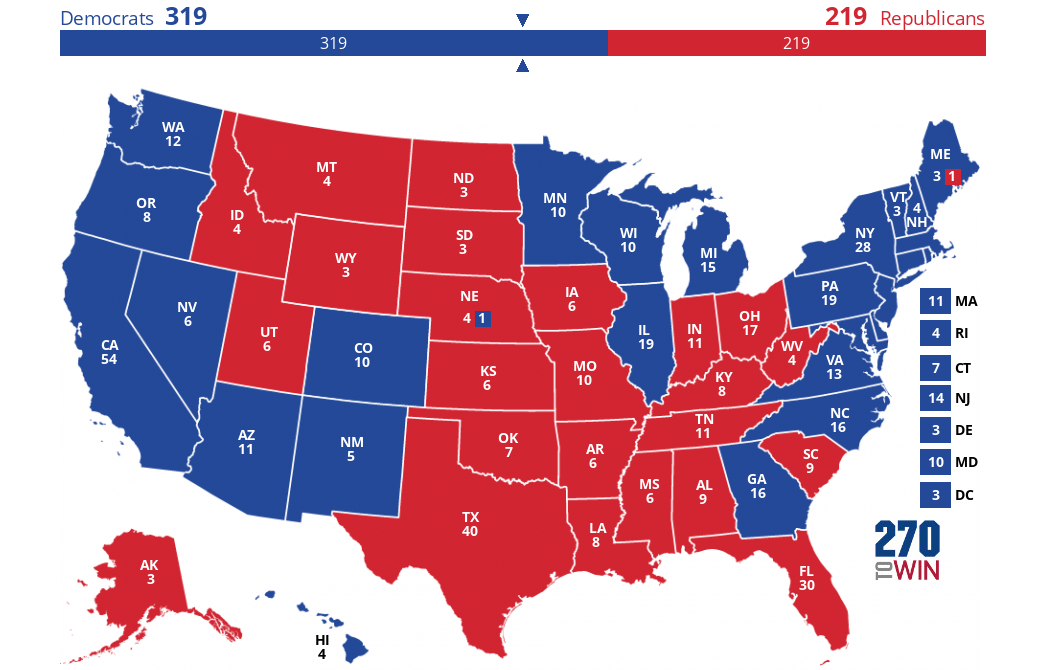
I like that map quite a bit, and I can see where they’re coming from. We’ve been talking this through for months, after all.
Let’s see what happens. It feels weird to leave it at that given the stakes – but that’s a very different conversation. Thank you all for reading. We’ll see you in the coming days.
-
January 31, 2025 at 10:10 pmThe Eyes Wide Open Election, Part 1: Acknowledgement | Within the Margin
 Within the Margin