State of Play: New York
There’s always some risk in stepping back and analyzing elections in your own backyard. It’s more personal, so you’re at greater risk of seeing what you want to see. You might offend people you actually know who’s involved locally, or you might do your readers a disservice by refraining from an observation so as to avoid doing so. And let’s face it: New York Democrats are in a sensitive place these days. The 2022 statewide elections were much closer than they’ve been accustomed to, and things went poorly downballot. 2023 brought something of a rebound in local elections – particularly in the Hudson Valley. But ongoing questions remain about Democratic erosion with non-white voters, as well as the state party’s ability to adapt to a changing political landscape. With half a dozen truly competitive Congressional races here, the stakes are high for the party. Less so for Within the Margin, but we still like to get things right – whether it’s our backyard or across the country.
Discussion around New York politics too often hinges on an upstate/downstate dichotomy that tells an incomplete story. Democrats have carried “upstate” – however defined – in plenty of 21st century elections, so the idea that “…but for NYC, Republicans would win” is as statistically illiterate as it is dismissive and unrealistic. Upstate NY is full of very Democratic cities – Buffalo, Rochester, Syracuse and Albany all have populations of 100,000 or more and each gave Biden at least 77% of their 2020 vote. Many of their suburbs have shifted left since the 1990s and especially so in the Trump years. Additional outposts like Schenectady, Binghamton and Ithaca provide additional Democratic strength upstate, while Saratoga County shows signs of becoming a bluish shade of purple up and down the ballot.
Long Island moves around quite a bit: it embraced Obama, then turned on him; its 2016 openness toward Trump quickly soured and punished numerous downballot Republicans; 2021 through 2023 were a bloodbath for Dems before Tom Suozzi’s special election victory this year marked the potential start of a turnaround. The Hudson Valley is a different kind of swing area, with small formerly industrial cities and picturesque towns oriented toward agriculture, the arts and recreation that have attracted transplants for decades. Whereas Long Island’s Republicans tend toward moderate positions on gun safety, that’s taboo further north. Hudson Valley Republicans are increasingly diverging from their Long Island counterparts on environmental moderation as well. At the same time, though, the more stridently progressive strain of Democratic politics found in parts of the Hudson Valley provide Republicans a bit more opposition fodder than the Suozzi style of Long Island Democratic centrism.
The Presidency – 28 electoral votes
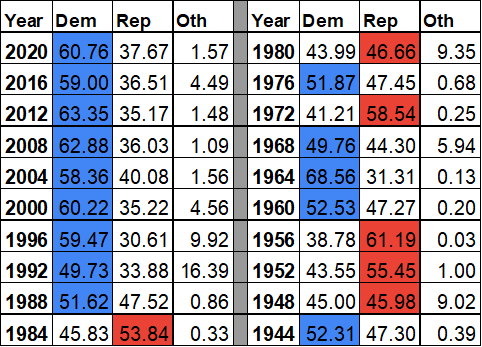
In the latter decades of the 19th century, presidential contests were typically as close-run as they’ve been in the first two and a half decades of this one. But in that earlier era, the country’s then-largest state was also a highly competitive one in presidential races: from 1864 through 1892, the largest winning margin in New York was Ulysses S. Grant’s 6.5% in 1872; the rest were all decided by three and a half points or less. During that period, New York also alternated each cycle between favoring the Democratic and Republican presidential nominees. The Empire State became a more reliable part of the Democratic coalition during the New Deal, but it also voted for Dewey, for Eisenhower twice, Nixon once, and Reagan twice. The 1990s are when it began to pile up massive majorities for Democrats in federal races, in part as a reaction to an increasing dominance in the GOP of Evangelical Christians from other parts of the country. The largest Democratic win here, as in most states, was Lyndon Johnson’s in 1964 with over 68% of the vote. But the rest of the best come more recently. Barack Obama’s 2008 win is next, when he carried New York by more than two million votes, followed by his 2012 re-election with 63.35% and a 1,995,381-vote margin. Joe Biden comes in fourth, at 60.76% and a 1,992,889-vote margin. Biden improved over Hillary Clinton almost everywhere, flipping four counties she had lost (Broome, Essex, Rensselaer, Saratoga) and coming within a few hundred votes of flipping Ontario, Orange, Suffolk and Warren as well – he lost them by a combined 435 votes, a few hundreds of a percentage point across the four counties. Another 419 votes separated him from Trump in Cortland County. The only places he fared notably worse than Clinton were Rockland County and New York City, where his vote share dropped in each borough outside Manhattan.
It will not be quite that kind of a win for Kamala Harris. For one thing, the mild erosion Biden saw in NYC – particularly pronounced in Latino neighborhoods and Haredi Jewish communities – in 2020 seems likely to continue, based on recent city council races, city polling confirming some dropoff, and national polling showing Harris struggling with Latino voters – though improving over where Biden was in the summer when he departed the race. The three biggest Republican talking points in this campaign – inflation, illegal immigration and crime – are acutely felt in New York right now, though it’s worth noting that only one of those actually has a statistical basis: inflation has indeed been higher here than many states. But the influx of migrants is the result of Republican governors dumping human beings here as a political stunt before joining Trump is demanding Congress kill a very conservative border security fill rather than fixing the problem. And violent crime in NY is once again plummeting, as it has been around the country for decades save for a brief pandemic-induced increase.
Another reason: New York’s state government and in particular Governor Kathy Hochul are unpopular right now and there’s a vitriol toward her that seems to go beyond the normal Republican griping about living in a high-tax, high-regulation state and beyond specific Hochul actions. It’s a dynamic for another piece, another day. But I suspect there are voters for whom federal, state and local politics used to be less-entwined who will vote against Harris as a way of voting against Hochul, crime policies, years-ago pandemic restrictions, and so on. The 2022 dynamic was amorphous, and it took some nuance to piece together how Trump could get demolished here but his acolyte and close ally Lee Zeldin could put together the best vote share for a GOP gubernatorial candidate since 2002. But it’s not clear that this somewhat nebulous anger has subsided, either.
On the other hand, WTM colleague Jim Kane notes that the gubernatorial swing map – showing how counties moved in terms of vote share from 2018 to 2022 – points to a geographic element that might be somewhat Hochul-specific. After a very long line of governors from Westchester and NYC, she’s the first governor who hails from a place north of the Bear Mountain Bridge since FDR almost a hundred years ago. Might she be struggling a little bit more downstate as a result? On the map below, districts are colored and shaded according to the direction and magnitude of their 2018-2022. The only district that swung toward Hochul is the Albany-area 20th; her predecessor Andrew Cuomo was despised throughout his tenure for his actions with respect to the state workforce and the pension system. The rest of upstate is a light shade of red…and everything from the 17th district south is deeper shades of red.

I’d argue that proximity to NYC makes the downstate and commuter region more susceptible to GOP narratives about uncontrolled crime, but it’s worth considering the possibility that Hochul resonates with voters less the further you get from her home base in Buffalo.
So you have a 61%-38% presidential win for Dems followed by a 53%-47% win in the gubernatorial race. These are vastly different results. Polling has shown Harris steadily improving on the poor margins Biden was posting in New York before he dropped out of the race in July, but still not matching his 23-point win. How big a drop will it be? In a state with a huge non-white population, the erosion pollsters are seeing nationally for Dems with non-white voters could move the dial here quickly. It’s not going to be a single-digit race like the Hochul/Zeldin election – will it be 15 points? 19? How much is the drop from 2020, and how concentrated is it in safe areas, minimizing the impact downballot? And will Republicans come out of this year feeling like they’re closer to a statewide win in New York?
2024 Rating: Safe Democratic
Senate Deliberations
Kirsten Gillibrand (D) vs. Mike Sapraicone (R)
Previous Senate results: 2022 – Chuck Schumer (D) 56.7%, Joe Pinion (R) 42.7%; 2018 – Kirsten Gillibrand (D) 66.96%, Chele Farley (R) 32.98%
We’re coming off the closest Senate race in NY since 2000, but Republicans made no real attempt to contest this next one. Mike Sapraicone is a retired NYPD detective, former school board president, and founder of a security services company. It’s not a bad resume, but he’d be better off starting with a state legislature or Congressional bid; scaling up to a statewide race is a huge ask. And identifying himself so closely with a presidential candidate who will lose the state handily is not a good strategy – but I assume he’s thinking in terms of a future GOP primary. And I suspect he’s in a bit of a Long Island Republican echo chamber that thinks Trump is an electoral god.
Kirsten Gillibrand has won three Senate races handily, after flipping and holding a Congressional seat in the upper Hudson Valley and lower Adirondacks in 2006 and 2008. She’s a progressive and a workhorse, best known for an assiduous focus on providing health benefits for 9/11 first responders sickened or injured by their work on the pile. She has also labored for years to limit stock trading by members of Congress, and gained a high-profile co-sponsor for her STOCK Act 2.0 in the otherwise-odious Josh Hawley. It’s the type of bill that would help restore some faith that Congress is interested in us, and not simply their own security and enrichment. Gillibrand performs better upstate than just about any other statewide Democratic candidate without sacrificing support further downstate and seems to have a good formula for appealing across the aisle while still maintaining rock-solid progressive credentials. She won’t have quite the same margin of victory this year as her previous races – the state is in a different place now politically. But it won’t take very long on Election Night to confirm her victory.
2024 Rating: Safe Democratic (hold)
House Calls
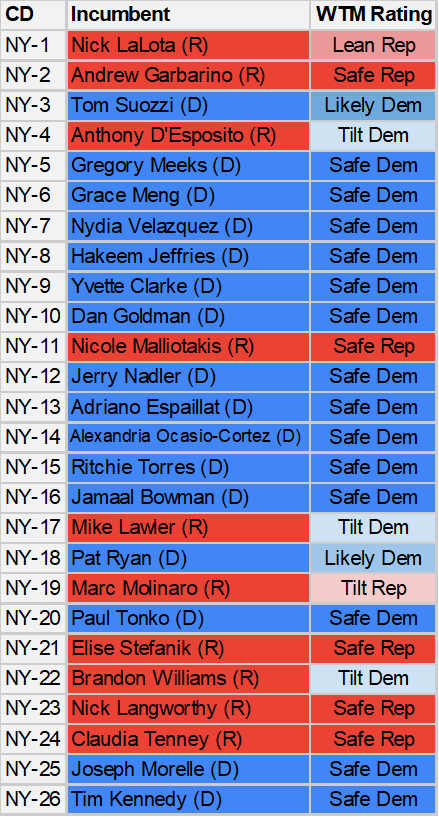
After the state legislature’s efforts to draw a Congressional district more or less in line with the suggestions of Democratic Congressional Campaign Committee chairman (and then-Congressman for the mid-Hudson Valley, Sean Patrick Maloney) crashed and burn in a series of legal defeats, a special master was appointed by a Republican judge to draw the maps for the next decade. The special master made odd choices here and there, but the districts were mostly compact with plenty of competitive seats – and indeed four of them flipped to Republicans. One, captured by noted fabulist George Santos, has already flipped back to Democrats in a special election following Santos’ expulsion from the House after his federal indictment. For 2024, the state courts decreed the “independent” redistricting commission should take another shot. They furnished a ridiculous incumbent-protection map, which the state legislature promptly rejected. Lawmakers drew a new map with modest changes, but without the dubious features of the commission map. Its biggest change comes in Central New York’s 22nd district, as we’ll discuss below. What doesn’t change is that New York is arguably the biggest House battleground this year, with seven competitive seats (if we include the just-about-safe NY-3). Their profiles follow below.
NY-1 (Eastern Long Island, including Northport, Smithtown, Port Jefferson, Riverhead, Shelter Island and the Hamptons)
Incumbent: Nick LaLota (R, elected 2022)
2022 House result: Nick LaLota (R) 55.5%, Bridget Fleming (D) 44.5%
2020 Presidential result: Trump 50.3%, Biden 48.5%
The Hamptons are the best-known part of the 1st, but they make up a fraction of the district’s population. Elections here are won and lost in the much more populous and swingy towns of Huntington and Brookhaven, each of which have most of their population in this district and make up about 64% of the total population. Reliably red Smithtown is here, too, in its entirety, as are several smaller towns – Southampton, Riverhead, East Hampton, Southhold and Shelter Island.
Tim Bishop held this district for Dems for 12 years, including some comfortable wins. But after two tight wins, he faced conservative state senator Lee Zeldin in a rematch of their 2008 race. Bishop had worn out his welcome, Brookhaven was trending right, and Zeldin had been preparing for this race for a long time. This seat always felt like it was going to flip that year, and when it turned into a red wave, that sealed Bishop’s fate. Zeldin won by nine points and was re-elected three times without much difficulty. The idea that someone who identified so closely with Donald Trump could be competitive in a gubernatorial race seemed far-fetched at the outset, but Zeldin rode a law-and-order message and just kept closing the gap. Despite his longtime opposition to abortion rights and same-sex marriage, he claimed the mantle of social moderation, and enough voters believed him for him to get to 47%.
In the meantime, Babylon resident Nick LaLota was the new Republican nominee here and won comfortably over Suffolk County legislator Bridget Fleming. LaLota’s a Navy veteran, former elections commissioner, and Babylon resident. I note that again because Babylon, of course, is not in this district. LaLota promised to move into the district but two years later, he could not vote for himself in this election because he still doesn’t live here. He also seems to get distracted from his district: along with NY-4’s Anthony D’Esposito, LaLota spend an inordinate amount of time earlier this year campaigning in the special election to replace George Santos. The Republican candidate, Mazi Pilip, seemed unwilling or unable to field questions at campaign events – so LaLota and D’Esposito frequently spoke for her. It was an odd spectacle but I cannot vouch for whether it was noticed in LaLota’s district, or how it was received.
His challenger is John Avlon, a former CNN anchor and Daily Beast editor-in-chief. He’s also the co-founder of No Labels, a bipartisan group with GOP funders, but he hasn’t been involved with them lately. Avlon’s campaign offers an affirmative kind of centrism – there are themes of cooperation and compromise, but he also calls out bad faith and bullshit in a way we don’t always see from self-consciously centrist campaigns.
This district got slightly redder in the second round of redistricting. With Siena showing a close race in mid-October, that decision by state legislators may prove pivotal in the end. That poll also showed Harris and Trump neck-and-neck in this district, so Avlon does not face major partisan headwinds. LaLota has proven not to be as strong an incumbent as I expected, and while Avlon is a transplant, he’s something of a known quantity locally. We see LaLota as having the edge still, but Avlon’s late entry into the race has not held him back and this race seem to be getting closer as Election Day approaches. Matt rated it Tilt Rep; Jim and I have it Lean Rep.
2024 Rating: Lean Republican (hold)
Past flips: 1950, 1952, 1960, 1978, 1986, 1994, 1999 (party switch), 2000, 2002, 2014
NY-3 (Long Island’s north shore, including Glen Cove, North Hempstead, parts of Oyster Bay and Huntington, and northeast Queens)
Incumbent: Tom Suozzi (D, elected 2024. Previously served 2017 through 2022.)
2024 special election result: Tom Suozzi (D) 54%, Mazi Melesa Pilip (R) 46%
2022 House result: George Santos (R) 53.8%, Robert Zimmerman (D) 46.2%
2020 Presidential result: Biden 55.2%, Trump 43.8%
This district received outsized attention for the antics of one of its shortest-serving members of Congress. When Tom Suozzi opted to run for governor instead of re-election in 2022, Democrats nominated longtime political activist Robert Zimmerman; Republicans nominated their 2020 candidate, a self-proclaimed Wall Street financier and investor named George Santos. He had lost his race against Suozzi by 13 percentage points – 46,000 votes – but refused to accept his defeat, claiming ballot manipulation on a grand scale. He refused to leave the House’s freshman orientation sessions even after his defeat was certified. These should have been flashing red warning signs, but Republicans had taken a liking to Santos and he was unopposed for the 2022 nomination. Zimmerman was 68 and the Dem brand was suffering on Long Island worse than just about anywhere in the country; the younger, fresher Santos lived outside the district and had some other questionable elements in his campaign’s official biography – but only the North Shore Leader, with its tiny circulation, bothered to investigate and raise concerns. The various Democratic campaign organizations were asleep at the wheel, and Santos won by eight points.
Before long, the Santos narratives started to unravel. Shortly after being sworn in, he had colleagues from his own party – the one that asked no questions when nominating, endorsing and electing him – demanding his resignation. Then came federal indictments, a failed expulsion resolution, and finally a successful one. That set up a February special election to replace him – and this time, Democrats went with a proven candidate. Tom Suozzi was twice elected Nassau County executive, then served three terms in Congress as a moderate, normal dude – the opposite of George Santos, in other words. Republicans nominated Nassau County legislator Mazi Melesa Pilip. On paper, she was a fantastic candidate. Of Ethiopian-Jewish heritage, she served in the Israel Defense Forces. That’s particularly compelling in a district with as substantial a Jewish population as this one. But Pilip’s campaign failed to live up to the promise. She dissembled on key issues. Rather than answer questions at her own press conferences, she’d turn the microphone over to Long Island congressmembers Nick LaLota and Anthony D’Esposito. It sometimes felt like those guys were trying to win the race on her behalf. Voters weren’t impressed and they were primed to punish the GOP for Santos’ myriad scandals anyway. The 3rd returned more or less to its previous partisan leanings for a day and gave Suozzi a comfortable eight-point victory.
The district got even bluer in this year’s redistricting do-over. The Republican challenger is former state assemblyman Michael LiPetri, who served a single term in Albany before a failed Congressional bid in the old 2nd district in 2020. LiPetri is something of a lightweight and Republicans are consumed with other races on the Island, so Suozzi wins this barring a 2022-esque collapse for Democrats down here.
2024 Rating: Likely Dem (hold). Jim went Lean, I have it Likely, Matt rates it Safe. Averages out to Likely.
Past flips: 1974, 1992, 2000, 2022, 2024 (special)
NY-4 (southwest Nassau County, including Long Beach, Hempstead, Freeport, Valley Stream, Uniondale, Wantagh and the Five Towns)
Incumbent: Anthony D’Esposito (R, elected 2022)
2022 House result: Anthony D’Esposito (R) 51.8%, Laura Gillen (D) 48.2%
2020 Presidential result: Biden 56.8%, Trump 42.2%
A pretty good indicator of how dire things got for Democrats on Long Island in 2021 and 2022: Republicans flipped a seat Biden had won by fourteen and a half points, and while an upset, it was not completely unforeseen. It was clear the bottom was falling out for Dems here in the fall of ’22 – even if the degree of decline was surprising. This is Long Island’s bluest district, and it’s the site of a rematch of the 2022 contest.
The 4th is a pretty cleanly-drawn seat in the southwestern corner of Nassau County. It includes nearly all of the Town of Hempstead, plus the small city of Long Beach. Hempstead is a massive town of nearly 800,000 people, with a lengthy history of Republican politics at the town level but blue and purple pockets throughout. Long Beach votes Democratic at the presidential level, but a bit less so in the Trump Era (56% and 58.6% so far) than previously. The district’s bluest strongholds are inland: the villages of Hempstead and Freeport, the hamlet of Uniondale, and the parts of Valley Stream and Elmont along the Queens border. The reddest portions are mostly along the water (with the exception of Long Beach) – especially the formerly liberal Five Towns, with a large Orthodox Jewish population that tends to vote Republican.
The 2022 winner here was Anthony D’Esposito, a former NYPD officer and Hempstead councilmember. He defeated Laura Gillen, who in 2017 became the first Democrat elected Hempstead town supervisor in 112 years. She lost two years later, but remained a plausible Congressional contender when incumbent Kathleen Rice announced her retirement in 2022. She hit D’Esposito during his campaign for various complaints against him during his police career, but the electorate was more interested in rolling back police reforms that may have overreached. Their rematch was expected to be close, but D’Esposito’s a bit of a mess: he had an affair and then put his girlfriend on the government payroll in an unclear capacity…and did the same with his fiancée’s daughter. He has spent a fortune from his campaign account on steakhouses, booze and travel – perhaps not the best use of funds in a tight race, and perhaps an indicator to his constituents that he’s more of a partier than a workhorse. Gillen’s emphasizing the need to secure the southern border; D’Esposito is hammering her for taking campaign contributions from people who uttered the dreaded words “defund the police.” In late October, Siena found Gillen with a sizable 12-point lead (53%-41%) in a sign that D’Esposito’s misadventures were not being well-received by the public. Some hedging is required given just how dramatically Long Island has been shifting around politically in recent years, but Gillen has the edge to flip this seat.
2024 Rating: Tilt Democratic (flip)
Past flips: 1970, 1996, 2022
NY-17 (lower Hudson Valley: Rockland and Putnam counties; northern Westchester County including Peekskill, Mount Kisco and Sleepy Hollow; parts of southern Dutchess County including East Fishkill and Pawling)
Incumbent: Mike Lawler (R, elected 2022)
2022 House result: Mike Lawler (R) 50.3%, Sean Patrick Maloney (D) 49.7%
2020 Presidential result: Biden 54.5%, Trump 44.4%
The geographic bottleneck as you head south through the lower Hudson Valley toward New York City means that when the state has to eliminate a Congressional district due to the decennial Census, it ends up being the part of the state that’s generally gaining or holding population that misses out, rather than the much-slower growing or population-declining portions of the state further north and west. So it was that in 2022, two Hudson Valley incumbents found their districts combined: five-term Congressman Sean Patrick Maloney of Cold Spring in Putnam County, and freshman Mondaire Jones of Spring Valley in Rockland County. Maloney was DCCC chair in addition to his seniority, and prevailed upon Jones to avoid a primary. Jones made the unfortunate decision to run for an open seat in Manhattan instead, which he did not win. And Maloney went on to lose a very tight race to a freshman Republican assemblymember from Rockland, Mike Lawler. This year, Jones is back trying to reclaim the district he should never have had to leave, but now he faces obvious attacks for having decamped to Gotham.
This is decidedly suburban territory, albeit with copious state parkland and public reservoirs. Rockland County is the largest portion, with about 44% of its population. Historically Democratic but not overwhelmingly so, it was one of the few counties in New York where Trump fared better in 2020 than 2016 – thanks to a huge swing from the large Haredi Jewish population in the center of the county. Northern Westchester is about 39% of the district, and these days it’s quite Democratic. Even Somers and Yorktown flipped to Biden in 2020 as he dominated countywide.
Putnam County makes up about 12% of the district, and is the reddest county in the Mid- and Lower Hudson Valley, despite the presence of very blue Cold Spring and Garrison. The remainder of the district is in Dutchess County: the towns of East Fishkill and Pawling, and part of the town of Beekman. This part of the district is very red, but only about 5% of the total population.
Lawler is boundlessly ambitious, constantly appearing on cable news, and has worked to reassure his constituents that he’s supportive of abortion rights and in vitro fertilization despite countless votes to the contrary by his co-partisans…including some votes that he himself has cast. After splitting support from the district’s Orthodox Jewish communities with Maloney in 2022, he has all the rabbinical endorsements this time and can expect near-unanimous support this time around. Jones has to make up the difference with socially liberal, anti-Trump voters, and they’re plentiful (especially in Westchester).
Out of 435 Congressional districts, this one probably has the widest spread between our three forecasters. I think Lawler has played his hand well and talks a good enough game to persuade moderates that he’s with them despite this party’s extremism. Coupled with Jones having to overcome the sense that he opportunistically sought office in Manhattan, I think it’s too big a lift for Dems. I have this race as Lean Rep. On the other hand, Jim thinks the district’s lean in a presidential year is just too much for Lawler to defy, especially given the additional focus on the aftermath of the Dobbs ruling. He has this rated Tilted Dem. And Matt – a district resident – is confident that Jones has this: he rates it as Likely Dem. It averages out to a Tilt rating. This is one we’ll be talking about quite a bit on Tuesday night, given our diveragence of views.
2024 Rating: Tilt Dem (flip)
NY-18 (mid-Hudson Valley: all of Orange County including Newburgh, Middletown, Palm Tree and West Point; eastern Ulster County including Kingston; and most of Dutchess County, including Poughkeepsie and Beacon)
Incumbent: Pat Ryan (D, elected 2022)
2022 House result: Pat Ryan (D) 50.7%, Colin Schmitt (R) 49.3%
2020 Presidential result: Biden 53.8%, Trump 44.7%
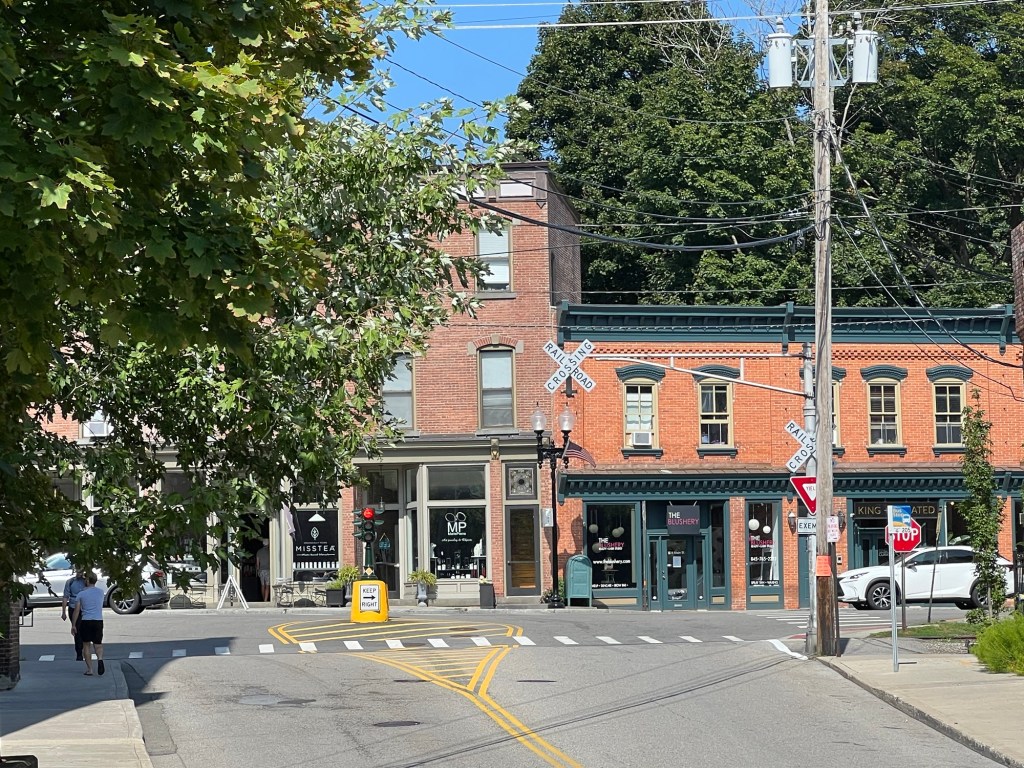
This is the district where two-thirds of the WTM ratings crew grew up and has lived most of our lives, including your humble author. There’s some post-industrial cities here, like Poughkeepsie, Newburgh and Beacon. There’s quite a few small, walkable villages. There’s iconic artist havens like Woodstock. There’s plenty of farmland, most notably the onion-growing Black Dirt country of western Orange County and the fruit and vegetable farms of northern and eastern Dutchess. And there’s plenty of suburbia, particularly in southern Dutchess and eastern Orange – along with three MTA commuter rails lines.
Orange County is the largest portion, with just over half the district’s population. After voting narrowly twice for Obama, Trump won it more comfortably in 2016. It moved almost all the way back to the blue column in 2020, with Trump only carrying it by 113 votes out of 172,539 cast – an infinitesimal margin of 0.07%. Dutchess is a third of the population. Most of the county is in the 18th, but a few rather red towns are in the 17th. Dutchess as a whole voted 54%-44% for Biden; the percentage is higher if you just look at the 18th’s portion. Finally, there’s eastern Ulster: it’s only about 16% of the district, but it’s the base of incumbent Pat Ryan’s strength and it’s deep blue. Politics in Ulster is increasingly progressive, with a sizable contingent of volunteers to power Democratic campaigns on the ground.
The first West Point graduate to be elected as his alma mater’s representative in Congress, Pat Ryan served two tours of duty in Iraq as a military intelligence officer. In 2018, he launched his first bid for office in the old 19th district, then held by freshman Republican John Faso. Ryan finished 2nd in a seven-way primary behind Antonio Delgado, who went on to defeat Faso. Ryan didn’t have to wait long for his next shot in politics: when Ulster County executive Mike Hein took a job in the Cuomo administration in 2019, Ryan entered the special election to succeed him and won easily; he cruised to victory for a full term later that year. When Delgado was appointed lieutenant governor in 2022, Ryan took another shot at the sprawling 19th as the Democratic candidate for an August special election. He defeated Dutchess County executive Marc Molinaro in a tightly-contested battle taking place in the aftermath of the Dobbs ruling. Whereas Ryan positioned himself as an impassioned supporter of abortion rights, Molinaro vacillated and clearly resented having to weigh in on Dobbs and the prospects for national bans or additional restrictions. Ryan won the special for a district that would not exist a few months later: the fall general election was fought on new maps, and Ryan’s home was now in the 18th district – which was also considerably bluer. He won a closer-than-expected victory over Orange County assemblymember Colin Schmitt, who had given a fiery pep talk to a busload of Trump supporters headed to the Capitol on January 6 and voted a consistently conservative line in Albany. A political obsessive with designs on one day being president, he held Ryan to a winning margin of a point and a half.
This year, Ryan’s opponent is Alison Esposito. A former NYPD officer who was born in Orange County but lived until recently on the Upper East Side of Manhattan, she was Lee Zeldin’s pick for lieutenant governor on his 2022 ticket. The National Republican Congressional Committee (NRCC) considered her a prized recruit but she hit the ground slowly in terms of fundraising. Nonetheless, they’ve continued to pour money into her race – mostly hitting Ryan on the same stuff as Molinaro and Schmitt before her: marching with “extremists” who wanted to “defund the police.” It’s important to note that the march they’re referencing was in fact a peaceful, bipartisan march in the summer of 2020 where Ryan walked arm-in-arm with Marc Molinaro. Dishonesty aside, Esposito’s profile is a mixed bag. The Hudson Valley is accustomed at this point to people moving here from the city to run for office, from both parties. At least she does have some Orange County ties. This is a part of the country that elects law enforcement veterans to public office all the time, so Esposito fits the standard in that respect. For his part, Ryan has been campaigning with the full spectrum of Democrats, from Alexandria Ocasio-Cortez to Kathy Hochul. He’s pretty confident in his own political skin and the district has an increasingly reliable Democratic performance, with its high turnout in places like Beacon and Rhinebeck. If Democratic fortunes are not collapsing, he should win again. Matt has him listed as Safe; Jim and I are Leans. That averages out just ever so slightly on the Likely side.
2024 Rating: Likely Democratic (hold)
NY-19 (parts of the Catskills, Capital Region, Hudson Valley, Leatherstocking Region, Southern Tier and Finger Lakes. Includes Ithaca, Binghamton, Oneonta, Monticello and Hudson)
Incumbent: Marc Molinaro (R, elected 2022)
2022 House result: Marc Molinaro (R) 50.8%, Josh Riley (D) 49.2%
2020 Presidential result: Biden 51.2%, Trump 46.8%
The 19th takes in parts of all of the regions mentioned above…and doesn’t quite take in the entirety of any of them. Stretching from Ithaca in the west to the Connecticut border in the east, this seems to have been the special master’s way of allowing other districts to be much more compact. That said, many of these counties have been tied together on Congressional districts over the years; this bears some similarity to the districts represented by Matthew McHugh and Maurice Hinchey from 1974 through 2012, and to some degree the more recent 19th district of the 2010s.
It’s highly competitive terrain. The university town of Ithaca and surrounding Tompkins County are quite blue – over 73% for Biden, and cities like Binghamton and Oneonta provide additional Democratic strength. Columbia County and the district’s portion of Ulster are deep-blue at this point. But Republican fight back in counties like Chenango, Delaware, Greene and Sullivan – though the latter saw a restoration of Democratic fortunes in local elections last year following a period of precipitous decline. There’s a rapidly growing Orthodox Jewish community in Sullivan that incumbent Marc Molinaro is closely aligned with and that might help offset the steady stream of often-liberal NYC transplants who have relocated deeper into the 19th as remote work becomes more feasible.
As mentioned above, Molinaro ran in the 2022 special election under the line lines and was defeated. He opted to run in the new 19th despite living across the river in Dutchess County since it was the redder of his options; he has since bought a home in Greene County. Molinaro has held elective office since 1994 when he was 18, without any gaps: mayor of Tivoli, county legislator, state assemblymember, county executive. Politics is what he does, and for a time, that tenacity combined with an instinct toward moderation served him well. That particular era of Molinaro is over now. He is increasingly aligned with Trump and helped shepherd the deeply conservative Speaker of the House, Mike Johnson, into his position.
That said, it should not be assumed that he cannot continue to win. Molinaro has carefully cultivated support in the district’s conservative strongholds and works most of the district very hard. He faces a rematch with Josh Riley, an Endicott native (with an IBM parent, in classic Endicott fashion) who returned home after a stint in D.C. working as a staffer for the Senate Judiciary Committee. Riley’s a good fundraiser, consistently outraising Molinaro, and his campaign seems to have found its stride down the stretch as he seeks to improve upon a very close defeat in 2022. Molinaro’s attacks lately are relying more on condemnations of state government, despite the fact he holds and is running for a federal office. Riley’s closing ad is a jaunty number talking about economic security, and the election results will make for an interesting test of what works better: Molinaro’s increasingly dark worldview versus Riley’s optimism. Jim and I have this as Tilt Rep; Matt went Tilt Dem.
2024 Rating: Tilt Republican (hold)
NY-22 (Central New York, including Syracuse, Utica, Auburn and Cortland)
Incumbent: Brandon Williams (R, elected 2022)
2022 House result: Brandon Williams (R) 50.5%, Francis Conole (D) 49.5%
2020 Presidential result: Biden 54.6%, Trump 43.2%
The industrial city of Syracuse went through a decline phase in the latter part of the 20th century like so many other manufacturing hubs, but it’s increasingly a high-tech manufacturing hub these days to go along with its strength in higher education and health services. Utica’s population is a far cry from its peak when it was a major upstate city, but it too has elements of a rebound in place – in part from integrating refugees from around the world. Madison County gives the district an agricultural stronghold; Cayuga County offers finger-shaped lakes and the wine and tourism that accompanies them.
Syracuse and Onondaga County make up 61% of the 22nd’s population, and it’s the bluest portion. Democratic presidential candidates generally get about 59% countywide, though the party has had more trouble when it comes to county and local offices, plenty of which are in Republican hands. About 18% of the district is in Oneida County, where Utica (smaller than it once was but still a decent-sized city) and Kirkland (home to Hamilton College) are the blue outposts in a sea of red. In between Onondaga and Oneida sits Madison County, which supported Obama twice but has given Trump 53-54% of its vote. The district’s portion of Cayuga County leans Republican but not overwhelmingly so; the tiny Cortland County segment includes the city of Cortland and its SUNY campus so Dems can actually carry the 22nd’s section of the county. On balance, you get a district Biden won by more than 11 points. This year’s redistricting made it a few points bluer than the 2022 version.
The various iterations of Syracuse/CNY districts have elected Republicans most of the time even as the region has become more Democratic; that in part owes to the person vote for someone like a John Katko who represented the district from 2014 through 2022. A former federal prosecutor, he held the seat with landslide margins as a somewhat moderate and consistently honorable, good faith Republican. That meant that he voted to impeach former President Trump for his actions on January 6 – and that meant Katko was finished as far as local GOP activists and committees were concerned. Katko retired rather than face a nasty primary.
Both parties set about contesting the seat. The winner, narrowly, was Trump-aligned Navy veteran and farmer Brandon Williams. He defeated fellow Navy veteran Francis Conole by a point. Williams has been a stridently conservative and partisan voice in the House, but he did push early and consistently for George Santos to resign and ultimately voted to expel his mysterious co-partisan. This year’s Democratic primary featured two-term state senator and former science teacher John Mannion and DeWitt town board member and former Air Force operations officer Sarah Klee Hood; Mannion prevailed, parlaying his longstanding organized labor ties into an edge in ground game. He’ll need more of that against Williams: as blue as this district is, it has a tendency to split its ticket. Williams is more conservative than the district prefers, so something has to give. We’re unanimous in thinking Mannion flips it, but narrowly
2024 Rating: Tilt Democratic (flip)
Past flips: 2008, 2010, 2012, 2014
 Within the Margin