State of Play: New Hampshire
[note: due to my own buffoonery, I’ve had this one done for a while but forgot to schedule it. So it’s publishing out of order. Obviously, it was supposed to go between South Carolina and Virginia.]

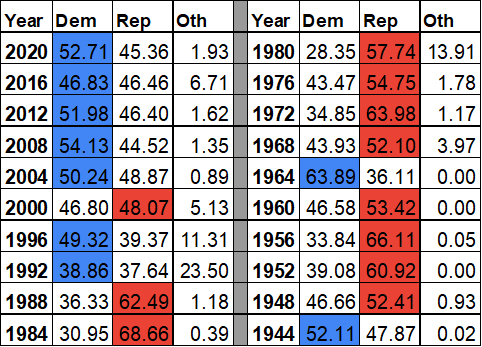
This is the second state in our series that looms large in presidential primary contests – but unlike South Carolina, it has also spent time recently as a swing state. It’s worth remembering that for all the talk of Florida in 2000, Gore would have carried New Hampshire that year if a third of Nader’s voters opted for him instead, and its four electoral votes would have given him 271 and the presidency.
2004 marked something of a turning point. New Hampshire was the only state that swung from Gore to Kerry, beginning a streak of five Democratic wins in a row here. John Lynch won the first of four two-year terms as governor that year – the only Dem in the state’s history to do so. Democrats flipped one of the Senate seats in 2008 and the other in 2016. The two Congressional seats went back and forth for a few cycles before settling into a Democratic groove. Both houses of the state legislature are GOP-held but narrowly; the executive council remains swingy.
The Presidency: 4 electoral votes
Historically, northern New England – Vermont, New Hampshire and Maine – was more Republican than southern New England. Vermont was generally populated by liberal Republicans while New Hampshire elected conservatives. These days, Vermont is Democratic and progressive; New Hampshire is swingy and moderate – though its state legislature’s unique nature and tiny district sizes results in a heavy quotient of cranks. After giving Republican candidates its electoral votes in ten out of eleven elections from 1948 through 1988, it has now gone with the Democratic nominee in seven of eight. 2016 was quite close, with Hillary Clinton prevailing over Donald Trump by less than 3,000 votes – 0.37%. Four years later, New Hampshire had one of the biggest swings in the country, with Joe Biden cruising to a seven-point win – and a margin of more than 59,000 votes. Biden’s position looked perilous here before he dropped out of the race, with the obvious implication that if Democrats were struggling here, the race was lost nationally. Kamala Harris reset things with her entry into the race, and polling mostly points to a repeat of 2024 here. Even as the Trump campaign makes late noises about putting New Mexico and Virginia back on the map, they’re not talking about New Hampshire. For our part, Matt has it listed as Safe for Harris; that’s a stretch but Jim and I are comfortable with a Likely rating.
2024 Rating: Likely Dem
Senate Deliberations
There’s no U.S. Senate election in New Hampshire this year. The next one will be in 2026, for Democrat Jeanne Shaheen’s seat.
House Calls
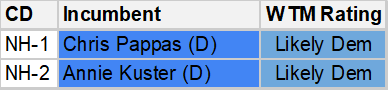
Republican state legislators attempted to dramatically change the state’s two Congressional districts in 2022, something that is historically not really done here. Their idea was to create one safely Democratic district and one safely Republican district, as opposed to the two moderately blue but basically competitive districts that were in place. With Republican governor Chris Sununu bucking his party and threatening a veto, a stalemate ensued before the state Supreme Court intervened and appointed a special master with minimal change to the 2010s map. So New Hampshire continues to have two seats that lean Democratic but could go Republican with strong candidates and/or a GOP-friendly national environment. This is not that year, so both seats are looking likely to stick with Dems – but a contentious primary in the open-seat 2nd district might have created a slight opening for the Republicans.
NH-1 (Eastern New Hampshire, including Manchester, Derry, Dover, Rochester, Merrimack, Portsmouth, Laconia, Conway, Wolfeboro)
Incumbent: Chris Pappas (D, elected 2018)
2022 House result: Chris Pappas (D) 54.0%, Karoline Leavitt (R) 45.9%
2020 Presidential result: Biden 52.2%, Trump 46.2%
The 1st includes the state’s largest city (Manchester), its flagship university (UNH, in Durham), its biggest lake (Winnipesaukee) and its stretch of Atlantic coastline. It’s much taller than it is wide, stretching from the Massachusetts border up to the White Mountains in northern New Hampshire. There’s quite a bit of maritime and industrial history here. Like many of the cities along the Merrimack River, Manchester was a major textile producer in its days as an industrial hub. Portsmouth, on the Piscataqua River, was an important seaport and shipbuilding town; much of its beautiful historic architecture remains and contributes to its draw for tourists. The southern portion of the district is a quick drive to Boston, but still feels distinctly its own rather than being part of a large metro area.
This has been competitive terrain for much of the last 20 years. When Democrat Carol Shea-Porter defeated Jeb Bradley in 2006 as part of that year’s national blue wave, she kicked off a back-and-forth tenure. Shea-Porter triumphed again in 2008, lost the seat to Manchester mayor Frank Guinta in 2010, took it back from him in 2012, lost it to him again in 2014, and won it back again in 2016. She retired in 2018 – a good year to pass the baton to another Democrat. In addition to owning a restaurant, Chris Pappas had already held several offices in state and county government by the time he ran for Congress that year at age 38, and in that friendly year he won by a fairly comfortable margin, 53.6%-45%. He won by five points in 2020 and faced a ballyhooed but flawed challenge in Karoline Leavitt in 2022. Leavitt had worked as a communications staffer for the Trump administration and then New York congressmember Elise Stefanik, so her MAGA credentials were solidly in order. That’s helpful in a GOP primary but less so in a general election; Pappas defeated her by eight points.
This year, the Republican nominee is former executive councilor, state senator and water treatment systems wholesaler Russell Prescott. He finished fourth in the ’22 primary but despite his extensive political experience, he’s been significantly outraised and outspent in this race. Dems don’t appear worried, and Reps don’t appear hopeful. We’ve got two Likely Dem ratings for this one, and one Lean Dem. Pappas should be fine this year unless the indicators showing Kamala Harris comfortably in front in the Granite State prove dramatically wrong.
2024 Rating: Likely Democratic (hold)
NH-2 (Western and northern New Hampshire, including Nashua, Concord, Salem, Keene, Berlin, Hanover)
Incumbent: Annie Kuster (D, elected 2012)
2022 House result: Annie Kuster (D) 55.8%, Robert Burns (R) 44.1%
2020 Presidential result: Biden 53.6%, Trump 44.1%
The 2nd includes arguably the most suburban piece of the state – Nashua, along the Massachusetts border – and its remote stretches, in the White Mountains and the border area with Quebec. Nashua (population 91,000) is the district’s largest city and was once a Republican stronghold of professional workers seeking refuge from Massachusetts taxes just over the border. George H.W. Bush won it 59%-39% over Massachusetts’ own Michael Dukakis in 1988. But Republicans have not won it at the presidential level since that year, and Joe Biden delivered his party’s biggest win so far by matching that 59%-39% margin in 2020 (and with a substantially larger raw vote). The realignment of voters along educational lines is on full display there.
The district’s other Democratic powerhouses are college towns – places like Keene and Hanover – and artistically-oriented tourism spots like Peterborough. The many smaller towns of the district split both ways; even the very rural onetime paper mill hub of Coös County – the only part of New Hampshire with unincorporated land its remotest stretches – has some Democratic towns. On balance, the district is the bluer of New Hampshire’s districts, but landslide margins are rare. Annie Kuster defeated Charlie Bass to win this seat back for Democrats in 2012; Bass had also held it from 1994 to 2006 before being pulled under the Democratic tide that year. Kuster has been winning more comfortably in recent years but opted to retire this cycle.
The Dem primary to replace Kuster this year was unpleasant. Colin Van Ostern, a former member of New Hampshire’s executive counsel and the party’s unsuccessful 2016 gubernatorial nominee, sought the seat with Kuster’s backing; he had also served as one of her senior advisors. Maggie Goodlander, an antitrust attorney in the Biden administration, returned home to her native New Hampshire to run as well. She comes from a wealthy and influential (and generally Republican) Granite State family, but her outsider status was offset by plenty of New Hampshire Democratic insiders’ frustration with Van Ostern. Former governor John Lynch switched his endorsement mid-campaign from Van Ostern to Goodlander after losing faith in the negative tenor of Van Ostern’s messaging and advertising. Goodlander’s Democratic credentials are relatively recent, as is her residency, but she connected far better with voters, and defeated Van Ostern handily in the September primary. The Republican nominee is Lily Tang Williams, formerly chair of the Colorado Libertarian Party and their nominee in the 2016 U.S. Senate race in that state. Now a Republican, she moved to New Hampshire after signing the Free State Project pledge and quickly started running for office there. Tang Williams lost the 2022 GOP primary for this seat. For all of New Hampshire’s low-tax, small-government preferences, they generally do not elect fringy libertarian types to federal office, and Tang Williams seems unlikely to buck that trend. This seat is never quite blue enough to be sure, and there may be some Dem divisions lingering from the primary. But in a battle between two recent arrivals, the edge likely goes to the one with the stronger resume and better New Hampshire ties, plus the advantageous party label.
2024 Rating: Likely Democratic (hold)
 Within the Margin