State of Play: Virginia
Virginia came out of the gates fast, winning eight of the country’s first nine presidential terms and adding another not long after when John Tyler succeeded William Henry Harrison’s short-lived presidency. In more recent times, Virginia’s national influence has more to do with serving as the base of operations for countless federal agencies, campaign headquarters, think tanks…and stately homes-away-from-home for many Congressmembers, especially those inclined to spent more and more of their time in the D.C. area as their seniority grows and their desire to journey back to their homes and districts wanes. Or in the case of a Josh Hawley, sometimes that desire wanes immediately, before they have any seniority whatsoever.
It also serves the function of providing political pundits something to obsess over in the first odd-numbered year following each presidential election, as one of the only two states to elect its governor on that cycle. Most years it elects a governor from the party opposite to the most recent presidential winner, allowing for dire warnings that the incumbent president has “over-reached” or “lost touch” and “faces headwinds ahead of the upcoming midterms.” The pattern commenced in the mid-70s: Democrat Jimmy Carter had won the presidency in ’76, and Republican John Dalton was elected governor in ’77. Since then, the only exception has been 2013 when Terry McAuliffe won the governorship a year after his co-partisan Barack Obama was re-elected president. It’s true enough that almost all presidents “face headwinds” by that point in their term, but that also means it says more about the fickleness of American political preferences. That’s particularly true in an era of negative partisanship.
The Presidency: 13 electoral votes
Virginia’s geographic diversity and its proximity to the Mason-Dixon Line has long meant that its politics were not purely “Solid South” politics in support of whatever party was aligned with the conservative sentiments of the day. 50 of is counties seceded from the Commonwealth of Virginia during the Civil War to form the new state of West Virginia; these largely mountainous counties were opposed to the domination of the slave-owning planter class and courthouse towns. Their delegates had mostly voted against secession from the Union. In the decades following Reconstruction, Virginia was Democratic but not as unanimously as much of the South: the remaining mountain counties in the state’s western and southwestern portions were physically and politically remote from the state’s ruling elite, and less obsessed with maintaining segregation at all costs.
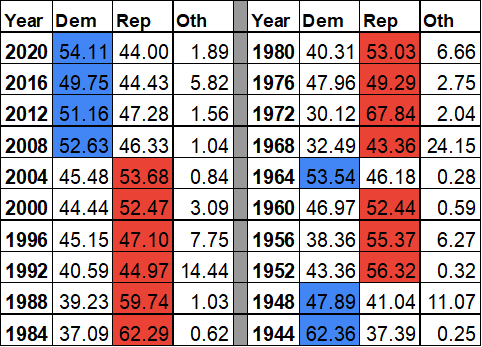
The northern Virginia cities and counties nearest to Washington, D.C., meanwhile, began to boom after the Great Depression and World War II, as air conditioning made the humid summers more livable and the federal workforce grew – along with contractors and those seeking to influence national decisionmakers. Increasingly suburbanized and affluent northern Virginia (and the deeply conservative suburbs of cities like Richmond) combined with longheld GOP tendencies in the Shenandoah Valley and Blue Ridge Mountains, and increasing GOP strength in the Hampton Roads and Tidewater region of southeast Virginia, to give the GOP a period of domination in presidential contests and competitiveness downballot before many other Southern states completed their respective transitions. Republicans won 13 out of 14 presidential contests in Virginia from 1952 through 2004; indeed, it was the only Southern state to vote for Gerald Ford over Southerner Jimmy Carter in 1976.
In the 21st century, though, Democrats regained their footing in presidential elections. With Fairfax County and the rest of Northern Virginia becoming ever more diverse, Barack Obama became the first Democrat to carry the state since 1964. Hillary Clinton’s vote share dropped under 50% here in 2016, but Joe Biden cruised to an easy win four years later. Biden was the first Dem to carry Chesterfield County (in the Richmond suburbs) since 1948, and improved his margin by nine points in Henrico County (on the other side of Richmond). He carried Virginia Beach, the first Dem to do so since the LBJ landslide in ’64, and won back adjacent Chesapeake. And he generally improved upon Clinton’s NoVA margins by 5-6 points in each county/city. I recall early on Election Night 2024 when a friend expressed alarm about how surprisingly close Virginia looked. I urged him to wait for Fairfax County’s results – as yet de minimis – to come in, and predicted a ten-point Biden margin statewide once they did. Sure enough, he won Fairfax by more than 450,000 votes, and the state by 10.1%.
With NoVA continuing to grow larger and bluer, and the Richmond suburbs becoming competitive, the Trump Era has not been good to Republicans here. The Democratic floor in federal races is pretty high at this point – to paraphrase a Democratic strategist talking about the state of the presidential race, the resistance to Trump is massive enough in the northern suburbs to withstand even a total collapse in the Hampton Roads and Richmond areas. That’s why I found polling showing the race tied in the first half of 2024 to be troubling but likely inaccurate: the highest-propensity voters in the state (those likeliest to vote) have sufficient numbers to keep Virginia in the Dem column even if other “reach” states flipped. Of course, polling rebounded to more or less normal numbers once Biden departed the race in July, and Harris may end up approaching his ten-point winning margin of 2020.
2024 Rating: Likely Dem. The WTM boys are now unanimous on this one.
Senate Deliberations
Tim Kaine (D) vs. Hung Cao (R)
Previous Senate results: 2020 – Mark Warner (D) 56%, Daniel Gade (R) 43.9%; 2018 – Tim Kaine (D) 57%, Corey Stewart (R) 41%
Both of Virginia’s Senate seats flipped to Democrats during their 2006-2008 period of electoral ascendance up and down the ballot all over the country, and have stayed with them during the more difficult period since. Tim Kaine held this seat for Dems when Jim Webb retired after a single Senate term. They offered different profiles; Webb was a Navy veteran and Defense Department official who had recently changed parties in opposition to George W. Bush’s foreign policy. Kaine took a break from law school to work with Jesuit missionaries in Honduras, then practiced law and entered politics – first in the city of Richmond, where he became mayor in 1998, and then statewide when he was elected lieutenant governor in 2001 and governor in 2005. Kaine was generally viewed as a successful governor, and he won his first Senate election in 2012 by defeating a previous holder of the seat, George Allen, by about six percentage points. Allen’s strident conservatism was increasingly out of step with Virginia voters, and they retained a dim view of him from his racist comments on the campaign trail in 2006 (and his disturbing choice of office decor, perhaps). After a competent but unmemorable stint as Hillary Clinton’s safe pick for running mate in 2016, Kaine ran for re-election in the Dem-friendly year of 2018 against a deeply conservative county supervisor best known for his defense of Confederate symbols and harsh attacks on immigrants. He won easily.
This year, Kaine faces a somewhat stronger foe in Hung Cao, a former Navy captain who lost a 2022 race for Congress in northern Virginia. Cao’s glibness at times makes him an engaging candidate, and at times makes him someone who insults his would-be constituents by referring to the Shenandoah Valley “podunk” in his criticism of one of its local newspapers. The paper in question, the Staunton News Leader, reported on how Cao’s SuperPAC fundraised on promises to donate to state-level Virginia candidates in 2023, but failed to actually distribute the money and dissembled on why.
Kaine is basically a national Dem who has nonetheless not had to make many centrist concessions to solidify his electoral position in Virginia. Polling this year has consistently shown him with double-digits leads over Cao, as Kaine’s brand as a hardworking, polite but partisan senator works just fine here – especially when the GOP insists on nominating Trump-friendly candidates for federal races. It’ll take a dramatic collapse for Kaine to lose this race – conceivable if pollsters are missing a massive enthusiasm surge among Republican leaning voters, but unlikely.
2024 Rating: Likely Dem. The three-person WTM ratings crew is united on this rating.
House Calls
Virginia moved to redistricting by an independent commission for the current cycle but it failed to agree on a map. So this decade’s Congressional maps were drawn by a pair of court-appointed special masters, who produced a reasonable map with a lower efficiency gap1 than the last one, and a median seat whose partisan lean is closer to the state’s overall lean. In other words, Virginia’s map is a reasonable approximation of the state’s partisan preferences as a whole.
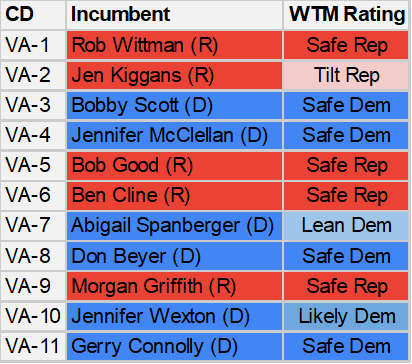
Current: 6 Dem, 5 Rep
Forecast: 6 Dem, 5 Rep
A couple of national publications rated VA-1 as competitive, but we don’t see it that way and in fact I don’t see the edge case for it. The three that we have rated as at least mildly competitive get profiles below.
VA-2 (Southeast Virginia, including Virginia Beach, Suffolk, part of Chesapeake, the Great Dismal Swamp and the Delmarva Peninsula)
Incumbent: Jen Kiggans (R, elected 2022)
2022 House result: Jen Kiggans (R) 51.7%, Elaine Luria (D) 48.3%
2020 Presidential result: Trump 50.1%, Biden 48.2%
This is one of two Virginia congressional districts, along with VA-3, that is heavily identified with the Navy and with maritime industries. It includes Virginia Beach, which at 459,000 or so souls is the state’s most populated city – though it has a diffuse, suburbanized feel rather than a dense urban core. It’s a tourism destination for its vast coastline, but it also includes Naval Air Station Oceana and its roughly 20,000 servicemembers and family. Most of the city of Chesapeake’s land is in this district, but only 126,000 or just over half its people – the portion in the 2nd includes part of the Great Dismal Swamp National Recreation Area. Sussex is in the 2nd, with 94,000 people and additional swampland. Beyond Sussex, heading out toward peanut-farming country (roadside peanut stands! Very enjoyable.) is the more rural Isle of Wight County and the district’s portion of Southampton County, and the small independent city of Franklin. The rest of the district’s population is across the mouth of the Chesapeake Bay, on the Virginia portion of the Delmarva Peninsula.
This is swingy territory on the whole. Historically Virginia Beach was reliably Republican – after voting for JFK and LBJ, it behaved like many Sun Belt cities and settled into a half-century of GOP voting habits. Obama narrowed the margins, though, and finally Trumpism proved too much: Biden won the city by five and a half points and over 12,000 votes in 2020. Suffolk tends to give Democrats a decent margin, but the district’s portion of Chesapeake (at 55%-44% for Trump, it’s much redder than the city’s northern neighborhoods) and the two outlying mainland counties neutralize it. The two Delmarva counties make up a tiny portion of the district and are mirror images politically, in that Trump carried Accomack by nine and a half points and Biden carried Northampton by ten and a half. Accomack is larger, though, and thus slightly outvotes Northampton. On the whole, then, you get a very narrow 2020 win for Trump districtwide.
Jen Kiggans won the redrawn, slightly redder district (no longer featuring any of Norfolk as the previous district did) in 2022, capturing it from two-term Democrat Elaine Luria. As is customary in this district, both 2022 candidates had Naval background: Luria was a 20-year officer, reaching the rank of commander and spending nearly entire career serving on combat vessels, while Kiggans was a helicopter pilot who later attended nursing school before winning a state senate seat. Like Luria before her, Kiggans’ voting record is not that of a down-the-line partisan – but she supported the Dobbs ruling and favors a national abortion ban after 15 weeks, with some exceptions. She was the only Virginia Republican who voted to expel George Santos from Congress…but she was only recently (and only through a spokesperson) able to acknowledge that Joe Biden did indeed win the 2020 presidential election. As I have noted from time to time, what passes for moderation in today’s GOP is rather thin gruel.
The Democratic challenger this year is another Navy veteran. Missy Cotter Smasal served as a Surface Warfare Officer and deployed during Operation Enduring Freedom. She later became a Rita’s Italian Ice franchisee and a non-profit executive. It’s a robust resume, but so is Kiggans’; that tends to be the price of entry in this district. Polling shows a tight race and both national Congressional campaign arms are heavily involved – here’s a decent write-up of the scene on the ground. In such a competitive battle, in such a tight national political environment, a narrow edge here has to go to the candidate whose party matches the district’s (slight) lean. Neither outcome would surprise, though.
Previous flips: 1986, 2000, 2008, 2010, 2018, 2022
2024 Rating: Tilt Rep (hold). I have it Lean Rep; Jim and Matt went Tilt.
VA-7 (parts of central and northern Virginia, including Fredericksburg, Culpeper, Dale City, Woodbridge and Spotsylvania Courthouse)
Incumbent: Abigail Spanberger (D, elected 2018)
2022 House result: Abigail Spanberger 52.3%, Yesli Vega 47.7%
2020 Presidential result: Biden 52.6%, Trump 45.8%
Virginia’s 7th district reaches from the southernmost D.C. suburbs almost to the Richmond area, and west to Shenandoah National Park. A host of major Civil War battles were fought all over this district; you never feel far from history in this state and especially this part of the state. Its geographic – and perhaps historic – heart is the city of Fredericksburg, though there are much more populous communities to the north. The district includes part of Prince William County, a rapidly-growing and rapidly-blueing portion of the D.C. metro area – well south of the beltway but still commutable. Prince William County went from voting Republican in every presidential election from 1968 through 2004 to giving Biden 62.6% of its vote in 2020. Stafford County, to its south, is the only Biden-voting county fully contained in the 7th. Fredericksburg is a blue outpost as well, and together these areas give the district a blue tinge. There are several counties here that make up ground for Republicans; Orange, Culpeper and King George counties all gave Trump 59-60% of their vote in 2020 while tiny Greene and Madison counties are even redder. Caroline County voted twice for Obama and twice for Trump – an unusual trend for Virginia.
In the 2000s and 2010s, a predecessor of this district was represented by Eric Cantor, a rising star in the House Republican leadership. Cantor was a conservative, he was a partisan, he was a co-author of the ridiculous Young Guns book with Kevin McCarthy and Paul Ryan, and he lost a stunning primary to Tea Party challenger Dave Brat in 2014. It shook a lot of people up to realize that Cantor was not a satisfactory avatar for the GOP base, but it was a harbinger of what was to come in the Trump Era.
Brat didn’t last terribly long. By 2018, Trump was unpopular, Brat’s attacks on health care – from Medicare to the ACA – were polling disastrously, and he had a strong Democratic challenger in former CIA officer Abigal Spanberger. She was one of the party’s prized recruits that cycle and went on to defeat Brat by two points. She won a tight re-election in 2020, and a somewhat more comfortable one against flawed challenger Yesli Vega in a slightly bluer district in 2022. Vega made the odd suggestion during that campaign that it might be harder for a woman who was a victim of rape to become pregnant as a result. Science disagrees, and perhaps the voters did too, as Spanberger defeated her by about five percentage points.
Spanberger is retiring this year in advance of a gubernatorial run next year. The new Democratic nominee also comes from a national security background: Eugene Vindman, a former Army colonel and deputy legal advisor for the National Security Council. His twin brother Alexander was an NSC staffer on the phone call where former President Trump demanded the Ukrainian government launch investigations into a United States citizen (Joe Biden’s son); his reports of the phone call led to Trump’s first impeachment. The Vindmans’ national profile enabled Eugene to build a formidable fundraising operation and win the Democratic primary. He’s facing off against Derrick Anderson, who campaigns with a fake family. Anderson served as a Green Beret – we assume he’s not lying about that – and then worked in Trump’s Office of National Drug Control Policy. These are two notable resumes, especially in a state with so many people connected to the military and national security. In that respect it echoes the 2nd district contest, but this seat voted for Biden by almost seven points. Virginia appears likely to produce a similar breakdown at the top of the ticket this year, and that will likely be too much for Anderson and his “family” to overcome.
2024 Rating: Lean Dem (hold). The WTM board is united on this one.
VA-10 (northern Virginia, including Loudoun County, parts of Prince Williams County, and Manassas, Warrenton and Washington)
Incumbent: Jennifer Wexton (D, elected 2018)
2022 House result: Jennifer Wexton 53.3%, Hung Cao 46.7%
2020 Presidential result: Biden 58.3%, Trump 40.2%
Virginia’s 10th district brings us closer to D.C., though still not deep in government-dominated Fairfax County (mostly – just 1.6% of Fairfax’s population lives in the 10th), Arlington or Alexandria. All of Loudoun County is here. It’s Virginia’s third-largest county at 420,000 and still growing fast, with the highest median income in the nation. Once known primarily for its pretty horse country, it is increasingly the province of those connected to the federal government in some fashion, and that’s a class that leans increasingly Democratic. So where Loudoun once was steadily Republican – voting for almost every GOP nominee from Eisenhower through George W. Bush, skipping only Goldwater – it is now blue and getting bluer. Obama carried it twice; Clinton won it by nearly 17 points and Biden by 25.
The second-largest chunk of the district is the northwestern portion of Prince William County, including Linton Hall, Buckhall, Gainesville and Haymarket. This is the less Democratic section of PWC compared to the portion in the 7th, but it’s still solidly blue (58% for Biden in 2020). Located within Prince William County – but not part of it – are the independent cities of Manassas and Manassas Park. Best known for multiple battles early in the Civil War, these small cities are among the many places in Virginia that went blue in 2008 and have stayed that way.
There’s two solidly-red counties in the 10th: Fauquier and Rappahannock. But these are small, rural counties, and Trump’s comfortable wins here do not move the dial much. As a result, the 10th is solidly blue and blue-trending territory. It wasn’t always that way: it used to be much more rural when there was not as much population in the areas closer to D.C., and those suburban/exurban areas were among the first parts of Virginia to turn Republican. Joel Broyhill held it from 1952 until the Watergate landslide year of 1974; Republican Frank Wolf won it back in 1980 and held it until his retirement in 2014. That year, Barbara Comstock held it by a healthy margin in one what initially expected to be a competitive open seat race. Comstock had made her name as an opposition researcher in the 90s dedicated to taking down Bill Clinton and defeating Al Gore in the 2000 election; she later was instrumental in assisting George W. Bush’s appointees in their confirmation process. After a stint in the Virginia House of Delegates, she was ready for Congress in and 2014 turned out to be a very GOP-friendly year. She won easily and held her seat by a somewhat closer margin in 2016.
And then came 2018. Two years of Trump devastated the GOP brand in northern Virginia, and Democrats had a strong challenger in state senator Jennifer Wexton. The race wasn’t close; Wexton won 56%-44%. Sadly, she is battling a major illness that has forced her to retire this year. State Senator Suhas Subramanyam is the Democratic nominee and shouldn’t have too much trouble against Mike Clancy, who worked in the Navy’s Office of the General Counsel before moving on to a career in corporate law. Clancy has money and connections, but the tide is likely too strong in this part of the state that is not only anti-Trump but turns out quite reliably in elections.
Comstock, for the record, has endorsed Kamala Harris.
2024 Rating: Likely Dem. Unanimous rating.
- Per FiveThirtyEight, the efficiency gap is the difference between each party’s share of “wasted votes” — those that don’t contribute to a candidate actually winning the district. ↩︎
 Within the Margin