State of Play: South Carolina
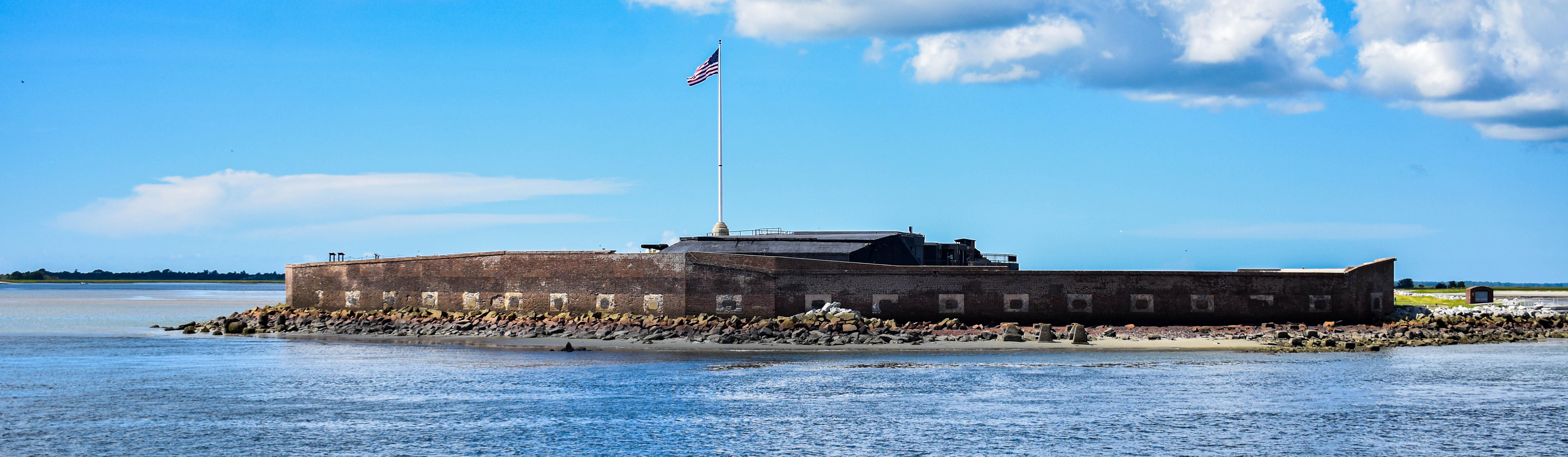
South Carolina and its political class have taken lead roles in American upheavals. John C. Calhoun pivoted dramatically from nationalist support for a strong federal government to supporting nullification and states’ rights (specifically the right to preserve slavery) and became a massive influence on those who would ultimately secede from the union a little under a decade after his death – beginning, of course, with South Carolina. The Republican Party of Abraham Lincoln became virtually criminalized in the decades following the Civil War, giving rise to the “Solid South” for Democrats. That began to crumble in 1948, when segregationists led by South Carolina governor Strom Thurmond1 abandoned the Democratic Party after its adoption of a civil rights plank at the national convention.
Thurmond launched his own presidential campaign under the banner of the States’ Rights Democrats. The segregationist Dixiecrats carried four Southern states that year, including Thurmond’s own South Carolina. Thurmond and South Carolina were at the forefront of the next sizable crack in the Solid South when he switched parties to endorse Barry Goldwater in 1964. Thurmond was staunchly opposed to Lyndon Johnson and the national Democratic Party’s support for the Civil Rights Act of 1964. Goldwater carried only six states in his landslide defeat – his home state of Arizona, and five southern states including, of course, South Carolina. By 1968, Thurmond was closely aligned with Richard Nixon and helped deliver several Southern states to the GOP column once again. The Solid South was done, the party coalitions were being remade, and South Carolina’s outsized role in conservative politics – had survived the transition intact, as the state would play a critical role in GOP presidential primaries in the decades to come.
The Presidency – 9 electoral votes
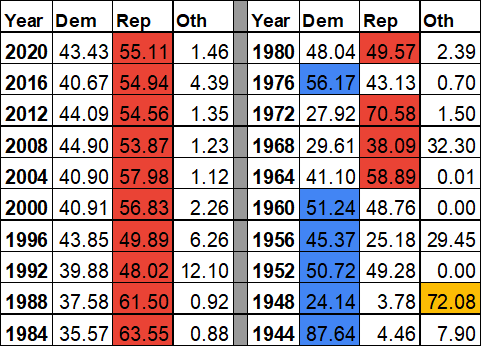
South Carolina plays an outsized role in the presidential primary calendar, with a history of hotly-contested races that have proven pivotal for both parties. George W. Bush’s campaign deployed an array of gutter tactics to defeat John McCain here in 2000. Barack Obama proved that he could win over and mobilize the state’s large Black electorate to defeat Hillary Clinton decisively in the Palmetto State’s 2008 primary. Joe Biden rebounded from a trio of early losses to win South Carolina and completely reset the narrative around the 2020 nomination campaign. Come the autumn, though, South Carolina hasn’t been close since 1980, and hasn’t been won by a Democratic presidential candidate since Jimmy Carter in 1976. Obama did keep the margin into single digits just barely in 2008, but he was not actively contesting the state. Like many Southern states, South Carolina is largely inelastic in its toplines: racially-polarized voting tendencies mean there’s not a lot of play in the margins between the parties. In the last four presidential elections, the GOP vote share has varied by less than a point and a half. That belies changes beneath the surface: the Charleston, Greenville and Columbia areas are fast-growing and are becoming bluer, though not as quickly as the large metro areas in Georgia and Texas. Meanwhile, the fast-growing Myrtle Beach area is adding Democratic transplants, but not nearly as fast as it’s adding Republican newcomers. It feels like a state that will be more competitive a decade from now, but for now it’s nothing but stable, comfortable margins for South Carolina Republicans in presidential elections.
2024 Rating: Safe Republican
Senate Deliberations
There’s no U.S. Senate race in South Carolina this year. Lindsey Graham’s seat comes up again in 2026.
House Calls
South Carolina’s population growth earned it a new Congressional seat starting in 2012. The new 7th district was centered on the Grand Strand (the Myrtle Beach area) and Florence and looked like it might be competitive at first, but Democrats’ preferred candidate ended his campaign after a drunk driving arrest before the primary. Charges were ultimately dropped, but Tom Rice prevailed by nearly eleven points over a much lesser-known Dem nominee. Rice was a solid conservative vote throughout his tenure…but then he committed the gravest sin one can as a Republican in this era: he held Trump to account. Rice voted to impeach the former president for his role in the January 6 attack on the nation’s Capitol. That drew him six primary challengers; the relevant one being state representative Russell Fry, who defeated Rice 51%-25%. The outcome was never in doubt: Republicans are not permitted to condemn Trump’s actions without a (usually successful) attempt at electoral retribution.
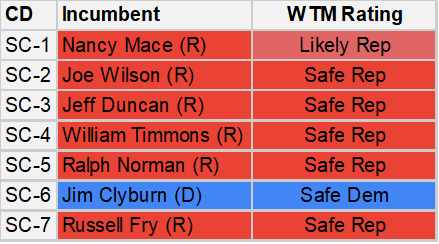
Current: 6 Rep, 1 Dem
Forecast: 6 Rep, 1 Dem
The only South Carolina district that currently receives a non-safe rating is the 1st. That earns it a profile below.
SC-1 (South Carolina’s Sea Islands including Hilton Head, Beaufort and Port Royal; parts of Charleston and its suburbs/exurbs including Mount Pleasant, Summerville, Hanahan and Moncks Corner)
Incumbent: Nancy Mace (R, elected 2020)
2022 House result: Nancy Mace (R) 56.5%, Annie Andrews (D) 42.5%
2020 Presidential result: Trump 53.5%, Biden 44.9%
The South Carolina 1st contains much of the Charleston area, but not all of the city itself: its peninsular downtown and famed French Quarter are in the 6th district, along with West Ashley and the city of North Charleston. Daniel, James and John islands are in the 1st, along with another Peninsula (Cainhoy) at the city’s much less-populated far eastern end. In total a little under a third (about 50,000 people) of the Charleston population is in the 1st. Note that the city’s jagged municipal lines mean there’s additional population on the islands outside the city boundaries – but it’s all in SC-1. James and John islands lean Democratic, while Daniel Island and the Cainhoy Peninsula tend to be Republican.
South Carolina’s 4th-largest city, Mount Pleasant, lies across the Cooper River from the downtown Peninsula. Mount Pleasant voted decisively (55%-37%) for Trump in 2016 but Biden cut that nearly in half in percentage terms (54%-44%). Moving southwest from Charleston, the Sea Islands have some Democratic pockets but are solidly Republican in the aggregate. Northeast from Charleston, the coastal areas are generally Democratic but the inland portions include precincts that gave Trump over 90% of the vote. And the inland areas north of the city of Charleston lock it up for the GOP: Summerville is trending blue but Hanahan and the areas surrounding Summerville are deep red. As a whole, this is a district whose population is growing so quickly that political changes come quickly.
The old SC-1 provided an upset victory for Democrat Joe Cunningham in 2018. Incumbent Republican Congressman Mark Sanford, who once sat on the right of his party but was deemed insufficiently Trumpy for this new era, lost to state representative Katie Arrington in the primary. Cunningham then won the general election in one of the more surprising pickups in that Democratic wave year. He was a unique addition to Congress: an ocean engineer, a construction attorney, and co-owner of a yoga studio with his wife. A fervent booster of his district, Cunningham clearly had some political talent – but he also had a red enough district that 2020’s presidential year turnout was too much to overcome. Republicans recruited state representative Nancy Mace to run that year. In 1999, she had been the first female to graduate from The Citadel’s Corps of Cadets program, and in 2020 she became the first female Republican to win a South Carolina Congressional seat by defeating Cunningham 50.6%-49.3%. South Carolina’s Republican-dominated state legislature redrew the 1st to be considerably redder in 2022, in an effort to withstand its Trump-era Democratic trends. Mace held off a primary challenge in the new district from Arrington two years later, 53%-44%, and defeated a longshot Democratic challenger 56%-42% in the general.
Mace’s tenure has been a lurching and erratic series of attention-getting activities. She condemned Trump strenuously for his role in instigating and failing to stop the January 6 attack on the Capitol before voting against his impeachment. She voted against the first attempt to remove Liz Cheney from her House leadership position over her breaks with Trump, appeared at fundraising events with her…and then voted to remove her on the second vote to do so. She co-sponsored the Life at Conception Act that would provide legal recognition to fertilized eggs as people, with no protections for in vitro fertilization…and then cast herself as a champion for IVF. She shocked many colleagues and observers when she voted to remove Kevin McCarthy from the Speakership – allegedly over legislative promises he had broken, but it was a stunning turn after his heavy investment in her 2020 election. In response, McCarthy recruited and supported a primary challenger but with Trump’s backing, Mace easily won a three-way race with 57%.
Whatever concerns she once ahead about Trump have been cast aside as she has become one of his loudest boosters during the current campaign. For the time being, the district is still red enough that she probably has more to fear in a primary than a general election: but she drew an intriguing Democratic challenger this year. Michael B. Moore was president of an internet software company and CEO of a food company and the International African-American Museum. Deeply rooted in the state’s history, he counts among his ancestors Robert Smalls, who in 1861 made his escape from slavery by stealing a Confederate transport vessel and delivering it to the Union navy. Smalls later served in the South Carolina legislature during Reconstruction and in Congress before white conservatives fully re-asserted their dominance over Southern politics. Mace is outraising and outspending him 3:1 and national Democrats are not making a play for the seat this year, but Mace’s erratic approach to politics could leave some voters cold to her and make the race a bit closer than it appears on paper.
2024 Rating: Likely Republican (hold)
- At age 22 – two decades before becoming governor – Thurmond impregnated his family’s 15 or 16-year old Black domestic servant, Carrie Butler. Family values and all that. ↩︎
 Within the Margin