State of Play: Maryland
Mountains, bays, ocean beaches, a major city, two major metro areas, farmland, suburbs: Maryland fits a diverse landscape into its acreage, the ninth-smallest among the 50 states. There’s not as much political diversity, as Democrats dominate the Old Line State. The counties west of Frederick, stretching into the Allegheny Mountains, are rock-ribbed Republican, and the GOP does well in much of the Eastern Shore and a pair of exurban/rural counties (Harford and Cecil) northeast of the city of Baltimore. But the blue strongholds are numerous: the city of Baltimore (87% for Biden); the much more populous, suburban Baltimore County (strongly Republican in the latter decades of the 20th century, but 62% for Biden); affluent Montgomery County – the largest in the state with all its federal employees (79% Biden); fast-growing Prince George’s County (second-largest in the state, majority-Black, 89% for Biden). There’s also Howard County, another affluent and fast-growing county, east of Montgomery but increasingly oriented toward Washington, D.C. It gave Biden 71% in 2020. Anne Arundel County, home to the Naval Academy’s Annapolis where the Severn River flows into Chesapeake Bay, was once a Republican stronghold. But in 2016, it voted for its first Democratic presidential nominee since Lyndon Johnson in ’64 and gave Biden nearly 56% four years later.

The Presidency: 10 electoral votes
Almost every county in Maryland, including most of the solidly Republican ones, shifted left from 2016 to 2020. Governor Larry Hogan managed to win re-election comfortably in 2018 anyway, but this is not a state that enjoyed the Trump years. Daily attacks against the federal workforce as some kind of malign “deep state” didn’t help – nor did the frequent racism, in a state that’s only about 40% non-Hispanic white. This is a diverse, highly-educated (second only behind Massachusetts in the percentage of its residents with at least a bachelor’s degree as well as those with advanced degrees) and government-oriented state: that doesn’t leave much of an opening for today’s Trumpian Republican Party.
2024 Rating: Safe Democratic
Senate Deliberations
Angela Alsobrooks (D) vs. Larry Hogan (R)
Previous Senate results: 2022 – Chris Van Hollen (D) 65.8%, Chris Chaffee (R) 34.1%; 2018 – Ben Cardin (D) 64.9%, Tony Campbell (R) 30.3%
The retirement of three-term Democrat Ben Cardin opened up a Senate seat, and the late entry of popular former governor Larry Hogan into the race raised the prospective of a Maryland rarity: a competitive race for U.S. Senate. Hogan’s a fairly moderate Republican who has spoken out against Trump from to time. It runs in the family: his father was a Maryland congressman and the only Republican on the House Judiciary Committee to vote for all three articles of impeachment against Richard Nixon in 1974. For that, Lawrence Hogan’s party rejected him in its gubernatorial primary that year despite polling showing him competitive against the incumbent Democrat.
His son has tried to have it both ways: in 2019 he supported the opening of the impeachment proceedings against Trump for his extortion of the Ukrainian government for domestic political ends in; then he condemned the impeachment vote, saying Democrats had pre-determined an outcome. Curiously, he did not condemn Senate Republicans for pre-determining the outcome of their impeachment trial despite Majority Leader Mitch McConnell stating there was “no chance” the Senate would convict Trump. After the January 6 attack on the U.S. Capitol, Hogan strongly condemned Trump and has stated that he would have voted to convict and remove Trump from office on his second impeachment. Hogan entertained a presidential run in 2024 as the candidate of the ostensibly centrist but Republican-funded No Labels organization; he ultimately chose the Senate race instead. Senate Republican campaign strategists made clear to Trump that Hogan was the only Republican who could conceivably put this seat in play, creating the possibility of detente; that may have ended when Hogan called for Americans to respect the verdict after Trump’s conviction by a New York jury of his peers this past spring, with Trump’s campaign manager declaring Hogan’s campaign over. Trump endorsed Hogan in June in a move of little value in Maryland. Hogan did not reciprocate…but he likes to tout the endorsement when donors fret about his shaky relationship with Trump.
The Democratic nominee is Prince George’s County Executive Angela Alsobrooks, a trailblazer serving as her county’s first female executive and Maryland’s first Black female county executive. She was previously elected twice as State’s Attorney (prosecutor) for the county, re-organizing the office and increasing conviction rates while also focusing on rehabilitation for juvenile defendants. In the Senate primary, she defeated wealthy, self-funding Congressmember David Trone 53%-43%. She trailed Trone in polling for a while but finished strong, in a victory for those who’d rather the Senate not be populated exclusively by rich white dudes (and occasionally rich white women). She also trailed Hogan in general election polling before she became the nominee, but Democratic voters and leaners soon consolidated behind her. Not to the extent you’d usually see: Hogan remains well-regarded for his time as a tax-and-fee-cutting governor, and he’s running ahead of typical Republican Senate candidates here. But his awkward navigation of Trumpism and the national debates around abortion rights has not helped him, nor has the spending of national GOP entities. He’s hovering around 40%, and it looks like he’ll be latest popular governor who can’t overcome a state’s partisanship in a federal race: see Linda Lingle in 2012, Phil Bredesen in 2018, and Steve Bullock in 2020.
2024 Rating: Likely Democratic (hold).
House Calls
Going in 2002, Maryland’s eight-member Congressional delegation was split 4-4 between the parties. In an unusual turn of events, Democrats played to win in that year’s round of decennial redistricting: they passed a visually-hideous gerrymander designed to defeat conservative Republican Bob Ehrlich in the 2nd District (Harford County and deep-red portions of Baltimore County) and moderate-to-liberal Republican Connie Morella in Montgomery County’s 8th district. It worked: Ehrlich bailed to run for governor (and won, before being defeated in 2006) and Dutch Ruppersberger defeated former Congresswoman Helen Delich Bentley; Chris Van Hollen (now a U.S. Senator) defeated Morella narrowly. The 8th would have flipped before long anyway given population growth and political trends in the DC suburbs. The 2nd, though, would still be competitive under something resembling the old lines. Both seats have been utterly safe since those initial 2002 races.
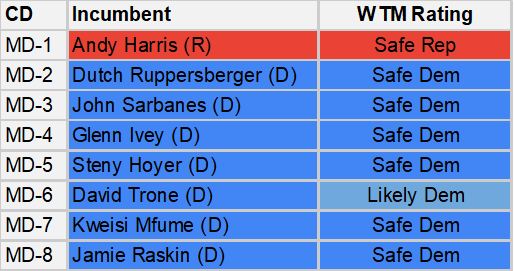
In 2012, Democrats played to half-win. They targeted one but not both of the remaining GOP-held seats, choosing to go after MD-6. Twelve years and an abortive attempt to redraw it later, it happens to be one of the only two Maryland seats that has a competitive rating from our group here at Within the Margin, so it gets a profile below.
MD-1 (Eastern Shore, plus Harford County and easternmost Baltimore County)
Incumbent: Andy Harris (R, elected 2010)
2022 House result: Andy Harris (D) 54.4%, Heather Mizeur (R) 43.1%
2020 Presidential result: Trump 56.3%, Biden 41.7%
The Eastern Shore of Chesapeake Bay can feel a world removed from the rest of Maryland. Instead of cities and dense suburbia, it’s mostly small towns, rural crossroads, and quiet shores along the Bay. Instead of government-focused employment, the major sectors here are agriculture, tourism and fishing. And instead of Democratic dominance, one finds mostly Republican strength – though there are exceptions, like Salisbury, Princess Anne (home of am HBCU, the University of Maryland-Eastern Shore), and Cambridge. There’s a section of the district not on the Eastern Shore as well: safely Republican Harford County as well as the deep-red easternmost portions of Baltimore County.
In 2008, a quartet of Republicans launched a primary challenge against longtime moderate Republican incumbent Wayne Gilchrest. The winner was a deeply conservative state senator from northeastern Baltimore County, Andy Harris. Democrats were buoyed by Barack Obama’s strong performance atop the ticket and had recruited extremely well across the county, so they had a formidable candidate from the Eastern Shore in young, moderate Queen Anne’s County State’s Attorney Frank Kratovil. Democrats all over the country were winning with similar profiles – prosecutors, military veterans – and Kratovil got an additional boost when Gilchrest endorsed him. He narrowly defeated Harris 49%-48% to become the first Democratic winner in MD-1 since 1990.
The tide turned quickly, as it does in America. Harris ran again in 2010 and this time the political gravity was too strong for Kratovil to defy: it was one thing to win an R+13 seat in a year of Democratic dominance up and down the ballot, with local Republicans bitterly divided. It’s another thing to win when the GOP is back in the ascendancy and Harris’ arguably extremist views now had momentum, however astroturfed the Tea Party movement was at its outset. That was a lot for Kratovil to overcome and Harris won easily, 54%-42%. He’s held on since. The district is a bit bluer now but Democrats in Maryland have not chosen to make it winnable, which they could do without much difficulty by crossing the Chesapeake Bay Bridge into Anne Arundel County and Annapolis. Arguably, such a district makes more sense than including areas closer to Baltimore as it currently does.
Harris is coming off his closest Congressional race: in 2022, Heather Mizeur held him to a 54%-43% win – still comfortable, but a sharp drop from previous cycles. Mizeur had previously served in the Maryland House of Delegates from a Montgomery County-based district. After leaving office in 2015, she moved to a farm on the Eastern Shore to grow organic herbs. Harris refused to debate her, perhaps realizing he had his first formidable opponent since Kratovil over a decade earlier. This year, Harris is closing out his campaign with the curious message that North Carolina (not the state he represents) should award its electoral votes to Donald Trump prior to the election (not an option under the United States Constitution). But Democratic candidate Blane Miller is a non-factor; he’s campaigning a bit but has not filed campaign disclosures with the FEC. One of the WTMers (are we…Marginals, perhaps?) rated the race as competitive; two of us have it Safe so that’s where it averages out.
2024 Rating: Safe Republican (hold)
MD-6 (Western Maryland including Cumberland, Hagerstown, Frederick and Emmitsburg; parts of Montgomery County including Clarksburg, Germantown and Gaithersburg)
Incumbent: David Trone (D, elected 2018)
2022 House result: David Trone (D) 54.7%, Neil Parrott (R) 45.2%
2020 Presidential result: Biden 53.9%, Trump 44.1%
The 2000s version of the 6th was in the western part of the state, including the Allegheny Mountains, the cities of Cumberland, Hagerstown and Frederick, and rural stretches further east along the Pennsylvania border, including the northernmost parts of Baltimore County and Harford County. The new district devised by Democrats for the 2012 cycle included the western portions but went south from Frederick instead of east, to take in parts of ever-bluer Montgomery County. The gambit worked, as John Delaney defeated quirky Republican incumbent Roscoe Bartlett by 21 points. Delaney managed to nearly lose to whack job radio host and conspiracy-monger Dan Bongino in 2014; he retired in 2018 to pursue a quixotic presidential bid. The new Democratic Congressman was David Trone, who had become wealthy as the founder of Beer World, later known as Total Wine & More. Trone lost the MD-8 primary in 2016 and tried again in this seat when Delaney retired. It’s an open seat again this year, after Trone departed to unsuccessfully seek a Senate seat. And because this is America, we’re going back to the Delaney family: the Democratic nominee is the former Congressman’s wife, who resides about 10 miles outside the district in Potomac, MD. She self-funded her primary campaign to the tune of a million dollars. She is not without credentials: she had a career in law and non-profit advocacy and was a Department of Commerce official in the Biden administration. But when parties nominate self-funders from outside the district, it confirms a lot of people’s worst suspicions about politics: that it’s about ambition for its wealthy practitioners, rather than representation of the voters.
For the third cycle in a row, the Republican nominee in this district is Neil Parrott, a businessman and former twelve-year member of the Maryland House of Delegates from Hagerstown. He’s deeply conservative, with his political roots in the Tea Party movement of 2009-10 and an unsuccessful referendum effort to overturn Maryland’s legalization of same-sex marriage. Parrott’s views tend to fit the western part of the district, but are anathema to the southern portion closer to DC, and are increasingly out of favor in the purple Frederick area. It will be difficult for him to assemble a winning coalition in a seat where the highest-propensity voters are the most Dem-inclined, and vice versa. That said, I think choosing another Delaney as the Democratic standard-bearer here was not a terribly wise choice by the party’s primary voters. I have it at Lean Dem; Jim and Matt rate it Likely and Safe, respectively. Averages out to Likely.
Past flips: 1916, 1930, 1942, 1958, 1960, 1970, 1992, 2012
2024 Rating: Likely Democratic (hold)
 Within the Margin