State of Play: Massachusetts

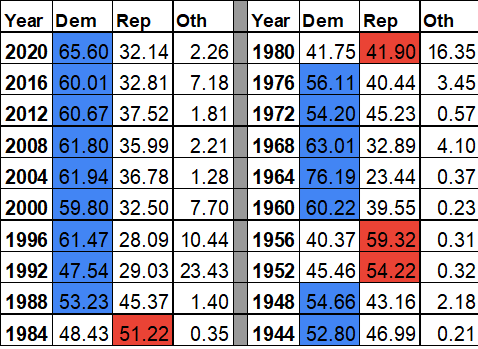
1920, 1924, 1960 (both parties!), 1972, 1988, 2004, 2012: the last century was replete with Massachusetts natives and officeholders on major party tickets….even if the last one, Mitt Romney, spent a lot of time reassuring his party’s right flank that his days as a moderate New Englander were nothing to worry about. The state carried tremendous political weight in the country’s earliest days, of course, but its combination of commercial heft and professional politics contested between mostly-Protestant Yankee Republicans and mostly-Catholic Democrats of immigrant stock meant that it produced quite a few candidates on the national stage well beyond the days when it when it was a top-ten state in population, as it was through the 1970 Census. There’s not much in the way of competitive races to talk about there this cycle, but that in fact tells its own story: in an era where political divides along educational lines are taking on ever-greater prominence, Massachusetts is not only a highly-educated state but one where its plethora of colleges means that more people work in higher ed here than do in many states with larger populations. It’s not shocking, then, that the state rejected Trump even more harshly in 2020 than it had in 2016: the realignment along these lines is strong and Massachusetts does not have a factor that would offset it, like a high rate of religious adherence.
The Presidency: 11 electoral votes
From the Bay to the Berkshires, Massachusetts is blue – now perhaps more than ever. There are Republican towns, of course. They’re mainly along the southern border with Connecticut and Rhode Island and in the southeastern part of the state, below U.S. 44 but before the coast. I’m writing this section of the article while visiting one, in fact. But there are few real strongholds – the reddest town in 2020 was Blandford, whose 775 votes gave Trump 58.58%. The largest Trump-supporting town was Dracut, with a little under 18,000 voters who gave Trump a 49.4%-48.8% victory. These are not exactly building blocks for the Republicans. Furthermore, the distribution of the vote is so consistent across the state – ie, there’s no large region of profound GOP strength – that it appears to be impossible to draw a Congressional district that would have voted for Trump. Breaking through statewide in a presidential race, as Eisenhower and Reagan each did twice, is not happening any time soon.
Massachusetts does like its Republican governors, though: the moderate and Trump-skeptical Charlie Baker won two terms including a Trump-era re-election in 2018, and the party has actually won six of nine gubernatorial races dating back to 1990. Baker supported Trump’s impeachment after the January 6 attack on the Capitol. Further back, Mitt Romney was elected governor as a moderate in 2002 before taking a sharp turn to the right that precluded a re-election bid here. Despite this, Republicans appear unable to help themselves: they nominated hardcore Trump supporter Geoff Diehl for governor in 2022 and he predictably lost to then-attorney general Maura Healey by 29%, giving Democrats one of their three gubernatorial flips that year. The rest of the Bay State’s row offices have been won by Democrats for decades.
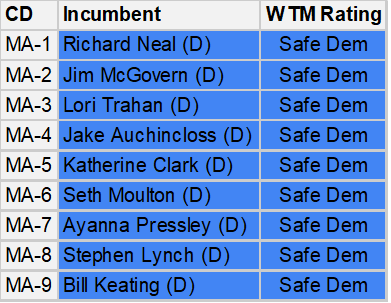
In 2024, Kamala Harris and Tim Walz can expect to win Massachusetts’ 11 electoral votes with ease. Elizabeth Warren can expect to win a third Senate term with ease. And Democrats can expect to win all nine of Massachusetts’ Congressional seats with ease – seven of them are unopposed, in fact. The GOP hasn’t made a Congressional race here competitive since 2012, and hasn’t won any since 1994. Republicans did flip a state senate seat in a November 2023 special election, cutting the Democratic majority to 36-4. In the state House, Dems gained four seats in 2022 to expand their majority to 134-25, with one independent.
Senate Deliberations
Elizabeth Warren (D-incumbent) vs. John Deaton (R)
Previous Senate results in Massachusetts: 2020 – Ed Markey (D) 66.2%, Kevin O’Connor (33%); 2018 – Elizabeth Warren (D) 60.34%, Geoff Diehl (R) 36.2%
This is the seat that Republicans held briefly when Scott Brown won a special election in January 2010 to replace the late Ted Kennedy. Brown’s victory propelled him to national prominence and was an early harbinger of the GOP landslide to come in that year’s midterms, but his Senate tenure proved brief. In the regularly-scheduled election for a full term in 2012, attorney Elizabeth Warren – who proposed and developed the Consumer Financial Protection Bureau during the Obama administration – defeated him by seven and a half points. After cruising to re-election against state rep Geoff Diehl in 2018, she launched a presidential bid that briefly led national polling. The chief controversy in her race was the parsing of her tenuous claim on Native American ancestry, and the degree to which it helped to advance her career. But the main reason she failed to win a primary in 2020 was Bernie Sanders’ ongoing dominance of the party’s left wing, and her inability to expand her support beyond the party’s highly-educated academic and professional class. Warren retains sufficient support in Massachusetts, however, and is not facing any difficulty in dispatching the 2024 Republican nominee, attorney John Deaton. His campaign has received little interest from national Republicans: while Warren tends to run slightly behind her party’s presidential nominees (and the state’s other senator, first John Kerry and now Ed Markey) the gap is nowhere close to large enough to put her in any danger.
2024 Rating: Safe Democratic (hold)
House Calls
I hope to get district profiles up for each of Massachusetts’ seats in a separate post, but that’s dependent on free time as I don’t want to get bogged down speaking at length on safe or uncontested seats. The delegation here is current 9-0 Democratic, and it will stay that way. Only two seats are contested by Republicans: the 8th (parts of Boston: South Boston, the North End, Back Bay and downtown, plus tentacles reaching out to Walpole and Brockton) represented by Stephen Lynch since 2001 and the 9th (Cape Cod, New Bedford and the South Shore) represented by Bill Keating since 2010. Neither race will be close.
 Within the Margin