State of Play: Connecticut

Is it the Nutmeg State? Is it the Constitution State? Only one allows for an easy demonym. That’s all the more important in a state whose name does not facilitate one (“Connecticutian?” “Connecticuter?” The syllable emphasis is awkward). What it is for sure is a Democratic state, and we’re all a bit removed from the days when a wider variety of states might earn a presidential candidate visit on the final weekend before the election – or get an impromptu speech after midnight. That’s what happened in the early morning hours of November 6, 1960, when John F. Kennedy arrived in Waterbury two days before the election. A crowd of 40,000 souls had waited hours in the rain to greet him after a day of campaigning in New York, and an exhausted Kennedy was moved to address his drenched admirers from the hotel balcony before going to bed. He spoke for nearly an hour, calling the crowd the biggest of the campaign so far. In a manner that might remind us of the contrast in vigor that has marked the 2024 race, Kennedy noted that his opponent Richard Nixon had likely been asleep for hours at that point…and not unlike the Harris’ campaign’s emphasis on not going back, he noted that “now we are moving ahead.” Kennedy campaigned the next day in Bridgeport and New Haven, and went on to win the state comfortably over Nixon.
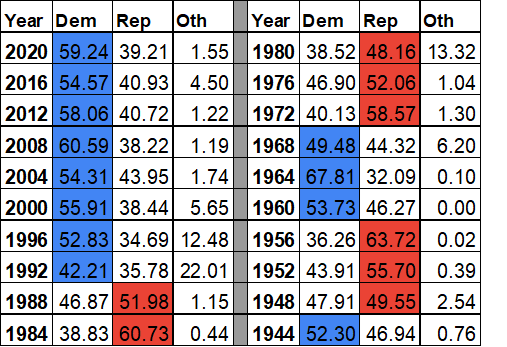
The Presidency: 7 electoral votes
In 1988, Connecticut gave native son George H.W. Bush its (then) 8 electoral votes, as the Texas transplant cruised to a five-point victory in the place he grew up. It marked the fifth consecutive Republican presidential win in the Nutmeg State, but they haven’t taken it since. What was once a contested battleground between moderate Yankee Republicans and working-class Catholic Democrats is now safely in the blue column for most statewide contests. These days, plenty of the Catholics vote Republican – but many of those former moderate-to-liberal northeastern Protestants were repelled by their party’s dominance by conservative Evangelicals as the 20th century drew to a close. More recently, Trumpism has damaged the GOP in its wealthy former redoubts: they’re no longer guaranteed to win in places like Greenwich and New Canaan. But the evolution of the state’s white voters only tells part of the story: Connecticut has substantial non-white populations, with Latinos making up 17% of the state. 11% are Black, with about 5.5% AAPI and 1% Native American. By and large these communities boost Connecticut’s Democratic performance, though this is by no means uniform; the Connecticut GOP is doing better lately at recruiting diverse candidates for major races. That includes the state’s most competitive Congressional district, as we’ll see below.
In state-level contests, Democrats are enjoying a four-election winning streak in gubernatorial races. That follows a four-race win streak by the GOP. Former Republican governor John Rowland was once a dominant figure and a rising star in his party, but he resigned less than halfway into his third term amid threats of impeachment. A campaign donor and contractor doing considerable business with the state had renovated Rowland’s weekend home free of charge; his chief of staff had already pled guilty to steering state contracts to the same company. Rowland pled guilty to honest services fraud for this scandal in 2004, and a decade later he was convicted on seven federal counts for a subsequent scandal.
Lieutenant Governor Jodi Rell served out the remainder of his term and won a subsequent one while consistently scoring as one of the most popular governors in the country – and distancing herself from her predecessor. Rell was a moderate Republican who easily won despite a Democratic wave in 2006; her retirement in 2010 resulted in the election of a Democrat, Dan Malloy, who won two very tight races in very Republican years. Republicans have not won a statewide race here since Rell’s 2006 triumph: Democrats control each statewide office as well as both U.S. Senate seats. Republicans did pull into a surprising tie for control of the state senate in the 2016 elections, but Democrats surged again in 2018, 2020 and 2022 and now lead 24-12 in that chamber, and 98-53 in the state House of Representatives. Republican special election victories along the way proved not to be indicative of a rebound.
Connecticut is rarely polled in presidential contests. The Connecticut Mirror is the only entity to sponsor public polling in the Nutmeg State since Harris took her place atop the ticket; they had her ahead by 16 points. There are no indications that this cycle will bring an end to the double-digit victories for Dems here at the presidential level.
2024 Rating: Safe Democratic
Senate Deliberations
Chris Murphy (D-incumbet) vs. Matt Corey (R)
Previous Senate results: 2022 – Richard Blumenthal (D) 57.5%, Leora Levy (R) 42.5%; 2018 – Chris Murphy (D) 59.5%, Matt Corey 39.4%
It’s a rematch of the 2018 election between two-term Senator Chris Murphy and Navy veteran/bar owner Matt Corey. A resident of Manchester, Corey likes to run for things: in addition to these U.S. Senate bids, he also ran for Congress in 2012, 2014 and 2016, and for state senate in 2020. He is yet to reach 40% in any general election and is unlikely to do so this year.
Chris Murphy, on the other hand, has never lost an election. One of the Democratic Party’s sharper messengers, he has a knack for persuading people who previously supported Republicans. He flipped a Republican-held state House seat in 1998 and held it in 2000. He flipped a Republican-held state Senate seat in 2002 and held it in 2004. He flipped a Republican-held Congressional seat in 2006 and held it in 2008 and 2010. In 2012, Democrat-turned-independent Joe Lieberman retired, and Murphy won the race to replace him.
[As an aside, Lieberman’s career was quite a journey: after a lengthy tenure in Hartford as a state senator and attorney general, he challenged Connecticut’s liberal Republican senator Lowell Weicker in 1988. Running from Weicker’s right on most issues, Lieberman prevailed. As a social liberal, fiscal moderate and foreign policy hawk, Lieberman had something for everyone during his Senate days. He voted to impeach President Bill Clinton, which was seen by some Democratic strategists as a feature, not a bug, and resulted in his somewhat odd selection as Al Gore’s running mate in 2000. He was simultaneously re-elected to the Senate that year, and became a sometimes-ally of President George W. Bush during his first term when foreign policy and national security were the dominant issues. Yet he ran for the Democratic nomination to take on Bush in 2004. He fared poorly in the early primaries, as Democratic voters were looking for something very different on foreign policy than he had to offer. In 2006, he lost the Democratic primary for Senate to Ned Lamont (now governor) who campaigned against Lieberman’s support for the Iraq invasion. Lieberman then launched an independent bid for the general election, defeated Lamont and a low-wattage GOP nominee, and caucused with Democrats as an independent. John McCain seriously considered him as his running mate in 2008 but ultimately went with Sarah Palin; Lieberman endorsed him over Barack Obama. That – and his insistence that a public option be dropped from the Affordable Care Act – finished off whatever support he had among Democrats ahead of a prospective 2012 re-election effort, and he retired.]
Murphy faced WWE executive Linda McMahon in his first Senate race. She had run two years earlier and lost a race that briefly seemed winnable in that Republican-friendly year; this time around she occasionally led in some polls before Murphy pulled away for good following the revelations of nearly a million dollars in unpaid debts owed by the incredibly wealthy McMahon and her husband. Chris Shays, the moderate former Congressman who McMahon defeated in the Republican primary, declared that in his nearly 40-year career in politics he had never respected an opponent less than McMahon. Calling her “embarrassingly clueless,” Shays suggested she had not done any of the work to understand what it would take to be a U.S. Senator. Voters more or less agreed, and Murphy won comfortably enough, 55%-43%. He cruised to re-election in 2018 against the man he’ll defeat again this year.
2024 Rating: Safe Democratic (hold)
House Calls
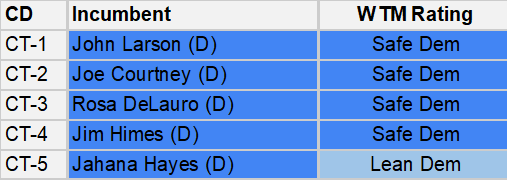
Current: 5 Dem, 0 Rep
Forecast: 5 Dem, 0 Rep
The rating listed here is our average rating from our three-person ratings group. Any district that has a non-safe rating from one of us OR from one of the major forecasters gets a profile below.

CT-5 (Northwest Connecticut: Danbury, Waterbury, Meriden, New Britain, the Litchfield Hills, parts of Torrington)
Incumbent: Jahana Hayes (D, elected 2018)
2022 House Result: Jahana Hayes (D) 50.4%, George Logan (R) 49.6%
2020 Presidential Result: Biden 54.6%, Trump 43.9%
Prior to 2002, Connecticut had six Congressional districts. That year’s redistricting essentially combined the old CT-5 (essentially following the I-84 and I-691 corridors from Danbury to Waterbury to Meriden) and CT-6 (the northwest corner east to New Britain and Windsor Locks). The new district contained each of those places save Windsor Locks, losing some of its northwestern territory closer to Hartford. It’s a fascinating mix of small cities, often with substantial immigrant populations and diverse socioeconomic situations, and rural areas including some very wealthy second-homer and tourism draws in the Litchfield Hills region. The latter has trended blue in the Bush and Trump areas, in part because of the overt religiosity of the national GOP party and the realignment of political support along educational lines. As you travel east from the Route 7 tourism corridor, though, you hit some of Connecticut’s reddest towns, like Watertown and Harwinton. This area includes the more urbanized, downtown area of Torrington, as well as the affluent Hartford suburbs of Avon and Simsbury – which became very blue in the Trump years. Danbury and Waterbury are Democratic cities in federal races, though not overwhelmingly so (they’ve settled in around 60%-40% in presidential contests, with Danbury trending slightly bluer of late and Waterbury trending slightly red. They continue to elect a mix of Democratic and Republican state legislators and local officials. Meriden and New Britain have been redder in the Trump Era than they used to be, but still gave Biden 59% and 67%, respectively.
CT-6’s incumbent Republican Nancy Johnson triumphed by a comfortable margin in the 2002 incumbent-versus-incumbent contest over CT-5’s incumbent Democrat Jim Maloney. She won two more terms before Chris Murphy defeated her in the ’06 blue wave. When Murphy ran for Senate, former state representative Elizabeth Esty faced off against state senator Andrew Roraback, a legitimate northeastern moderate Republican. Esty prevailed in a tightly-contested race; she’d retire in 2018 amid revelations that her chief of staff was accused of sexual harassment and violent threats. She kept him on staff for another three months and wrote a positive letter of reference. It became clear that Esty’s position was rightly untenable, and she opted not to run for re-election.
The new congresswoman would be Jahana Hayes, the 2016 National Teacher of the Year for her work teaching government and history at John F. Kennedy High School in Waterbury. Hayes defeated former Meriden mayor Manny Santos 56%-44% to become the first Black woman and first Black Democrat to represent Connecticut in Congress. Hayes has since won two re-elections and compiled a solidly liberal voting record with a committee focus on education (logical, given her background) and agricultural (also a logical fit, as there’s still some farming in northwest Connecticut and she gets to work on SNAP benefits – important in some of the district’s rural stretches and urban centers).
Her last election was tight: former state senator George Logan had lost his seat in the 2018 blue wave, but mounted a competitive challenge. The most intriguing thing about Logan is that he’s the frontman in a Jimi Hendrix tribute band, but I suppose his educational and professional background in engineering is cool, too. Of Jamaican descent, Logan was the first Black Republican to serve in the Connecticut Senate. He’s a sharp guy but keeps his issue positions vague – perhaps dangerously so in a blue-leaning district that Trump lost by ten and a half points and where it might be wiser to reassure constituents that he won’t be a generic Trump Era Republican. He nearly defeated Hayes in 2022, losing by 2,004 votes or eight-tenths of a percentage point. Logan’s back for another run this year, and it was expected to be close again. An Emerson poll in mid-October found a 49-46 Hayes lead. But as I write this on October 23 for future publication, we’re a few hours removed from the announcement that the GOP just canceled $600,000 in TV advertising reservations made on Logan’s behalf. It’s an indication that the race is not breaking their way this time, either. There’s a good chance we’ll move this to Likely Dem by the end.
2024 Rating: Lean Democratic (hold)
 Within the Margin