State of Play: New Jersey

The Presidency: 14 electoral votes
Every four years, with rare exceptions, Republicans suggest that New Jersey is in play for the presidency. The Bush campaign did so in 2004. McCain did so in 2008. A Romney surrogate did so in 2012. And lo, the usually-demure Donald Trump upheld this time-honored tradition in 2016 and again this year. In reality, no Republican has carried New Jersey in a presidential election since George H.W. Bush did so in 1988. He came close in 1992 and his son substantially reduced the Democratic margin in 2004 in the aftermath of the 9/11 terror attacks, but the streak remains intact.

Part of the reason for this quadrennial indulgence is that in between presidential elections, Republicans often have some success in New Jersey gubernatorial elections. In recent times, their standard-bearer has earned the right to reside at Drumthwacket after the 1981, 1985, 1993, 1997, 2009 and 2013 elections, and Jack Ciatarelli came surprising close to defeating incumbent Phil Murphy in 2021. New Jersey’s a blue state with a willingness to elect Republicans for the governorship, and not just Phil Scott types who do not much resemble the national GOP. Surely, the thinking goes, it’s not a huge leap to then support one for president? Perhaps, but Jersey voters look for something different at the federal level. Social issues resonate more than they do in state elections, and the national GOP’s aggressive social conservatism and Evangelical Christian alignment do not comport with Jersey’s northeastern liberalism. And as much as chemical companies have an imprint here – just glance to the west as you head down the Turnpike, and take in the vast industrial landscape referenced by Springsteen in “Open All Night” (and in an earlier incarnation in the unreleased-until-Tracks outtake “Living on the Edge of the World“). Donald Trump might share some cultural DNA with parts of New Jersey and have a launchpad from which to operate at his Bedminster golf course, but he didn’t come close to beating Hillary Clinton here in 2016. Joe Biden widened the margin to almost sixteen percentage points four years later. As happens here sometimes, polling early this year showed Trump within single digits. But neither Harris nor Trump is organizing on the ground or spending resources advertising here, and we should expect another comfortable win.
2024 Rating: Safe Democratic
Senate Deliberations
Andy Kim (D) vs. Curtis Bashaw (R)
Previous Senate results: 2020 – Cory Booker (D) 57%, Rik Mehta (R) 41%; 2018 – Bob Menendez (D) 54%, Bob Hugin 43%
From the start of his Senate tenure after being appointed to fill the vacancy caused by Jon Corzine’s election as governor in 2005, Bob Menendez was under ethical scrutiny. During his first Senate campaign in 2006, Republicans in New Jersey accused him of breaking conflict-of-interest laws. In 2015, he was indicted for bribery, fraud, and making false statements. Those charges were ultimately dropped, with the Justice Department citing the Supreme Court ruling in McDonnell v. United States, a case that dramatically narrowed the definition of public corruption. But the close friend and donor at the center of that case, Salomon Melgen, was eventually convicted on 66 fraud counts (and then had his sentence commuted by Trump). Menendez’s 2018 re-election campaign played out in the aftermath of the Senate Select Committee on Ethics severely admonishing him for accepting gifts from Melgen which he failed to disclose…repeatedly. It was readily understood by any person with a functioning moral compass that Bob Menendez was a deeply corrupt man who would eventually fail to stay one step ahead of the law. And sure enough, in 2023 he was indicted for providing the government of Egypt with with sensitive government information and failing to register as a foreign agent; meanwhile Menendez was accepting cash, gold bars, and other gifts in exchange for helping the Qatari government. That got him indicted again. He was convicted on all charges this past July and after an extended period of pressure from his own party – but not Republicans – he finally resigned on August 20.

Long before his resignation, he bowed to pressure to end his bid for a fourth full term in the Senate. Democratic Congressman Andy Kim announced a bid for the seat shortly after Menendez’s 2023 indictment. Realizing he couldn’t win a primary but needed leverage, Menendez announced an independent bid that went nowhere. Kim, meanwhile, saw off a bid by Tammy Murphy (the governor’s wife) by methodically winning the support of many of New Jersey’s county Dem organizations. These were thought to be in the bag for Murphy, but Kim had grassroots support and won over various county committees. Murphy dropped out before the primary, and Kim defeated two minor candidates with 75% of the vote. He’s something of an anti-Menendez: young (42) and a rare Congressman with humility, he stayed in the Capitol into the early morning hours of January 7 to clean up his workplace after it was ransacked by rioters. Kim came to Congress with an extensive background in foreign relations, having served in the State Department as an advisor to David Petraeus in Afghanistan and as a national security advisor to Barack Obama. He flipped South Jersey’s NJ-3 for Democrats in 2018 by defeating two-term Republican Tom MacArthur in a close race.
The Republican nominee is Curtis Bashaw, a real estate developer, hotel owner and former executive director of New Jersey’s Casino Reinvestment Development Authority for two years under Democratic governor Jim McGreevey. Clearly a bright guy and lacking the gutter instincts of a Trump or Vance, he’s what passes for a “moderate” Republican in 2024. He calls himself pro-choice while supporting the Dobbs ruling that allows anti-choice states to outlaw abortion. He tepidly endorsed Trump. On immigration and Israeli self-defense, he holds conventional Republican positions. He’s gay, which distinguishes him from typical Republican candidates. He has an experienced campaign team including some of the stars of NJ Republican politics. But it would need to be quite a Republican-friendly year for him to triumph, especially over a guy like Andy Kim who brings the pent-up enthusiasm of a Democratic base tired of being embarrassed by Bob Menendez.
2024 Rating: Safe Democratic. It’s not unanimous, as I’m inclined to hedge slightly given the near-total lack of polling here and the possibility of a critical mass of independent-minded voters wanting to punish the party of the disgraced former Senator – though it’s worth noting Dems were quite vocal in seeking his resignation. I have it Likely Dem; my colleagues outvoted me with Safe Dem ratings.
House Calls
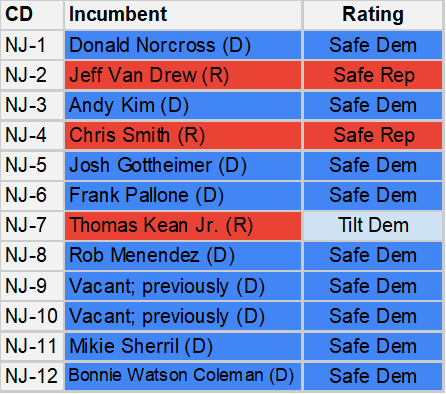
Current: 9 Dem, 3 Rep
Forecast: 10 Dem, 2 Rep
The rating listed here is our average rating from our three-person ratings group. Any district that has a non-safe rating from one of us OR from one of the major forecasters gets a profile below.
NJ-3 (parts of Central and South Jersey: Freehold, Mount Laurel, Trenton’s eastern suburbs)
Incumbent: Andy Kim (D, elected 2018)
2022 House Result: Andy Kim (D) 55.5%, Bob Healey Jr. (R) 43.6%
2020 Presidential Result: Biden 56.3%, Trump 42.3%
Obviously, you have to start with Freehold: Springsteen started there, after all. Along with towns like Holmdel, Centerville and Marlboro, this portion of Monmouth County makes up the northeastern corner of New Jersey’s 3rd district. The northwestern section includes the Trenton suburbs of Lawrenceville and Hamilton Township, the district’s largest municipality. The southern portion of the district is Burlington County, the only county entirely contained in the 3rd. This includes modestly-sized townships like Evesham, Mount Laurel and Willingboro, the joint military installations of Fort Dix, Lakehurst and McGuire, as well as much of the Pine Barrens. We tend to think of New Jersey as densely-populated cities and suburbs with some industrial terrain in the mix, plus a famed set of beaches and barrier islands. But New Jersey’s coastline is not its only natural wonder: the Pine Barrens are a remarkable ecosystem, and they also provide New Jersey with largely unpopulated acreage in stark contrast to so much of the state.
Politically, the district is Democratic on balance. Burlington County voted 59%-39% for Joe Biden; it has some Republican towns in its southern reaches but these are vastly dwarfed by the more populous Democratic municipalities. The Mercer County towns near Trenton range from medium to dark shades of blue. Only the Monmouth County portion provides a net win for the GOP: Freehold and some of the other boroughs are consistently blue but the larger townships surrounding them are quite friendly to Republican candidates up and down the ballot. The district is substantially changed from the one Andy Kim first flipped in 2018, and it’s now just about a safe seat for Democrats. In fact, we have it as such – though at least one of the other rating entity’s does not, so we’re keeping it in our battleground and it gets a profile here accordingly. Longtime Moorestown state assemblymember Herb Conaway is the Democratic nominee here, with Kim leaving to run for the U.S. Senate. Conaway is the only member of the state legislature with both law and medical degrees. He served in the Air Force Medical Corps prior to his legislative career and continues to practice internal medicine. If he defeats cardiologist Rajesh Mohan as expected in the general election, NJ-3’s first Asian-American representative in Congress will be replaced by the district’s first African-American congressmember.
2024 Rating: Safe Democratic (hold)
NJ-5 (parts of Central and South Jersey: Freehold, Mount Laurel, Trenton’s eastern suburbs)
Incumbent: Josh Gottheimer (D, elected 2016)
2022 House Result: Josh Gottheimer (D) 54.7%, Frank Pallotta (R) 44.3%
2020 Presidential Result: Biden 55.6%, Trump 43.2%
Starting with the state’s 1982 map, New Jersey has had a Congressional district stretching from the densely populated, suburban Bergen County across the state’s northern tier and into the rural northwestern portion of the state – sometimes all the way to Warren and Hunterdon counties. For most of those decades it was drawn to be a Republican district – either as vote sink by Democratic redistricters or part of a bipartisan commission’s incumbent protection scheme. For twenty years, it was represented by the moderate Bergen County Republican Marge Roukema; in 2002 she grew tired of repeated primary challengers from conservative state assemblyman Scott Garrett and opted to retire. Garrett duly won the seat and set about becoming ever-more conservative for a northeastern Republican. He voted against the reauthorization of the Voting Rights Act; he sought the teaching of intelligent design in public school science classes, railed against same-sex marriage and eventually stopped paying dues to the House GOP campaign apparatus in response to the recruitment of a small number of gay candidates. In the 2000s iteration of the seat, these sorts of things were manageable. But the 2010s version was a bit more Democratic. Garrett had always won comfortably but rarely by landslide majorities, and the sense grew that he was vulnerable to the right challenger. That challenger came along in 2016, when former Clinton administration speechwriter Josh Gottheimer mounted a challenge. Well-funded and running as a business-friendly centrist in a district populated by private sector commuters into New York City, Gottheimer won 51%-47%, a bright spot in an otherwise unpleasant election cycle for Democrats. He has subsequently won re-election by wider margins, most recently defeating Frank Pallotta 55%-44% in their 2022 rematch in a district considerably bluer than the 2010s version.
Bergen County is by far the largest component here, making up more than 80% of the district population. About two-thirds of the county is in the 5th, reaching as far south on its eastern side as Fort Lee, Palisades Park and Hackensack. To the west are ridgelines, small mountains, and lots of lakes and state parks. The district takes in the northernmost section of Passaic County (about 10.6% of the county’s population, including Ringwood and West Milford) and about 60% of Sussex County, including Franklin, Sussex and Newton. Sussex is a quite solidly Republican county, without a single township or borough that voted for Biden in 2020. The district’s portion of Passaic is much redder than the rest of the county. But these are easily outvoted by Bergen, which has plenty of Republican towns but on balance tends to vote in line with the state as a whole – in 2020, that meant 57%-41% Biden wins in both Bergen and statewide Large portions of all three counties swung left in 2020 after Trump’s term as president. Districtwide it nets out to a comfortable Biden win. It would take a very poor election year for Democrats to lose this seat, and that does not appear to be in store in 2024. One of the other ratings entities included it in a non-safe category over the summer so we include it in our battleground, but it’s looking safe as ever for Gottheimer.
2024 Rating: Safe Democratic (hold)
NJ-7 (parts of North and Central Jersey: Hunterdon and Warren counties; Sparta, Bridgewater, Summit, Rahway, Linden)
Incumbent: Tom Kean Jr. (R, elected 2022)
2022 House Result: Tom Kean Jr. (R) 51.4%, Tom Malinowski (D) 48.6%
2020 Presidential Result: Biden 51.1%, Trump 47.3%
New Jersey’s 7th District starts along the Delaware River adjacent to Pennsylvania’s Lehigh Valley and stretches across the state to the Arthur Kill separating New Jersey from the western shore of Staten Island. It’s much wider in the western section, taking in all of Warren and affluent Hunterdon counties; it’s much more densely populated in the narrow eastern arm where it includes Union County municipalities like Clark Township and the cities of Linden and Rahway. In between, the 7th includes about half of Somerset County – one of the wealthiest, healthiest and highest-educated counties in the country – including the county seat of Flemington and the commercial hub of Bridgewater Township; and about 40% the population of Sussex County, including Sparta and the lengthy Delaware Water Gap National Recreation Area that straddles both sides of the Delaware River. Finally, about a quarter of Morris County’s population is in the 7th, including Mendham and the communities around the southern end of Lake Hopatcong.
The district is much more rural in the west, and much more conservative. There are some Democratic-leaning boroughs sprinkled in, but Hunterdon County is reliably Republican as a whole and Warren (57% for Trump in 2020) and Sussex (the portion in the 7th giving him 56%) even more so, with their agricultural pockets and woodsy expanses. Each of the three last voted for a Democratic presidential nominee in 1964. Morris County was in that category as well before voting for Biden in 2020, though the portion in the 7th narrowly supported Trump (50.1%-48.4%). Somerset County was already blue but was even more so in ’20; the 7th’s section gave Biden 54%. The Union County section is the bluest part of the district, at 62% for Biden. The latter is also the largest portion, with about 26% of the district’s population. Somerset is next at about 20%; that helps them outvote the redder sections. But only slightly: this seat became more Republican-friendly in the 2022 redistricting, supporting Biden by a little under four points.
In the 1980s, Tom Kean was a popular moderate Republican governor of New Jersey. After winning the 1981 election by less than 2,000 votes in the state’s closest-ever gubernatorial race, Kean won re-election in 1985 in the state’s biggest gubernatorial landslide. He went on to chair the 9/11 commission in the early 2000s. Kean’s son has been less popular but has carved out a life as a career politician nonetheless. He was first appointed to the state Assembly to serve out an unexpired term in 2001, then was appointed similarly to a state Senate seat in 2003. He ran for Congress in 2000, losing the Republican primary; for U.S. Senate in 2006, losing to Bob Menendez; and for Congress again in 2020, losing to freshman Democrat Tom Malinowski. He opted not to seek re-election to the state Senate in 2021 in order to focus on a second run against Malinowski, who was thought to be toast after a close contest in a now-redder district. Kean leaned hard into Malinowski’s sloppy (at best) failure to disclose certain stock purchases, but surprisingly won by only a narrow margin of less than three points.
Kean Jr. has now spent more than two decades holding public office, but doesn’t seem to be terribly popular with voters. His state legislative district has elected nothing but Republicans to the Assembly and Senate for decades; it took two tries to beat the vulnerable Malinowski and he only did so by a slim margin. That makes him a major target for 2024, and Democrats nominated a promising candidate in Sue Altman, a former professional basketball player and executive director of the New Jersey Working Families Alliance. In the latter role, Altman led a coalition that unveiled a billion-dollar corporate tax incentive program that funneled money to corporate officials rather than creating jobs. Their advocacy led to a criminal investigation, seven-figure fines, and the indictment of some of the South Jersey Democratic party officials long thought to be shady figures. So Altman has credibility as a good-government advocate who will take on powerful players in her own party. She’s run effective ads touting support from local law enforcement. That said, in her advocacy role she has also been associated with some very progressive and unpopular positions, so Kean’s advertising is casting her as a radical. In an affluent district with some blue trends and a not especially popular incumbent, Altman has an opening, but an Altman-sponsored poll and DCCC-sponsored poll both show her down two points. We think she closes strong and takes it.
2024 Rating: Tilt Democratic (flip)
NJ-11 (North Jersey: most of Morris County, inc. Morristown and Parsippany, parts of Essex County inc. Montclair and Bloomfield; parts of Passaic County inc. Wayne and Totowa)
Incumbent: Mikie Sherrill (D, elected 2018)
2022 House Result: Mikie Sherrill (D) 59.0%, Paul DeGroot (R) 40.2%
2020 Presidential Result: Biden 57.8%, Trump 40.9%
For decades, Morris County was synonymous with northeastern Republicanism. Democrats last won a county-wide office in 1973; Republicans carried the county in all but two presidential elections from 1896 to 2016 (New Jersey’s own Woodrow Wilson in 1912 and Lyndon Johnson in his 1964 landslide). And from the mid-80s through 2016, the Congressional district containing the bulk of Morris County saw Democrats fail to exceed the 40% mark every cycle. Then came the Trump years, and the moderate suburbanites of Morris County reacted with disdain. Trump carried it in 2016, but by the smallest margin of any GOP nominee since ’64. Popular 12-term Congressman Rodney Frelinghuysen retired, and Dems recruited a strong candidate in Mikie Sherrill for their first concerted effort to win a Morris-based Congressional seat since 1984…and she prevailed in landslide fashion over state assemblymember Jay Webber, 57%-43%. And sure enough, Biden flipped Morris County at the presidential level two years later, 51%-47%. This affluent patch of suburbia where the real contests had long been between moderate and conservative Republicans still had that dynamic at the local level, but Democrats can now win federal races here against the Trumpified national GOP.
Morris County accounts for just over half the population of NJ-11. Another 40% or so are in Essex County. That’s New Jersey’s bluest county, though some of the places in the 11th are Republican (Fairfield, Cedar Grove, Roseland). The considerably larger townships of Montclair and Bloomfield gave Biden 88% and 72% of their votes, respectively, and on the whole the Essex portion of the 11th give the district its rather blue hue. The last 10% of the district is in southern Passaic County, including the sizable Wayne Township and the borough of Totowa – both solidly Republican despite substantial student (William Paterson University) and Arab-American populations. Taken together, it makes for a substantially Dem-leaning district, more so than the one Sherill first won in 2018.
Sherrill represents a marked departure from the aristocrats that have typically represented this part of New Jersey in Congress. An example: her predecessor, Rodney Frelinghuysen, hails from a family that has produced four United States senators; his father also served in Congress for 22 years and a maternal great-grandfather co-founded Procter & Gamble. Sherrill does not come from immense wealth; she was a Naval Academy graduate and helicopter pilot before getting her law degree and serving as an assistant U.S. Attorney for the state of New Jersey. Her 2020 re-election was her closest but she still won by six and a half points; she was comfortably under a new map in 2022. Her opponent this year is Joseph Belnome, a building inspector in Belleville who ran unsuccessfully for state senate last year.
2024 Rating: Safe Democratic (hold). This is the rare seat where I’m not the most pessimistic of our three race raters: Matt and I list this as Safe Dem for Sherrill; Jim rates it as Likely Dem.
 Within the Margin