State of Play: Georgia

The Presidency: 16 electoral votes
Georgia has made the journey from the old Democratic Solid South of the post-Reconstruction era to the mostly-solid Republican era of the post-Civil Rights era South to a highly-competitive era where it ranks in that most exclusive of categories: the modern presidential swing state. Republicans continue to dominate the Congressional and state legislative ranks thanks to maps they drew for themselves, but Democrats are back in contention for statewide races. They flipped two U.S. Senate seats in 2020 (technically January 5, 2021), one of them for an unexpired term that necessitated another election two years later. Dems won that one too, with Rafael Warnock earning a full term in a hotly-contested race with ample national attention. And of course, in 2020 Joe Biden became the first Democratic presidential nominee to carry Georgia since Bill Clinton’s 1992 victory.
A fun fact: Georgia went from a five-point Trump win in 2016 to a fifth-of-a-point Biden win in 2020, but only one county flipped: Burke County…which went from Biden to Trump. Elections in this era are about margins as much as they’re about absolutes.
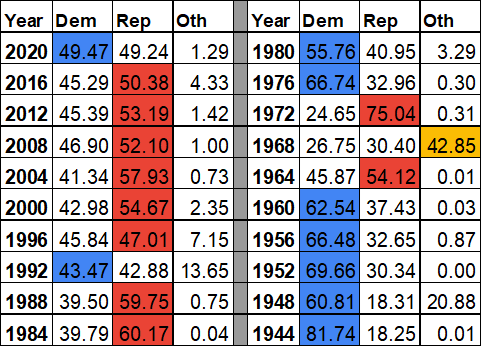
Biden’s victory so shook the Trump campaign that the then-president called the Republican Secretary of State, Brad Raffensperger, to demand he “find 11,780 votes” to overturn the tabulated result. Raffensperger resisted; Trump got indicted for racketeering and fraud.
Throughout the 2024 cycle, Georgia appeared out of reach for Biden’s re-election campaign. He had won in 2020 with a diverse coalition of suburban ex-Republicans horrified by Trump, young professionals of every racial background, and the state’s stalwart Black voters who had stuck with the party through the years where Georgia was not particularly competitive. Each of these groups showed a bit of erosion in polling before Biden withdrew from the race, allowing Trump to open up a lead. Once Kamala Harris replaced Biden atop the ticket, the margins narrowed again. Depending on which polling average you look at, Trump leads by a little under a point to two points. As with all of the Magnificent Seven Swing States, a very normal polling error in either direction could take us from either candidate winning narrowly to either candidate winning somewhat comfortably.
Harris feels like a better fit for this state in 2024 than Biden, with her capacity for big events. Her Georgia rallies have been a celebration of Atlanta’s hip-hop and R&B scenes. She’s had Bill Clinton making some campaign stops in rural Georgia, where he did quite well long ago, with smaller groups. And she has a prominent Republican crossover endorsement in this state from former lieutenant governor Geoff Duncan, who remains horrified by Trumpism and spoke eloquently at the Democratic National Convention this summer about the need to unify behind Harris to preserve American democracy from Trump’s autocratic and criminal tendencies.
All of that has gotten her close, but not ahead. In 2020, Biden led the FiveThirtyEight polling average by just over a point in Georgia by Election Day, while Trump led RealClearPolitics’ average by a point. The actual margin once all the voters were counted? Biden by 0.23%. Not bad – remember, polling misses in 2020 were bigger in whiter states like Wisconsin and not so bad in more diverse states like Georgia. Confronted with another extremely tight presidential contest in Georgia, there’s a case to be made that the Harris campaign is better-suited to identify and turnout its voters than Trump’s campaign, which has largely outsourced get-out-the-vote efforts to Elon Musk’s America PAC and Charlie Kirk’s Turning Point organization. These operations are struggling. Campaign infrastructure absolutely matters on the margins, and Harris is very likely in better shape on that front.
An open question Harris still has room to grow with Republicans – particularly those who voted for Nikki Haley in the 2024 GOP primaries. Haley barely registered any support in most Georgia counties, but in the Atlanta metro she managed 23% in Cobb County, 38% in Fulton County, and 40% in DeKalb County. Recent polling shows Haley-backing Republicans around the county unmoved by her endorsement of Trump at their convention this summer, and giving Harris a decent chunk of their support. The Bulwark’s poll showed a sample of Haley-voting Republicans and independents that supported Trump 59%-29% in 2020 backing him by only 45%-36% now. He’s got room for growth with this group get back to his 2020 numbers, but they haven’t gotten there yet. And there’s a lot of these voters in the Atlanta metro. Can Trump offset erosion with these voters with growth among Black, Latino and Asian-American Georgians, and/or the young men they’ve focused so much of their campaign messaging toward? I tend to think he will – he has a lot of pools of voters where he appears to be doing a little better than 2020, and while lacking the infrastructure to reliably turn them out, he has enough of those “pools” to give him some margin for error in holding his polling lead here.
For me, the downside is just enough to rank this as tilting toward Trump, but my colleagues take the upside and give Harris the narrow edge. Two Tilt Dems outweigh a Tilt Rep.
2024 Rating: Tilt Democratic
Senate Deliberations
There are no U.S. Senate elections in Georgia this year. The next one comes in 2026, when first-term Democrat Jon Ossoff defends his seat.
House Calls
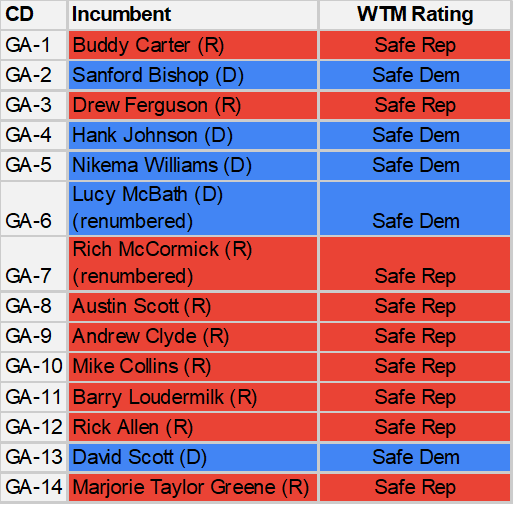
Current: 9-5 Republican
Forecast: 9-5 Republican
In 2021, Georgia’s Republican-controlled legislature combined the seats of two Democrats who had flipped suburban Atlanta seats; Lucy McBath prevailed in the 2022 primary over Carolyn Bordeaux in the combined district, numbered the 7th. That map was deemed by a federal court to have illegally discriminated against Black voters, along with the state legislative maps. Republicans drew new maps in response and convinced a court that they had avoided racial gerrymandering while maintaining the elimination of one of the previously Dem-held seats. That map renumbered McBath’s seat as GA-6. She’s safe; GA-7 continues as a safely Republican district.
The only seat where any our trio of raters here at Within the Margin offered a non-safe rating is GA-2 in the state’s southwest, so it gets its own profile below.

GA-2 (southwest Georgia, including most of Columbus and Macon, plus Albany, Americus, Bainbridge, Plains and Thomasville)
Incumbent: Sanford Bishop (D, elected 1992)
2022 House Result: Sanford Bishop (D) 55%, Chris West (R) 45%
2020 Presidential Result: Biden 54.7%, Trump 44.4%
The birthplace and still home of former president Jimmy Carter, Georgia’s southwest corner has a largely rural character, dotted with small courthouse cities but with a few larger ones as well. Columbus sits along the Chattahoochee River across from Alabama and is best know to many Americans for its massive military installation, Fort Moore. Previously known as Fort Benning after an enslaver and Confederate general, the re-christened facility serves over 120,000 active-duty military, families, reservists, retirees and civilian employees. The city’s placement on the Chattahoochee enabled it to become a major industrial and shipping power by the Civil War, and today it headquarters major service sector companies along with its substantial military and university employment. The 2nd contains the city’s downtown, western and southern sections, along with Fort Moore.
The district’s northeast corner includes most of Macon (consolidated with Bibb County into a single administrative government. Macon was a major Confederate arsenal during the Civil War. It struggled through the decline of the textile industry into the 2000s but is more recently diversifying with an emphasis on aerospace and other manufacturing. A number of rural Black majority counties are found in the center of the district, while its most conservative stretches are in the white majority counties between Columbus and the Black Belt as well as those closer to the Florida border. Outside the cities, this is a heavily agricultural district – peanut farming country in particular.
This is the state’s largest Congressional district by area, and as currently configured the only Democratic-held seat the party could lose in the coming years. It’s majority non-white: 49% Black in the 2020 Census, 40% White, 6% Latino, 1% Asian, 3% two or more races (and 1% other). Many of the rural counties are losing population, in some cases seeing double-digit percentage drops in population between 2010 and 2020. The larger drops are seen in the Black-majority counties in the center of the district, though white populations are generally falling in those counties as well. Columbus is still growing and is now over 200,000 people; Macon-Bibb County is stable.
Sanford Bishop was first elected in 1992 when the 2nd was redrawn as a Black-majority seat; previously it had been represented by a moderate white Democrat and before that a long line of conservative white Democrats. A mid-90s redistricting made it majority white again but Bishop held on and increased his vote share most cycles as he gained seniority. His only really tough race came in 2010 when a massive Republican wave coincided with revelations that Bishop awarded taxpayer-funded scholarships to family members. Bishop held on that year, defeating Mike Keown by less than three points in his closest electoral scare. After that, his vote share stabilized, usually falling right around 59% until a somewhat narrower win in 2022.
The Republican nominee this year is Wayne Johnson, an Army veteran and banker with administrative experience in the U.S. Department of Education. He finished third in the 2022 GOP primary here. Johnson’s a plausible enough recruit and he’s self-funding a bit, but likely lacks the resources to prevail. That said: this is a district where racially-polarized voting gives Democrats a modest but enduring advantage. White voters overwhelmingly vote Republican in this part of the state, but Black voters are nearly unanimous in their support for Democrats. If the latter tie is beginning to fray – as some polling indicates and as many a pundit has pondered this cycle – Dems lose their margin for error here. Johnson released an internal poll earlier this month showing him down 45%-42%. Bishop followed up with his own release showing him ahead 51%-40%.
For our part here at WTM, two of us have this race rated Safe and one has it Likely.
2024 Rating: Safe Dem (hold)
 Within the Margin