State of Play: Pennsylvania
The Presidency – 19 electoral votes
This is, of course, the big one. Pennsylvania’s far from the largest state, with its 19 electoral votes representing a steady fall from its peak of 38 in the 1910s and 1920s. But it’s the largest of the seven close swing states. We can debate how competitive Florida and Texas are this cycle, but it’s clear that a Kamala Harris victory in those states would be icing on the victory cake. Pennsylvania, though, is on a knife’s edge as it was in 2004, 2016 and 2020.
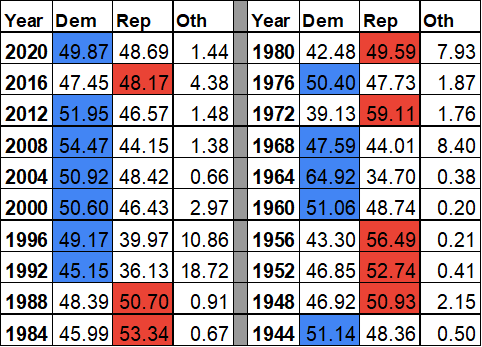
We’re a long way removed from Barack Obama’s ten-point win here in 2008, or even his larger-than-expected 2012 win in the Keystone State. And while stranger things can happen, we’re probably not going to see what we saw in 1968, 2000 and 2004, where the Democratic nominee carried Pennsylvania but still lost the Electoral College: if Harris is holding up here, it likely means that she has avoided significant erosion with the core Democratic constituencies, and is probably faring well enough in other swing states as a result.
Polling is absurdly close in Pennsylvania, with the various polling averages finding a roughly one-point lead for Harris. Left to my own devices, I’d rate the race as Tilt Republican as I see more downside for Dems than upside:
- party registration trends in PA since 2020
- erosion with Black and Latino voters in Philadelphia and likely other cities
- GOP efforts to very specifically target infrequent voters and/or those who hate politics (they’re numerous)
- the idea that the Trump assassination attempt occurring in Butler might impact local voting inclinations and turnout in a way we don’t see elsewhere in the country
- the loss of “Scranton Joe” from the ticket
To be clear, I consider the first three factors to be of far greater magnitude than the latter two, whose effect will be tiny to vanishing – but in such a close race, perhaps meaningful.
So that’s my take. But to avoid one man’s excess skepticism (or exuberance, as the case may be), we’ve got a three-person ratings bureau here at Within the Margin, and my compatriots see those downsides as less severe or perhaps even reversing in the aftermath of Democrats swapping in a new candidate this fall. After all, Tom Bonier has documented various signs of improvement in post-July 21 (the day Biden withdrew) registration. And polls have found Democrats catching up and even passing Republicans in terms of enthusiasm to vote since mid-summer, which we’d expect to be crucial in a toss-up race. With two out of the three of us having Pennsylvania Tilt Dem at the moment, that carries the day.
2024 Rating: Tilt Democratic
Senate Deliberations
Bob Casey Jr. (D-incumbent) vs. Dave McCormick (R)
Previous Senate results: 2022 – John Fetterman (D) 51.2%, Mehmet Oz (R) 46.3%; 2018 – Bob Casey Jr. (D) 55.7%, Lou Barletta (R) 42.6%
For most of the class of Democratic senators facing re-election in 2024, they’ve faced nothing but favorable cycles in their careers. Bob Casey is a good example. A pro-gun, anti-choice Democrat with considerable rural appeal in those days, he took on two-term incumbent Rick Santorum in 2006, when anti-Bush sentiment was high. Santorum’s popularity had crashed of his own accord, of course, but Casey’s landslide margin was certainly enhance by a pro-Dem national environment. Casey won everywhere that Dems used to win, all the places they win now, and a few others counties to boot in a 59-41 thrashing of former rising star Santorum. Facing a middling opponent in 2012, Casey was generally in control throughout the race, but it didn’t hurt that Obama was carrying Pennsylvania and the country (by greater margins than expected, in fact). Tom Smith won plenty of counties that Santorum did not, but Casey was still holding up well in areas of the state that were trending Republican and won 54%-45%. Then, in 2018, Casey faced Congressmember Lou Barletta, who had a reasonably high statewide profile. But in that anti-Trump Democratic wave year, he was never really in danger and cruised to a 56%-43% victory.
This time, Casey’s running in a coin flip political environment where neither presidential candidate has a clear lead in Pennsylvania or the wider electoral college. What Casey does have are solid and enduring ties to his state: his father was elected statewide as auditor and governor, and Casey Jr. has served in statewide offices (auditor, then treasurer, now senator) since 1997. Republican businessman Dave McCormick grew up in Pittsburgh and then Bloomsburg, where his father was a university president. After West Point, Gulf War service, and graduate school, McCormick eventually ended up back in Pittsburgh for a few years before his career in various companies (plus a stint in the Bush administration) took him elsewhere. Despite residing in Connecticut, McCormick launched his first bid for a Senate seat in Pennsylvania in 2022, losing to fellow out-of-state resident Dr. Oz in a close-fought GOP primary. He was the GOP’s prized recruit for this cycle, owing to his wealth and therefore ability to fund his own race, and his profile as Trump-aligned but not as crazy as, say, a Doug Mastriano who was obliterated in the governor’s race here two years ago. Is the lack of recent residency offset by his legitimate earlier ties to the state? Is he succeeding as much as some publications seem to think in capturing more Jewish votes than Pennsylvania Republicans typically do? He’s hammering Casey for not getting a floor vote in the Senate on the Anti-Semitism Awareness Act. Amusingly, of course, I suspect Casey is getting flack from his left flank over the lack of a ceasefire or an end to American weapon shipments to Israel. It’s that squeeze that would concern me as a Democratic strategist this cycle.
At minimum, Republican partisans appear to be coming home to McCormick with polls steadily narrowing from summertime Casey leads in the high single-digits to a two- or three-point lead in more recent surveys. But it’s important to note that some of those close late-September polls were from GOP-aligned firms, so we’re still approaching the shift with caution. This is Lean Dem for now, and very likely trending toward Tilt Dem.
2024 Rating: Lean Dem (hold)
House Calls
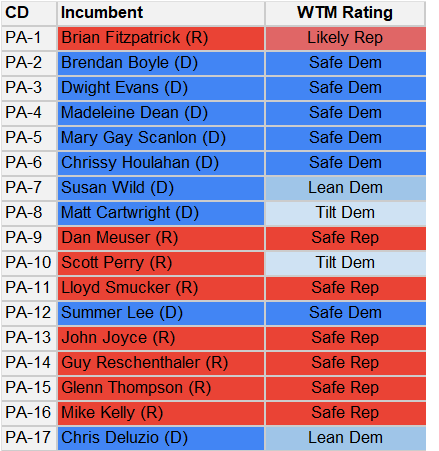
Current: 9 Dem, 8 Rep
Forecast: 10 Dem, 7 Rep
Appropriately enough for an independently-drawn map in a big, tightly-contested state, we have no fewer than eight districts to profile below (by virtue of receiving a competitive rating from one of our members, even if the consensus averaged out to Safe).
PA-1 (Philly suburbs: all of Bucks County, plus part of eastern Montgomery County)
Incumbent: Brian Fitzpatrick (R, elected 2016)
2022 House result: Brian Fitzpatrick (R) 54.9%, Ashley Ehasz (D) 45.1%
2020 Presidential result: Biden 51.8%, Trump 47.2%
Bucks County has spent the last 32 years narrowly but consistently voting for Democratic presidential candidates. It has also spent those 30 years represented in Congress by Republicans, with only a four-year break coming perfectly in the middle of that stretch.

Bucks has always struck me as notable for its three distinct components. Lower Bucks is industrial terrain – U.S. Steel’s Fairless works once employed 7,000 people and the complex surrounding it is home to various metal-, mineral- and energy-related facilities. Central Bucks is solid suburban: places like Doylestown filled in as Philadelphia’s suburban sprawl reached ever-further into the countryside. And Upper Bucks retains some of its woodsy character from the days when Bucks was an artist haven and a playground for wealth New Yorkers and Philadelphians. There’s a lot of parkland here, and idyllic little towns along the Delaware, with charming narrow car bridges into New Jersey (or better, wee walking bridges).
These three pieces are not all moving in the same direction politically. Industrial, working-class Lower Bucks was staunchly Democratic into the 2000s and early 2010s, but Trump improved immensely on the Bush/McCain/Romney performances here in 2016, and improved again in 2020. Biden won each of the townships and boroughs in Lower Bucks, but by the smallest margins in decades. Meanwhile, Central and Upper Bucks gradually grew more Democratic in the 1990s and 2000s, and in Central Bucks that trend surged in the Trump years. Upper Bucks had gotten a little bluer in the Bush and Obama years, gave Trump a shot in 2016, and trended back toward Dems in 2020. Most of those boroughs and township voted for Trump both times, but by smaller margins in ’20. The sum of all this? Democrats have now won Bucks at the presidential level in eight consecutive elections dating to 1992, but by fewer than four and a half points in all of them save Obama’s 2008 triumph. Local countywide offices are swinging back and forth, with a series of Dem wins in 2017 and 2019 followed by mixed results in the odd-years since. County row offices are currently split 5-4 in favor of the GOP. This is swingy territory with multiple moving parts.
Brian Fitzpatrick is a near-perfect fit for a district whose default preference is divided government: a Democratic president, a somewhat moderate Republican Congressmember, and quarterly showdowns about government funding inspired by the latter’s far-right colleagues and the Speakers they combine to empower. Coming into 2024 I thought Ehasz was well-positioned for a rematch, but Fitzpatrick is in control and has rolled out an impressive set of endorsements from labor, environmental, animal welfare, and foreign affairs advocacy groups. His campaign followed that up by releasing the results of an internal poll showing him in landslide territory, leading 54%-40%. One should always take internal polling with a grain of salt and revise down the sponsoring candidate’s advantage, but even a generous regression leaves Fitzpatrick comfortably in front. That said, Fitzpatrick has had Speaker Mike Johnson and NRCC chair Tom Emmer fundraising for him this month after Ehasz outraised him in the third quarter.
The Bucks district rarely yields a Safe rating anymore given how close our national elections continue to be, but Fitzpatrick’s approach might get him there someday. The Philadelphia Inquirer is less impressed: in their endorsement of Ehasz, they argue that Fitzpatrick has “come up small on major issues involving women’s rights & defending democracy” and that “when it really matters, Fitzpatrick has been on the wrong side of history.” True though that may be, we’re skeptical the voters agree.
Past flips: 1976, 1992, 2006, 2010
2024 Rating: Likely Rep (hold)
PA-4 (most of Montgomery County; eastern Berks County)
Incumbent: Madeleine Dean (D, elected 2018)
2022 House result: Madeleine Dean (D) 61.3%, Christian Nascimento (R) 38.7% (Dem hold)
2020 Presidential result: Biden 58.9%, Trump 40%
Bordering the city of Philadelphia to the northwest, Montgomery County is largely suburban in flavor, especially the sections contained in Pennsylvania’s 4th district – places close to Philly like Plymouth Meeting and Glenside, as well as towns like Pottsville and Lansdale further out along SEPTA lines or expressways. The district reaches into eastern Berks County, taking in a few more blue places like Kutztown, Laureldale and Muhlenberg Township as well as a number of much redder, rural towns – including some of PA’s best place names: Basket, Woodchoppertown, Yellow House. With the exception of Amity Township, the rural Berks towns in the 4th each have populations under 10,000, often considerably so. Montgomery thus dominates the district in numbers and population.
For most of the 20th century, MontCo was a reliable suburban stronghold for the Republican Party. As late as 1988, it was giving George H.W. Bush 60% in a presidential election and mostly electing Republicans downballot. But it was growing quickly, and as in so many suburbs the newcomers were more favorably disposed to Dems…and at a time when the Gingrich/Bush flavored GOP would take on a much more socially conservative lean that fit poorly with MontCo’s diverse and highly-educated population (second only to Chester among PA counties in terms of the percentage of the population with a college degree). In 1992, Bill Clinton became the second Dem in 90 years to flip MontCo, with 42% in a three-way race. By 2020, Joe Biden clocked in at 62.4%, making MontCo Pennsylvania’s third-bluest county. Various Republican gerrymanders left the county split various ways using contorted district lines before state courts intervened in 2018; the court-drawn map that year included much more compact lines for MontCo and lo, an easy triumph for Democrat Madeleine Dean in the new, MontCo-centered 4th district. Dean has been re-elected without incident since. Republicans will generally carry the Berks portion of the district, but it is considerably smaller and does not afford them a real foothold.
2024 Rating: Safe Dem (hold). Two of us rated this Safe and one Likely.
PA-6 (all of Chester County, parts of Berks County including Reading, Wyomissing and Birdsboro)
Incumbent: Chrissy Houlahan (D, elected 2018)
2022 House result: Chrissy Houlahan (D) 58.3%, Guy Ciarrocchi 41.7%
2020 Presidential result: Biden 56.8%, Trump 42%
Chester County makes up the southwestern portion of the Philly metro; this is a fast-growing suburban and exurban county (now over half a million people). It includes plenty of commuter country (including via passenger rail), rolling farmland and exurban outposts. Politically, Chester County was staunchly Republican in its voting habits up and down the ballot, pausing to vote narrowly for Woodrow Wilson in his three-way (or in some places five-way) victory in 1912 and Lyndon Johnson in his 1964 landslide; Barack Obama’s 2008 breakthrough was a demonstration of his unprecedented dominance in much of metro America. Chester flipped back to Mitt Romney in 2012 but has comfortably voted against Trump in the last two elections and recorded the largest swing to Dems of any Pennsylvania county in 2020. Locally, Republicans held the county row offices from 1799 until 2017, when Dems broke through for the first time to win elections for county treasurer, controller, coroner and clerk of courts. Then, in 2019, Dems won every county row office and flipped the Board of Commissioners for the first time ever. These feats were repeated in 2021 and 2023, completing Chester’s transformation into solidly Democratic territory.
The seat also includes part of Berks County, including Reading, the state’s fourth-largest city. Reading’s suburbs shifted blue in 2020 but the city itself moved sharply to the Republicans. Why? Its large Latino population. As was the case in much of America and certainly throughout Pennsylvania, Latino precincts made a substantial move in the direction of Republicans in 2020 – Reading went from a 78% showing for Hillary Clinton in 2016 to 71.6% for Biden. That’s still a dominant Democratic advantage – but it is erosion that Democrats cannot afford in statewide races. At the Congressional district level, however, this seat remains comfortably Democratic barring a total collapse in the Latino vote and/or receding support in suburban America. The latter is unlikely to happen at this time, at least in Chester, Pennsylvania’s highest college attainment county.
Republicans drew and held a Chester-based seat through its 2002 and 2012 iterations, first with Jim Gerlach and then Ryan Costello. The latter, a young and media-savvy moderate, was skeptical of Trumpism early on; that frustration plus the 2018 court-drawn redistricting contributed to his retirement in the 2018 cycle. Chrissy Houlahan won comfortably that year in the new district, and has held the seat by solid margins since.
Past flips: 2018
2024 Rating: Safe Dem (hold) Two of us rated this Safe and one Likely.
PA-7 (Lehigh Valley: Lehigh and Northampton counties, plus Carbon County and part of Monroe County)
Incumbent: Susan Wild (D, elected 2018)
2022 House result: Susan Wild (D) 51%, Lisa Scheller (R) 49%
2020 Presidential result: Biden 49.7%, Trump 49.1%
This was steel, cement, coal and slate country, best known as the home of Bethlehem Steel until its 1980s decline and 2003 closure. These days, the preserved stacks are a museum, while part of the former property is now a casino. In one of the great ironies of our time, construction on said casino in 2007 was complicated by…wait for it…a global steel shortage.
One can see why the Lehigh Valley was a region of interest for those seeking to understand and explain Trump’s appeal in 2016 and beyond. America’s industrial heartland, now shuttered and silent! The people cry out for a leader who will bring these darkened husks back to life! In reality, the Lehigh Valley never stopped growing. Lehigh County has gained gained population in every census since the nation’s founding; Northampton County has done so in each census since 1950. Replete with institutions of higher education, these two counties do not lag far behind Pennsylvania as a whole in educational attainment. The two largest cities, Allentown and Bethlehem, reached new population peaks in the last census. They are by no means without their problems, but Rust Belt narratives are often more complicated than media outlets – or the individuals they talk to in local diners – would lead us to believe.
The district also includes Carbon County, lying in the Coal Region and partly in the Poconos. Carbon’s county seat is the fascinating borough of Jim Thorpe (who never lived in the town); it was formerly known as Mauch Chunk and was the site of one of the trials of the Molly Maguires. It features stunning, well-preserve late 19th-century architecture with a few streets that feel as European as they do American. This region saw bloody warfare between miners and industrialists; today, tourism relating to the region’s mining and rail history is one of its economic engines. Politically, Carbon County generally voted for the national winner in presidential contest through 2008 (voting for Al Gore, popular vote winner but electoral college loser, in 2000) but like so many places with a mining history, shifter toward Mitt Romney in 2012 and then swung hard to Trump in 2016. It was slightly bluer in 2020 but still a comfortable Trump win (65% to 33%). It’s the reddest county in PA-7, but it only casts about 8% of the vote. The district also includes the two southwesternmost towns in Monroe County, bordering Carbon – these are Monroe’s two reddest towns but make up only a tiny portion of the district.
The vast majority of the district, then, is in the Lehigh Valley counties. Lehigh (home to Allentown, several suburban townships and some rural outlying towns) is the more populous and bluer of the two, voting for the last eight Democratic presidential nominees dating to 1992. Most of the county swung left in 2020, with the exception of Allentown itself: with its sizable Latino population shifting to the right, it dropped from a 69.5% for Hillary Clinton to 66.9% for Biden. Northampton includes most of the city of Bethlehem (home to Lehigh and Moravian universities) and, across the Delaware River from New Jersey, Easton (home to Lehigh’s archrival, Lafayette College). Further north is the much more rural Slate Belt, with several quarries still active in Bangor, Pen Argyl and Wind Gap. Northampton generally runs a few points redder than Lehigh and gave Trump a win in 2016 before returning to a narrow Dem advantage four years later. The net result across four counties? A tiny Biden win, and a Congressional seat sure to be hotly contested every two years.
Democratic incumbent Susan Wild has proven her chops. She flipped the open seat by eight points in 2018, when longtime Republican incumbent Charlie Dent retired, making her the Lehigh Valley’s first Democratic member of Congress since 1998. Dent was relatively moderate – more so than his predecessor, Pat Toomey – and increasingly Trump-skeptical; he went on to endorse Joe Biden for president in 2020 and Josh Shapiro for governor in 2022 over extremist GOP nominee Doug Mastriano, who he called a “threat to the rule of law.” The district, in other words, is accustomed to representatives with a more discerning eye than strict party-line followers, so Wild is being held to a certain standard.
Wild held on by almost four points in 2020 as several of her fellow freshmen were defeated, and won again by two points in the 2022 midterms – one of many seats where vulnerable Dems fought off a red wave once deemed inevitable. This year, Republicans have nominated Ryan Mackenzie, a 12-year veteran of the Pennsylvania House of Representatives from a Lehigh County district. He’s an odd duck known to lie about his age, but takes fairly conventional issue positions for a Pennsylvania Republican outside the Philly metro area. House polling is rare these days and usually comes from groups aligned with one side or the other; an August poll from the progressive organization Future Majority found Wild leading 47-43. It’s hard to see either candidate distinguishing themselves enough to run very far ahead of their party’s presidential nominee, so this is feeling like a seat that rises and falls on the national tide in 2024. For the moment, with Harris leading in the popular vote and Dems leading in the generic Congressional ballot, that gives Wild a slight advantage in this very slightly-blue district.
Past flips: 1904, 1906, 1920, 1922, 1924, 1926, 1928, 1932, 1978, 1992, 1998, 2018
2024 Rating: Lean Dem (hold)
PA-8 (Wyoming Valley including Scranton and Wilkes-Barre; Hazleton; Poconos)
Incumbent: Matt Cartwright (D, elected 2012)
2022 House result: Matt Cartwright (D) 51.2%, Jim Bognet (R) 48.8%
2020 Presidential result: Trump 50.9%, Biden 48%
As the birthplace of Joe Biden and his home for the first ten years of his life, Scranton has been a frequent touchstone in recent political discourse. The wider region, though, was already receiving greater attention during the ascent of Donald Trump. Its historic Democratic ties have eroded substantially in recent years, with Trump tapping into something that the Bushes, John McCain, and Mitt Romney could not.
Focused on anthracite-mining Coal Region, the 8th contains all of Scranton’s Lackawanna County, part of Wilkes-Barre and Hazleton’s Luzerne County, most of the Poconos’ Monroe County, and all of rural Wayne and Pike counties along the New York and New Jersey borders in the northeastern corner of the state. The Wyoming Valley is the most densely-populated section, featuring Scranton (the Electric City), Wilkes-Barre and a host of smaller towns readily familiar to anyone who has driven the I-81 corridor countless times: Throop, Dunmore, Moosic (where I spent part of Election Day 2012 and home of the district’s incumbent Congressman), Avoca, Pittston, Forty Fort, Korn Krest. Many of the Wyoming Valley towns remain Democratic, but 10-20 points less so than in the Obama years. Lackawanna County, for example, was an eight-point win for Biden in 2020, but Obama carried it by more than 25 points in both of his elections. Luzerne County (whose redder northwestern portion is not in the 8th) voted Obama twice before giving Trump a pair of landslide wins. Down in southern Luzerne is Hazleton – a narrowly Republican borough – where former mayor and congressmember Lou Barletta gained national attention for his hostile policies toward the small town’s influx of Latino immigrants in the 2000s and 2010s. Some of those policies were ultimately deemed unconstitutional and lawsuits against the town cost taxpayers millions of dollars.
Most of Monroe County is here in the 8th as well; this is a somewhat more affluent county along the NJ border and likely best known for the Poconos region of mountain resorts and amusement parks. The state university town of East Stroudsburg is here, too, along with Tobyhanna Army Depot and the Appalachian Trail outpost of Delaware Water Gap. Something for everyone, in other words. Monroe County was one of the closest counties in the country in 2004, with George W. Bush carrying it by just 4 votes out of 56,342. It flipped to Obama in 2008 by more than 16 points and has stayed in the Democratic column since by oscillating margins.
The district’s two smaller counties in terms of population, Pike and Wayne, are replete with state parks, game lands and other scenic wonders, including the standout Delaware Water Gap National Recreation Area. Pike has couple of Democratic pockets (Lehman Township and the borough of Milford; Matamoras in the not-distant past); Wayne not so much. At 59% and 66%, respectively, for Trump in 2020, these counties pull the GOP in front district-wide.
Yet Matt Cartwright has proven durable. His Congressional career began in 2012, when Republicans set about updating their 2002 gerrymander of Pennsylvania’s districts. Lou Barletta had flipped the Scranton/Wilkes-Barre-based 11th district two years earlier but further south in the 17th, Democrat Tim Holden had survived the red wave. So Republicans decided to concede the bluest portion of the 11th to him, and give Barletta a much redder district. With so much new territory, though, Holden was bound to draw a primary challenger from the Scranton area. Cartwright, an attorney with some prominence as a legal analyst on the local NBC affiliate, ran to Holden’s left and beat him by a comfortable margin. He won that year’s general election with ease, but his margins have diminished nearly every election since. 2020 and 2022 saw Cartwright defeat Jim Bognet twice, by only 2.4 points in the latter contest. This time he faces construction company executive Rob Bresnahan, who became a CFO in his family’s business at age 19 and soon after was CEO. Bresnahan centers the company’s growth and unionized workforce in his messaging, and can also point to his investments in rehabbing historic buildings in the Wyoming Valley. The darker side of that, of course, is that Bresnahan sold the company to a private equity firm funded by unknown investors and is in turn funding his campaign with that money. If northeast Pennsylvania is looking for a generational shift and private sector business success at a time when the nation is skeptical of the Biden/Harris economic record, Bresnahan offers it – even if his bio is not quite the American story he presents.
Past flips: Complicated because of assorted GOP gerrymanders; Scranton and Wilkes-Barre have been divided between districts as often as not. In 2002, Scranton and its environs (the most populous parts of Lackawanna) were finally joined with Wilkes-Barre and most of Luzerne County. That district flipped in 2010; then the Wyoming Valley corridor of Scranton/WB and its nearby towns were wrenched from the rest of their counties and tied to Schuylkill County as a sort of Dem vote sink. It stayed blue through 2018, when a court-drawn map undid the gerrymander and restored Scranton, Wilkes-Barre, all of Lackawanna and the more populous parts of Luzerne to a northeast PA district that remains in Dem hands heading into this election.
2024 Rating: Tilt Dem (hold). To pull back the curtain, our three-person Ratings Bureau has two Tilt Dems for this race and one Tilt Rep (it’s me, hi, I’m the Tilt Rep). If you apply a number to each part of the scale and round the decimal averages, this is closer to zero – a true toss-up. For the purposes of our ratings, we do not round to Toss-Up status.
PA-10 (south central Pennsylvania, including Harrisburg, Carlisle and York)
Incumbent: Scott Perry (R, elected 2012)
2022 House result: Scott Perry (R) 53.8%, Shamaine Daniels (D) 46.2%
2020 Presidential result: Trump 51.3%, Biden 47.2%
Whether independently drawn or part of a gerrymander, this part of the state usually ends up being a relatively compact and coherent district. For decades, Adams, Cumberland and York counties were joined together in the 19th district. The 2012 redistricting added parts of Dauphin County to the mix and renumbered it to PA-4 as Pennsylvania no longer had 19 districts. Adams County exited in the 2018 and 2022 remapping.
The current edition, numbered PA-10, is centered on the capital city of Harrisburg, which is also the largest city in the district. York is here, as is Carlisle and much of fast-growing Cumberland County. For most Americans, the most recognizable place in the 10th is probably Hershey, home of an amusement park dedicated to chocolatey goodness.
Harrisburg and Hershey’s Dauphin County is the only one fully contained in the 10th. In 2008, Barack Obama became the first Democratic nominee to carry it since 1964, and the presidential winning streak for Dems in Dauphin reached four when Biden carried it decisively (53.4%-44.0%). It’s also the site of a competitive state senate seat that Dems need to flip in order to eventually control that chamber.
To Dauphin’s west is Cumberland County, the majority of which lies in the 10th. Here we find suburban communities like Wormleysburg, New Cumberland and Camp Hill directly across the Susquehanna River from Harrisburg; further inland there are a few more commercial clusters around Mechanicsburg and the county seat of Carlisle, home to the U.S. Army War College. Beyond Carlisle lies some of the most fertile and beautiful farmland in the eastern United States, surrounding sturdy and charming (genuinely, not just in the tourism magazine sense) villages and hamlets like Newville and Boiling Springs. Some of these communities have started voted Democratic in recent years, but they’re virtually all trending that way. Where Cumberland was once a GOP stronghold – giving George W. Bush a 28-point win in 2004 – it is now increasingly competitive. Educational attainment has become a strong indicator of partisan leanings, and Cumberland now ranks 7th among Pennsylvania counties in the percentage of its population with a bachelor’s degree or higher. Trump only won Cumberland by ten and a half points in 2020, Cumberland’s closest presidential race since the Johnson landslide in 1964.
South of Dauphin is York County. This district includes roughly its northern, including the longtime Democratic stronghold of the city of York with its significant Black and Latino populations. The outlying parts of York County are decisively Republican. This was not always the case; York County was mostly Democratic until the 1950s, and it trended a few points back toward Dems during the Trump years.
Taken as a whole, the 10th leans slightly Republican, with Trump winning by four points in 2020 and most downballot offices held by that party. But there’s a distinct blue trend in the district…and this spells trouble for one of the most right-wing members of Congress, Scott Perry. He could be an inspiring American story, coming as he does from modest roots and working his way up through blue-collar jobs and service in the Army National Guard. Alas, Perry’s public service has taken a dark turn. Beyond his garden-variety votes as a member of the Freedom Caucus, Perry played an active and leading role in efforts to overturn the results of the 2020 election. The district may lean right, but it’s not clear it tolerates Perry’s extremism; pastor and Army veteran George Scott gave him a very close race in 2018. Former state auditor Eugene DePasquale was thought to have a good chance at dislodging Perry two years later but lost by six points; 2022 was a somewhat more comfortable Perry win over Shamaine Daniels, a Harrisburg city councilperson. This time, Democrats recruited Janelle Stelson, well-known locally as a former news anchor for WGAL television. She won a competitive primary and outraised Perry 2:1 in the second quarter this year. She irked progressives at times during that primary, but one should keep in mind that this is still a Republican district and it’s not going to be one by tacking left. A more concerning issue is that she lives outside the district in Lancaster County. While she has familiarity from her TV days – WGAL reaches the entire district – Perry can try to paint her as an outsider, though I don’t believe people in this part of Pennsylvania view immediately-adjacent Lancaster as particularly exotic or distant. Stelson is polling well…in fact, she’s polling very well considering she’s up against an incumbent. Perry, meanwhile, is saying quintessentially Perry things about how he fears God and thus has nothing else to fear.
Past flips: 1958, 1960, 1964, 1966 (with overlap mainly in York and Cumberland counties)
2024 Rating: Tilt Dem (hold). To pull back the curtain, our three-person Ratings Bureau has two Tilt Dems for this race and one Tilt Rep. If you apply a number to each part of the scale and round the decimal averages, this is closer to zero – a true toss-up. For the purposes of our ratings, we do not round to Toss-Up status.

PA-12 (City of Pittsburgh and suburbs and exurbs, including Bethel Park, Jeannette, McKeesport, Monroeville, Plum)
Incumbent: Summer Lee (D, elected 2022)
2022 House result: Summer Lee (D) 56.2%, Mike Doyle (R) 43.8%
2020 Presidential result: Biden 59.4%, Trump 39.5%
The heart of the 12th is the Steel City, though these days the city’s population makes up less than half a district (Pittsburgh’s population is also less than half its peak population from the 1950 census). One of the county’s most distinctive big cities thanks to its hilly geography, Pittsburgh is very much a city of neighborhoods owing to the natural boundaries between them. Those neighborhoods have long been Democratic in almost all cases; the entire city had just three precincts that voted for Trump in 2020. But they get there in different ways, whether it’s Black neighborhoods like the Hill District, or Squirrel Hill with its significant Jewish community, Mount Washington with its young professionals, or Marshall-Shadeland with its hints of the central and eastern European communities that once predominated (citywide, Pittsburgh continues to have one of the largest Slavic-American populations in the United States).
Donald Trump and JD Vance like to use Pittsburgh as some kind of shorthand for conservative policy preferences, but their rhetoric has no bearing on reality. But Pittsburgh has been a Democratic city, and often a progressive one, for a long, long time.
The 12th includes parts of eastern Allegheny County and westernmost Westmoreland County. Bethel Park and Plum are examples of affluent Republican suburbs that shifted several points left in the Trump years, while Monroeville (and its mall where Dawn of the Dead was filmed) spent decades within a band of narrow but consistently Dem-leaning results before giving Biden a comfortable 57%-41% win in 2020. Across the border, Westmoreland County was once part of Democrats’ near-uniform dominance in southwestern PA. From 1932 through 1996, it voted for every Democratic presidential nominee except McGovern, while Democrats dominated local and county offices. As with so much of southwest PA outside Pittsburgh and its suburbs, though, the 1990s saw the beginnings of an erosion in Democratic support that would gain momentum in the George W. Bush years and skyrocket in the Obama era. These days, Westmoreland gives Republicans hefty presidential margins (63%-35% in 2020) and most of the local offices. The parts in PA-12 mostly contribute to those margins, but it’s also true that they trended very slightly blue from 2016 to 2020.
On balance, the very blue city of Pittsburgh and purple-to-blue eastern Allegheny County suburbs prevail decisively over the Westmoreland portion of PA-12, for a 59% Biden total and generally speaking, comfortable Democratic wins downballot. There are reasons to believe freshman incumbent Summer Lee might run somewhat behind those margins. Originally recruited to run for the state House of Representatives by a local Democratic Socialists of America (DSA) organizer, her ties to that organization point to a brand of Democratic politics that plays fine in parts of the city but somewhat less so in neighborhoods like Squirrel Hill, the suburbs and outlying areas. She won with 56% of the vote in 2022 in a good year for Pennsylvania Dems – a slightly tighter margin than the district baseline against a non-competitive opponent. A caveat is required, though: that non-competitive Republican was named Mike Doyle, the same name as the retiring longtime Democratic congressman for Pittsburgh and many of its suburbs. Since then, she has cast a number of votes relating to the Israel/Palestine conflict that put her outside the mainstream – though they might help her with her district’s substantial student population. Lee should win, but if Dem fortunes declined substantially she might be in trouble if she proves unable to match her party’s support.
Past flips: Years of population decline (finally stabilizing, it appears) and some particularly contorted gerrymanders make it quite difficult to compare the rest of the 12th to past districts. Perhaps the best point of comparison at any time is the district containing all or most of the city of Pittsburgh, and those districts have been steadily Democratic since 1932. There’s also a decent overlap in the eastern part of this district with the mid/late1940s PA-29. It flipped to Dems in ’48 and back to reps in ’50 before being substantially changed in the 1952 map.
2024 Rating: Safe Democratic (hold). Our trio of raters are not unanimous on that Safe rating (I have it Likely Dem), but our average rounds to Safe.
PA-17 (Greater Pittsburgh: suburbs including Penn Hills, Mt. Lebanon, Ross and Moon townships; along with Beaver County)
Incumbent: Chris Deluzio (D, elected 2022)
2022 House result: Chris Deluzio (D) 53.4%, Jeremy Shaffer (R) 46.6%
2020 Presidential result: Biden 52.3%, Trump 46.5%
A recurring theme as we talk about western Pennsylvania is how blue it was in the 1970s and 1980s as so much of the rest of the country trended red, and how much it has trended red in more recent decades even as the country as a whole is so closely divided. That story has played out in a number of the districts we’ve discussed…but not this one. In fact, even more than the Pittsburgh-based 12th, the 17th has been moving leftward, especially in the Trump years.
Part of that drift is the concentration of suburban territory; the higher-income and higher-education suburbs in particular rejected Trump. Mt. Lebanon has gone from voting 50%-48% for Bush in 2000 to 54%-45% for Obama in 2008 to 61%-34% for Clinton in 2016 and finally 67%-32% for Biden. The district’s largest township is the much more diverse Penn Hills, where the story is less about affluent voters…but there is nonetheless a shift, voting 59% for Gore in 2000 and 69% for Biden twenty years later.
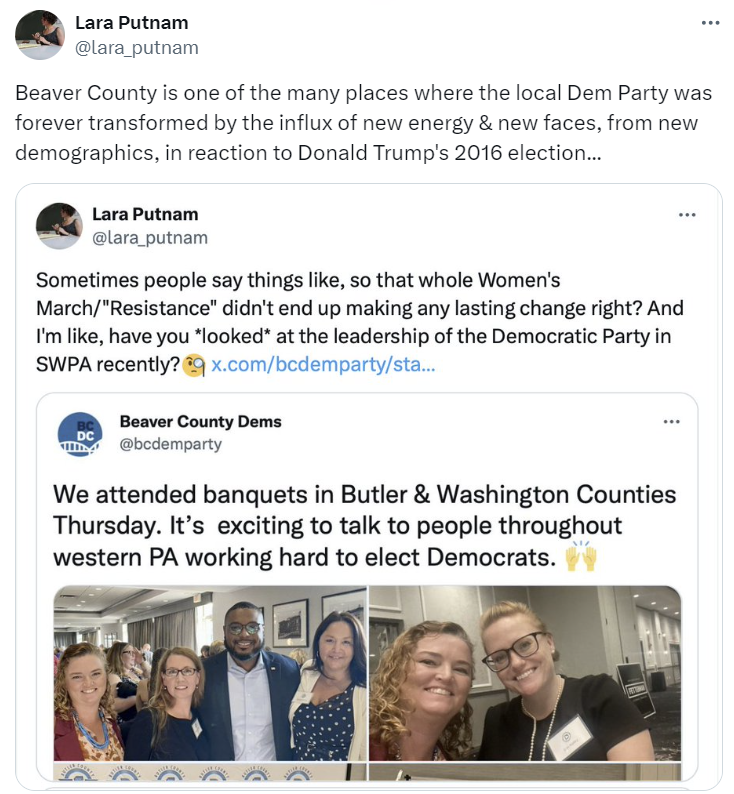
Another part of the story, though, is somewhat more complex. Beaver County, to Allegheny’s northwest, is one many counties in western Pennsylvania that voted for Democrats up and down the ballot throughout the postwar era, and generally by huge margins – 63% for Mondale and 66% for Dukakis even as they lost decisively statewide and nationwide, while dominating countywide offices and local government posts. That era came to an end in the 2000s and 2010s, with Beaver voting against Obama twice while Republicans gradually won more and more state legislative seats and providing key margins to flip Beaver’s new Congressional district in 2012. And like most of the counties out here, it made a big shift toward Trump in 2016. But unlike many of those counties, it did not follow that with another shift in 2020. Like Washington and Westmoreland, Beaver instead crept back to the left, slightly, with Trump’s margin dropping by a point. A 58%-40% Trump is a landslide, to be sure, but if that’s the peak and the fightback is underway, local Dems will be pleased. There’s reason to believe it might be. University of Pittsburgh historian Lara Putnam has written extensively about political change in Pennsylvania and particularly this part of the state, and she has closely followed the rebirth of Democratic leadership, activism and fortunes in Beaver in particular. I highly recommend this piece from 2020. And give her a follow.
So you take rapid Democratic gains in the Pittsburgh suburbs, and combine them with a red county where Republican gains have slowed or even started to reverse, and you have a district Dems can win – and lately have been. Marine and federal prosecutor Conor Lamb flipped the predecessor to this seat for Dems in a special election in the old PA-18, overlapping with some of the current district’s suburban territory, in May of 2018. He was re-elected later that year and again in 2020 under a new court-drawn map that now included Beaver and lost some conservative territory elsewhere. Lamb opted for a Senate run in 2020; Dems nominated Navy veteran, attorney and legal scholar Chris Deluzio for the open seat and he won by a surprising wide margin. One can ask, though, if we should be surprised, given the district’s makeup. While we used to think of southwest PA as a land of culturally-conservative anti-abortion Democrats, there was another component: pro-choice Republicans in the Pittsburgh suburbs. Some of those folks are voting Democratic these days, and they’re indexed pretty heavily in this district. A next-generation Dem who just turned 40 this year, Deluzio is a staunchly pro-labor representative whose background in cybersecurity law and policy stands in stark contrast to so many Congressmembers who are still trying to figure out how to enable two-factor authorization. He faces a tough challenger this year in Rob Mercuri, a 43-year old West Point graduate (and classmate of my own Congressmember, Pat Ryan) and two-term state representative. Mercuri went into finance after his military service, working at one point for quintessential Pittsburgh-area firm PNC. The fundraising gap between Deluzio and Mercuri isn’t as large as it has been for many House races this year, and Mercuri’s voting record and issue positions mean he is not an easy target for the usual attacks against socially-reactionary Republican candidates. This is a matchup between two of the stronger candidates either party could put forward for a seat like this, and it may simply come down to how closely Kamala Harris can replicate Joe Biden’s six-point win in this district from four years ago. In August, the progressive group Future Majority released a poll showing Deluzio up 48-40, but remember that internal polling and polling from allied groups typically tilts several points toward their favored candidate.
Past flips: 2006, 2012 (Beaver and northern Allegheny portions); 2018 special (parts of Allegheny)
2024 Rating: Lean Dem (hold). From time to time the Ratings Bureau here at Within the Margin will have disagreements in both direction and magnitude. This is an example of the latter: I have it at Tilt Dem; my colleagues Matt and Jim both went with Lean Dem.
 Within the Margin