House Race Capsules: The Southwest
This is a region replete with competitive and impactful races up and down the ballot, from goverbors to secretaries of state to Congress and the state legislatures.
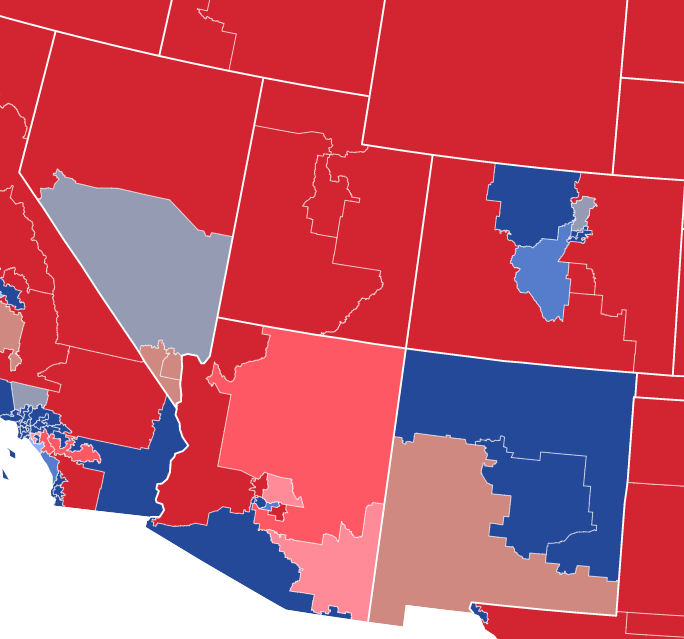
Let’s break the race for Congress down state by state.
Arizona – 9 seats
Current: 5 Dems, 4 Reps
Projected: 6 Reps, 3 Dems
Arizona fell short of expectations and failed to add a seat in the 2020 Census, so they continue with a nine-member map. But it’s a very different map from 2012, when the independent commission turned out a Dem-friendly map (and got sued for it, unsuccessfully). The decade brought plenty of ups and downs but ended with Dems holding five seats and increasingly competitive in a sixth. That map is gone, replaced with one that left Republicans gleeful. It also, unhelpfully, renumbered the seats.

AZ-1: Dogged by corruption allegations and a seat trending blue, longtime Republican incumbent David Schweikert has been holding on by narrower margins in recent cycles. And he landed in the one competitive seat that became better for Democrats on this new map – Trump won his previous seat (then numbered AZ-6) by four points but the new one voted for Biden by a point and a half. Its basic geography remains the same, however – Scottsdale, Paradise Valley and Fountain Hills in the northeastern Phoenix metro. This is a seat that should generally be in play but it’s probably not happening for Democrat Devin Hodge, an intriguing candidate, this cycle, though the one public poll we’ve seen had the race even (in mid-August, alas). One of many seats where we’d really like to have seen district-level polling. Lean Rep.
AZ-2: The successor to the old AZ-1, this seat continues to be an odd amalgamation of northern and eastern Arizona along with a bit of the extreme edge of the Phoenix metro. Its vastness includes the strongly Democratic city of Flagstaff, along with Sedona, Prescott, and the Hopi and Navajo reservations. Closer to Phoenix, it includes the city of Maricopa along with the Gila River reservation. The addition of Prescott and Yavapai County is unhelpful for Democrat Tom O’Halleran, who flipped a seat blue in 2018 – especially because it comes at the cost of Democratic areas north of Tucson. The territory swaps take O’Halleran from a seat that voted for Biden by under two points to won that voted for Trump by more than eight. It’s asking a lot for O’Halleran to hold on under these conditions, but maybe the onetime Republican has some crossover appeal he can tap. More likely, Eli Crane flips it red. Likely Rep.
AZ-4: Greg Stanton, a former Phoenix mayor who was very helpful when I talked to him on the phone in 2011 about a recycling firm that was seeking to open a plant in the municipality where I was working, has been holding down the old AZ-9. That district was based around Tempe and western Mesa; it also included part of Phoenix and northern Chandler. The new version loses the Phoenix piece and stretches east to take in more of Mesa. In the process it goes from a seat Biden won by more than 20 to one he still carried by 11 points; Stanton should be fine unless it’s a catastrophic night for Dems. Likely Dem.
AZ-6: This is southeastern Arizona’s seat, including parts of eastern Tucson. Its predecessor is the current AZ-2, captured by Democrat Ann Kirkpatrick in 2018. She was re-elected by a ten-point margin in 2020, but is retiring in the face of a more difficult map. The district now reaches up to Casa Grande in the far reaches of exurban Phoenix; the Pinal County additions represent hostile terrain for Dems. It also adds parts of sparsely-populated but blood-red Graham and Greenlee counties. The district loses Dem-friendly border areas for seemingly no reason; these are incoherent lines seemingly designed to create a Republican seat. The old seat voted for Biden by double-digits; the new one by a few tenths of a point. Republicans have recruited well here with Juan Ciscomani; Democrats triaged the seat in October and face an uphill battle for former state senator Kristen Engel to earn a surprising win. Lean Rep.
Colorado – 8 seats after gaining one in the 2020 Census
Current: 4 Dems, 3 Reps
Projected: 5 Dems, 3 Reps
Notable changes to Colorado’s map: CO-3 gets safer for Lauren Boebert (R), CO-6 becomes even safer for 2018 pickup Jason Crow (D), CO-7 gets tricker but still decidedly Dem-leaning for the retiring Ed Perlmutter (D), and the new CO-8 in Greeley and the Denver suburbs is the most closely divided seat in the state.

CO-7: Perlmutter flipped this seat in the Denver suburbs in 2006 and has usually won comfortably since. It’s a tougher seat now – losing northern suburbs like Brighton, Thornton, and Commerce City; on the whole, most of the territory lost is very blue. The areas gained in southern Jefferson County includes friendly spots like Evergreen but also much more marginal and red precincts further south. The old CO-7 voted for Biden by 23.5 points; this one by 14.5. Perlmutter’s retiring so Lakewood state senator Brittany Pettersen is the Dem nominee. She flipped her seat from the GOP in 2018 so she’s familiar with terrain more difficult than this. Dems seem a bit shook by the new map but this is Likely Dem.
CO-8: Can’t say the same about CO-8. It gains those northern Denver suburbs from the old 7th, and the generally-Democratic Greeley anchors the seat at its far northern point. But the areas in between are quite Republican-friendly, and on balance Biden only won the district by 4.7 points. So it’s not much bluer than the nation as a whole, and this is not likely to be as good a year for Dems as 2020. But candidate factors do still matter:
- the Dem nominee is pediatrician and state representative Yadira Caraveo, first elected to the state legislature in 2018.
- Republicans nominated freshman state senator Barbara Kirkmeyer, who previously backed a northeast Colorado secession movement, supports a personhood amendment, and wants to annul same-sex marriages. She seems rather extreme for a Biden-supporting district.
- In the years that I have followed politics, other election-watchers have waxed on every time Republicans nominate an obstetrician or pediatrician. I’m led to believe that people love electing doctors who treated their kids. And yet when Dems elect a Latina pediatrician in a 44%-nonwhite district, with political experience no less from winning a pair of state rep elections, no props are given. Mystifying. I moved this one to Tilt Dem in defiance of various national prognosticators in October, and I’m keeping it there now.
Nevada – 4 seats
Current: 3 Dems, 1 Rep
Projected: 3 Reps, 1 Dem
In an attempt to bolster incumbents in NV-3 and NV-4, Democratic legislators drawing new maps sapped some of their party’s strength in NV-1. We’ll see how that plays out in a difficult year where Nevada seems to be sliding toward Republicans.
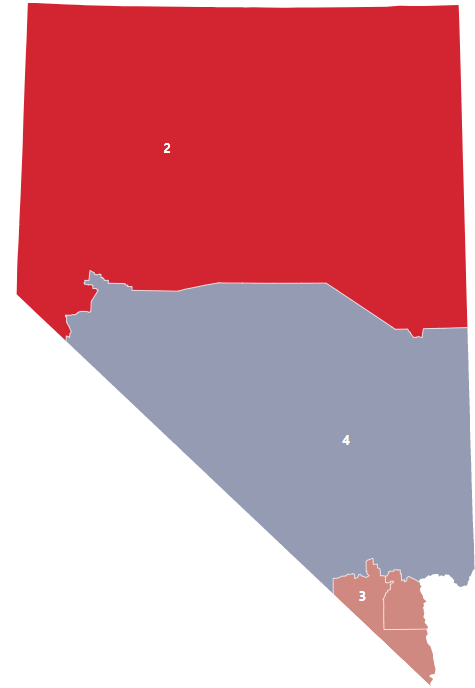
NV-1: Dina Titus does have experience in competitive terrain: she flipped the old NV-3 for Dems in 2008 before losing it in 2010 and rebirthing in 2012 in the safer NV-1 under new maps. She has been drawing on that long-ago experience this year, as new Dem-drawn maps put her in a seat Biden won by a little under 9 points instead of her utterly safe district of the last decade. With Dems struggling up and down the ballot in Nevada and talk of Latino voters (there’s quite a few in NV-1) migrating to Republicans, Titus is in trouble. Army veteran Mark Robertson had pulled even with Titus in a mid-October NYT/Siena poll, and led by double-digits in subsample of the statewide Emerson poll later in the month. The Democratic firewall from mail voting in Clark County doesn’t seem to be what it needs to be, so this seat has shifted two slots to Tilt Rep since my October 21 ratings.
NV-3: Susie Lee’s seat got safer (from basically even to Biden +6.7) but that doesn’t seem to be enough this year. Attorney April Becker led in Emerson’s subsample and is better positioned than some suburban Republican candidates to survive post-Dobbs elections. I have shifted this from Tilt Dem to Tilt Rep since October 21, partly in light of iffy mail voting from Nevada Dems so far.
NV-4: Stephen Horsford now sits in a district Biden won by over eight points compared to one he carried by about four; that should be just enough for him to hold on if private and public polling is to be believed. Horsford holds on but barely. Tilt Dem (down from Lean Dem on the 21st).
New Mexico – 3 seats
Current: 2 Dems, 1 Rep
Projected: 2 Dems, 1 Rep
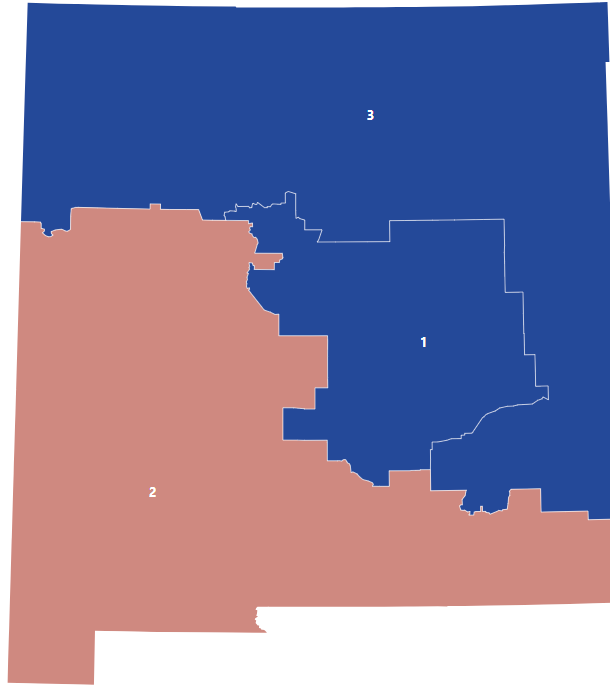
New Mexico Dems redrew the 2nd district (captured in 2018 but lost in a 2020 rematch) to be more favorable, and unlike Nevada, appear not to have jeopardized other seats in the process. The new NM-2 voted for Biden by 5.7 points instead of the former district’s 12.5-point Trump edge. In the long run it should flip back to Dems, and this might be the year – Las Cruces city councilman Gabe Vazquez led narrowly in two of the three late October polls released. The other has incumbent Yvette Herrell up by 11. I’ve been down on Vazquez’s chances because he’s too easily tagged as a defund-the-police guy, but some of these polls show voters are a little savvier than that so I’ve upped the uncertainty. Moved this from Lean Rep to Tilt Rep.
Utah – 4 seats
Current: 4 Reps
Projected: 4 Reps
Stop me if you’ve heard a variation of this before: Dems flipped a Salt Lake City area seat in 2018, lost it in 2020, and Republican state legislators redistricted it into GOP safety. That’s the story in Utah’s 4th district, which goes from being the state’s only competitive district to being…not competitive. Utah’s an interesting place, though – the SLC area is still growing and the LDS is not uniformly supportive of Trump or the GOP’s Trumpist turn. We’ll see what the next decade brings.
 Within the Margin