House Race Capsules: The Northwest
We have plenty of competitive races in these states, including a new (for this century) seat in Montana and a few in an unexpected place – the great state of Oregon.
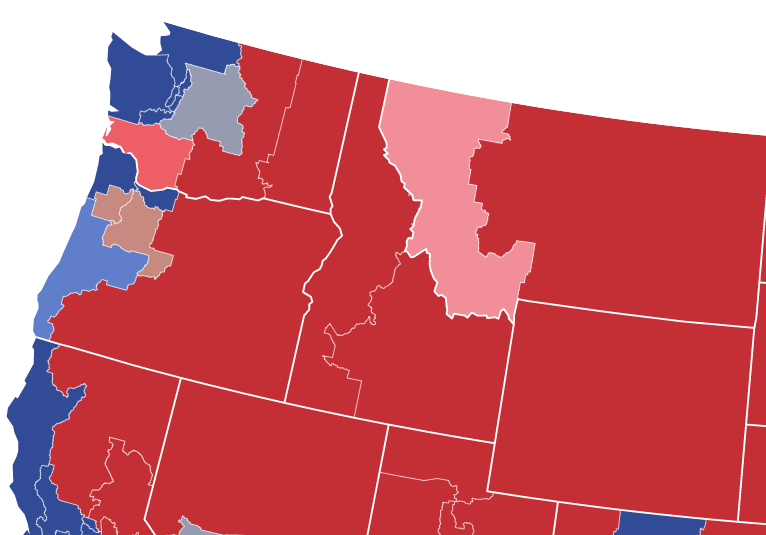
Let’s drill down into these states and their varying dynamics.
Idaho – 2 seats
Current: 2 Reps
Projected: 2 Reps
Idaho’s Congressional elections used to involve some suspense; Richard Stallings held ID-2 for Dems from 1984 through 1992 and Larry LaRocco won ID-1 in 1990 and 1992. Walt Minnick flipped ID-1 for Dems in 2008 before losing in the 2010 wave. These days, though, both seats are Safe Rep. Idaho’s race for attorney general is the one to watch in the Gem State this year.
Montana – 2 seats, after gaining one from the 2020 Census.
Current: 1 Rep
Projected: 2 Reps
Montana regains its second Congressional seat, last featured in the 1980s. Current at large congressman Matt Rosendale will run for re-election in safely Republican MT-2, which includes Helena, Great Falls, Billings and a vast swatch of more conservative rural territory; the eastern Montana 1st is where the action is. Despite featuring the Democratic cities of Missoula and Butte, this is still a seat Trump won by 7 points. But Montanans have split their tickets more than some states over the years, and there’s a gulf in candidate quality here. Republicans nominated former at large congressman and Trump Interior Secretary Ryan Zinke, who spent his time in the cabinet batting away scandal allegations. The Democratic candidate, attorney Monica Tranel, is a strong one, and her endorsement from former governor and RNC chair Marc Racicot demonstrates she has some bipartisan backing against the controversial Zinke. Lean Rep in a tough year for Dems, but it’ll be interesting to see if Zinke can clean up his act as a Congressman when he’s spending his day talking to lobbyists and donors. Seems unlikely.
Oregon – 6 seats, after gaining one from the 2020 Census.
Current: 4 Dems, 1 Rep
Projected: 3 Dems, 3 Reps
Oregon gained a new Congressional seat, Dems got to draw the map, and somehow managed to put themselves in a position where Reps could gain both the new seat and two others. Of course.

OR-4: Eugene, Corvallis and Roseburg. Peter DeFazio held on by five points against former National Guardsman and Paris train terrorism hero Alek Skarlatos in 2014. The district is now considerably bluer on paper (Biden by 13 points), DeFazio is retiring, and Skarlatos has since been revealed to have joked about choking women on a podcast a few years ago – among other demeaning things. He apologized after being called out and acknowledged the comments to be hurtful and immature; Democratic candidate and Oregon Labor Commissioner Val Hoyle has been relentless in featuring them in attack ads. The problem of course is that these comments were made in 2018 – is that long enough that we can be sure this guy has changed, considering that if he won he’d be part of a decidedly imbalanced power dynamic as a Congressman with a likely very young staff in the precarious world of legislative employment? I suspect Oregon voters are coming to the same conclusion, and making the safer choice. Likely Dem.
OR-5: northern Bend and the southern Portland suburbs. This seat got a point redder in redistricting; it still voted for Biden by about eight points. Longtime moderate incumbent Kurt Schrader, increasingly a thorn in progressive sides, was defeated in his primary by Jamie McLeod-Skinner. She faces the former mayor Happy Valley, Lori Chavez DeRemer, and it is not going well. Both candidates released some private polls, but not since Labor Day; the general consensus seems to be that LCD will edge out JMS and I don’t have much more to add, unfortunately. Oregon Dems will have to reconsider how far left they want to go in 2024. Tilt Rep.
OR-6: Oregon’s new seat is based in the Willamette Valley, centered on Salem and stretching northwest past McMinnville and north to Beaverton and Garden Home-Whitford. It was drawn to be solidly Democratic, voting for Biden by 13.7 points. But by all accounts it’s not playing out that way. Democratic state rep Andrea Salinas faces Republican businessman Mike Erickson, founder of a Fortune 500 logistics company. He ran in CO-5 in 2006 and 2008, which were not the best years for Republicans. This time he has the political winds at his back, particularly in Oregon where Republicans are on the verge of winning the governorship for the first time in 40 years. I imagine, too, that voters concerned about inflation and supply chains might consider the leader of a successful logistics company to be someone they want in Congress. Tilt Rep – the only reason it’s not Lean Rep is the partisanship of the district.
Washington – 10 seats
Current: 7 Dems, 3 Reps
Projected: 7 Dems, 3 Reps
Washington’s independent commission made minimal changes. The bigger impact was the impeachment votes of two of the state’s Republican incumbents – which cost one of them, Jaime Herrera Beutler from WA-3, her seat in a primary.

WA-3: Beutler’s primary loss means the much more conservative, Trumpy and white supremacist-aligned Joe Kent carries the torch for Republicans here. That gives Democrat Marie Gluesenkamp Perez an opening. She’s an interesting candidate for Dems, as an auto repair shop owner leaning into her working-class Washingtonian roots. This is difficult terrain for her – Trump carried it by four and a half points – but maybe Kent is disqualified by some of the voters in this Vancouver and southwest Washington district. Likely Rep.
WA-8: After a narrow escape in eastern King County district in 2020, Democrat Kim Schrier faces another tough race. Attorney Matt Larkin is trying to reclaim a seat Republicans held with the relatively moderate Dave Reichert for over a decade until 2018. Like so many districts, we don’t have any recent polling here. Biden carried it by about seven points; close watchers are convinced this will be much, much closer. Tilt Dem.
Wyoming – 1 seat
Current: 1 Rep
Projected: 1 Rep
Wyoming’s at large seat was competitive in 2006 and 2008 when Gary Trauner ran two very solid campaigns. He fell short both times and Dems haven’t come close since. This year, Dems turned their attention to saving democracy by trying to get apostate Liz Cheney through her Republican primary against arch-Trumper and election-denier Harriet Hageman. They did not succeed, and Trump gains another devoted follower in Congress.
 Within the Margin