House Race Capsules: California
In a state with 52 districts, you’re bound to have some competitive ones – though in the days before California’s independent redistricting commission, that was usually not that case. But as we enter our second decade of the Commission Era, we have plenty to examine in the Golden State. Dems flipped seven seats here in 2018 and Reps took back three of them two years later. Plenty of those in play once again.
California started out with two members upon achieving statehood in 1850. In every census that followed, the state held steady or more often, gained seats. That ended with the 2020 census, when California lost a Congressional seat for the first time in its history. California’s gold-standard independent commission was tasked with drawing a 52-seat map and the final product yielded plenty of competitive seats. Let’s discuss some notable situations after the map.
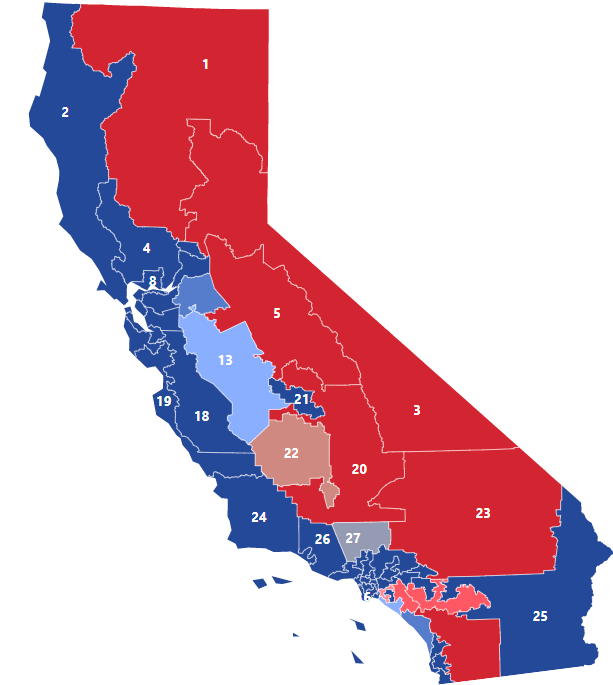
California – 52 seats after losing one in the 2020 Census
Current: 42 Dems, 11 Reps
Projected: 42 Dems, 10 Reps
CA-9: Several expert ratings have this Stockton-based seat as Lean Dem; in the absence of any polling data since July and limited if any Republican spending here, I have it Likely Dem, owing to incumbent Josh Harder having triumphed twice (including over an entrenched incumbent in 2018) in much…harder terrain. This is a district Biden won by 12.7 points while Harder’s old seat was evenly-matched in partisanship.
CA-13: The Cook Political Report and Larry Sabato/UVA Center for Politics Crystal Ball each have this open Merced-based seat as a toss-up. I’m more bullish for Dems here; it’s another double-digit Biden district and I’m not persuaded the floor is falling out for Dems in California as much as some blue states. Nursery owner John Duarte is a solid Republican candidate, if inclined toward some obfuscation on abortion rights; Assemblymember Adam Gray is an experienced candidate who started with some name rec. It’s between Tilt Dem and Lean Dem for me; Tilt is really intended for gut calls on toss-ups and I think this situation is slightly more Dem friendly than that given that we have two strong candidates but a fundamentally Dem-leaning district. Lean Dem.
CA-22: This Central Valley seat, stretching from Tulare south to take in part of Bakersfield, is one of the toughest races to predict in the country. Republican David Valadao suffered one of the most surprising defeats in the 2018 midterms, losing by less than a point; before then he won three terms in his moderately Dem-leaning district regardless of political winds. He bounced back in 2020, regaining his seat by one-point margin. Now he faces a somewhat bluer district; Biden carried it by 13 points (his former CA-21 was Biden by 11). Valadao carved out a moderate niche in his heavily non-white district, and he’s one of the few Congressional Republicans who voted to impeach Trump and has survived to the general election. He faces a number of questions:
- Can he continue his trend of dramatically overperforming his party? Even if this is a good midterm for Republicans, this district’s default tendencies are Democratic.
- How much will Democratic erosion with working class voters – including working class Latinos – impact the results? It’s an 82% non-white district, but fewer than 10% of adults here have college degrees. If the realignment along educational lines continues this year, Valadao will likely find easier sledding than the district’s prior partisanship would indicate.
- Does Valadao suffer a penalty among Trump-supporting Republicans for his past apostasy? He can’t afford to bleed much support from his own party and survive.
Tilt Rep, because Valadao is battle-tested and I anticipate further struggles with Democrats among working class voters of all ethnicities. But that’s (educated) guesswork.
CA-27: This Antelope Valley district in northern LA County includes Lancaster, Palmdale and Santa Clarita. Its predecessor seat flipped to Dems in 2018; when Katie Hill resigned, Republican Mike Garcia flipped it back for the GOP in a special election. Later in 2020 he won again, by a dramatically reduced margin of 333 votes. The new seat is bluer, majority non-white, and Assemblymember Christy Smith is back for a third try at winning it. Her special election campaign did not impress, but from a distance she has appeared crisper each time and has the edge against a surprisingly Trumpy incumbent. Tilt Dem as I think the third time’s a charm here.
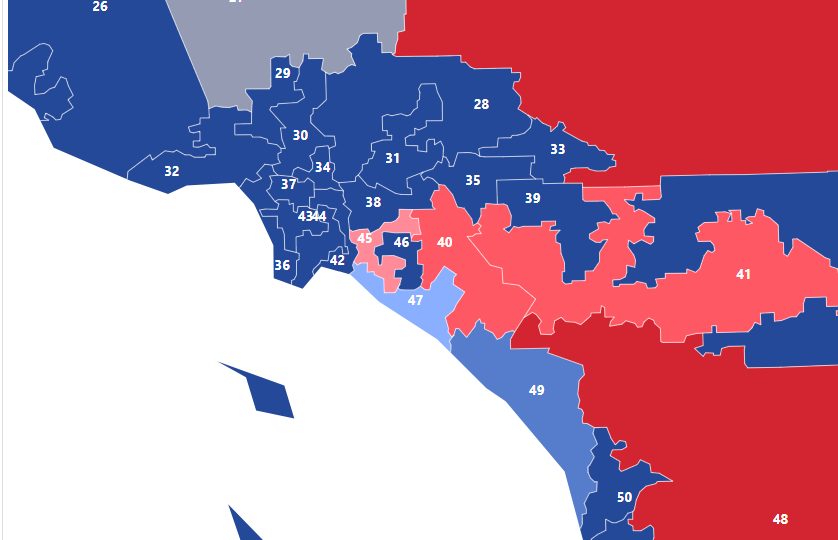
CA-40: Young Kim defeated freshman Gil Cisneros in 2020 to win back one of the many California seats Dems flipped in 2018. Her district has changed substantially under the new map, retaining Yorba Linda but losing areas to the north and west. Instead, it now reaches south to take in Anaheim and Orange nearby, and much further south to Mission Viejo and its neighboring cities. Biden won it by two points; this is almost certainly not the sort of place Dems are going to flip back in 2022. Likely Rep.
CA-41: Longtime Republican incumbent Ken Calvert’s new district retains its corner in Norco and Corona but now stretches east to take in the Palm Springs/Rancho Mirage area. He goes from a district that Trump won comfortably to one that he took by just a point. In 2022, that’s almost certainly enough for a Republican to hold on – but Calvert’s conservative votes on social issues over the years put him badly out of step with his new constituents. Likely Republican but stay tuned in future cycles.
CA-45: Michelle Steel flipped CA-48 back to the Republicans after one term; it was another 2018 Dem pickup in the Golden State. She’s now running in the new 45th. It’s quite a change from her old district along the Orange County coastline from Westminster past Laguna Beach; the 45th includes Westminster but heads north and inland, taking in Los Alamitos, Cerritos, Garden Grove, Fullerton and Placentia, among others. The seat she won in 2020 was voting for Biden by a point and a half; the new one voted for him by a little over six points. We have no public polling here – just a vague sense that it’s not the year for Dems in Orange County, especially with a strong candidate like Steel. Lean Rep but a classic example of how little we actually know about this House cycle amid a lack of polling along with potential realignment among various ethnic groups.
CA-47: Katie Porter is one of the many Dems who flipped a California seat in 2018 but unlike several of them, she survived in 2020. Her district has changed: it retains Irvine as its core but loses other inland cities while gaining Orange County coastal towns from Seal Beach to Laguna Beach. It’s still a district Biden carried by almost 12 points, but the combination of new territory and perceived Democratic weakness in Southern California has this seat in toss-up territory over at Cook. There’s no polling here and the California discussion’s dire tone seems to rely heavily on vibes rather than substance; we’re leaving Porter at Lean Dem and trusting that the district’s blue tilt and her strengths as a candidate give her the edge here.
CA-49: Mike Levin flipped a southern Orange/northern San Diego County coastal seat for Dems in 2018 and was re-elected by six points over Brian Maryott in 2020. His new seat is similar, stretching from Dana Point and San Clemente in the north to Oceanside, Carlsbad and Encinitas in the south. Its partisanship is similar, if slightly more red; Biden won it by a little over eleven points. It ought to be safest in all but the reddest waves and we actually do have a recent poll here, unlike so many seats. It shows Levin up 6 – hardly comfortable, but enough that we leave him Lean Dem.
 Within the Margin