House Race Capsules: Southeast
No independent commissions and plenty of fresh Republican gerrymanders mean this group of states is badly lacking in competitive races. Let’s take a look at the map and then some quick state summaries.
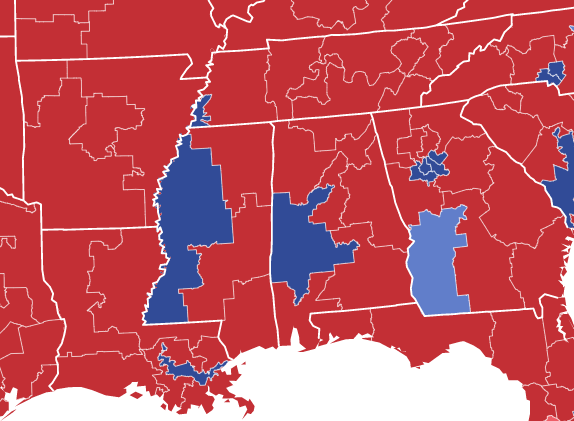
Onto the individual states.
Alabama – 7 seats
Current: 6 Reps, 1 Dem
Projected: 6 Reps, 1 Dem
After an initial court ruling requiring Alabama to draw a second Black-majority district, a subsequent ruling restored the status quo. We’re a long way now from 2008 when Dems held three of Alabama’s seven districts. One was lost to a party switch late in 2009 and the other in the 2010 Republican landslide. Huntsville and the Birmingham suburbs have shown some signs of movement toward Dems, but it will be some time before those have any impact on the state’s Congressional elections.
Arkansas – 4 seats
Current: 4 Reps
Projected: 4 Reps
AR-2 popped onto the competitive radar in 2018 and 2020 but Dems fell short; the new map sees to it that this does not happen again by splitting Little Rock’s Pulaski county across three districts. Trump carried the new AR-2 by 13 points in 2020. Dems controlled three of the state’s districts until 2010 when AR-1 and AR-2 fell; AR-4 was lost in 2012. It’ll be a while before Dems win one back.
Georgia – 14 seats
Current: 8 Reps, 6 Dems
Projected: 9 Reps, 5 Dems
Democrats picked up GA-6 in 2018 and GA-7 in 2020 as the rapid bluing of the Atlanta metro area transformed the state’s politics. Naturally, Republicans responded by combining those two Dems into a new, safely Democratic 7th district, where Lucy McBath will continue to serve. GA-6, on the other hand, becomes safely Republican. That leaves one competitive seat – GA-2, the southwest Georgia seat represented since 1992 by Sanford Bishop with only the occasional hiccup. It became slightly redder but still voted for Biden by 10.5 points. Nonetheless, Republicans have targeted the seat and a pair of mid-October polls showed Bishop ahead by only 3 and 4 points, respectively. Chances are Bishop holds on, presumably having learned from a 2010 scare that he can’t take anything for granted when the political winds shift. Likely Dem.
Louisiana – 6 seats
Current: 5 Reps, 1 Dem
Projected: 5 Reps, 1 Dem
Governor John Bel Edwards battled to get a second Black-majority seat in Louisiana but ultimately the Supreme Court voted 6-3 to block a lower court judge’s order to draw such a district. As a result, only the New Orleans-based 2nd will be Democratic, with the other five seats safely Republican. This maintains the Congressional status quo in place since 2012, when Louisiana lost its seventh seat.
Mississippi – 4 seats
Current: 3 Reps, 1 Dem
Projected: 3 Reps, 1 Dem
The new map maintains one safe Black majority district in the Mississippi Delta region, along with three safely Republican seats. MS-1 and MS-4 flipped to the GOP in 2010 and haven’t been close since; they’ve held MS-3 since 1996.
Tennessee – 9 seats
Current: 7 Reps, 2 Dems
Projected: 8 Reps. 1 Dem
After losing three of their ancestrally-Democratic seats in 2010, Tennessee Dems still had the Nashville-based 5th and Memphis-based 9th in their column. That came to an end with redistricting this year, as the Tennessee legislature cracked Nashville into three seats. Perhaps the Nashville area’s rapid bluing will put one of those seats into play by the end of the decade, but for now they’re all safely Republican.
 Within the Margin