House Race Capsules: Great Plains and Upper Midwest
There’s a handful of competitive races across this sprawling landscape, even with the Dakotas completely falling off the competitive map – at least in terms of major-party tussles – for the time being. Let’s start zoomed-out:
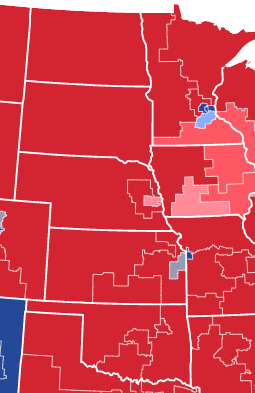
And below we go state-by-state.
Iowa – 4 seats
Current: 3 Reps, 1 Dem
Projected: 4 Reps
The Republicans flipped two Iowa seats in 2020 – the Cedar Rapids, Dubuque and Decorah seat in northeast Iowa, where freshman Dem Abby Finkenauer was defeated by Ashley Hinson, and the Burlington, Davenport, Clinton, and Iowa City seat in southeast Iowa where Marianette Miller-Meeks captured it by six(!) votes upon longtime seven-term incumbent Dave Loebsack’s retirement.
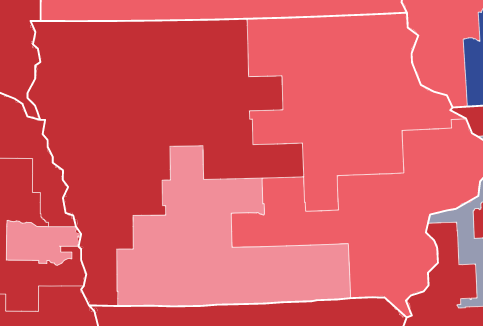
IA-1: Now Miller-Meeks finds herself renumbered to IA-1 but the geography and fundamentals remain similar. The district is slightly bluer but still favored Trump by three points and M-Cubed should be fine for at least this cycle. Likely Rep.
IA-2: Hinson has been re-numbered to the 2nd but it retains Cedar Rapids and northeast Iowa, getting a point redder in the process. Cedar Rapids is a blue city but it can’t do it all on its own. Hinson’s opponent is journalist and state senator Liz Mathis, who has a strong community profile and has run a competent campaign. Is that enough in a rough environment? Selzer’s latest polling showing Republicans pulling away in Iowa indicates it probably is not. Likely Rep.
IA-3: The lone remaining Dem in Iowa’s delegation is Cindy Axne, who flipped the Des Moines and Council Bluffs-based district in 2018. The Bluffs are gone and the districts instead takes in a few counties heading east along the Missouri border out to Ottumwa. It remains a district Trump won by a few tenths of a point, and one that would be hard for any Dem to hold in a midterm scenario like this one. State senator Zach Nunn served in the Air Force previously, making it all the more alarming that he waves away the investigation into the January 6 as a witch hunt. Sadly for our democracy, that won’t cost him unless Axne can run a few points ahead of her party in this election. Lean Rep.
Kansas – 4 seats
Current: 3 Reps, 1 Dem
Projected: 3 Reps, 1 Dem
Kansas grabbed the nation’s attention in early August when Sunflower State voters overwhelmingly rejected (59%-41%) an effort to amend the state’s constitution to curtail abortion rights. While voters will now be making decisions based on the full array of issues, I suspect states with such a referendum on or recently on the ballot will see a slight Democratic edge thanks to the clarifying power of such an amendment. That’s one reason – along with her considerable strengths as a candidate – that second-term incumbent Sharice Davids retains an edge in her Kansas CIty suburban district even as it has been pushed out into some more rural territory and is now only about as Democratic as the nation as a whole. KS-3 is Tilt Dem as droves of former moderate Republicans in the KC ‘burbs continue to re-align with their new party.
Minnesota – 8 seats
Current: 4 Dems, 4 Reps
Projected: 4 Dems, 4 Reps
Minnesota’s new map made very minimal changes; the western suburban Twin Cities MN-3 that Dems flipped in 2018 gets a little safer and the southern suburban Twin Cities MN02 that Dems flipped the same year get a tiny bit safer but remains competitive.
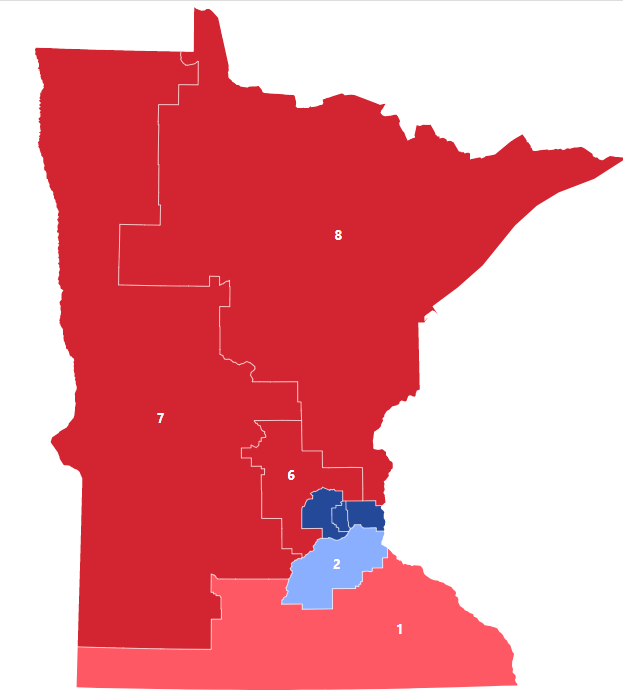
MN-1: This mostly-rural district along Minnesota’s southern border does have one major Democratic outpost: the city of Rochester. Dems overperformed here significantly in a summer special election to replace Jim Hagedorn, who flipped the seat for Republicans by a tiny margin in 2018 after repeated attempts to do so. Hagedorn held on by three points in 2020 as Trump was winning here by ten. The special election went to Brad Finstad, a former one-term state rep and Trump’s USDA Rural Development director for Minnesota, by just four points. That stronger-than-expected performance by the Dem candidate, former Hormel Foods CEO Jeff Ettinger, was generally attributed to the fallout from the Dobbs ruling. The new district is a point bluer and Ettinger is running again – it’s a longshot but he has already demonstrated that he can run well ahead of his party’s usual standing. We’ll see how much of that was a fleeting post-Dobbs phenomenon versus a durable change here. Likely Rep.
MN-2: Republicans are targeting Angie Craig fiercely here; it’s a rematch of 2020 whe she beat Tyler Kistner by 2.2%. Public and private polling both show an even race, and I’ll defer to the district’s partisanship to give Craig the edge instead of Kistner. Tilt Dem.
Nebraska – 3 seats
Current: 3 Reps
Projected: 3 Reps
NE-1 was the site of another fascinating summer special election, immediately after Dobbs. It’s harder to imagine that one getting better in November the way we could see MN-1 doing so, and that leaves NE-2 as the competitive seat in the Cornhusker State. This is the Omaha seat, and it flipped to Dems in 2014 of all years…before Don Bacon won it back for the Reps in 2016. He held on in 2018 and 2020 against a Bernie Sanders-aligned progressive, and this time faces a more moderate candidate better suited to the district’s electorate. State senator Tony Vargas is making the right moves and this district remains one that voted for Biden by more than six points. But Bacon has carved out a relatively moderate persona in Congress, including a vote for the bipartisan infrastructure bill. This district suffers from a curious lack of polling, but I’m assuming Bacon’s efforts to be something of a moderate give him another win in a GOP-friendly year. Some of the other prognosticators have it as a toss-up; I’ll skip Tilt and go to Lean Rep.
North Dakota – 1 seat
Current: 1 Rep
Projected: 1 Rep
Republicans flipped North Dakota’s at large seat back in 2010 and haven’t faced a close election here since, as the Peace Garden State has generally trended hard to the right in that time. Can’t beat someone with no one so Dems won’t be winning it this year either; incumbent Republican Kelly Armstrong’s opponent is former Miss America and recent Harvard Law grad Cara Mun, running as an independent. We’ve seen four public polls here, showing Armstrong up 30, 17, 22 and 4, in chronological order. The first three were GOP-sponsored; the last one Dem-sponsored as Mund is the party’s de facto candidate despite running as an independent. It would be interesting to have more recent, independent numbers to see if Mund has a shot here, but independents generally end up short of their polling and North Dakotans probably just view her as the Dem candidate. Maybe in a different year this could get interesting. Safe Rep.
Oklahoma – 5 seats
Current: 5 Reps
Projected: 5 Reps
Dems flipped OK-5 in one of the bigger surprises of the 2018 wave, but Kendra Horn was defeated two years later by Stephanie Bice. Redistricting then made OK-5 safe by removing much of Oklahoma City and connecting several conservative outlying counties; Trump carried the new district by almost 19 points. Dems seem to have a shot at some of the statewide races in the Sooner State this year, so they can focus there and hope things change over the course of the decade on the Congressional scene.
South Dakota – 1 seat
Current: 1 Rep
Projected: 1 Rep
Republicans won back the South Dakota at-large seat in 2010 and haven’t come close to losing it since. Dusty Johnson won’t lost to his Libertarian challenger this year, either.
 Within the Margin