House Race Capsules: Great Lakes
Alright, now we’re back in competitive territory, with some seats changing hands in both directions. Lots to unpack here thanks to an independent commission in Michigan, a court-selected map in Wisconsin, and a trio of partisan maps. First the overview:
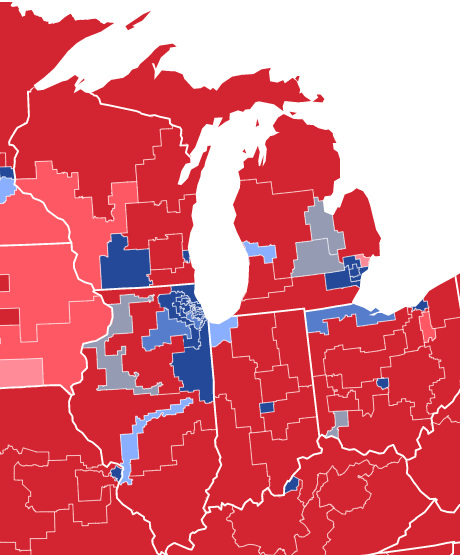
And now on to the state-by-state breakdowns.
Illinois – 17 seats, after losing one in the 2020 Census
Current: 13 Dems, 5 Reps
Projected: 14 Dems, 3 Reps
In 2012, Illinois Dems gerrymandered the state to flip several seats and largely succeeded, taking IL-8, IL-10, IL-11 and IL17 while merging two other GOP-held seats into one (Illinois was losing a seat). They drew IL-6 and IL-14 as Republican seats, but anti-Trump sentiment in Chicagoland would flip those as well in 2018. Now, in 2022, the gerrymander needed an update. Illinois is again losing a seat; in effect, the eliminated seat is Adam Kinzinger’s. The recent apostate would have lost his primary to a Trump Republican anyway, so it made sense for that to be the one. Elsewhere, the map shores up Laura Underwood in IL-14 and strengthens the open IL-17 left vacant by the retiring Cheri Bustos; it also turns IL-13 into a Dem-leaning district.
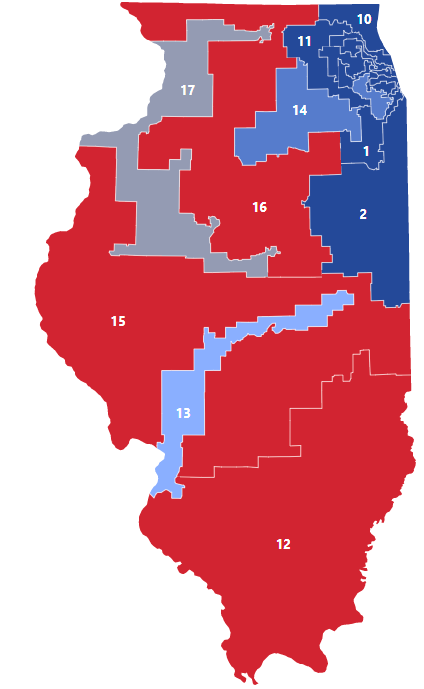
IL-6: Second-term Dem Sean Casten was drawn into a primary with freshman Maria Newman; he prevailed and now faces Orland Park mayor Keith Pekau. While Casten has some new territory and a well-funded opponent in this western Chicagoland district, it remains fundamentally friendly and Likely Dem.
IL-13: Dems made an effort to flip this central IL seat over the last decade but never quite got there. The old version included Springfield, Champaign, Decatur and Edwardsville along with much more conservative rural stretches. The new 13th cuts a narrower path around those cities so that it can also take in East St. Louis. A district Trump won by a little under 4 points becomes one Biden took by almost 12. Nathan Gonzalez at Inside Elections says this race is trending toward the GOP, but we have no public polling since July. District fundamentals tell me to keep it no worse than Lean Dem.
IL-14: Lauren Underwood’s exurban Chicagoland seat goes from a Biden +2.4 to a Biden +11.7, as she gains Joliet and DeKalb and loses northern McHenry County. She should be fine. Likely Dem.
IL-17: Cheri Bustos retired after a tricky reelection in a district Trump narrowly won. Now it’s considerably bluer (Biden by 8) and a competitive race. Meteorologist Eric Sorensen can be an off-putting character at times, and Republicans have a strong nominee in Esther Joy King, an attorney and Army reservist. The only public poll we have showed Sorensen up nine points in September. That’s enough to keep it at Tilt Dem despite some pessimism about how this one is drawing to a close; feels like one that could very easily get away from Dems on Tuesday.
Indiana – 9 seats
Current: 7 Reps, 2 Dems
Projected: 7 Reps, 2 Dems
Going into the 2010 elections, Dems held five of these seats and were coming off Obama’s 2008 victory in the state – the first for a Democratic presidential nominee since 1964. They’d lose two IN-8 and IN-9 in 2010, and IN-2 fell in 2012 when Joe Donnelly ran for Senate. It seemed like Dems were on course to capture IN-5 in the Indianapolis suburbs two years ago, but ultimately fell short as with so many other House seats that year. They won’t get another shot for a while, as Republicans have transformed IN-5 to a Trump +16 seat. The lone competitive seat now is the Dem-held IN-1 in the northwest corner of the state, featuring Gary and all of Lake County; Portage, Valparaiso and all of Porter County; and Michigan City in LaPorte County. Dems have held this seat since 1932, but it has trended redder with the realignment of working-class white voters in the Gary suburbs. Obama carried a similar IN-1 62-37 in 2008; Biden carried the 2020 version by 8.9 points and this very slightly-altered 2022 version by 8.5. Frank Mrvan led in the only public poll here back in May; the freshman Democrat faces a strong opponent in Air Force veteran Jennifer-Ruth Green. The district has enough of a cushion for Mrvan to survive this year, but in the long term Dems need to re-establish their strength with working-class voters across the board. Lean Dem.
Michigan – 13 seats, after losing one from the 2020 census
Current: 7 Dems, 7 Reps
Projected: 7 Dems, 6 Reps
The first edition of Michigan’s new independent redistricting commission ended a run of GOP gerrymanders and created a number of competitive seats. Michigan had to lose a seat as a result of slow population growth, and the disappearing seat is effectively the former 4th, held by the GOP. The new map makes significant changes to the Detroit area, disrupting incumbents there and effectively creating a new seat (numbered as MI-10) where the GOP is favored this year.

MI-3: Peter Meijer won an open seat race here to hold the seat for the GOP in 2020 upon Rep-turned-indy Justin Amash’s retirement. With his background as a veteran and scion of a prominent Michigan grocery store dynasty, Meijer was expected to settle into a lengthy career. And then he voted to impeach the president for inciting an attack on the Capitol. Meijer did the right thing and his party came after for him for it – John Gibbs took his troubled past and rode Trump’s endorsement to a primary win. Some attributed it to ads DCCC ran playing up Gibbs as the conservative Trump candidate, but the likelihood of any impact there is minimal. Meijer supporters were welcome to counter as needed and failed. With redistricting turning this from a seat Trump won by three points to one Biden carried by eight and a half, it’s a heavy lift for Gibbs to hold on as an extremist against Hillary Scholten, a DOJ and non-profit attorney with impeccable local roots. She lost to Meijer by six points last time out but is a solid favorite this time. One of two Lean Dem flips, along with Illinois’ 13th.
MI-7: Elissa Slotkin flipped MI-8 for Dems, held on by three and a half points in 2020, and now faces re-election in the 7th. The old 8th includes Lansing and Brighton, then reached around other districts to take in northern Oakland County, over and down to Rochester Hills. The new district is more compact, going a little west of Lansing but not stretching as far east. It’s still highly competitive: instead of voting for Trump by about a point like the old 8th, it voted for Biden by about a point. Slotkin faces state senator Tom Barrett and has shown resilience in public polling. I think she holds on, narrowly, as one of the more talented members of the 2018 intake. Tilt Dem.
MI-8: Democrat Dan Kildee traditionally runs ahead of his party in his Flint, Saginaw and Bay City-area district, and he’ll need to again in a difficult midterm environment on terrain trending Republican in recent cycles. His old district voted for Biden by 4.5; the new one by just over two points. The Kildee name is well-respected here, he has an showing him drumming and standing up to his party, and he faces a weak enough opponent that I thin this is still Tilt Dem.
MI-10: Republican have been trying to make John James a rising start for several cycles now. After losing a pair of U.S. Senate races in 2018 and 2020, he set his sights on Michigan’s 11th district this time around. Redistricting changed it to the 10th, where there was no incumbent and where Trump won by a little under a point in 2020. This is a Macomb County seat, along with Rochester Hills from Oakland County, and I expect the abortion referendum to aid Dems less in Macomb than in some of the other suburban counties – owing to Macomb’s GOP trend and generally socially conservative inclinations. James is talented enough to take advantage of the political environment. Lean Rep, though if the referendum is truly transforming Michigan’s races this year, a win for Macomb County judge Carl Marlinga would not be surprising.
Ohio – 15 seats, after losing one from the 2020 Census.
Current: 12 Reps, 4 Dems
Projected: 11 Reps, 4 Dems
Ohio’s mapping journey took quite a while as courts continually struck down various GOP gerrymanders that violated the state’s constitution. They finally ran out the clock and ended up with one that’s…not great for Dems but could theoretically be worse. The map hurts Dems in some places but provides improved prospects in a couple others.

OH-1: After decades of Cincinnati being split even when there is no earthly reason to do so, the city is finally left intact in the new 1st. It also takes in its suburbs in eastern Hamilton County – deeply Republican for decades but trending blue in the Trump era. The new district also includes heavily Republican Warren County to the northeast. This shifts from a district Trump carried by three points to one Biden carried by more than eight and a half, meaning longtime Republican incumbent Steve Chabot is in real danger. Chabot first won his seat in 1994, lost it in 2008, and won it back in the 2010 wave. He’s facing Cincinnati city councilman Greg Landsman, a former public school teacher. Landsman is the favorite here but Chabot has proven very difficult to dislodge over the years. It won’t come easily in a friendly environment for Republicans, and it’ll be interesting to see how many of the district’s more recent converts to voting Democratic are willing to do so – in other words, what will weigh more heavily: Dobbs or inflation? Tilt Dem.
OH-9: In 2010, as the Republican wave built, longtime Toledo-area incumbent Marcy Kaptur found her seat in rare jeopardy. Then the GOP Challenger, Rich Iott, was discovered to be a member of a Waffen-SS reenactment group. Iott was known to dress up from time to time as an SS soldier. National Republicans bailed on the race, withdrawing support for Iott even as city and county Republican stuck with him. Kaptur went on to win 59%-41%. Twelve years later and two dramatic re-drawings of her district later, the 40-year incumbent finds herself in jeopardy once again – she’s gone from a seat Biden won by 19 to one Trump carried by just under 3. But Kaptur once again got help from an absurdly bad opponent – this time, J.R. Majewski, who reporters discovered had lied about his military experience (and business experience, too!) National Republicans bailed and Kaptur seems likely to make it to another term. You’d like to think Majewski is utterly disqualified, but there’s always a chance if the year gets too precarious for Dems. Likely Dem.
OH-13: The previous 13th was Tim Ryan’s seat stretching from Youngstown and the Mahoning Valley to parts of Akron and the Cleveland suburbs. The new 13th is much more compact, with all of Akron and Summit County plus northern Stark County, including Canton and part of Massilon. The Mahoning Valley is now split between the 6th and 14th instead. The old 13th voted for Biden by 3.4 points; this one by 2.8. It’s an open seat with Akron state rep Emilia Sykes carrying the flag for Dems and right-wing conservative media personality Madison Gesiotto Gilbert trying to flip it for Republicans. Two young candidates – both under 40. Sykes is the more experienced hand, after eight years as a state legislator. But Gilbert has experience of her own from targeting millennial conservatives through her column and TV commentary. Maybe Tim Ryan’s strength as a Senate candidate is helping in his former overlapping territory; it makes sense to move this from my earlier pessimistic Likely Rep rating to Lean Rep now.
Wisconsin – 8 seats
Current: 5 Reps, 3 Dems
Projected: 6 Reps, 2 Dems
The state’s map, selected by the state Supreme Court, changes little. Much more meaningful is the retirement of Ron Kind (D) in WI-3, in the southwestern corner of the state.

WI-3: Kind has been running ahead of his party for most of his career but has thrown in the towel after a close escape against Derrick Van Orden in 2020. A Navy SEAL who participated in the rally-turned-riot at the Capitol on January 6, Van Orden is the clear favorite in this Trump +4.8 district. He faces state senator Brad Pfaff, a plausible candidate in the wrong place in the wrong year. Republicans are likely to reclaim this seat for the first time since 1996. Likely Rep.
 Within the Margin