Archive
5 Questions for Florida and Beyond
I’ve been a bit absorbed in studying the proposed New York state legislative maps of late, but let me take a look at the state of play as the Republican nominating contest gives Romney a big win in Florida today. My questions:
- Does Romney crack 50% in Florida? Polling tells me he’s going to come close, and in fact I’ll predict he hits 50 on the nose. New Hampshire was supposed to be a big win for Romney, and while his margin was comfortable, he was held under 40%. Today he should finally get a win that’s impressive in both margin and percentage. Side note: InsiderAdvantage could get away with their pro-Gingrich polling in previous states when things were fluid and we were seeing late-breaking momentum altering the playing field in each state, but they’re going to look somewhat foolish tonight. They keep showing a 4-5 point Romney lead when everyone else shows a 15-20 point edge for Mittens…either IA is doing brilliant work, or they’re about to become completely irrelevant. I strongly assume the latter.
- What sort of momentum does the inevitable big win in Florida portend for Romney? It’s winner-take-all, so he’ll zoom ahead in the delegate count for a little while at least, but Florida’s scheduling shenanigans resulted in the halving of their delegates. So it’s not as important a win on paper as it would have been, but the media loves momentum and I assume they’ll award quite a bit of Big Mo in the aftermath of the Sunshine State’s big day.
- Does Gingrich show signs of holding on to Evangelical/born-again voters? He cleaned up with these groups in South Carolina, confirming that an important part of the Republican base was not climbing aboard the Romney wagon anytime soon. Florida’s primary electorate will include a smaller share of Evangelicals so we won’t have the best information to work with, but it will be interesting to see if they either splinter off to Santorum or start coalescing around Romney.
- Is Santorum still in this thing? Politico reports this morning that he’s heading to Missouri to compete hard in their February 7 primary. It’s a smart play: Gingrich isn’t on the ballot there and Santorum should match up well with a demographic that’s more blue-collar and Roman Catholic than Florida. I assume both candidates will play hard there, with Romney arriving after the Nevada caucuses on February 4. It’s a chance for Santorum to show why he’s a better not-Mitt than Newt, and a chance for Romney to show he can beat a variety of opponents in a one-on-one setting.
- Just what kind of impact can Ron Paul make in the upcoming caucuses? Obviously the assumption is that organization and enthusiasm matter more in caucuses than primaries, and Paul has these in spades. Nevada, Maine, Colorado and Minnesota loom large in determining whether Paul can bring to fruition his dream of bringing a significant contingent of delegates to the convention.
Drawing the Lines: Asian-Majority District in Queens
It was confirmed today that we can expect a new Asian-majority State Senate district in Queens when LATFOR releases its maps (originally expected late this morning). We’re told it will be 52% Asian and based in Flushing – here’s what just such a district might look like – click for larger image:
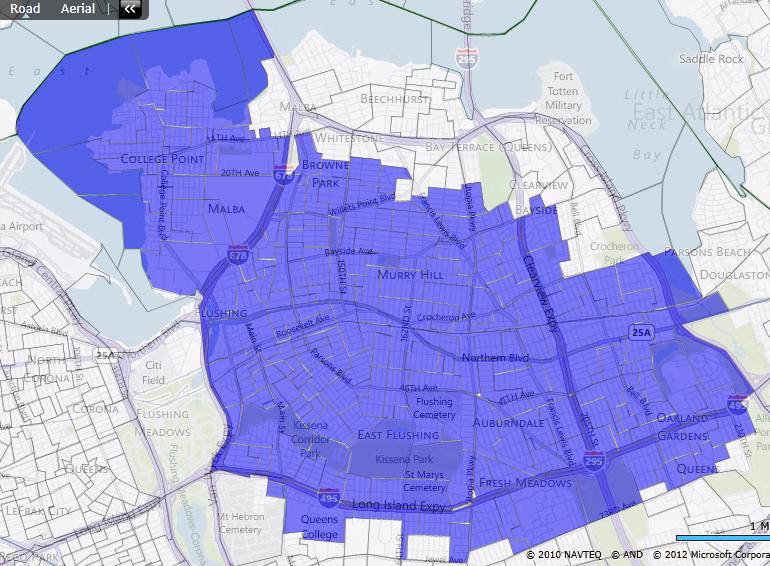
This district would incorporate much of the territory from the current 11th district, which Republican Frank Padavan represented from 1972 to 2010. Padavan held on in 2008 by 483 votes before losing to Democrat Tony Avella two years later. The territory within the borders depicted voted 62.8% for Barack Obama in 2008, compared to 62.6% in the old Padavan district. Once upon a time, the Republicans probably thought New York City Councilman Peter Koo might run for them in this seat, but Koo became a Democrat this month.
Drawing the Lines: The New 63rd District
This is part of our Drawing the Lines series, in which we focus on New York’s new Assembly, Senate and Congressional lines – how they’ll impact the makeup of each chamber, and how that impacts policy at the state – and perhaps federal – level.
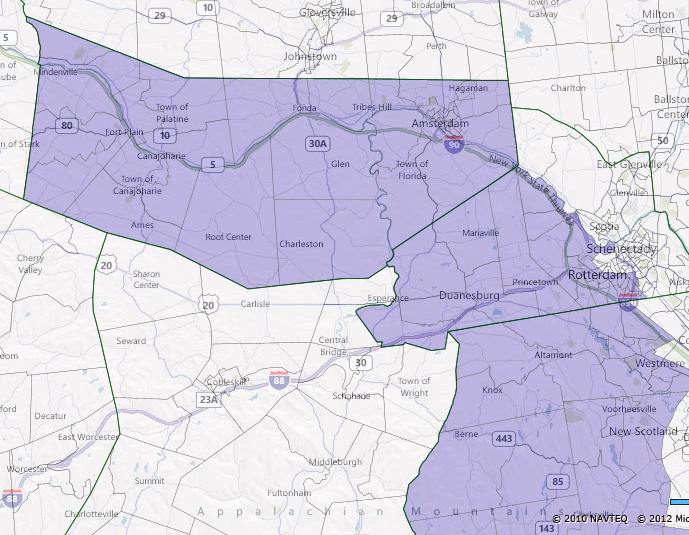
We haven’t yet seen the first draft of new state legislative maps out of Albany, but we know they’re coming soon. Jimmy Vielkind wrote last night about the proposed 63rd State Senate district – notable because it represents a controversial increase in the size of that body, and because its purpose would be to strengthen the GOP’s narrow (32-29 with one previously-Democratic vacancy in Brooklyn) hold on the chamber. Vielkind’s source in state government indicated the new district would be carved out of the capital region, though it’s best described as a hybrid that also draws from the Hudson Valley and Catskills.
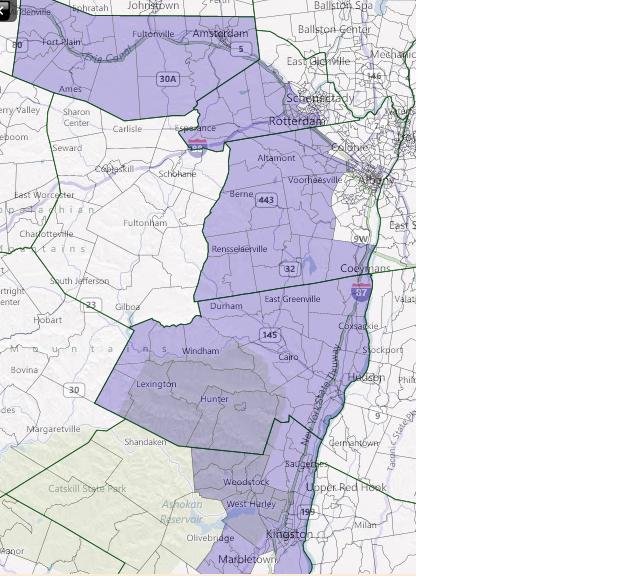
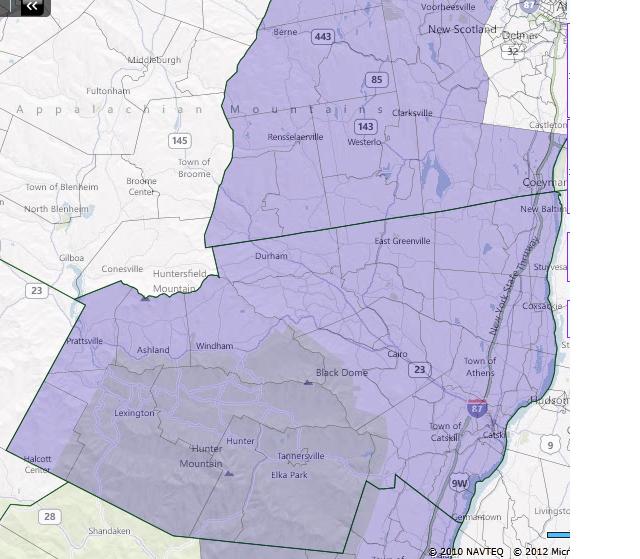
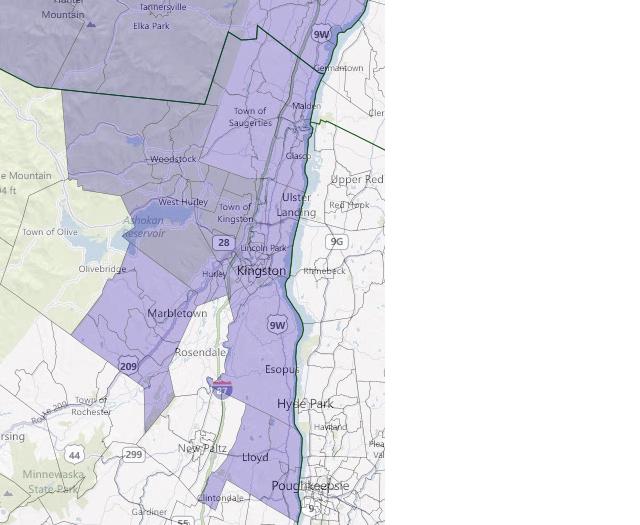
I have also uploaded close-ups of the upper, middle and lower portions of the proposed district.
In terms of aesthetics, it’s not a monstrosity: a bit long, but not particularly tortured or serpentine. It’s a stretch to say that Amsterdam and the Schenectady area have much to do with Kingston, but the NYS Thruway does serve as a common thread. Regardless, Republicans aren’t seeking awards for clean maps that preserve communities of interest: they want to pick up a free seat.
To that end, how good a job did they do here? If indeed the district Vielkind provides is the district we’ll see, call it a “Likely Republican” seat for now. Using DRA, it looks like a 53.5% Obama district (I didn’t include the sliver of Schenectady, but it’s only supposed to be about 1,000 people, and that won’t impact the 2008 presidential results much). That compares to 44.7% for McCain. As I (and others) have referenced before, that’s a pretty good district for Democrats on the federal level, but not so much in the New York state legislature. Democrats have rarely won any of the current districts that didn’t push a 58%-60% performance for Obama in 2008.
Looking into the individual components of the district, Montgomery County has been trending away from Democrats for a long time – Dukakis won it despite barely carrying New York in 1988, but McCain won it by 8 points in 2008. Obama barely improved upon Kerry’s performance there, a trend seen in several of of upstate’s older industrial cities. Andrew Cuomo barely beat Carl Paladino in Montgomery in the 2010 gubernatorial race. The district features some bluish Albany suburbs, connected to Montgomery by a small (and basically red) piece of Schenectady County. Further south, Greene County sees the occasional Democratic success at the town level and a few Democratic county legislators but is mostly Republican at all levels of government – Cuomo edged out Paladino by fewer than 400 votes – and has provided its current senator (Jim Seward of the 51st district) with comfortable margins during the last decade.
But then the district enters Ulster County, picking up Saugerties and Kingston and running all the way down the river to Lloyd (Highland) while also going inland for some Catskill communities. For me, this is the most interesting piece – because it means I live 10 minutes across the Kingston-Rhinecliff Bridge from the proposed district, and because of the rippling effects created across the western Hudson Valley’s senate districts. By grabbing strongly-Democratic areas like Kingston, Hurley, Marbletown and Woodstock, the proposed 63rd actually does feature a Democratic bench and organization. Presumably state Republicans are assuming that those liberal bastions won’t produce a candidate palatable further north, and there’s some validity to that. And Ulster is not monolithically Democratic by any stretch; Republicans control the county legislature and most town governments, even in the mountain towns. But Democratic Ulster County executive Mike Hein is riding high at the moment after running unopposed for a second term in 2011. Ulster Democrats right now are sorting through who the potential successor to retiring Congressman Maurice Hinchey will be, but they have enough people with experience and ambition that I wouldn’t be shocked if an Ulster Dem takes a shot at this race.
Republicans are said to already have their candidate in place, as Assemblyman George Amedore is expected to run. The Rotterdam resident won the 105th Assembly district in a 2007 special election and has been re-elected twice by comfortable margins. His campaigns have been well-financed and he would be expected to perform very strongly in his Montgomery and Schenectady base. Greene is a given for Amedore, even if they’ve not heard of him before he announces his bid. A Democratic opponent would need a very strong showing in Ulster and in the Albany suburbs.
That last bit might be the wild card here: for at least the last two decades, the entirety of Albany County has comprised its own senate district. This new district would carve the county into two pieces, with Senator Neil Breslin (currently of the 46th) seeing his district push across the river into Rensselaer County. While voters consistently tell pollsters they’re upset about gerrymandering, are they attached enough to Breslin that they’ll cast voters in large numbers against the party that cleaves him from the western section of Albany County? Breslin has faced primary challengers each of the last two cycles and lost the support of the Albany County Democratic Party in 2010. And will Democrats lose some votes as the advantage of incumbency disappears and they build their candidate’s name recognition from scratch?
Meanwhile, as I alluded above, nothing in redistricting happens in a vacuum. The Ulster portions of this district are being removed from Bill Larkin’s 39th and John Bonacic’s 42nd districts. Bonacic has occasionally been a Democratic target as his district leans Democratic, so these changes benefit him by removing blue sections from his turf. I could see a scenario in which Schoharie County replaces the territory lost to get it back up to population minimums, further securing his place. As for Larkin, he turns 84 next month. He’s taking one last shot before retiring in 2014, so Republicans would probably like to shore up that district. Removing Kingston and replacing it with Warwick (from David Carlucci’s overpopulated district) seems like a good way to do that.
In sum, Republicans have likely gained a seat here while better securing two others, but they’ve hardly assembled a rock-ribbed conservative district. It will likely be one of the better places for Democrats to play offense this year.
Perry leaves, Newt potentially on the way out as well
The march of inevitability to GOP Nominee for Mitt Romney was either bolstered or hit a snag today – at the time of this writing, I’m not sure which. Reports from The Hill announce that Rick Perry is leaving the GOP field days before the South Carolina primary. Does this help Mitt? Not really in South Carolina, where it’s actually a boost to the conserva-duo of Rick Santorum and Newt Gingrich. But more than likely it’ll help Santorum as he is now the right”s “anointed one.” More on that in a bit.
For Perry, this campaign is likely to end his time in the national spotlight – and what a disastrous time it was for him. A celebrated conservative when he entered the fray, Perry’s lack of message discipline and terrible performances in debates contributed to his short-lived campaign. Perry, unlike Gingrich or Santorum, had the money to compete and could have built the organization needed to win the Iowa caucuses and preform admirably in South Carolina. If there hadn’t been 15 debates between the time he entered the race in August and the time of this writing, Perry would likely be polling second or leading Mitt with many of his vulnerabilities unexposed. Perry’s debate prep was an issue of laziness on his part and on the part of his campaign. After a decade as Governor of Texas, and running with minimal opposition and eventually not even bothering to debate, it’s easy to see that Perry and his initial advisers had no clue what they were in for, especially confronting a man who’s been running for president full time since he left Beacon Hill in 2007. It would be premature and amateur of this author to prognosticate that Rick Perry’s political career is over due to this campaign. However, if the Governor does run for another term in 2014, a good number of Democratic potentials (while our bench in Texas is fairly pathetic, we’d find someone) would want to remind voters of Perry’s stances and gaffes and call his leadership into question. (An aside: while this sort of strategy would work in a more purple state, Texas’ deep red hue would make this mission a suicide run for near about any Democrat) But, the fact remains that the Governor’s national profile is ruined.
With Perry gone, the Evangelical wing of the Republican Party is now down to two choices: Rick Santorum, who has probably won the Iowa caucus, and Newt Gingrich, whose campaign is likely to blow up for the third time. This past weekend, Evangelical leaders essentially anointed Santorum as their pick for who they’d want to be the nominee, and more importantly, to stop Mitt Romney from gaining the nomination. For Santorum, it’s the needed jolt to a campaign that after a week of gushing about his Iowa success essentially fell on life support; he should have written New Hampshire off instead of even setting foot there. It’s tough to gauge how this will effect turnout for the former PA Senator, but it will provide him additional funds with the evangelical field winnowed. Santorum likely gets a good bounce as the sound replacement for pro-Perry, anti-Mitt and any “anyone but Romney and Paul” stragglers as well. Santorum will also likely benefit from the Speaker’s third immolation as a candidate in the course of this campaign.
The Phoenix Gingrich may not have any more ability to rebound from a potentially scandalous interview given by his ex-wife. According to reports on Twitter and the web, Drudge is linking the story and in place of what was called a successful debate by Mr. Gingrich, he’s once again on the defense about his personal life. How many times can a candidate burn and rise from the ashes? Newt’s impeccable luck only comes as a consequence of the abhorrent weakness of the Republican field. If any of the could-haves (for this we’ll say a competent and red meat-throwing Huntsman campaign, Tim Pawlenty not quitting when he did, or Chris Christie organizing a ground game, or Mitch Daniels and/or John Thune mounting a run) had entered and done so without the gaffe-fest Gingrich never would have made it out of his summer campaign collapse.
For this round of musical chairs, another unqualified person drops out, but the fractures facing this GOP primary electorate continue to be glaring between the “mainstream” or “Establishment” crew going for Romney, the Evangelical win pulling for Not-Romney, and the Paulist wing being…well, weird. The losers in all of this aren’t the Republican voters – they brought this upon themselves – but the American electorate as a whole as it continues to show a great apathy towards the two parties and ideas of governance, instead throwing up their hands in frustration about their lack of “choice.” There’s no real free flow of ideas of how government should run, and really in politics there hasn’t been that discussion in a long, long time.
Update (4:37): Perry endorsed Newt Gingrich this morning/afternoon in what has to be gasoline on Newt’s terrible, no good, very bad day. Sunday may well be Newt’s last day as a candidate for President.
With Huntsman Out, who’s going to put themselves above Partisanship?
I want to preface this piece saying that had Jon Huntsman been the Republican nominee that I would’ve had a hard time deciding who to vote for in November. While I disagree with many of the former Utah Governor’s stances, he earned a lot of my respect this campaign cycle for not bending to the will of those within his party, staying true to his vision of America and the Republican party, and for making me thankfully that finally there was a Republican politician that sounded reasonable on many fronts. Huntsman the 2012 statesman seemed willing to look past his personal views and instead want to have a discourse with people where you may have conflicting views, but you could walk away knowing your views were heard fairly and you gave his views and thoughts plenty of consideration.
Jon Huntsman’s exit from the Republican Party primaries was written in stone long before the first Caucuses got together in Iowa, and it wasn’t even his fault. Huntsman’s demise in the COP primary was cemented when he put partisanship besides him and accepted the position as President Obama’s first Ambassador to the People’s Republic of China. Look, there were many other facets of why Huntsman’s campaign never got off the ground: flying in the face of conservative Orthodoxy and being reasonable about things like Science and Energy policy, the fact that the super PAC that was “co-ordinated” with his campaign (lets be real, the Super PACs and the Federally registered campaign PACs know what’s going on, especially the Super PACs tightly associated with a candidate) was largely financed by his father, and Huntsman wasn’t willing to play ball with the Conservative wing of his party. Those reasons and his inability to raise funds ultimately killed his chances of making a dent in New Hampshire, where he didn’t have to win, but he needed to push Mitt Romney to the brink (something like a 35%-32% finished between Romney and Huntsman) in order to get his actual “ticket to ride” in this presidential primary.
There’s no questioning Huntsman’s conservative bonafides and a look at his political career on Wikipedia(please note read this today: 1/17/2012 or Thursday and later as Wikipedia will “black out” on Wednesday 1/18/2012 in protest of the Stop Online Piracy Now or SOPA Act) will more than confirm this. He was a staffer in the Reagan White House, was appointed an Undersecretary of Commerce and a US Ambassador to Singapore for President George H.W Bush; during the Clinton Administration Huntsman went to the Private sector awaiting the next Republican administration (since saying that sounds better than saying “ran Daddy’s Chemical Corporation until the next Administration post opened”), and was a Deputy US Trade Representative during George W. Bush’s administration. All of this before even running for elective office in a State where winning the GOP Nomination is the hard part and Election Day is a mere formality. He replaced another Bush appointed, Mike Leavitt, in the 2004 Utah Gubernatorial election with 58% of the vote, and won re-election in 2008 with an absurd 77.7% of the vote. His approval ratings at times were as high as 90%, no other Republican elected official in the race could boast those numbers except maybe 1993 Newt Gingrich, but he’d burned those polls long, long ago. That resume alone should have left the 2012 field of electable candidates to Romney and Huntsman, and had Huntsman actually campaigned on that resume he probably would still be running right now.
Huntsman took up the post-partisan appeal, sounding willing and even slightly eager to work across both party lines to put the interests of the country above those of partisan bickering. In terms of campaigning, this is suicide in a primary regardless of party. Yesterday in New York Magizine, John Heilemann states that Huntsman’s disdain for the process ultimately cost him.
Heilemann argues that:
Yet beyond all that, there was a more basic problem: a candidate who seemed to think of himself as superior to the process, love it or hate it, by which we select presidential nominees and elect presidents. As I wrote in a cover story on him and Romney six months ago, Huntsman entered the race sounding more like a diplomat than a politician and acting as if presenting a glittering résumé were enough to claim the big prize. But it isn’t. Hopefully Huntsman understands that now — for it would be a shame for such a smart man to stroll out of the room no wiser than when he ambled into it.
That’s a completely sound argument, but Huntsman didn’t want to be Ron Paul and he wasn’t going to present himself as Newt Gingrich, Rick Santorum and Rick Perry did. Why; because he’s better than that, sure just showing his resume would have been enough for the GOP of 2000 but not this rabidly conservative GOP today; however, Huntsman’s more experienced and seemingly presidential than Romney and the “anti-Romneys.” Yes Rick Perry’s spent more time as a state executive, but what good has that gotten him in this primary as he got lazy in the debate circuit and makes arguments that may sound fine and dandy to fellow conservative Texans, but make most groan. Huntsman’s disdain of the process was a hindrance to him on the trail, but who doesn’t hate the process and the grind required to be in a political campaign, especially one for the highest office in the land. He seemed to have the most cohesive vision, and in all honesty, as a Democrat, he was the only Republican that truly scared me in the Republican primary.
Buzzfeed makes the argument that:
“The party Huntsman imagined — modernizing, reforming, and youthful — could still be born. That might be the reaction to a second smashing defeat at Obama’s hands, or that might be where President Romney takes his re-election campaign. But it’s now hard to see Huntsman leading that change. He bet, too early, on a fantasy, and ran for the nomination of a party that doesn’t exist, at least not yet. His decision tonight to drop out just marks his recognition of that fact.”
It could be born this year as well, that modernizing and reforming zeal is what is hoped for but the group Americans Elect, a non-profit looking to gain ballot access in all 50 states with $30 million cash on hand. If Huntsman really wants to give his post-partisan message and continue on trying to convince the American people he’s electable, this may be a way to do it in place of running for President for another 4 years akin to Mitt Romney after losing the 2008 primaries. I’ll do a more detailed article on American’s elect sometime in the future. It may be the “sore loser” route for Huntsman to attempt this “non-partisan” “third party” route by way of Americans Elect. Hell, an Americans Elect route could actually help Mitt Romney as dissatisfied and/or impressed (or uninformed) Democrats would more likely vote for a post-partisan sounding Huntsman over casting a ballot feeling unsatisfied with President Obama. the likelihood of this is minimal, but it’s at the very least pluasible.
I recognize I’ve spent much of this space opining, but I felt I could do so because Huntsman’s exit from the GOP Primary has no bearing on the inevitable, the Republican Party will nominate Mitt Romney. Any Huntsman voters are likely comfortable voting for Romney, and there aren’t enough Huntsman supporters to really make things even more inevitable for Romney. If the “Anti-Mitt” vote weren’t split, I’d be intrigued by what Huntsman’s exit could have meant, but that’s not the case. Huntsman’s quick endorsement of Romney to me was part common sense (he’s going to be the nominee, crossing him isn’t going to help you) and part hoping it lands him a position (Secretary of State?) in a potential Romney Cabinet.
With Huntsman out, I have no one to really be interested in in the GOP and their manner of ridiculous rhetoric will continue to turn me off from their want for control. I will still attempt to comment on the field objectively, or as objectively as possible, but it is tough to do in the first place.
Drawing the Lines: Can The New Map Turn the 37th Red?
As 2012 continues, we’ll spend a fair amount of time analyzing the state of play in New York’s State Senate. The Republicans are clinging to a razor-thin 32-30 majority. They appear to have the chance to redistrict themselves into a safer position, but a lot can happen between now and the adoption of a new map. Even with a favorable map, demographics and political behavior make it unlikely that they’ll return anytime soon to the larger majorities they enjoyed in the State Senate at the start of the last decade.
We’ll also delve into whether it’s even a majority worth winning, given the chaos and legislative failure of Democrats’ brief stint in the majority in 2009 and 2010, as well as the dark clouds surrounding recent and current conference leaders like Malcolm Smith and John Sampson.
***
Today, longtime Democratic senator Suzi Oppenheimer announced her retirement from the 37th District. This sets up an open seat race sure to be hotly-targeted by both parties. The 37th sits in central and southeastern Westchester along part of the I-287 corridor and the Long Island Sound shoreline, and includes all of White Plains and most of New Rochelle, along with Harrison, Mamaroneck, New Castle, North Castle, Ossining, Rye (town and city) and Scarsdale. Notable villages and hamlets include Chappaqua, Larchmont and Port Chester.
Republicans smell blood, and immediately began talking up their chances at taking the seat. Bob Cohen was already in the race, following his narrow 2010 defeat against Oppenheimer – a race where the outcome wasn’t known until the first week of December. A businessman and New Rochelle resident, Cohen ran a relatively moderate campaign and lost by only 730 votes. He said today that he’s eager to see the district as re-drawn by the Republican senate majority; we’re expecting the first draft of legislative maps any day now. Cohen has much to gain, obviously: during the last re-drawing, the Republicans held three neighboring Westchester seats and therefore needed to consolidate Democratic territory in Oppenheimer’s district. Since then, they’ve lost the 34th and 35th districts and can reasonably view the 37th as a better target, having seen their candidate come close to winning the last cycle.
Some Democrats were particularly bearish – the AlbanyProject, for one, tweeted about their serious doubts as to whether Dems can hold the district. But I think the idea that this seat is in greater danger with Oppenheimer gone is a bit overblown. We’re talking about a district that Barack Obama won with nearly 65% of the vote in 2008. That may prove to be the high-water mark for Democrats in the lower Hudson Valley for some time, but it’s still a profoundly blue district as current drawn. But we know the low-water mark, too: County Executive Andrew Spano lost the 37th 56%-44% in his 2009 re-election bid against Rob Astorino. That’s not too far off from Astorino’s county-wide percentage – the Republican’s victory was not a total shock, but the margin was stunning. Now, as we know all too well, Democratic turnout lags far behind Republican turnout in non-presidential years, and 2012 is a presidential year. Even if Obama is lagging behind his 2008 margins in lower Westchester, it’s hard to imagine him coming anywhere close to losing the district. But is that enough to thwart Cohen’s chances? The New York state senate has proven somewhat resistant to presidential coattail effects, or Democrats would control it by a huge majority. Keep in mind that Obama won 53 of the 62 NY state senate districts in 2008…but Democrats only took 32 senate seats. Andrew Cuomo blew out Carl Paladino the 2010 gubernatorial race, but his party lost more seats than they gained.
A “safe Dem” district in the Senate requires an Obama number approaching 58%-60% in most circumstances, and Senate Republicans were no doubt already hoping to draw the 37th closer to that figure before Oppenheimer announced she would not be a candidate this November.
Is it feasible? Tonight, I attempted to draw a more Republican-friendly 37th using Dave’s Redistricting Application.
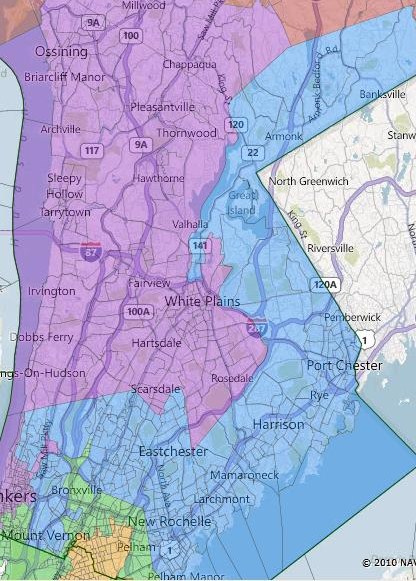
Possible 37th District
The result? It’s definitely feasible, but I think Republicans need to be ballsy enough to divide the City of Yonkers three ways to feel good about their chances. I’m not sure that’s even allowed under the state Constitution, as the language is fairly arcane. If it is permissible, then Republicans have a shot at drawing a somewhat-friendly 37th with minimal disruption to the lone currently-Republican district that includes part of Westchester, that of Greg Ball.
By removing heavily-Republican Eastchester from Jeff Klein’s district and placing it into the 37th, it becomes possible to connect the district to eastern Yonkers. This conservative, mostly middle-class section of the city features many of John McCain’s best Westchester precincts from 2008, and it voted reliably Republican enough to keep Nick Spano in the State Senate for almost two decades. By the way, there’s no relation between Nick and the aforementioned Andrew Spano; everyone in Westchester politics on both sides of the aisle is named Spano.

Lower Westchester closeup
The old Spano district, now held by Democrat Andrea Stewart-Cousins, compensates for the land-grab by taking in deep-blue Ossining and New Castle along the district’s northern border. She would still represent a healthy chunk of Yonkers, but the bulk of the district’s population would now be in suburban areas. Klein’s 34th would retain its current borders in the Bronx, Mount Vernon and Pelham, but would take in some heavily Hispanic areas in southern Yonkers. On the whole, his district’s character changes little, which fits the likely approach of Republican redistricters who are unlikely to displace their quasi-allies in the Independent Democratic Conference, of which Klein is the leader.
This new 37th gave Obama 56.8% of the vote, so it represents a roughly 8% improvement for the Republicans. If Cohen’s 2010 strength is ephemeral enough to be bowled over in a presidential year, that won’t be enough. But when one considers how difficult it is for Democrats to win Senate seats outside of the five boroughs, such a map probably creates a swing seat out of this lower Westchester territory. That’s not what Dems are looking for, a week after Republicans confirmed that they will be conjuring up a 63rd district out of thin air in the hopes of preserving their majority.
Roemer for 6th Place? Here’s Hoping.
New Hampshire feels like an interregnum, between an interesting Iowa and a possibly-climactic South Carolina.
I think Matt ably summed up what New Hampshire will look like when the results come in tonight: Romney gets an easy win, but he’ll still be hard-pressed to crack 40%. Nate Silver projects him to come in around 38.5%, and I’ll take the over on that – but just barely. It’s not as good as McCain’s 48% in 2000 or Reagan’s 50% in 1980, but it will surpass other recent winning New Hampshire totals on the Republican side.
Coverage this week has focused on three themes:
- Huntsman is generating some momentum, but too little and too late to ensure even a distant second-place finish.
- Santorum followed his Iowa surge by stalling out in NH ahead of what many see as a must-win in South Carolina. Santorumentum looks to be over unless he can get a head-to-head matchup with Romney in South Carolina (see below).
- There are still too many non-Mitts to derail Willard’s path to the nomination.
I concur with all three of these, as well as with the notion that New Hampshire was never really going to matter. New Hampshire, by virtue of being one of Romney’s de facto home states and by showcasing a slightly more libertarian brand of Republicanism, cannot serve as a winnowing force in the field. That’s apparently now the role of South Carolina, where Perry will make his last stand. One imagines that Santorum and Gingrich will also both head to SC, with one perhaps dropping out and endorsing the other sometime between now and January 21st. I’m not betting on it, though. The idea that conservative leaders will coalesce around a non-Romney in time to do some damage in SC is somewhat plausible, but the idea that individuals as stubborn as Newt or Santorum would subsume themselves for the good of a wider movement strikes me as laughable – even in the context of their mentor/protege dynamic. Newt was a distant 4th in Iowa, and that was an opportune time to drop out if he wanted to give Santorum some space. He didn’t.
I’ll conclude with the estimates – whereas in Iowa I was banking on Santorum outperforming his polling by a decent margin (and he in fact exceeded even my generous figure), I don’t see anyone doing so tonight.
Mitt Romney: 39%
Jon Huntsman: 19%
Ron Paul: 18%
Rick Santorum: 12%
Newt Gingrich: 10%
Buddy Roemer: 1% (I overshot in Iowa on this one…Buddy won’t let me down this time.)
Rick Perry: 1%
Others – <1%
New Hampshire: Romney’s débutante ball, Huntsman’s last stand and the Field taking a large pass.
With the waves of spin that have emerged from Tuesday night’s Caucus in Iowa it’s time to really look at the next state: New Hampshire and try to figure out what’s next in the reality show that is the Republican Primary for President (if MTV filmed this whole thing, I’d actually have respect for that network). New Hampshire isn’t a state with a large portion of evangelical voters, so right off the bat the likes of the Ricks (Santorum and Perry) are going to have a hard time winning over voters who may be church going, but not CHURCH GOING. Ron Paul’s economic vision should play well here, and it likely will to a second or third place finish, but Ron’s been running for President for 24 years and has no shot at the nomination.
Then there’s Mitt Romney and Jon Huntsman. Huntsman has said that all the cards are on the line in New Hampshire, and after a paltry 700+ vote performance in Iowa, you certainly can’t blame him. Huntsman has probably taken to New Hampshire the way Santorum did to Iowa and actually did something that the major players haven’t particularly done well this year: campaign. Santorum’s over-performance wasn’t magical polling that the major firms missed, just look at his itinerary, he took Iowa seriously and Romney and the others didn’t. Huntsman’s doing the same in New Hampshire. Yesterday’s endorsement from the Boston Globe for the former Ambassador to China and Utah Governor is certainly nice, but how much pull does it have; that remains to be seen, it’s timed just late enough to sway some undecideds, but it likely won’t have the penetration into NH to make the endorsement a game changer by any means. Huntsman could finish top three in NH despite a ridiculous “surge” for Santorum which would be the product of a week of pretty good press and not voters doing their due diligence with regards to the candidate. Jon Huntsman won’t win New Hampshire, but he sure could help the “Anti-Romney” crowd with a Santorum-like over performance due to actually campaigning and winning folks over.
Then there’s Mitt Romney. He may or may not have won the Iowa Caucus, and the polls have him winning New Hampshire by 25 points, but that’s not going to be good enough for Romney if his end game is a short primary and a long general election. if he wants to shorten the primary, he needs to push his numbers to >50% in polling. Yesterday’s Suffolk University tracking poll had Romney at 43% and Paul at 18, impressive, but when you’re the “favored son” in that Primary/Caucus you have to be getting greater than 40% in the polls. The conventional wisdom of this whole primary was that Romney wouldn’t preform great in Iowa (and he didn’t) and would preform exceptionally in New Hampshire, leaving Nevada, South Carolina and Florida as his biggest stepping stones to the nomination. Romney’s still upside down in South Carolina and Florida, and a sub-50% finish in his “home state” isn’t going to ward off the rabble-rousers who hate Mitt Romney. Mitt’s still the favorite for the nomination, he’s the only one with any realistic chance of beating President Obama, or so the conventional wisdom goes. Romney needs a big win, and a win in terms of a majority of the votes cast, not being the highest total of the plurality.
Iowa and New Hampshire are places to whittle the field, Iowa claimed Tim Pawlenty early (I wonder what his numbers would look like right now had he decided to stay in) and Michele Bachmann late (thank god for that). Both parties nominations will never be won in either state, let me be clear about that right now, but impressive wins in either makes for shortening the primary season, which I don’t see happening with this year’s primary.
Turnout is always reliably unpredictable, you never know what the day’s conditions (weather, last minute robocalls, dirty tricks from other campaigns) will forebode for you. In the closing days of the New Hampshire primary, Mitt Romney’s going to get what he wants (a win) and not what he needs (a huge win to begin to shorten the primary).
‘Twas the night before Iowa…
In less than 24 hours, we should know the outcome of the Iowa Republican caucuses. It’s less likely that we truly know what that outcome means, though: polling basically shows a three-way tie between Mitt Romney, Ron Paul and Rick Santorum and I think that we’ll have a result pretty close to that, which will mean that the most a non-Romney winner could claim is some momentum – nothing approaching a decisive win. And the most Romney could claim is that he barely won against deeply-divided opposition, and that he still has a great deal to prove going forward.
Over the past few days I have been able to convince myself that any of the three will come out on top.
Rick Santorum, because of his late momentum – to use a cliche, he’s peaking at the right time, when it’s too late to really come under attack from his opponents or be savaged by the press. The possibility exists that enough Bachmann and Perry supporters opt to go with a (potential) winner and move their votes to the man who most easily passes for their next-of-kin. Familiarity with Santorum, borne out of the man’s near-residence in the state this year, has resulted in the highest Iowa favorability of any of the Republicans in the race and could get him over the hump.
Ron Paul, because we have always been told that organization counts a great deal in Iowa, because we have seen how organization counts, and organization he has in spades. He’s doing a late fade after his brief surge, but Paul’s floor has always been stable.
Mitt Romney, because he never fades, because his opposition is not up to the task of mounting a sustained offensive on the openings he provides, and because – most importantly – Mitt said Monday that he was going to win. I’m not being tongue-in-cheek; I think that really is important. More on that below.
I will not, under any circumstances, give Gingrich a shot at winning this thing. The ridiculousness of watching a man concede defeat, only to hours later start talking about compound sentences and how he may indeed pull of a historic upset, rivals only that of watching Rex Ryan incorrectly assess his team’s playoff chances at a post-game press conference. For Gingrich, we’ve already moved into the post-game. Yet, does his book tour require him to press on for now? His egomaniacal desire to be able to declare that he influenced the course of debate may also necessitate appearing in another couple of debates. And he would certainly lose face among conservative opinionmakers by bailing before New Hampshire after receiving that state’s most promiment newspaper endorsement.
Likewise, Bachmann and Perry are done. Bachmann isn’t getting out of the high single-digits in current polling, she’ll probably end up bleeding even more supporters to Santorum at the very end, and she has no money to continue after this. Her campaign will end tomorrow in the state where she was born. As some of my family members pointed out to me on Christmas Eve, when the discussion around the wood stove turned to politics, she didn’t flame out as spectacularly as Perry or Cain or even Gingrich. She couldn’t raise money, and she couldn’t hold on to staffers, but her relatively quiet rise and fall are a distinct phenomenon from other other one-time pack leaders.
Perry, on the other hand, may continue past Iowa because he has the money to do so and because South Carolina looms as a potentially friendly environment for the Southerner to mount a final stand. But more likely, the Santorum surge finishes Perry and dooms him to single-digit performances in Iowa and any other states he contests.
That leaves Jon Huntsman, who has maintained a laser-like focus on New Hampshire but is stagnating there even as his opponents are encamped in Iowa, and Buddy Roemer, the oft-forgotten former Louisiana governor whose populist, shoestring campaign has not caught on anywhere. Both do register a bit of support in most Iowa polling, so I include them in my final call.
So my prediction – or perhaps best guess – about Tuesday’s final numbers:
Mitt Romney – 25%
Rick Santorum – 23%
Ron Paul – 21%
Newt Gingrich – 12%
Rick Perry – 9%
Michele Bachmann – 6%
Jon Huntsman – 3%
Buddy Roemer – 1%
There’s nothing earth-shattering there, though clearly I’m buying into the idea of Santorum finishing even stronger than his current polling shows, by claiming a good chunk of the undecideds and nipping a point or two from Gingrich/Perry/Bachmann. And I think Romney wins with a lower percentage in the Iowa caucus than we’ve seen in the modern era – even lower than Bob Dole’s 1996 showing.
Why do I see Romney hitting 25% and taking the win, despite failing to reach that mark in any of the four weekend polls? I’m putting a lot of credence in his Monday statement that “we’re going to win this thing.” Yeah, I know a campaign aide later said he was referring to the nomination, but the context of the statement was clearly about Iowa, because he immediately followed by referring to “other states.” Mitt’s campaign has been marked by limiting Iowa expectations while raising expectations everywhere else. They’ve been remarkably disciplined in this approach. Mitt rarely goes off-script, in part because emotion is what makes you go off-script, and emotion is not what Mitt does. That the words came out of his mouth, even in the heat of the moment, even on the eve of a major election, when candidates are tired and raw, tells me that Mitt believes their organization will get the job done on Tuesday.
The ordained Republican frontrunner usually – well, always – wins the nomination. But he rarely wins Iowa. I think this is the year that changes, and that Romney wins despite never really planning to do so.
But don’t count out the two guys still standing – Paul and Santorum – who actually engender some enthusiasm among Republicans. And tell us what you think in the comments.
 Within the Margin